With only two months til the release of Warhammer 40k 11th Edition, Games Workshop has been slowly rolling out previews for the rules, set to arrive this June. We did an
initial recap of those showcased in the Adepticon preview show, but since then Warhammer Community has trickled out the specifics on a number of key changes. The goal with this series is to condense all of that into exactly what you need to know, and how it will impact armies during the transition between Editions. Given we're retaining existing Codices, it's vital to point out what units might end up winners, what Enhancements fall short, and how changes to the fabric of the game will alter Stratagem usage. With all that being said, let's dig in.
1. Detachment Points Define Lists
 Credit: Games Workshop
One of the most contentious aspects of the new Edition revealed at its initial preview show was the idea of multi-Detachment armies. This smelled of 7th edition's Formations, or 9th's armies with multiple subfactions, and each time that mechanic has appeared it's invited a lack of balance and reduction in skew. Skew lists are themselves contentious, because dedicating yourself to a specific unit type (Cult of Blood's Jakhals/Goremongers) requires both specific collections and a radical shift in gameplan.
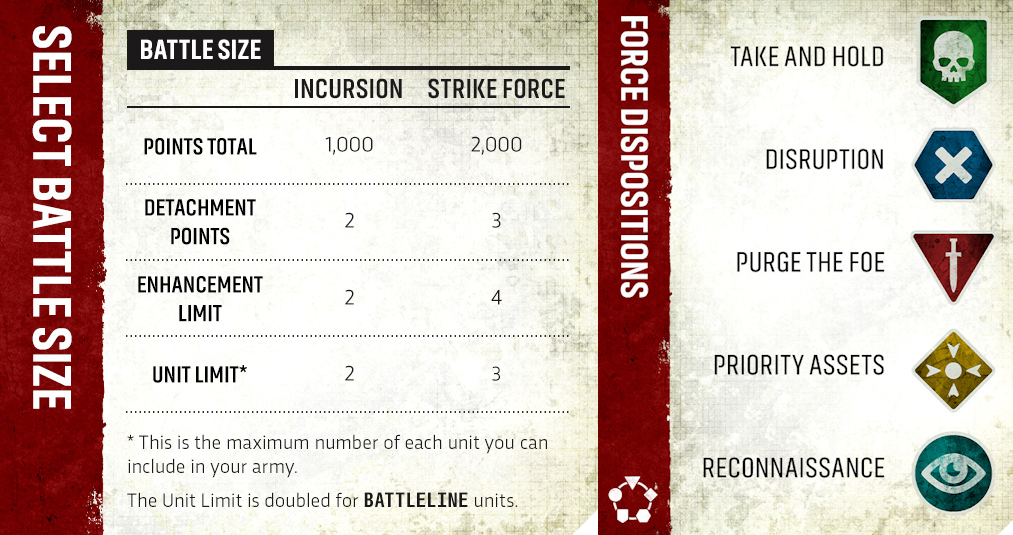
The good news is that we now know far more about the new core mechanic of list building in 11th, Detachment Points. Every Detachment will be assigned a number of points between 1-3, and you'll have 3 points to spend when selecting your Detachments. For the vast majority of generalist Detachments, such as Gladius Task Force, I'd expect to see a price of 3; they provide all the tools an army would need, regardless of the specific units therein. Where this gets fun, however, is for options like 1st Company Task Force
—while it's seen zero play in 10th, that stems largely from how thoroughly one needs to dedicate themselves to Terminators (though its lackluster rules don't help). If it were only 1 Detachment Point, you could allow your Terminators to feel a lot better outside of a skew list, and spend the rest on some secondary Detachment Terminators don't receive a ton of value in, like Firestorm Assault Force. In short, it's very likely that the more specific a Detachment is, in terms of the units or scenarios it has impact on, the lower its Detachment Points will be. The designers have given themselves a number of knobs to adjust when it comes to balance, and being numbers I could see problematic or powerful Detachments shifting up or down in Detachment Points, as another lever of balance. On the whole, I'm bullish on this, even when I was initially worried.
2. Not All Leaders Are Equal
Leaders as we know them in 10th are being broken down into two categories: Leader and Support units. Things like Captains are largely remaining the same, although with the added bonus of retaining their 'when leading' rules even after their squad is slain, alongside the side grade of being attached during list construction. You don't have to attach Leaders, though, so picks like the Solo Gravis Captain likely persist into 11th. This is less true of Support units, secondary pieces meant only to, fittingly, support attached units. These must be attached, and while we've not heard specifics, likely aim to reduce weird single character interactions in things like Genestealer Cults (e.g. Triple Benefictus in a transport). The application of this divide defines its success, and it's hard to say whether this is good, bad, or otherwise without a complete list of Support units.
3. Enhancements Are for Everyone
Unit customization has been a center point of narrative play for the whole of 10th, and that's being brought to matched play in 11th, with some changes to Enhancements. Going forward, Detachments will come with Enhancements for units, and not just Leaders; this isn't retroactive, as far as we're aware, but instead spreads the design ethos of 10th's Corsair Enhancements across all armies going forward. This makes sense, especially with the above mention of breaking down skew options by Detachment Points, and some niches lacking dedicated Leaders. I also feel this is a compromise on pointed wargear, because while we've heard nothing of it coming back (leading us to believe it isn't), these unit-specific Enhancements provide more options for granularity in list building. As a bonus, the number of Enhancements available to an army at 2000pts is being raised from 3 to 4, given many lists will pick from two Detachments' worth. I'm a huge fan of how the recent swathe of Corsair rules were handled, so seeing that version of Enhancements become the rule and not the exception seems great!
4. Force Dispositions Increase Asymmetry
 Credit: Games Workshop
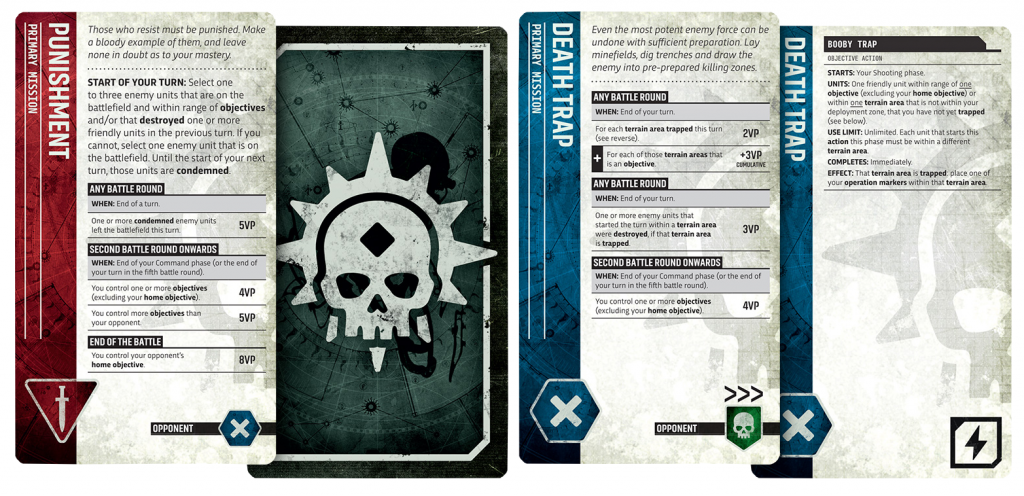
Detachments are even more important to an army's playstyle than before, and that comes from each providing access to one (or more?) Force Disposition(s). These represent the mission or strategy your army is undertaking in a given battle, and will radically alter the course of play thanks to it affecting your Primary Mission. Before the game begins, you compare your Disposition with your opponent, and follow a handy dandy flowchart to figure out each players' Primary Mission, based on their opponent's Disposition. Ad you can surmise, this means that unless both players have the same Disposition, each player is scoring a different Primary Mission during the course of a game, which is a *wild* concept. For matched play, every force locks their Force Disposition in at list building, meaning you know the five possible Primary Missions available to you before attending a tournament. This helps a ton both in terms of pre-planning, given savvy players can know the specific measurements and gameplan for their missions, and is significantly easier on organizers in selecting their mission packs...given the game selects for you. From a conceptual standpoint, I'm all for this, but as mentioned in the article some highly lethal forces can focus less on actions & objectives, and more on killing. Coming out of C'tan Winter, that's just a bit spooky, and statcheck armies likely see massive upside from choosing a lethality-driven Disposition.
5. Point Caps Are the Limiting Factor
 Credit: Games Workshop
Scoring is changing in 11th, in a way that seems to make Secondaries less of a hassle to score for skew armies. No longer is your limiting factor 2 Secondaries per turn, discarding those you don't score, but 15 Secondary score each Battle Round, 45 total for the game, with the same being true for Primary. This incentivizes conservative play, and pre-planning actions, as you're far less likely to trade away a piece by exposing it on an Objective to score a few Secondary points, now that they're less 'use it or lose it'. I fully expect these changes, coupled with the tie of Primary Missions to Force Dispositions (read: more ideal for a given list) will lead to higher-scoring games of 40k. I have a hunch this means some of the lower-scoring Force Dispositions start at a disadvantage, given breakers done via total points will favor players who can shoot for perfect 100pt games; this reminds me immensely of AoS 3rd Edition, where a pyrrhic victory could cost you a spot at the podium, compared to armies with free-to-score Battle Tactics. I wager this causes a completion of the shift to Elo ratings as the tiebreaker for players with similar records, something we've already seen at GTs in 10th.
6. Stage Safely with Hidden
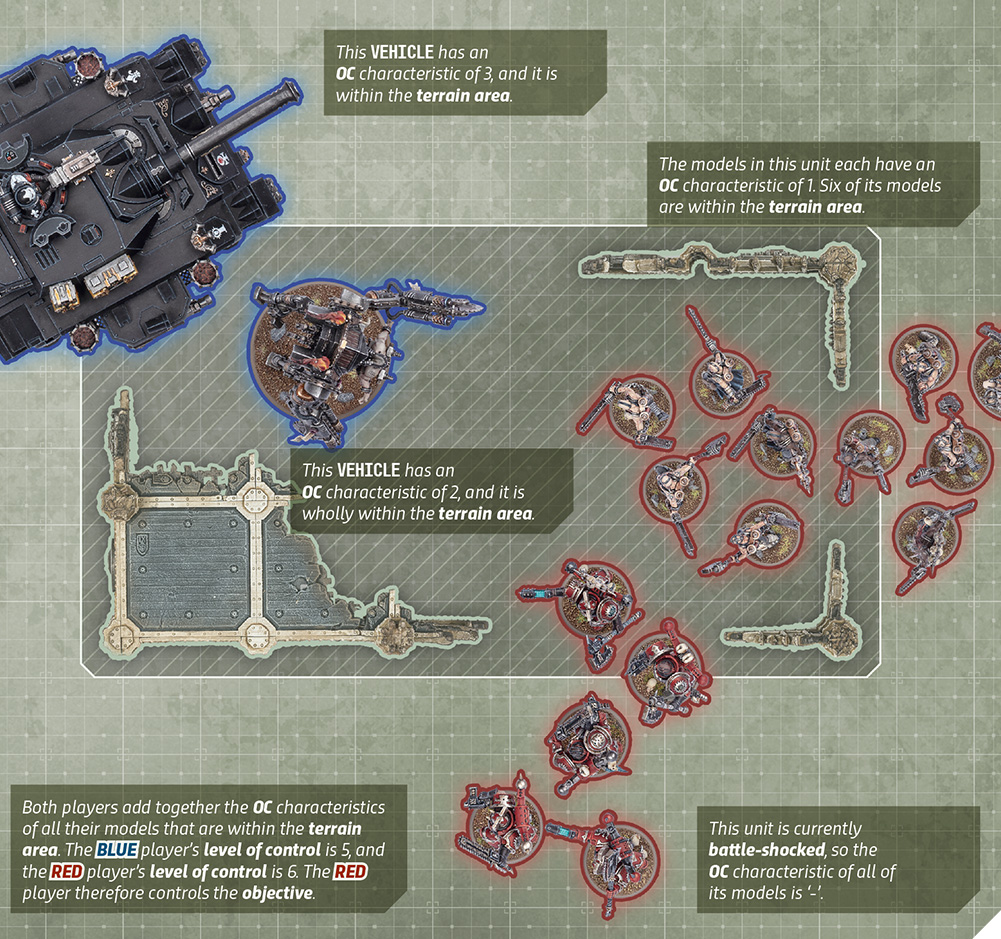
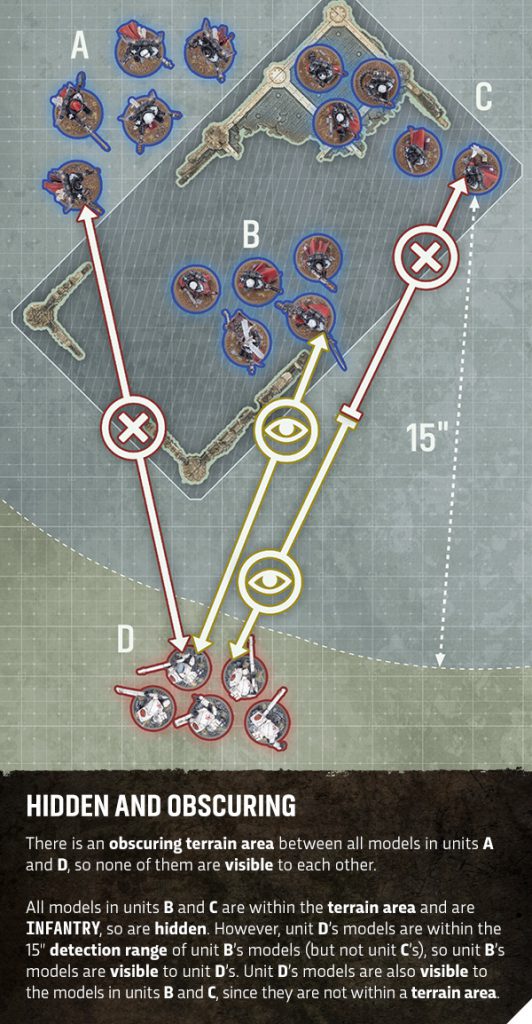
Unifying the terrain rules was one of the thrusts of 10th, and in 11th, that continues with the introduction of Hidden, and a change to cover itself. Terrain is divided into 2D footprints (Terrain Area) & 3D features (Terrain Features). Regarding Terrain Area: Hidden is a new status for Infantry, Beasts, & Swarms, denoted by them being in that area,
and not having shot in the current or previous player turn. This leaves the door open for out-of-turn shooting not removing Hidden, but I have a hunch the designers have nipped that in the bud. While Hidden, that unit essentially has Lone Operative 15", introducing the idea of a "Detection Range"
—one can already imagine rules or stratagems changing to keyworded effects like this, such as Shroud Protocols from the Skitarii Hunter Cohort altering the target's detection range to 12". Staging squads has never been easier, and this seems primed to assist squishy melee trade pieces in getting up the board, and into your opponent's front lines. Moreover, because many of the terrain pieces you'll be wrestling for control over lack places to park Vehicles/Monsters, they're far more likely to be won by infantry. That being said, OC isn't changing much beyond the shape of the objectives themselves, so it's more about holding them from within protected walls, than re-learning how to hold them.
7. Cover & Obscuring Change...Slightly
 Credit: Games Workshop
We haven't heard directly if cover is still as easy to acquire in 11th as it is in 10th, where any blockage on a model provides it, but what is known is the rule's effect: -1 to BS, rather than +1 to save. This is a sizeable change, and allows units that have rerolls to hit but lower AP to be better against targets with cover. Obscuring also remains, being able to hide wholly outside & behind Terrain Areas to prevent targeting, the main means of hiding units that don't easily receive Hidden (read: Monsters & Vehicles). If Stealth is unchanged, this also implies you can stack a net -2 to hit on units in cover, and suddenly something like Hidden Venomthropes buffing your midboard threats sounds like a nightmare for ranged armies to handle. Cover likewise improves for units that previously couldn't push their save beyond a 3+, against AP0, like Marines. We also learned that Vehicles (and presumably Monsters) can't gain cover by toeing into Terrain Areas, though it remains to be seen if those wholly within receive it. Given the straightforward design philosophy of the Edition, I'd wager not, and that means survivability is afforded more readily to the squishier bodies; this is great news, given AP1 has approached AP0, especially in late 10th. Finally worth noting, units which previously received no benefit from cover, such as those with a 6+ save, but 5+ invulnerable save, now benefit equally from hiding behind battlefield debris.
8. Verticality Finally Matters...Slightly
 Credit: Games Workshop
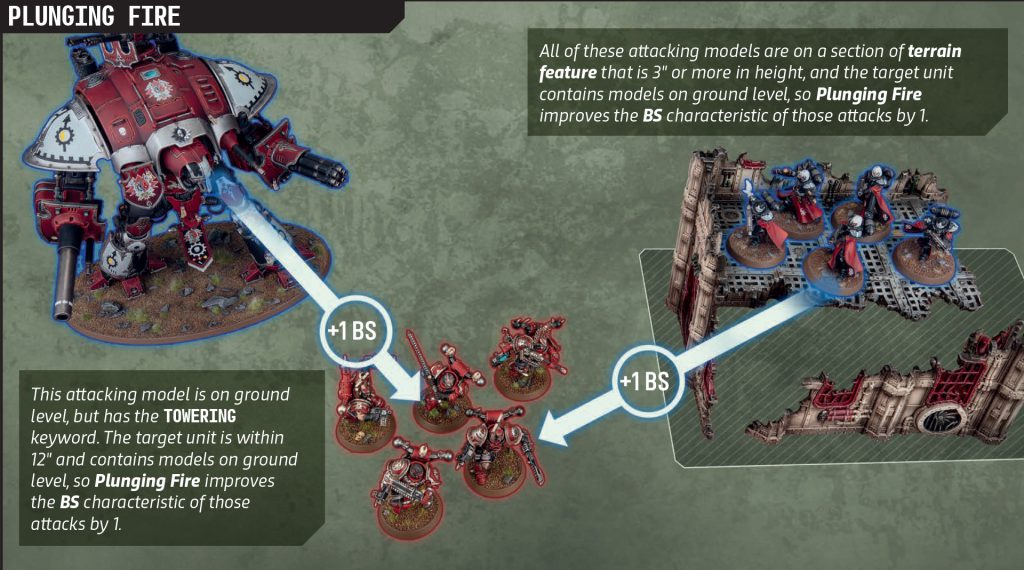
Among the new layouts we've seen, hiding a Knight seems quite difficult, and the existence of Hidden pushes these massive pointsinks closer to their opponents, and into the fray. In order to make up for the few rules which don't favor these Towering threats, the designers have instead given them some upsides...emphasis on the 'up'. Yes, Towering models within 12" of their target, and those on 3" or taller surfaces like upper levels of Ruins, receive +1BS with the return of Plunging Fire. This rarely-used rule we technically have in 10th makes its return, but +1BS is no joke when considering the impact of cover, and the fact it stacks with additional positive modifiers to hit. Getting it on your Towering models is just gravy, an apology for how well-hidden smaller squads can be in 11th. Still, given many tournament organizers tended to leave upper floors alone when designing tables (at least in my area), I have some doubts Plunging Fire comes up frequently outside of Knights. If Games Workshop is adamant it be a part of matched play, however, rules for moving vertically likely need to change in kind.
9. Terrain Dimensions Are Public
Games Workshop can have a temperamental relationship with storefronts for third-party supplements. On the one hand, neoprene or laser-cut objective markers & footprints were a must-have purchase for anyone trying to practice in matched play, for 10th, and that led to (as it always does) a number of excellent options from non-GW sources. Historically, Games Workshop doesn't even sell their own sets of markers, and if they are provided it's in the form of cardboard in starter sets
—not ideal for travel. On the other hand, the radical shift in both Layouts & Features likely leaves many of these sellers with dead stock. The quiet compromise, in that it can't be acknowledged, is the reveal of the exact dimensions & number of Terrain pieces needed for 11th, allowing production to kickstart
now, and ideally be ready for the summer release (there's already listings from a number of the big names, and surely more to come). Moreover, players can start creating their very own terrain setups, and I'm sure we'll see plenty of wicked tables shown off in the coming weeks. Providing this information early is quite a nice olive branch, and helps us test the Edition early, among other things.
10. Terrain Gets Smaller
 Credit: Games Workshop
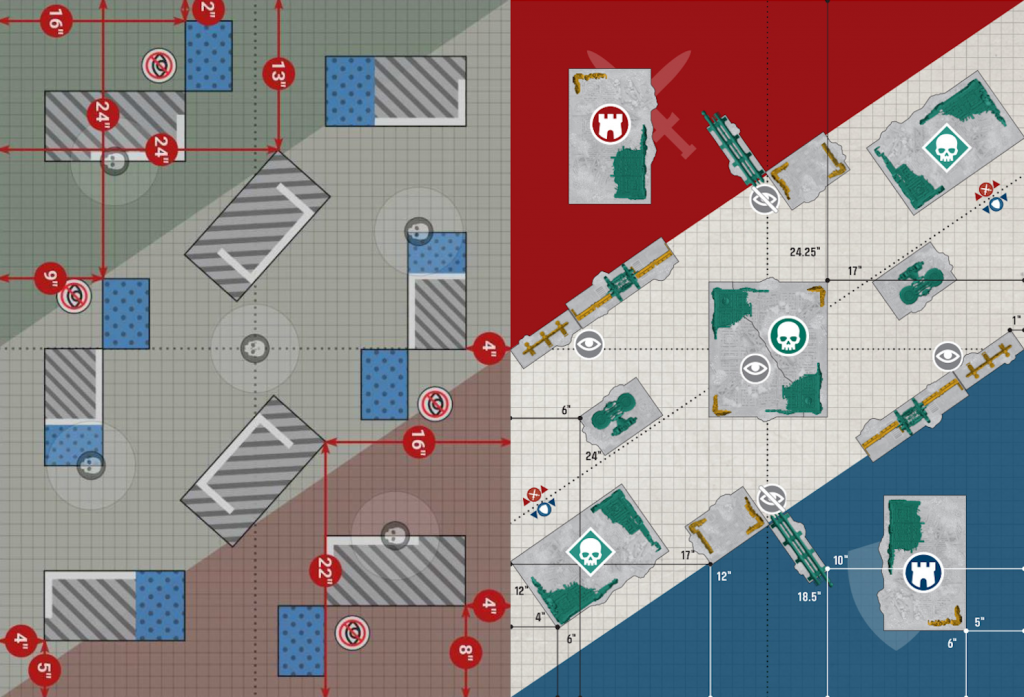
In terms of raw math, there will be less terrain on the battlefield, but that comes with a few caveats; going off of the provided Terrain Areas, we're looking at a shift from 628in^2 to ~608in^2, but that doesn't tell the whole story. Looking at a couple layouts with diagonal deployment, GW Layout 2 & the newly-revealed Crucible of Battle, the latter doesn't
feel less busy in terms of its terrain, and in fact has a reduction in firing lanes, given those thinner 'line' Terrain Areas are also Obscuring. This is due in part to the fact that, between the two new 11th layouts we've seen, the backfields have a lot more room. This should make for less clustered deployments, and that means potentially fewer opportunities for jailing lists to operate effectively. Later on in the game, this could also mean Deep Strikes are harder to screen, as parking a squad in the central line of deployment exposes you to a nasty cross-map firing lane...so be sure to give them Hidden, if you can. Another reason this seems similarly thick with terrain comes down to the footprints having crenelations, and little jut-outs that attempt to reduce the concerns with all of 10th's L-shaped terrain. I think that hate was overblown, mind you, but the push for a thematic map means strict squares no longer do. Another change is down to the color of each Terrain Feature—Yellow means go, paradoxically, for Vehicles & Monsters to move over, while Teal is similar to 10th's Ruins, passable only by smaller units. The last thing I want to call out is some of the wacky measurement. 24.25"? 18.5"? The best reason I can surmise for why these hard-to-remember numbers were chosen comes down to the fact that the central ruin mimics A4 paper size, with room for bleed, at exactly 8.5"x11". From a printing perspective, it probably made some sense, but leaves us in an odd spot that likely needs some touching-up from a Tournament Companion somewhere down the line.
11. 11th Looks Faster, Tighter, & Scrappier
If I may be so bold, the takeaway I have from what we've seen so far is that the designers want more skirmishing, and fewer gunlines—there's been an emphasis placed on allowing units to stage more safely, and with a the importance placed on holding terrain, it's much harder to park a Land Raider or C'tan in the midboard and sit on Primary. While there's something to be said of asymmetric Primary potentially
rewarding those highly concentrated, lethal lists, every player is going to be playing missions they know and have prepared for before a list is even finished. To that end, capping points and holding onto Secondaries is likely to make for closer games, with fewer opportunities to run away with things. Of course, you'll still potentially get caught in unwinnable scenarios, the point difference literally impossible to close
due to that cap, but two players of equivalent skill playing reasonable lists likely have closer games more often. Melee also seems significantly buffed, in part because shooting has gotten worse on the whole, but also because Hidden is a massive boon for any unit that moves 8" or more. Staging a pre-measured 15" away from any shooting threat, and moving in for a 7" charge seems a viable path, and rewards those fast, mobile melee threats that can sometimes get caught out. There's also something to be said about the sparing few datasheets that avoid vertical measurement, being an easy path to +1BS. You'll need to screen well, and measure frequently, but I think players who adapt to 11th's systems will find themselves rewarded by its unified systems. From what we've seen, many of the game's most annoying fiddly bits have been shaved off, and in their place are opportunities to do more fighting
inside terrain, rather than just in front of or behind it. There'll be growing pains, sure (see the
Terrain hot take), but I think we're right to be optimistic here. The bones are good.
Have any questions or feedback? Drop us a note in the comments below or email us at contact@goonhammer.com. Want articles like this linked in your inbox every Monday morning? Sign up for our newsletter. And don't forget that you can support us on Patreon for backer rewards like early video content, Administratum access, an ad-free experience on our website, and subscriber-only content covering competitive Warhammer 40K!Thank you for being a friend.
 This website uses cookies. Learn more.
 11 on 11th: Recapping the New Warhammer 40K Rules Reveals Through 4/11