For everything you can say about 10th edition, both good and bad, one of the things that has stayed relatively consistent in this edition has been how players win games: The secondary and primary missions. Compared to some of the more drastically changing mission packs found in ninth edition, I would comfortably claim, for better or worse, that Games Workshop has done a better job keeping the play experience the same across all three major mission packs published throughout the three years of competitive play.
Not to say there have not been differences. Playing a game in Leviathan would definitely feel different to Chapter Approved, and digging into those differences will be very interesting. I decided to take this time leading up to 11th edition to really dig into a series of retrospectives on 10th edition, starting with the mission packs that build the foundation of competitive play.
Leviathan
I really think Leviathan did a lot of things right, but also made quite a few major mistakes that really could have been better ironed out. It is hard to design a system for a brand new edition and we can see some of the kinks in the system as we compare what we had in Leviathan to what came after.
Secondaries
The bones of the secondary systems we have now are here but their are some big flaws we had to deal with at the time. The biggest was only being able to use New Orders once per game. While this definitely made for some interesting tactics it made your game much more dependent on the luck of the draw. We also lacked any inbuilt redraw besides Engage on All Fronts. If you drew Bring it Down versus Custodes with zero tanks, well, I guess you were out of luck. There were also some very hard to score secondaries here. Investigate Signals, Capture Enemy Outpost, and A Tempting Target, were all secondaries that could really strain some armies ability to score. On the other hand you also some cards that could just swing the entire game on their own. Capture Enemy Outpost, while hard, could decided the entire game on its own if you draw it turn four or five, while Bring it Down could score 8 VP for killing a single Chaos Knight, or kill two Rhinos for 7 VP by themselves. The cards also had more points in general available. Behind Enemy Lines, Engage on All Fronts, Extend Battlelines, Storm Hostile Objective, and Teleport Homer (Establish Locus) all where worth an extra point on what you find in Chapter Approved, while Area Denial also gave you an extra point for the small condition. Overall this pack had some huge swings either way, giving a lot more variance then you really want in a competitive game.
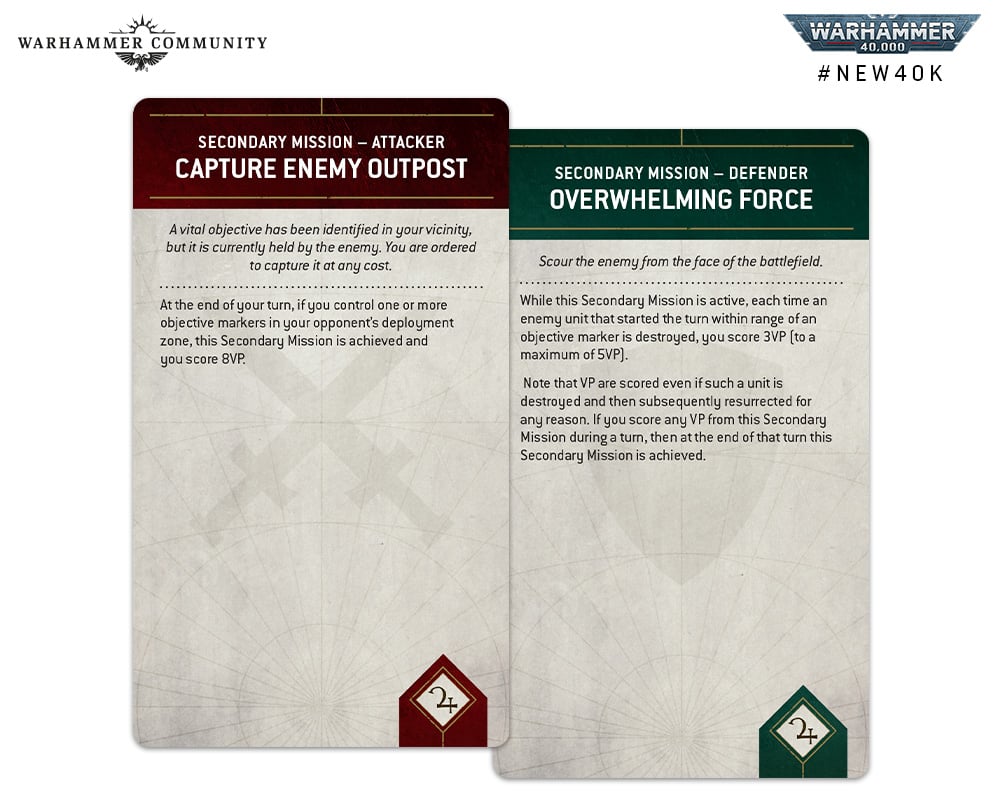 Credit: Games Workshop
Because of this increased variance you often turned to Fixed objectives, and this was the time to do so. Bring it Down had bonuses for any vehicle as large as a Rhino making it viable into most armies, while Deploy Teleport Homers being updated to give 3 VP for the center gave a super safe action secondary. Taking Deploy and a second card that matched up well into either your opponent or mission was a super solid strategy that carried Fixed objectives for the entire duration of the pack.
Missions
Looking back at the missions of Leviathan is very interesting as we see a window into what eventually was polished in Nexus and Chapter Approved. We see a lot of the same missions we have now, just slightly worse. Remember when you could get kill more turn one on Purge the Foe? I do, and it was not any fun. We also have Servo Skulls and old Ritual, two missions that were both disasters in their own right, along with Vital Ground, Priority Targets and Sites of Power, three missions found in Leviathan that do not return in future packs. Honestly all of these were unpleasant for different reasons. Vital Ground removing the center was probably the least offensive but still was not great, throwing off the balance of fighting for the middle that players are so used to. Priority Targets was a real stinker, super swinging the game to the player going second, with effectively 30 points in differential up for grabs at the end of the game. Sites of Power was perfectly fine for any army with multiple characters, but there were plenty and still are plenty examples of armies who just run one or two characters who this mission is terrible for. In general it is better for the game to keep missions as army-agonistic as possible; giving a mission to an army that only has one or two good characters and saying “tough luck” really is not what we want to be doing for a healthy game.
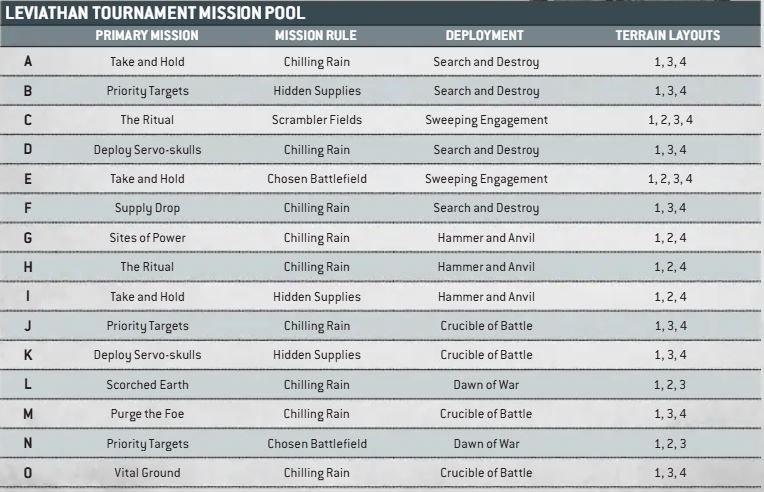 Credit: Games Workshop
We also have a large collection of mission rules. I do miss having mission rules, and some of these were pretty neat. Giving and extra Command Point on Supply Lines or everyone getting sticky objectives on Sweep and Clear are both examples of neat twists that do not change the game in crazy ways. But there is a reason Chilling Rain was a go-to pick during this time cause some of these were absolutely bonkers. Honestly the big highlight here is how screwed up some of these were for Deep Strike armies. Both Scrambler Fields and Delayed Reserves both just made it impossible to play Reserves-based armies. What if you had a one in three chance of just not bringing in your Bloodthirster on turn two? Well that's what Delayed got you. What if you just could not land on an objective with your Grey Knights Terminator unit? Behold, Scrambler Fields! There was also Vox Static, a mission rule that maps' Command Point Re-roll and New Orders both cost an extra command point which throws out the balance of your Command Point economy completely. Thankfully, besides Scrambler Fields none of these were in the Tournament Mission Pool but I personally played a non zero amount of games on them and it sucked.
Let's also take a brief moment to look at the worst of all the mission rules, and unfortunately one of the ones in the official mission pool, Chosen Battlefield. This mission rule gave you a mind game when you walked up to your table: Were you going to hand shake with your opponent and play a normal game or would you play optimally and screw them as much as possible? You and your opponent would alternate placing every single objective on the board where ever you wanted and let me tell you you could get some absolutely disgusting objective layouts that made the games completely unplayable if you knew what you were doing. Not to mention there were still events that used player-placed terrain during this time, so you could win control of both the first terrain piece placed and the first objective, and that was perhaps the easiest way to make you opponent strangle you possible in all of 10th edition history. As much as I enjoy mission rules, having examples that just make the play experience worse is not what players want and I am very glad we moved away from them.
Let's also take a brief moment to talk about Leviathan maps and deployment. Deployment looks very similar to what we play on now, with some slight differences for Sweeping Engagement and a lack of Tipping Point. One funny thing looking at the old deployment maps is seeing how we used to measure objectives from lines in the middle instead of the much simpler measurement from the edge that we use now which seems so glaringly obvious but somehow escapes designers at the time. The maps, well, they were okay. We see current Layout 1 and Layout 2 in this pack, as well as the old Layout 1 which features the “Thunderdome” which is better left forgotten, and old Map 2, which we somehow conceived ourselves was okay to play on Hammer and Anvil. The less time we spend thinking of that the better.
Catch Up
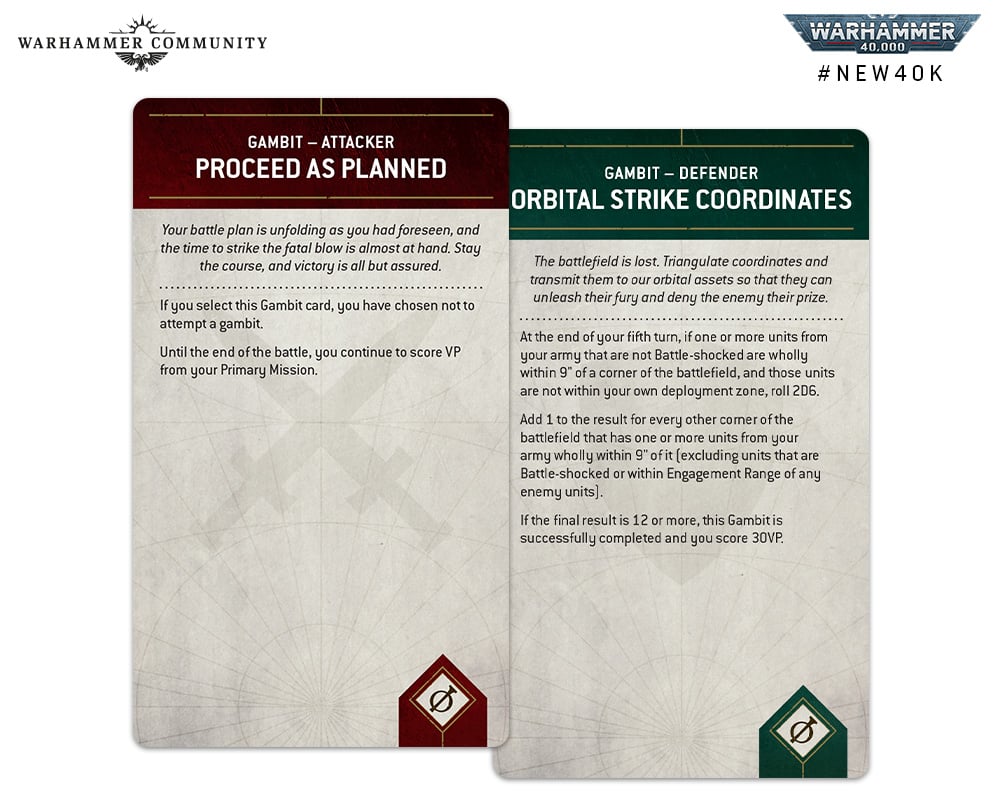
Out of all the catch up systems we will discuss today, gambits are certainly the worst of the three in regards to viability. I can count on one hand how many times I saw someone seriously take a gambit in a competitive game, and I can very confidently say I have only ever seen one time that it paid off for the player selecting the gambit. They were just so incredibly hard to score, while also having the enormous downside of cutting off all of your turn four and five primary scoring. Arguably the easiest, Orbital Strike Coordinates, “only” needed you to be wholly within 9” of each battlefield corner with a unit and only then you would get a 2d6 roll for a 8+ to get 30 Victory Points. How exciting. The others are no better, requiring you to roll an absurd number of 4+ on your dice to receive the Gambit blessing of 30 VP.
 Credit: Games Workshop
The strange thing is while the system itself sucked, it was arguably one of the best for competitive health. As hard as Games Workshop has pushed catch up mechanics this edition, they just are not what competitive players are looking for in a serious game. Anytime a Gambit, or a Secret Mission, or a Challenger Card paid off, it felt bad for that game. It just does not feel good for a player when your game gets stolen right out from under you from a crazy comeback you had no way to see coming, and while sure, you would get a crazy win of your own here or there, a net neutral of bad and good games is worse than just having a collection of games unaffected by weird ways to snatch victory from defeat. I for one can say I thoroughly enjoyed my time in Leviathan not having to worry about gambits much more than my time under the shadow of Secret Missions and Challenger cards.
Overall Leviathan had some good bones, but also some really big flaws. Many of which were directly addressed in the new and improved year two mission pack…
Pariah Nexus
Pariah Nexus as a pack really built up the 10th edition as a system built for competitive play. A lot of the early edition weirdness found in Leviathan is removed here and I applaud Games Workshop for that. So lets jump into how they improved on what came before.
Secondaries
Okay this is a huge upgrade from what we had before. Mainly because of the ability to cycle through the deck. There is way more access to redraws, with the new ability to redraw a card each turn instead of only once per game. We also have plenty of cards printed with the ability to cycle if they are drawn under conditions that cannot be scored or would be hard to score, like turn one. Some of the hardest to score secondaries were removed as well, like Capture Enemy Outpost and Tempting Target, along with the addition of some high scoring action secondaries, Containment, Sabotage, and Recover. We did get Marked for Death added, which is still not a great card, but you can now just New Orders it away without too much fuss.
Fixed got hit pretty hard here with the removal of the three point center Teleport Homer it's a lot harder to get a safe score on fixed, making tactical a lot more tempting in comparison. Bring it Down also raised the wound count necessary for the bonus score, making it a lot harder to hold onto for fixed versus any army that is not spamming tanks. Recover Assets almost became the new fall back for Fixed actions, but was shut down in the Tournament Companion before we even got the cards. The increased reliability of tactical cards means fixed here is a lot less viable, a trend we will see continue to develop going into Chapter Approved.
Missions
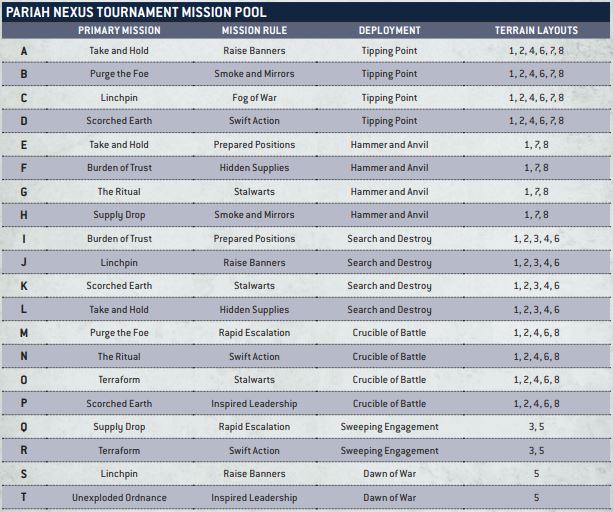
Along with secondaries we had a huge glow up on the mission pool department. We still have some stinkers; Ritual was really bad, and so was the original Burden of Trust. Both of which gave a huge advantage to the second and first player respectively, but some of the worst offenders we mentioned last time got removed or changed. All three of Vital Ground, Priority Targets and Sites of Power got sent to the bin, and while we still have Unexploded Ordnance (Servo Skulls) it is only one mission and was tweaked to be slightly better overall, now requiring actions to move them so you cannot juggle objectives all game, still not great thought. We also got Linchpin, a great mission, and Terraform, which was a bit different in Pariah Nexus, as Terraform was a permanent condition that you could not remove once set, giving another first favored mission.
 Credit: Games Workshop
The mission rules were greatly improved; most of them were mild in their changes, such as giving a small bonus to Battleline or extra leadership next to your warlord. The biggest outlier was almost certainly Stalwarts, which could power up Battleline to eleven when playing on this mission. Overall there was a lot less of the extremes found in Leviathan and no Chilling Rain so every mission felt different and unique, something I give a lot of credit to Pariah Nexus for.
Deployment and map wise we have huge improvements. Tipping Point is the newcomer and is by far the most popular deployment type at events, as it really gives a good balance when played on the right map. We also get measurements from the edges for the objectives, which was huge for my sanity and that of all other players across 40k. Maps also got hugely upgraded. Say what you will about Games Workshop map layouts, they are better now than they were in the past. I’ll take Map 4 or 6 over the Thunderdome any day. We got given quite a big variety of map choices across the pool and besides Map 5 you could reasonably see any of them at an event and not be too upset.
Catch Up
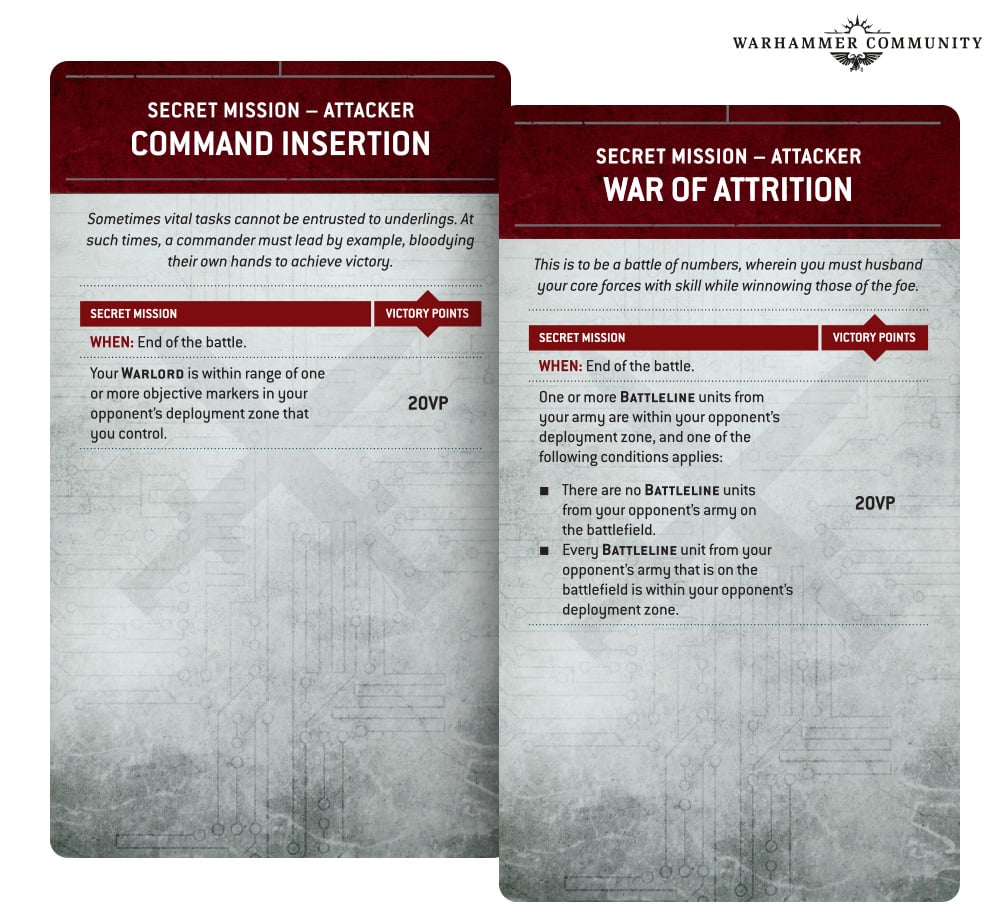
Okay so Secret Mission were honestly the most balanced any of the catch up mechanics were, with a big asterisk, after they were nerfed. Before the Balance Dataslate changed making it so you could not score any Primary on turn five if you picked up a secret, it was pretty crazy how nuts you could go with these with the right build. I definitely went for Command Insertion with Magnus the Red quite a few times, and most of the time it paid off, giving me 30-35 VP on turn five, which really was not healthy for the game.
 Credit: Games Workshop
After the nerf, honestly Secret Missions were not too bad. Would the game have been better off without them? Almost certainly, but the game was not breaking itself in half trying to deal with them. The downside is they gave a way for players to unexpectedly catch up, which as we discussed before, can feel bad. Secrets were pretty unique in how bad they could make you feel, mainly because of the “Secret” part. Often you would have a pretty good idea what your opponent would try to do when they selected a Secret Mission, but not always. I clearly remember one game where I was playing versus my opponent and he was convinced that I had taken Unbroken Wall, the mission where I had to hold three or more objective markers not in my deployment, and spent twenty minutes on his turn five doing everything he could to stop me from doing that. When it was my turn, I simply used Umbralefic Crystal on my Rubric squad and teleported into this deployment zone to score War of Attrition, the battleline in your opponent's deployment zone card, and win the game.
Did I lie to him? No, I never even suggested I had taken Unbroken Wall, but it still did not feel great. Warhammer 40k is an open information game, and it is played best when every player understands exactly what is happening across the table. I never want to trick my opponent or “gotcha” them, and neither should you, but in this specific case I was being explicitly told by Games Workshop that we are no longer playing an open information game and I need to try to trick my opponent to make it so I win, which I think was incredibly unhealthy for the game as a whole and I am glad we moved past Secret Missions.
Chapter Approved
We are coming to the end of the edition on Chapter Approved and there are two major things to note about it. The end of Chapter Approved is probably the best balanced the mission packs have been, but its start was almost certainly the worst out of all of the three packs at any point. There was one major reason for that: Challenger Cards, which were given to us this pack’s “catch up machinic.” First lets take a moment to enjoy what went right with the chapter approved.
Secondaries
This is definitely the most polished Secondaries have been all edition. With the roll over of the Pariah Nexus ability to redraw a card each turn instead of only once per game. Now we can also discard cards on our opponents turn as well, though not for a Command Point. As well as the continued support for cards printed with the ability to just redraw if they are drawn turn one or have no valid targets. Hot take, they should have been more aggressive with this. Their are still plenty of cards that are basically toilet paper when you draw them turn one. The amount of times you are able to score either Overwhelming Force or Marked for Death turn one is practically zero. Honestly I think there really could be an argument for just turning off secondary scoring on Battle Round one entirely for 11th edition, but that may be a bit too much of a hot take.
Other changes of note include some more smoothing out of cards, adding small scoring to Engage on All Fronts and Marked for Death, decreasing feels bads during games. The tweaking of Something a little less obvious but still important is the ratio of actions to non-actions. With the removal of Containment and the addition of both Tempting Target and Display of Might, we go to a ratio of 5/18 action/non-action (about ⅓) to just 4/19, (about ⅕). This I believe is one of the biggest reasons this last year has allowed so many skewed lists to exist at the top of the meta. Being able to push your five big knights, eighteen, victrix, or five C’tan, with only drawing two to three action cards instead of three to four is a pretty big deal. These action cards were also easier to score with Recover Assets being made easier to score, and Cleanse restored its Leviathan Points scoring. Only having to kill and move instead of stop and score is huge for these stat check lists and definitely something Games Workshop should think about when trying to rain in these lists, add back some more actions to slow down the meta some more preventing these skews from being able to score enough to be viable in the first place.
Finally lets give funeral rites to Fixed Secondaries. Fixed was already having a hard time coming out of Pariah Nexus; with increased flexibility and removal of the easiest ways to score Fixed found in Leviathan, it was rough out there already. Now Fixed is basically completely dead. There was a brief moment of hope for Fixed when No Prisoners was revealed as a possible Fixed mission, but it was quickly removed when the Tournament Pack was published. I have seen Fixed in basically only two scenarios, you are playing versus Imperial Knights with five bigs, or you are playing a weird Tyranid list scoring Behind Enemy Lines and Engage on All Fronts with your Spore Mines. Even in these cases I would often consider it a mistake. This really has happened because of two main reasons. Tactical Secondaries are generally easier to score now, and are much more flexible. Tactical already had an in built advantage on Fixed by both giving you Command Points and making you scoring unpredictable, and every time flexibly increased, like being given the ability to discard cards at the end of your opponents turn as well as your own being added, there has become less and less of a reason to run Fixed. I definitely believe there is some design space here. Maybe we can tweak the numbers to at least make Fixed an option, but in general Tactical cards being better is probably more healthy for the game. I am sure many of you remember 9th edition with its Fixed faction secondaries and shudder, we do not need to go down that road again. Maybe in 11th edition we will see Fixed make a glorious return, but until then I will enjoy my time with the most streamlined secondary scoring has been all edition.
Missions
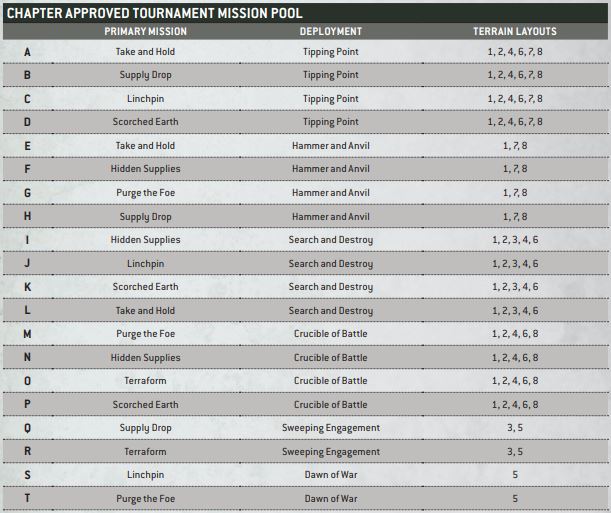
This is what I believe to be the strongest part of Chapter Approved. As someone who has run events all edition, this selection of missions is by far the strongest. Removing Unexploded Ordnance from the pack is a huge win, this was the worst mission by far. Fun fact, for the Tacoma Open 2024 Shadow Round, players were given Unexploded Ordnance as their mission of choice and it sucked for everyone there. This mission does not deserve to exist in a serious competitive game. This is also true for both Purge the Foe and Supply Drop. These are missions that widely twist how competitive 40k is played. I honestly do not mind these for RTTs to be frank, they give a spin to tried and true stand on ground circles type missions, but both have huge flaws. Purge wildly swings the game on both list construction like no other mission in the pack, can you imagine playing GSC vs Imperial Knights on purge? I have experienced this on both sides and it was a slaughter for Knights every time. It is also deeply favored for the player going second, much like Supply Drop. One of the most skewed missions for going second ever convinced. You pretty much have to table your opponent completely if you have any hope of blocking their turn five primary score when you are going first, while you have to hold on to dear life to have any chance of scoring your own. I would highly recommend any tournament organizer remove Purge and Supply Drop from their GT mission selection, and see how much better it feels for your players.
 Credit: Games Workshop
Both Ritual and Burden of Trust were also removed from the Tournament Companion but still exist as playable in the pack. Ritual 100% needed to eat dirt; another mission that just was not serious at all. Do you want to see 10 objectives on your table vs GSC? Because this is how you get that. Burden of Trust being removed is interesting. Burden definitely is not a flawless mission but after being changed to no longer being hilarious go first favored with the timing on guarding objectives, I honestly think it would be much better then both Purge and Supply in the player pack. Correct me if I am wrong but I would rather have the chance to stand on all five objectives all game then have them disappear underneath me. Hidden Supplies being added, and Terraform being changed were both good, giving two more missions that are not going to drive your players up the wall when they see them in your packs
We also have deployments to briefly talk about. Nothing really of note besides, man do we really need to as a player base remove Sweeping Engagement and Dawn of War from every event we even sniff at. 40k in 10th edition is fast; really fast. Guns and melee hit very hard and move at light speed. You cannot have a normal game on long edge boards. Maybe if you had a better map you can think about it, but if you have ever deployed any reasonable army on Map 5 you will quickly understand how bad it really is. I have had units deployed in my “home ruin” shot and charged on turn one on Map 5. Just please kill these in 11th edition, having them at any event, especially the World Championships is unacceptable.
Mission Rules went the way of the dodo in Chapter Approved, and honestly, I do miss them. Sure there were some that really did not make for a good time. Have you ever played Stalwarts vs fourteen Chaos Knight Wardogs? I have and it is no fun at all. Overall I think they did provide a bit of the flavoring that the current mission pack lacks. I would be much more happy to swallow a pack that was all Linchpin and Take and Hold if we had a different mission rule for each one. They are horribly hard to balance however, and barely impacted the game most of the time, I can think of countless games where me and my opponent just forgot about Raise Banners till turn three and have to look back and see where we missed it, or where both of us cheated and used a Core Stratagem under FOG OF WAR. While I miss them, unless Games Workshop can responsibly design them to both matter and also not be broken, I would rather play without. Something that I will reiterate time and time again for anything that comes in 11th edition.
Catch Up
Okay you know what else I wanted to play without? Challenger cards. I think everyone who took competitive 40k seriously immediately knew that this would be a problem within five seconds. Guess what? They were right. Challengers card broke 40k in half during their period in the game. Challenger Cards seem simple, if you are losing by six or more points you get to draw a card that will either score you an extra secondary or a free bonus stratagem, nothing too crazy right? Unfortunately they are too crazy. They gave us two huge problems. A huge second player advantage, and removed tactical planning from the game.
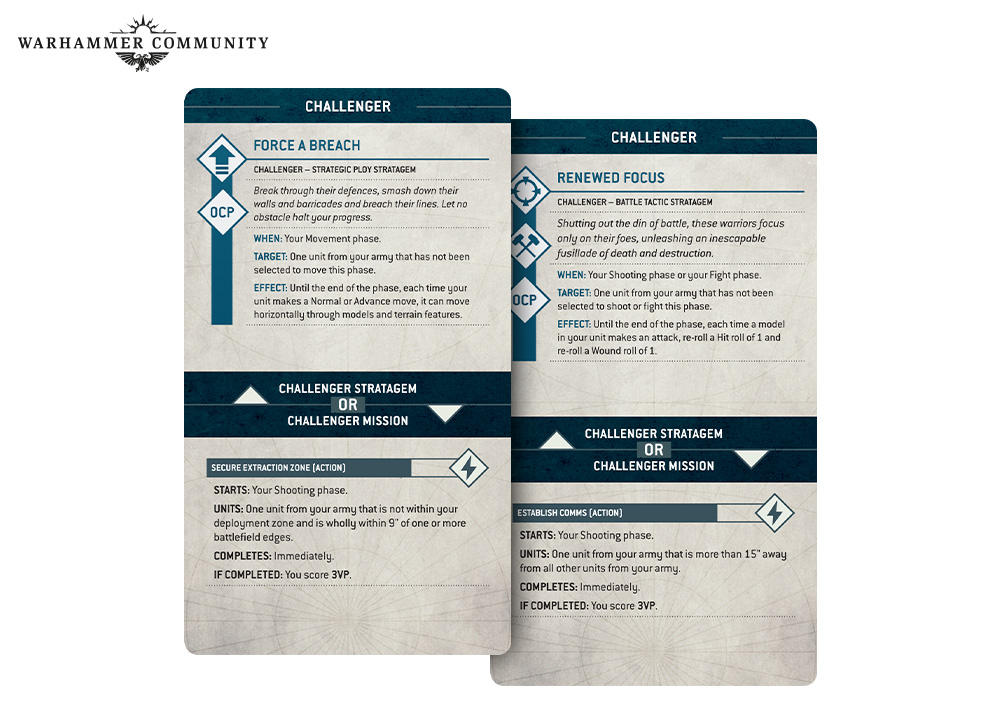 Source - Games Workshop
Let's talk about the second player advantage first. As the edition has developed it has become a widely known fact that going second generally has an advantage over going first. You get the first Rapid Ingress, you get end of game scoring, and you can force your opponent to be the aggressor so you can punish them. Challenger cards increased this advantage astronomically. Let's put forth a rather common example. You go first and draw Area Denial and Establish Locus, you push out your Scout squad, score both cards and pass. Then your opponent goes, they draw Sabotage and Engage on all Fronts. They push up, kill you off the middle, score a one point Engage, and then discard Sabotage for a Command Point. Sure you are now ahead by six points but now they get a Challenger Card! Now they are most likely really only three points behind, have am extra Command Point, are going second, and could just draw one of the big four Challenger Cards. What are the big three you may ask? Well lets talk about them.
If you draw a Challenger Card more often than not you probably grab your basically free three points and go, but there were four cards that basically broke the entire game wide open if you drew them. Great Haste and Burst of Speed, which gave you an unrestricted d6” of movement, one in shooting, and one in movement. Pivotal Moment, which either gave you advance or fallback and shoot/charge. And finally Force a Breach, which gave you a walk though models and walls. What do all four of these have in common, extra unplanned movement. At high level competitive Warhammer the most important thing you can do is “pre-measure” which is measuring out where your opponents units can reach and interact with your own units when you are planning your own turn. If you are winning GTs, Majors, or Super Majors, you are certainly practicing this method. Now, what if your opponent, if they are behind by a mere six points, can all of the sudden add a d6” move to any unit they want, or fall back out of combat with the unit you set up to specify to tag them, or walk straight over the unit you sacrificed to screen out their tank? It just is not right for skill to be removed from top level games and for the game to come down to, "Do I draw the Challenger Card that wins me my game automatically?"
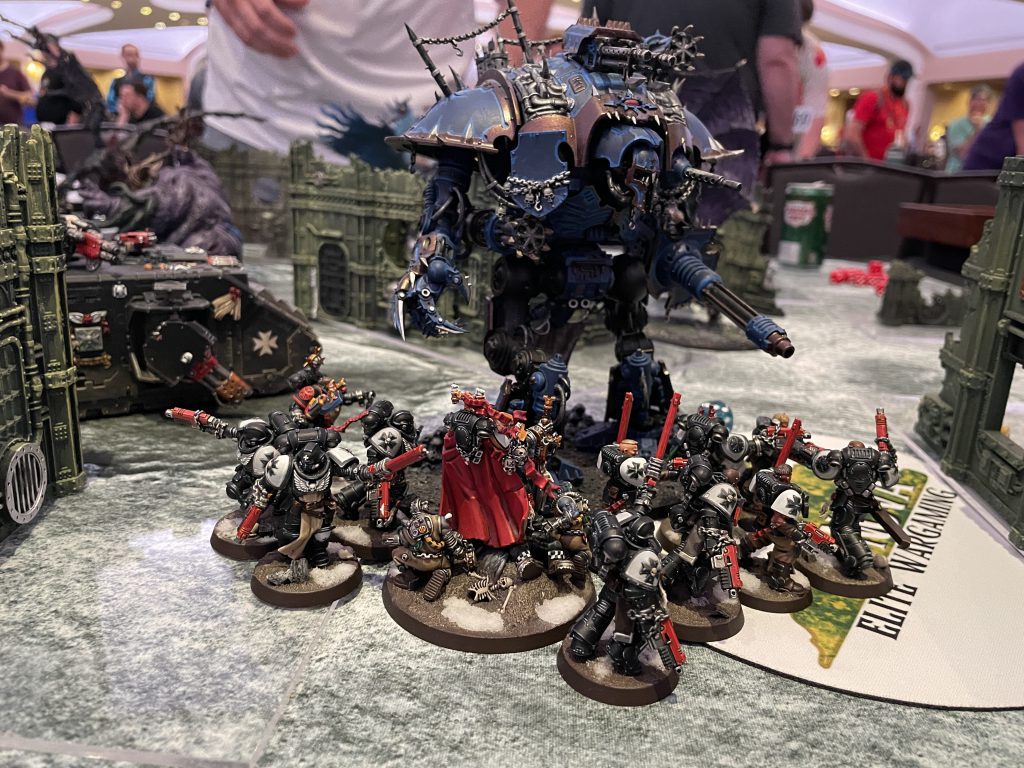 Would be a real shame if this Knight Desecrator could suddenly fall back shoot and charge! Credit: SRM and Phil
Thankfully Games Workshop removed Challenger Cards from competitive play. I hope they learned their lesson. Catch up mechanics, while they sound great on paper, do not really work at high level Warhammer 40k, and I hope they take that to heart going into 11th edition and do not make us go through the horrors of Secret Missions and Challenger Cards again.
Final Thoughts
After really having spent the past week going through the history of mission packs in 10th edition, I really have some mixed feelings. Are we better off now then we started? I believe that is true. Are there still some unpleasant components of mission design active now? Yes, I think that is also true. I hope Games Workshop really takes some time to learn from the mistakes of the past and builds our next mission pack better than ever. Removing some of the final bad actors in the pack, bringing back fixed as a viable archetype, and maybe even giving us mission rules back in some way, all of these could give us a much brighter future that we will hopefully see in an edition to come.
Have any questions or feedback? Drop us a note in the comments below or email us at contact@goonhammer.com. Want articles like this linked in your inbox every Monday morning? Sign up for our newsletter. And don't forget that you can support us on Patreon for backer rewards like early video content, Administratum access, an ad-free experience on our website, and subscriber-only content covering competitive Warhammer 40K!
Thank you for being a friend.
 This website uses cookies. Learn more.

 Goonhammer App and Patron Updates: April, 2026
 Kill Team Tournament Report: Engage, Party, Repeat's March Madness 2026
 Goonhammer Reviews: Tribal Conquest