 This website uses cookies. Learn more.
This website uses cookies. Learn more.
This website uses cookies. Learn more.

Large games of Warhammer 40,000 have always been cooler in theory than in execution. While players start imagining massive battles the moment they start playing, the reality is that massive games of Warhammer 40k have traditionally been a slog, being 6+ hour affairs where players stand around waiting for their opponents to finish moving and shooting, only to lose their largest units before they ever have a chance to be used. 8 hours later, they’ve played two whole turns. Suffice to say, the reality doesn’t live up to the hype.
So when Games Workshop announced new Apocalypse rules designed to streamline the process and make Apocalypse games take considerably less time, we at Goonhammer were psyched. Anything that can make games of that size fun and manageable is something we’re absolutely in for. But how does the final game stack up, now that we have the rules in-hand? And is it worth buying the box or the accessories?
In this post, we’re going to do a thorough unboxing of Apocalypse, from cards to rules. We’ll cover everything that comes in the box, plus the game’s ruleset. We’ll talk about what we like, what we don’t like, and what we think some of the key strategies will be for players looking to tackle Apocalypse competitively.
Games Workshop was pretty up-front about what comes in the Apocalypse Box. It’s a solid box that comes with a rulebook, some dice, a bunch of punch-out tokens, and a bunch of Command Asset cards. So there isn’t a *ton* to say here, but I’ll run through the contents and what’s nice about them anyways.
 It also came with a QR code for a free chapter of a novel, but I'm not gonna read that.
The tokens are pretty solid quality and you get a ton of them. The photo doesn’t show it, but there are two sheets of the large blast markers/objective markers to punch out. The dice are pretty much GW standard D6s, plus a handful of D12s. I have no idea how the D12s roll or if they’ll need to be replaced like all of my other standard GW dice.
 Pretty much all the tokens you'll ever need unless you are getting to games so big you need to play SUPERPOCALYPSE, with even more streamlined rules
One cool upside to the box is that it comes with a plastic organizational insert, so you can put all of your cards and tokens in the box for storage--I love this. There are enough slots for every faction in the game, plus two extras (well, depending on how you want to divide them, but I put Sisters of Silence with Custodes). One of these gets used for the universal Command Assets. The big downside is that these dividing spaces aren’t wide enough for sleeved cards, which is something I wish more game companies would take into account.
 Nice
Nice
 Everything in its place
Getting everything out of its packaging took a few minutes, and sorting the cards (plus the additional Command Assets) only took a few more. As you might have guessed, the cards aren’t evenly-distributed by faction. In addition to the large group of universal Command Assets, Space Marines and Chaos Space Marines get the most Assets out of the factions, while some factions like Chaos Knights and Custodes only end up with a few unique cards. This seems like a power imbalance to me right now, or just general laziness on the developers’ parts. There are a few cool Command Assets that work across enemy factions however, such as Ancient Doom, which can be used by Eldar or Slaaneshi units.
 those gaps definitely trigger some part of my brain to start screaming
 Better, but not amazing
With the box contents out of the way, let’s talk about the rules. For the most part, games of Apocalypse play like big, streamlined games of Warhammer 40,000 with a few changes to how turns are played and how damage is handled. Anyone familiar with Epic 40,000 will see a lot of similarities in the new Apocalypse rules, in a good way.
Games Workshop already put out a pretty good summary video you can check out that covers the basics (you can check it out here), so we’ll dig into more of the details in our article.
Unlike Warhammer 40,000 8th edition, Apocalypse uses shared turns with alternating activations, more akin to games of Kill Team. Each game turn is split into four phases:
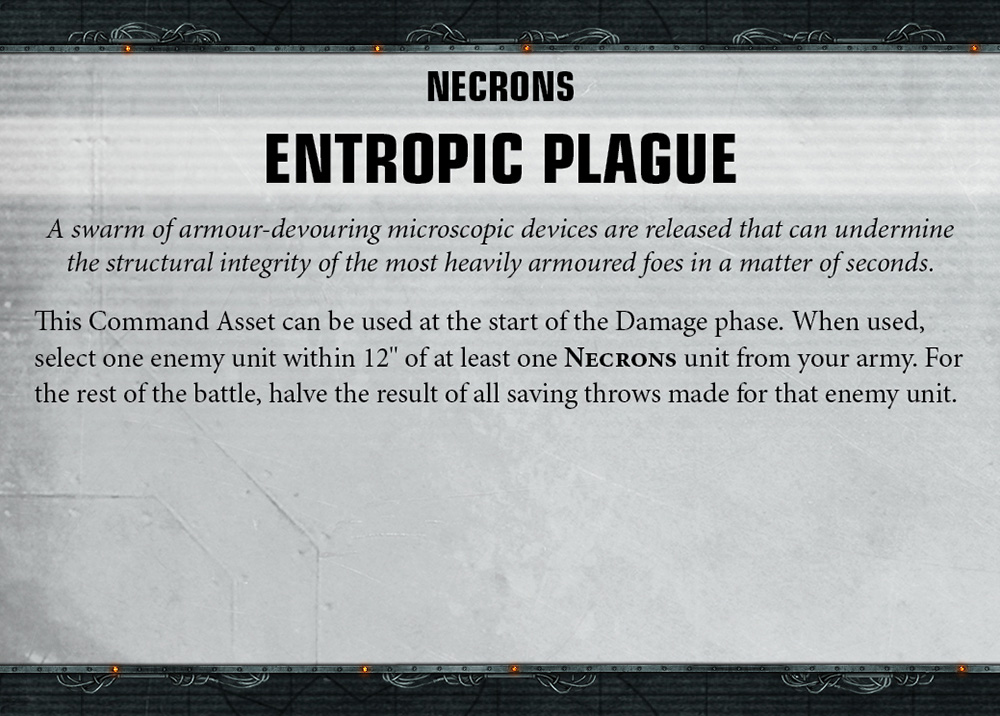
Before the game, each player constructs a deck of 30 Command Asset cards (no duplicates allowed). Each turn, players generate (draw) one Command Asset, plus an additional Asset for every Warlord they have on the table. Hand sizes cap out at 10. When you run out of cards, you shuffle your discard pile back into your deck.
 Credit: TheChirurgeon
Army organization in Apocalypse is done through detachments. Apocalypse has a list of detachments similar to the ones in the 40k 8th edition rulebook, but with some key changes. The first is that unit requirements are loosened, and the second is that most detachments have special abilities. The only way to get access to your faction’s detachment special rule is to have all of the units in a detachment be part of that faction. Also, troops in a Battalion get ObSec. When you issue orders and activate in Apocalypse, you do it at the detachment level.
Every detachment you create has to have a Commander, which is a unit chosen from among those with the highest Leadership value. If your Commander is also a CHARACTER, they become a Warlord, and help you generate Command Assets. When Commanders die, you choose a new Commander in that detachment, but they don’t become Warlords. One of your Warlords gets chosen to be a Warmaster at the start of the game, and they get a randomly-chosen (d12) Warmaster trait.
SHOOTING CHARACTERS: Unless they’re the closest unit to the enemy, Characters count as obscured, and the enemy shooting them gets -1 to their To Hit rolls. So unlike 40k, characters are targetable in Apocalypse, albeit slightly harder to hit.
There are three Orders you can issue to a Detachment in the Issue Orders phase:
This has immediate consequences with regard to army design: You’ll frequently want to build Detachments based on the orders you’ll want to give units in them, which means grouping assault units and shooting units separately in order to maximize their benefits. The last thing you want is not being able to shoot with a unit because you need to assault with another unit in the same detachment.
Wings Note: Unless you're Craftworld Eldar, because Elves are Better Than You.
There are three types of actions that result from Orders issued: Move, Shoot, and Fight. These work mostly how you’d expect them to.
 That's a whole lotta knights
Damage in Apocalypse works very differently from 40k. Attacks still follow the Roll to Hit -> Roll to Wound model, but saves and damage don’t happen right away. As units are wounded, they’re assigned blast markers, either small or large. If a unit with a small marker would be given another small marker, it upgrades a small marker to a large blast marker instead. During the damage phase, players alternate rolling saves for each unit with blast markers on it, using D12s for small blast markers and D6s for large ones. Every failed save results in the unit taking damage, and damage equal to Wounds kills a unit.
Units can also be critically damaged if they have damage equal to half their Wounds or more. In these cases they halve their attacks and take a -1 to hit on attacks made with Heavy weapons.
Terrain in Apocalypse is pretty interesting. Terrain is divided into Obstacles, Defensible Terrain, and Buildings. Obstacles are basically walls, barricades, crates, etc. If you have a unit wholly within 3” of an obstacle, and its between you and the opponent, you count as Obscured, and they get -1 to hit you. Note that being an obscured target is a state, and so Characters behind an obstacle don’t get any extra bonuses
Defensible Terrain is much more interesting, as it covers area terrain and things like ruins. Basically if a unit is wholly within 6” of a piece of Defensible Terrain at the start of its Move action, it can essentially “embark” into a piece of Terrain by Garrisoning it, allowing it to break coherency and from that point, LoS and ranges for it are measured to/from the terrain footprint. While garrisoning a piece of Defensible Terrain, unmodified save rolls of a 6+ always succeed, so it basically gets a more traditional cover save.
Aura abilities basically work like they do in 40k--they aren’t “on” while you’re in a transport--but if you garrison a piece of Defensible Terrain, your aura only extends to (but applies to) every other unit that is garrisoning that piece of terrain.
The rulebook gives players 5 regular detachments (Battalion, Outrider, Vanguard, Spearhead, and Super-Heavy), each with optional HQ options, and 5 Special detachments (Patrol, Air Wing, Super-Heavy Auxiliary, Fortification Network, and Supreme Command), which have some additional bonuses and restrictions on top of what you’d see in standard 40k. Note that there is no Brigade. You wouldn’t want to run one anyway though, because as we discussed earlier you generally want to be “focusing” your detachments.
That’s the bulk of the rules. They’re surprisingly light--the core rules only take up about 11 pages, plus there’s another 10 or so to cover Detachments, Keywords, Universal Special Rules (those only take a single page), and Warmaster Traits. I’m a big fan of alternating activations in 40k generally, and I think the detachment-level activations with damage resolution at the end of the turn seems like a great compromise between going full AA and keeping some elements of standard 40k’s IGOUGO system.
 Never again will my poor, sweet resin son die before getting to fire off his Vulkan Mega-Bolter
The Apocalypse rulebook details six basic missions, plus it has rules for generating missions randomly in a similar fashion to the Open War deck from 40k. All of the missions end when either one player has no units left, or at the end of turn 5. Five of the missions are standard 1v1 affairs, while the 6th is a multiplayer mission that has players deploying in table quarters. Because of the alternating activation nature of Apocalypse and how damage is resolved, it’s ideally suited to handling multiplayer scenarios, which is great.
The mission generator looks a lot like the Open War deck, and has you roll for deployment map (using the 6 core rulebook maps from 8th edition), Objective (12 options), Twist (12 options), and then if the armies are unbalanced, you can roll for a Ruse (6 options) or Sudden Death victory condition (6 options). These are all pretty straightforward, and none of them seem quite as broken as some of the Open War cards, and several revolve around Command Assets.
Finally, the book also includes War Zones, or rules for playing in specific types of battlefields. They’re all pretty interesting, though I suspect that, like the Killzones in 40k 8th edition, they’ll rarely see play. The ones included are:
 Triple Exocrines are a real pain in the ass
In all, there’s a lot to like about the new Apocalypse.
Overall, we like the new Apocalypse, but there are some definite missed opportunities in the new system.
 The Barbed Heirodule won this fight against Greg's Nephilim
The new rules are a huge step in the right direction for Apocalypse, and it’s easy to see how they speed the game up and make it more interactive for players on both sides of the table. Even though we felt there were a few missed opportunities in the new rules, the reality is that playing massive games of 40k using the 8th edition ruleset is just such a miserable slog that you don’t really have an alternative - Apocalypse is a must-buy for players who plan to run games of Apocalypse more than once or twice a year. If you aren’t planning to play that often though, you can probably skip it.
I’ve already got a copy, and I plan on running several games of Apocalypse this year and early next in the Astradus Campaign, where I’m hoping the streamlined process makes having regular games of Apocalypse easy enough that each one doesn’t have to be a major event.
Wings Note: I’ve also bought a copy even though I’ll probably play fewer large games than TheChirurgeon. I really appreciate the set as a game design exercise, and look forward to having it on my shelf as an option for if I can lure the foolish local Imperium players into challenging me and a friend’s 500PL of elf bullshit.
We’ve barely scratched the surface so far on Apocalypse. Sure, we’ve gone into detail about the rules and what’s in the book, but we haven’t talked about strategy, how the factions compare, or the Command Assets that make up a massive part of the game’s strategy. In the coming weeks we’ll explore good tactics and bad for Apocalypse, the units we’re most excited to use in the new game (my Warhound will finally see use!), and the basics of building a good Command Asset deck. So keep checking back in with the Goonhammer crew for more articles on Apocalypse--we’ve got plenty more content planned.
Tags:

Thank you for being a friend.
 Infinity N5 First Principles: Understanding the Outcomes of Face to Face Rolls
 Tactical Feedback: Timing the Go-Turn
 SRM's Roundabout to Adepticon 2026: Curd Is the Word
Support us on Patreon to get access to our Discord and exclusive App features.
Thank you for being a friend.
Already a Patron? Login with Patreon.
Visit our incredibly official store on RedBubble.

Support us on Patreon to get access to our Discord and exclusive App features.
Thank you for being a friend.