Hello and welcome to the lucky number thirteen in our series chronicling the history of the Black Library, as told from a Warhammer 40,000 perspective. For convenience, here is the list of the History so far:
- Part One: The Beginning. 1990. Inquisitor and Deathwing.
- Part Two: A short pause. 1993. Space Marine.
- Part Three: 1994-95. Harlequin and Chaos Child.
- Part Four: 1997. Dawn of the Black Library and Inferno!
- Part Five: 1997. The first year of Inferno!
- Part Six: 1998. Gaunt’s Ghosts and Last Chancers debut.
- Part Seven: 1998. Warhammer Monthly’s first ten issues.
- Part Eight: 1999. The books are back!
- Part Nine: The books of the year 2000.
- Part Ten: The short stories and comics of 2000.
- Part Eleven: Winter and Spring 2001. Eisenhorn appears.
- Part Twelve: Summer and Autumn 2001. Ongoing series continue apace.
Today we're going to look at the first half of 2002, which with the passage of time proved to be a fairly start-studded six months. All five of the novels are notable in some way, either as continuations of popular series or the starts of them. In one case, we even have a title that would join Ian Watson's
Space Marine in the Heretic Tomes label.
Entering its fifth year the Black Library was in full stride, with its talent pipeline apparatus fully deployed. The short story vehicle
Inferno! was on the verge of its thirtieth issue, but still every bit as approachable as it was at the outset for aspiring writers. In fact, as it entered the age of the internet there was even a buoyant sense of optimism at the new opportunities it promised on the part of editor
Marc Gascoigne.
"As of last month," he wrote in the editorial column for Inferno! #29, "we have started listing our 'forum' web address, along with the suggestion that you, gulp,
Talk to us!"
"What we have done is set up a new community message board, on our website, where anyone can pop along and discuss anything related to the Black Library. On the board you will find heated debate and reasoned argument in about equal measure.
"The Black Library acolytes drop in to add an official verdict now and then, and even the likes of Dan Abnett and Gordon Rennie have been known to pop by and soak up the atmosphere. In other words, if you are interested in any or everything to do with the Black Library, you should check it out."
It's easy to jadedly chuckle two decades on at the innocent excitement of an internet forum, a medium whose day has come and gone in favor of contemporary alternatives like Reddit and Discord. But that would miss the larger point, which was that the degree of separation between Black Library and reader was now at perhaps its thinnest point before or since.
The legions of modern aspiring Black Library writers keeping their quills sharp for the next open submission window (and its concomitant challenge
1) would kill to have this kind of accessibility:
"Firstly, we will look at story proposals from anyone. You don't have to be a professional writer. You don't have to work for Games Workshop or in the gaming hobby at large. You don't have to be over a certain age, or live in a certain country. To be honest, we wouldn't care if you were a three-headed Chaos mutant from a distant planet who was only three years old in Earth years - providing you followed our two very simple rules.
"Be true to the spirit of the Warhammer worlds and be any good."
And here's where it gets almost surreal:
"But just before you rush off to your browser, you might also want to know what we offer in return.
"First up, of course - hard cash! In fact, we pay better than most of the more famous SF magazines around. More importantly, perhaps, we also publish you, out there in public for all to see. The very best stories may even make it into one of our short story paperbacks, sold all around the world. And the best story writers then get offered a novel deal too!"
That's right, once upon a time the Black Library was pitching
you on the benefits of pitching
them.
It was a simpler time to be sure, but it's always worth taking a beat to marvel at what Gascoigne and company did to steer the ship true in those early days to become the Black Library we enjoy today.
Now, let's see what readers were enjoying in 2002...
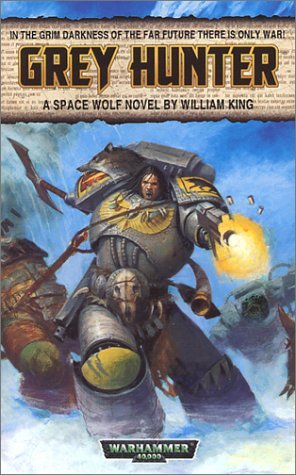 Image credit: Games Workshop
Grey Hunter, by William King
At this point the Black Library has hit its stride with a series of recurring characters driving its novel releases. That's not to say we won't see stand-alone or one-off books, but readers have shown an eagerness for ongoing sagas that continue to grow and develop across multiple books. All four releases in the second half of the 2001 would ultimately serve as parts of a series (Eisenhorn, Gaunt's Ghosts, and the Last Chancers, with Gordon Rennie's
Execution Hour also going on to generate a sequel).
Fitting, then, that we start the new year with another continuing storyline. As the third book in the tale of Ragnar Blackmane,
William King's latest followed the same 'flashback' convention of the previous two (
Space Wolf and
Ragnar's Claw) and concerned a campaign against a Chaos-infested world to retrieve an artifact sacred to the Space Wolves, the Spear of Russ.
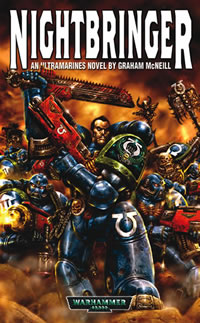 Image credit: Games Workshop
Nightbringer, by Graham McNeill
"Only now, at the end," reflected
Graham McNeill on what the process was like for crafting
Nightbringer2, "did I truly understand the phrase,
murdering your darlings."
McNeill is now considered a stalwart of the Black Library, but every journey has a beginning. He'd been with Games Workshop for a little over a year before being asked to write a novel about Space Marines, with the only caveat being that it needed to be a Codex Chapter in order to contrast with William King's Space Wolves.
"I instantly wanted to do a novel based on the Ultramarines," he noted, "since I felt they were getting a bad press as a 'boring' Chapter. I quickly realised that much of this was because, as a Warhammer 40,000 army, they had no special rules like the other Chapters had and were often the army newcomers to the Warhammer hobby were urged to collect.
"This was a notion I profoundly disagreed with... I began my quest to change people’s opinions by writing a short story called
Chains of Command3, where I introduced what was to be my main character, Uriel Ventris."
Nightbringer sees Captain Uriel Ventris sent to the planet Pavonis to deal with civil unrest, but things are far worse than they appear as Ventris finds that Dark Eldar, Necrons, and even a shard of C'tan are involved.
Ventris would be another hit for the Black Library, and the years that follow would see MacNeil deliver another half-dozen Ultramarines novels (and nearly twice that again in short stores) featuring him.
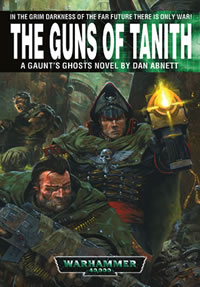 Image credit: Games Workshop
The Guns of Tanith, by Dan Abnett
By 2002, it was clear the Black Library had a huge hit on their hands with the Gaunt's Ghosts series. Whether it was strong and well-written characters, the grounded viewpoint of the Imperial Guard in a larger-than-life universe, or the gripping edge-of-your-seat action that drove it, Abnett had created something that transcended a trilogy arc and had started to become a real franchise.
Abnett shared one of the secrets of its success in an interview with
Richard Williams in
Inferno!, when asked about the range of tone in the different books and what he was looking to convey in them.
"Something different each time, for my sake and the reader's. There's only so much you can do with a lasgun firefight, and I'd hate it to get stale, so I change the setting, the purpose, the scale...
"First & Only has a World War One feel at the start, and ends with something wild and almost Napoleonic. Ghostmaker is a chocolate box of different settings. Necropolis, which has obvious echoes of Stalingrad, was an effort both to increase the scale and put the Ghosts on the defence for the first time. With tanks.
"Honour Guard is a bit of a road movie with spiritual undertones. With more tanks. The Guns of Tanith... well, that sees airborne action and depicts the Ghosts first full-blown specialist operation as 'commandos'.
"I like to think 'what haven't we seen before?' and 'where haven't we been before?' And of course, by now, the sub-plots that build steadily under the action are determining the structure of the novels."
If the readers were all in so was the Black Library, who ensured readers wouldn't be waiting for long- a second Ghosts novel would be following just months later. (We'll look at that one,
Straight Silver, in the next installment).
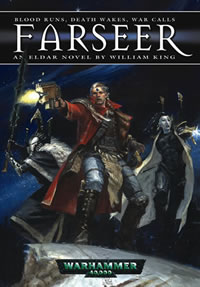 Image credit: Games Workshop
Farseer, by William King
In 2009, the Black Library announced its intention to launch a range of print on demand reprints for books that had been long out of print. "There are a few books that we are planning to bring back in to print however," they announced, "that were written in a different time and place, when the worlds of Warhammer and 40K were different from what they are now, and that editing these books would undermine the story, the author's intention and the fact that they are artefacts of their time. Rather than keep these books out of print in the face of unprecedented reader demand, Black Library will once again make these books available under the Heretic Tomes banner."
Heretic Tomes would ultimately encompass only a trio of books:
Space Marine by
Ian Watson,
Brian Craig's Pawns of Chaos... and
Farseer.
Farseer had the distinction of arguably being the first xenos-centered novel in the Black Library, at least as far as how it was marketed (note the tagline "An Eldar Novel by William King" on the cover). But that wasn't
exactly the case.
To understand the framing of
Farseer, we turn once more to Gascoigne
4.
"For anyone who wants to submit a story, we have a set of simple guidelines, that you can get on our website or by writing to us. In essence, though, our guides boil down to two simple rules. One: be true to the Warhammer or Warhammer 40,000 background. Two: be any good. Fulfil those two and odds are you'll be published in these pages at some stage!
"In our writers' guides we go into far more detail than that. And there is one particular clause in them that has people writing in with howls of protest time after time. It is this one: 'Things to avoid: any plot which features an ork (or orc) or eldar as a central hero; we will not take these.'
"But why?!? come the cries again and again. I've just completed a series of epic tales starring an eldar farseer! How dare you tell me that I can't submit them!
"The reasons for this are quite simple. The eldar, we are told, are a deeply alien race. Their culture is full of bizarre, inhuman concepts - they build spacecraft by singing at raw materials to grow them, for pity's sake! So while a story might make sense if written as if a human observer was witnessing an eldar, a tale written from an eldar perspective would make little sense. Eldar are not human, and as a result we are never going to print a story where it is plainly just about humans with a few words changed so it's allegedly about eldar.
"None of this is to say that the pages of Inferno! will be free of stories featuring eldar, orks, tyranids, tau, kroot or lacrymole. But they will be portrayed realistically, put in perspective by being described through human eyes - all the better to make their alienness seem truly strange indeed."
So while it's true that
Farseer was a xenos-centered novel, if you've ever wondered why the main character was (Human) Rogue Trader Janus Darke and not Farseer Auric Stormcloud, now you know. Of course, the only certainly in life is change, and we wouldn't have much longer to wait for xenos POV.
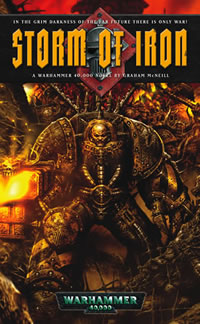 Image credit: Games Workshop
Storm of Iron, by Graham McNeill
"One of the most (for the time) distinctive aspects of this novel was that Chaos won," wrote McNeill about Storm of Iron
5, "which I think was a first."
"I’d known from the beginning that the good guys were going to be defeated, but had to structure the book in a way that didn’t make the outcome blindingly obvious from the get go. I wanted the reader to be constantly seesawing between believing the Imperium would be victorious to that uncomfortable, nagging feeling that the Iron Warriors might just pull it off…
"
Storm of Iron has proved to be an enduring novel... Many a Games Workshop fan has told me that they began collecting Iron Warriors after reading
Storm of Iron and plenty of the Games Workshop retail guys have mentioned that many of the Chaos players that frequent their stores have Iron Warriors armies thanks to
Storm of Iron. All of which is the most sincere form of compliment imaginable."
Fundamentally a story of siegecraft,
Storm of Iron introduced us to the heretic Astartes Honsou who, while not apparent at the time to MacNeill, would quickly become another of his stable of recurring characters. Honsou's prominence mirrored that of his other recurring star, Uriel Ventris, and it should come as little surprise that MacNeil would soon pit the two against one another...
...but that's a story for 2004.
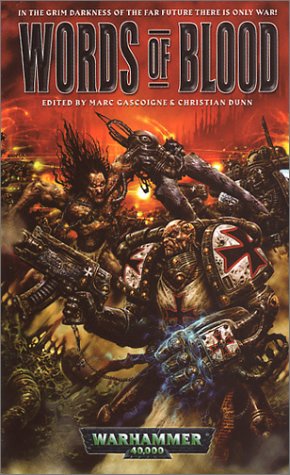 Image credit: Games Workshop
The Anthology: Words of Blood
Arriving that April.
Words of Blood was edited by
C. Z. Dunn and Marc Gascoigne and contained just shy of a dozen stories. As you'd expect most of these were reprinted from the pages of
Inferno!, which still remained the most reliable way of getting your name in print for the Black Library. Interestingly,
Words of Blood contained one new short story from man-of-the-moment Dan Abnett.
- Barathrum, by Jonathan Curran. We hadn't seen Curran since Inferno! #8 (The Raven's Claw), and this story- about some Adeptus Mechanicus explorator team accidentally unearthing an ancient evil- would mark his final contribution to the Black Library. (Originally in Inferno! #28)
- Business as Usual, by Graham McNeill. This Necromunda story tells the tale of an Underhive deal gone very wrong. (Originally in Inferno! #24)
- Chains of Command, by Graham McNeill. The first appearance of Uriel Ventris, this was to be only the first of a significant number of reprintings. (Originally in Inferno! #26)
- Defixio, by Ben Counter. While the Cadians and Catachans and Krieg are largely the face of the modern Imperial Guard, the setting is filled with a wealth of other, less-well-known forcdes that give it such richness of texture. One of those is the Savlar Chem Dogs Penal Legion, which have cropped up here and there in releases ranging from the Third Edition Codex to last year's Deathworlder by Victoria Hayward. Here Ben Counter spins a yarn of a Sevlar tank crew stranded miles within a greenskin horde
- Deus ex Mechanicus, by Andy Chambers. While it shares a certain topical similarity with another story in this anthology, Barathrum, Chambers' tale of an AdMech explorator team accidentally waking up some Necrons had originally appeared around two years prior. Tech-Priests stirring up things that are better left asleep is a common (and delightful) trope in the universe. (Originally in Inferno! #20)
- Liberty, by Gav Thorpe. Thorpe's tale centered on Lieutenant Kage of the Last Chancers. The 'Suicide Quad'-like Chancers never caught the same fire that the Ghosts did, but they left a number of entertaining stories from another side of the Imperial Guard. (Originally in Inferno! #27)
- Loyalty's Reward, by Simon Jowett. Although he'd manage one more short story in 2005 (Xenocide), by 2002 Jowett's involvement with the Black Library was winding down. His first story, Hell in a Bottle, had debuted back in Inferno! #8. Here, a notorious hive ganger crosses paths with the Inquisition. (Originally in Inferno! #23)
- Missing in Action, by Dan Abnett. The Inquisition is on the trail of a serial-killing Chaos cult in this frequently-reprinted early Eisenhorn story. (Originally in Inferno! #27)
- Ork Hunter, by Dan Abnett. A corporal assigned to the Armageddon Ork Hunters discovers what it feels like to be bait for something much larger, much uglier... and much greener! This was an original story that had not previously been published in the Black Library.
- Raptor Down, by Gav Thorpe. At what cost duty? A flight commander of the Aeronautica Imperialis must choose between obeying orders or breaking them to save the war- at the cost of his career. (Originally in Inferno! #24)
- Words of Blood, by Ben Counter. A desperate squad of Black Templars comes up with a plan that might just deliver victory- if they can follow them right down to the letter. (Originally in Inferno! #19)
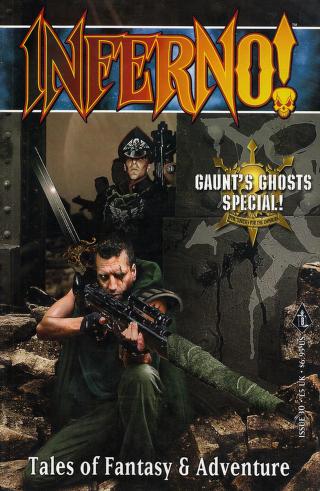 Image credit: Games Workshop
Tales from the Inferno
With the Black Library seeming to capture lightning in a bottle, Games Workshop was in full-court-press mode with Abnett's hit creation. Gaunt's Ghosts took central stage in the pages of May's White Dwarf, with new model and rules reveals for using the Ghosts in tabletop battles.
Not only that, but Inferno! #30 was an all-Ghosts issue, including an interview (and guest editorial) with creator Abnett.
The stories of the three issues from the first half of the year included:
- Bad Medicine, by Jonathan Green. A snake-oil salesman brings trouble to Tunnel Town, and it's up to Nathan Creed to get to the bottom of it in this Necromunda short. (Inferno! #29)
- Barathrum, by Jonathan Curran. Accompanied by an illustration by Steve Kane. (Inferno! #28)
- Crimson Storm, by Dan Abnett. An Iron Snakes story, this one concerns an apothecary jailed under suspicion of heresy and one battle-brother's effort to exonerate him. Accompanied by an illustration by Paul Jeacock. (Inferno! #29)
- Defixio, by Ben Counter. This story was an example of the near-parallel planning we've occasionally seen in the Black Library's release strategy, with the story seeded both in the January/February issue of Inferno! while also appearing in April's Words of Blood. Accompanied by an illustration by Simon Davis. (Inferno! #28)
- In Remembrance, by Dan Abnett. With Colonel-Commissar Gaunt recovering from injuries sustained during the siege of Vervunhive, an artist embeds with a Ghost patrol. Accompanied by an illustration by Alex Boyd. (Inferno! #30)
- Vermilion Level, by Dan Abnett. This story was originally intended for publication in Inferno! as a short story, but ended up being adapted for inclusion in First & Only, the Gaunt's Ghosts debut novel. Here, Inferno! presents the 'lost' manuscript of the story as originally written. (Inferno! #30)
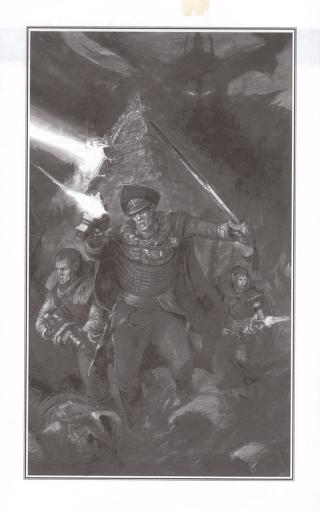 Image credit: Games Workshop
Visions from the Inferno
Inferno! continued its strong visual element, and many stories having illustrations accompanying them. Additional art (and lore) content in these three issues included:
- The Battle of Bhavnager, by Ralph Horsley. In this illustrated lore section, Horsley provides background and insight into a tank battle from Dan Abnett's 2001 Gaunt's Ghosts release Honour Guard. Whether this piece was intended as a foretaste or was just overflow content from upcoming the all-Ghosts issue, it was a prelude for what was to come. (Inferno! #28)
- The Emperor Protects, by Dan Abnett (script) and Paul Jeacock (art). The Tanith First-and-Only assault a Chaos citadel in this story from comic book veteran Abnett. (Inferno! #30)
- Heroes of Vervunhive, by Martin McKenna. McKenna's piece graced the cover of the all-Ghosts issue. (Inferno! #30)
- Necropolis - The Siege of Vervunhive, by Ralph Horsley. Another illustrated lore section from Horsley, this one taken from the third Gaunt's Ghosts book. (Inferno! #30)
- The Tanith First Battle Compendium, by C. Z. Dunn and Richard Williams. This illustrated list of places and names associated with the Ghosts served as a sort of early encyclopedia, highlighting just how rich and deep the lore had already become around the Black Library's breakout star. (Inferno! #30)
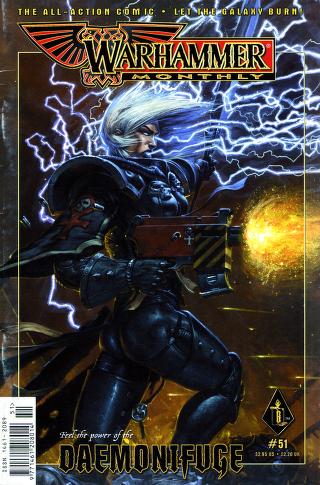 Image credit: Games Workshop
Meanwhile in Warhammer Monthly
The growth of the Black Library vision continued in the pages of Warhammer Monthly as well. The comic magazine had just celebrated its milestone 50th issue, and- similar to Warhammer+ today- subscribers had the opportunity to order a special diorama (Lysander and Cloten from
Bloodquest). Not only that, but in March the collected
Daemonifuge: The Screaming Cage hit the shelves as well.
Meanwhile, Warhammer Monthly ran the following in the first half of the year:
- Ahriman: Master Sorcerer of the Thousand Sons. With his appearance in the Epilogue of Damonigufe, Warhammer Monthly included a two-page lore spread on Ahriman himself. (Warhammer Monthly #51)
- The Black Crusades. Another lore explainer page as we had with Ahriman in issue #51. (Warhammer Monthly #55)
- The Black Crusade, by Karl Richardson. Legionaries menace from the cover of Warhammer Monthly #54.
- Bloodquest III, by Gordon Rennie (script) and Colin MacNeill (art). The Blood Angels have recovered the ancient relic sword that kicked off the start of this long-running series, but at terrible cost. The quest may be completed, but there can be no rest until Leonatos is recovered. (Warhammer Monthly #54, 55, 56)
- Daemonifuge – Lord of Damnation, by Gordon Rennie (script) and Chris Quilliams (art). The latest saga of Sister of Battle- and suspected heretic- Ephrael Stern concludes in its Epilogue. (Warhammer Monthly #51)
- Ephrael, by Adrian Smith. The Heretic Saint drawn in full action for the cover of Warhammer Monthly #51.
- Gravier, by Paul Jeacock. Some Inquisitor battle action by Jeacock for Warhammer Monthly #52's cover.
- Inquisitor: Ascendant, by Dan Abnett (script) and Jim Brady (art). Inquisitor Gavier- hunting for his mentor Defay, finds himself betrayed and in danger in the war-scarred wastes of planet Sepulchris. (Warhammer Monthly #51, #52)
- Kal Jerico: Above & Beyond, by Gordon Rennie (script) and Wayne Reynolds (art). "In all the underhive, and in every hive city on every hive world throughout the Imperium, there are two words guaranteed to strike terror into the inhabitants there: Arbites cull!" (Warhammer Monthly #56)
- Kal Jerico: Killing Time, by Gordon Rennie (script) and Wayne Reynolds (art). Card games can go wrong, and then they can go underhive wrong. Jerico's about to find out the difference. (Warhammer Monthly #54)
- Lone Wolves, by Dan Abnett (script) and Karl Richardson (art). Trapped on a barren ice-world, low on supplies and surrounded by a Tyranid swarm, an Imperial Guard detachment faces the longest odds of their lives in this new series debut. The issue also featured cover art by Clint Langley. (Warhammer Monthly #53)
- Titan, by Mark Harrison adorns the cover of Warhammer Monthly #56 in glorious red!
- Titan: Cold Steel, by Dan Abnett (script) and Anthony Williams (art). Princeps Hekate and the crew of the Titan Imperius Dictatio face their greatest challenge yet as they battle the forces of Chaos. (Warhammer Monthly #52, #54, #55, #56)
Abnett's ascendency continues through the second half of 2002, as we'll see in the next installment of our 40K History of the Black Library. Thanks for reading!
Footnotes
- Back in 2002 you could pitch the editors at will. In 2025, you have to essentially take a skills test just to get your foot in the door. (This year's challenge, for example, was to write a 500-word scene with two characters.) Scoreboard 2002!
- McNeill is a chronicler's dream, sharing lots of thoughts and insights on the books he's written over at his author website.
- Chains of Command was published in Inferno! #26, and we covered it here.
- This was from Inferno! #24. While we certainly owe Andy Jones a debt of gratitude for his tremendous efforts in guiding Inferno! and the Black Library in those early days, his editorials were a study in how to fill space with words (a playbook that Abnett aped in his own guest editorial for Inferno! #30, by the way). There's nothing wrong with that- they were plenty entertaining! But, by contrast, Gascoigne was candid and businesslike in the editorials he wrote during his turn at the helm. As someone looking back two decades later for the purposes of research and history, Gascoigne's have stood the test of time as something insightful, useful, and well worth rereading. If ever I get across the water to meet some of the Black Library's contributors, that man drinks for free.
- McNeill drinks for free, too, thanks to having a writer's site with author's commentary on his novels. History and posterity thank you for your service, sir.
Thank you for being a friend.
 This website uses cookies. Learn more.


 Infinity N5 First Principles: Understanding the Outcomes of Face to Face Rolls
 Tactical Feedback: Timing the Go-Turn
 SRM's Roundabout to Adepticon 2026: Curd Is the Word