We’ve written a ton about competitive terrain layouts but in this short series we’re looking at how to make good layouts for narrative play – layouts which go above and beyond the paintball arenas and bare MDF often presented in competitive formats. Last time around, I talked about using fortifications in 40k and some rules to improve them. If you’ve missed our previous articles in this series, you can find them here:
I've largely been avoiding talking about house rules or creating custom rules for 40k up to this point; that's because designing new rules is a bit outside the scope of a series that's mostly designed to make better battlefield layouts. That said, it's also a good time to tackle battlezones/warzones/theatres of war with the recent release of the Vespator Front campaign, which re-introduces theatres of war as a concept to tenth edition. And in doing so, we'll need to talk about houserules a bit, and how to make your own theatres of war.
Battlezones, Warzones, and Theatres of War
Something we've seen introduced and re-introduced in nearly every edition of Warhammer 40k are the idea of battlezones or theatres of war - rules designed to alter a mission or game to make it feel like you're playing in a specific environment. At their best, these missions can make a battle feel exciting and unique - like you're doing something you've never done before and telling a new story in your battle. At their worst, they just do a bunch of random mortal wounds to your models and turn the game into a slog.
When we
reviewed the Vespator Front campaign, we touched on these briefly but the rules for these Theatres are a mixed bag. On the positive side they're simple and they tell you what kind of terrain to bring, but on the downside, they have randomly selected effects (twists) each game. The appeal here is that doing this theoretically keeps things interesting if you play on the same theatre over and over, but the downside is that the theatre just feels like a random rule tacked on.
So what makes a good Theatre of War? Essentially, there are three things you need to do to make a good theatre of war:
- Make It Matter. There is no point in doing this if the impact to the game won't be enough to matter. There's nothing worse than those old killzone rules GW did where you'd roll a D6 for the effect and on a 1 you'd get a "no effect" result - why even play in that killzone? The rules for your theatre of war need to be meaningful and have a big enough impact on the game that they are worth playing with.
- Keep It Simple. Warhammer is already a complicated game with a lot to remember. Your rules need to be simple. The easiest way to do this is be reducing the number - I try to strive for a single rule for a given theatre of war, or at most two - and those have to be thematically linked. In my experience, trying to add more than one extra rule to a game or mission makes it incredibly likely that your players will just forget the rule during the game, defeating the whole purpose.
- Make It Something to Plan Around. Your twists don't have to be symmetrical necessarily, and they can be random, but they have to be something that a player can plan for. The randomness has to be somewhat predictable, the risk something a player can choose to mitigate, and the effect known ahead of time so a player can at least pick a force equipped for the conditions. Even when they're lopsided, we want our narrative games to feel like actual games, where the outcome is in question, not foregone conclusions where the shooting army lost because line of sight was reduced to 12" or the melee army got murdered because charge distances were halved.
So based on that, how do we design a good Theatre of War? Well, the good news about doing this is that making a Theatre of war is all about flavor, so it's what you'd call a "top down" design. We want to think about a particular theatre or battlefield and how we might model some of the things going on with it in rule format. For this I'm going to use an example from the Goonhammer Open - our Orbital Platform Battlezone.
The Orbital Platform
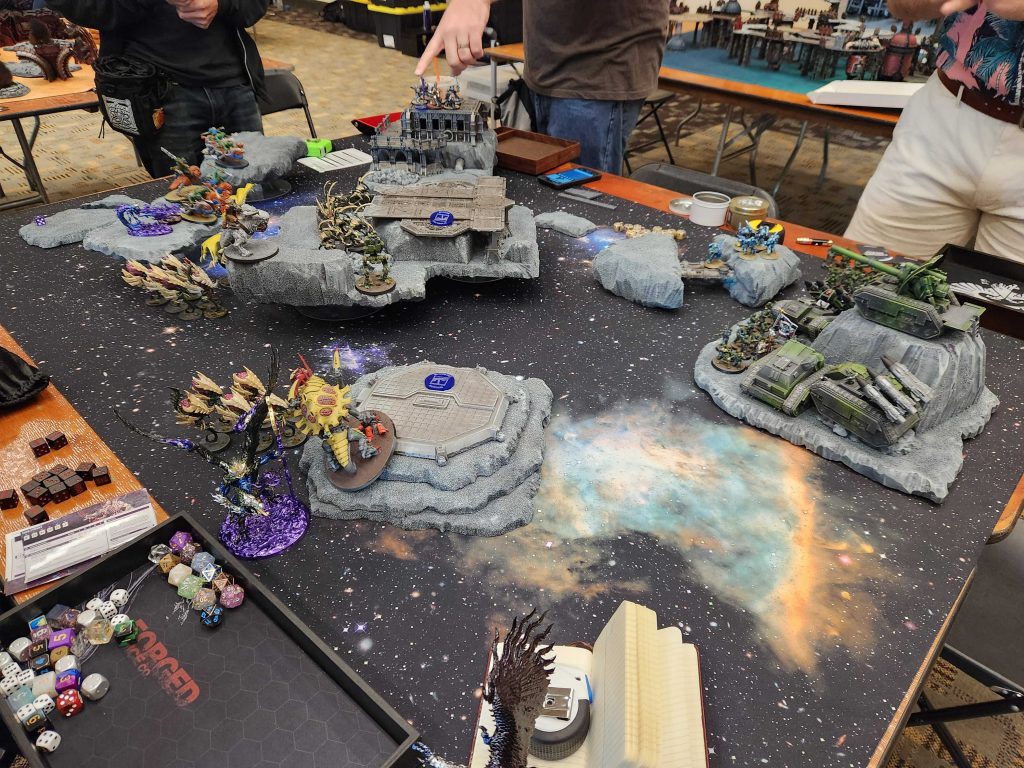 Bantavera Station
The concept here is pretty simple: It's in space. The battle takes place across a number of asteroids floating in the void. We made a custom set of space rocks with attached mining platform bits to act as the majority of the terrain for units to stand on. The idea here is that your walking units need to be on the rocks, but anything that can fly can move freely around the board. To represent this, we added the following rules:
- The Void. Units which end a move or are set up on the void (the space mat) without the FLY keyword are destroyed.
That's a super easy rule to remember, and it's intuitive - don't end your move on the mat if you can't fly. This has a cool consequence that if you destroy a transport with FLY and the guys inside can't fly, they're all flung off into the void - Great stuff. Because the table itself is a constant reminder of this rule, we can get away with some additional rules. First, we also needed to let units jump around, and so we added:
- Microgravity. Units without the FLY keyword can move as though they had the FLY keyword.
Easy, now we have moon jumps around the table. But I really liked the movie Gravity, and I wanted one more impactful thing here, so I created a rule to model a debris storm smashing through the battlefield - and doing it over and over as it orbits around the planet, whipping through the battlefield once in each round of the campaign.
- Debris Storm. At the start of the third battle round, roll a D6 for each unit on the battlefield, adding the Debris Storm counter to the total. On a 7+, that unit suffers D3 mortal wounds. On a 10+, that unit suffers D6 mortal wounds. On a 15+, that unit suffers D3+3 mortal wounds. Each time the Deadly Demise ability is triggered for a unit, add 1 to the Debris Storm counter. The Debris Storm counter starts at 0 for the campaign and is kept between rounds.
This added a nasty little twist but one that was both thematic - it's a cool visual and makes you root for explosions - and also something you can plan for. You know it'll happen on round 3, so you can hold reserves back for a turn or put a unit in a transport to protect them from the effects. It's also something that'll tick up each round, so you'll know how bad it can be later on if you check with other players. This ends up being three rules, but they work together and create something you can generally plan for and work with.
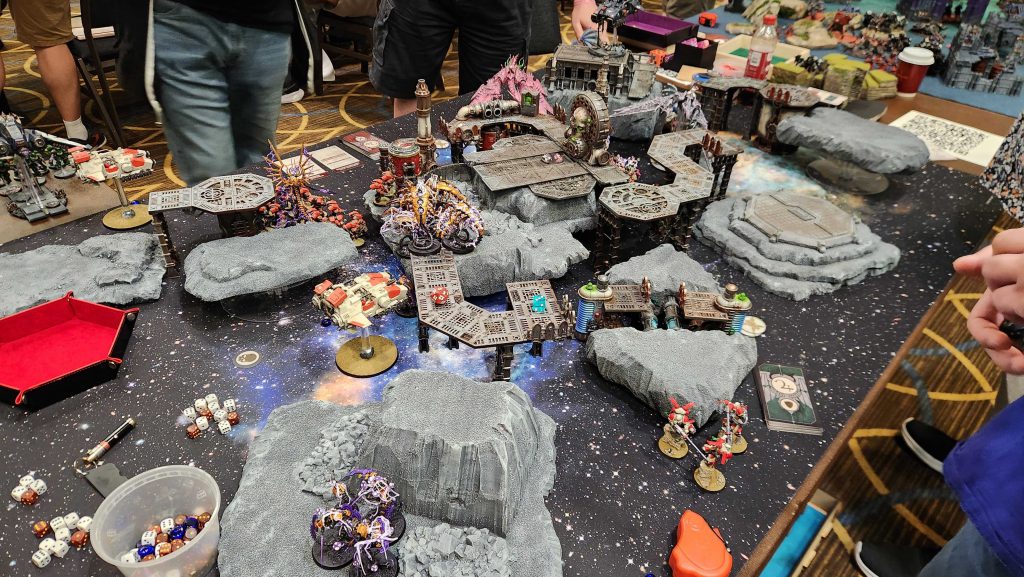
The Orbital Platform battlezone is one of our most popular now at the GHO events, and people really like the conceit and the rules associated. We've learned that it needs to have a bit more terrain to link platforms, and we've found that Sector Mechanicus gantries are good for that while helping us keep on-theme visually.
The City Spires
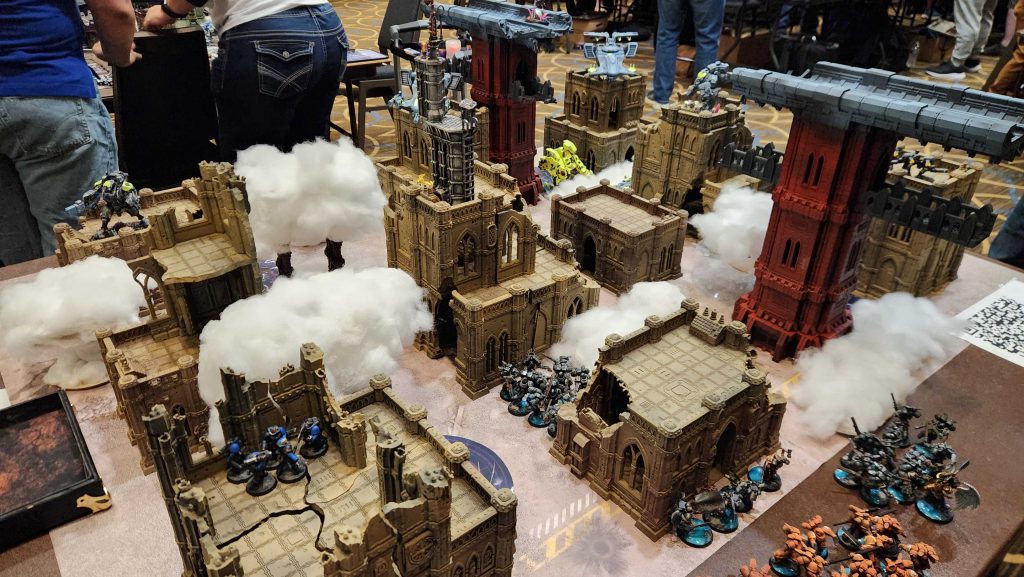
We did something similar conceptually last year at the Goonhammer Open, doing a battlefield for the spires at the top of a massive hive. We used a similar rule here for units - only units with FLY can end their move on the area between buildings - but removed the Microgravity rule - walking units are stuck on whatever building they end up on. We gave players more choice this time about which battlefield to play on each round, so a player going to this table would know what they were in for.
The big addition this time? Clouds. We wanted a better way to block line of sight across the battlefield. So we added clouds which block line of sight for units on either side. The Clouds move across the table each turn, moving 6" from one table edge toward the other at the start of each battle round.
Other Effects We've Experimented With
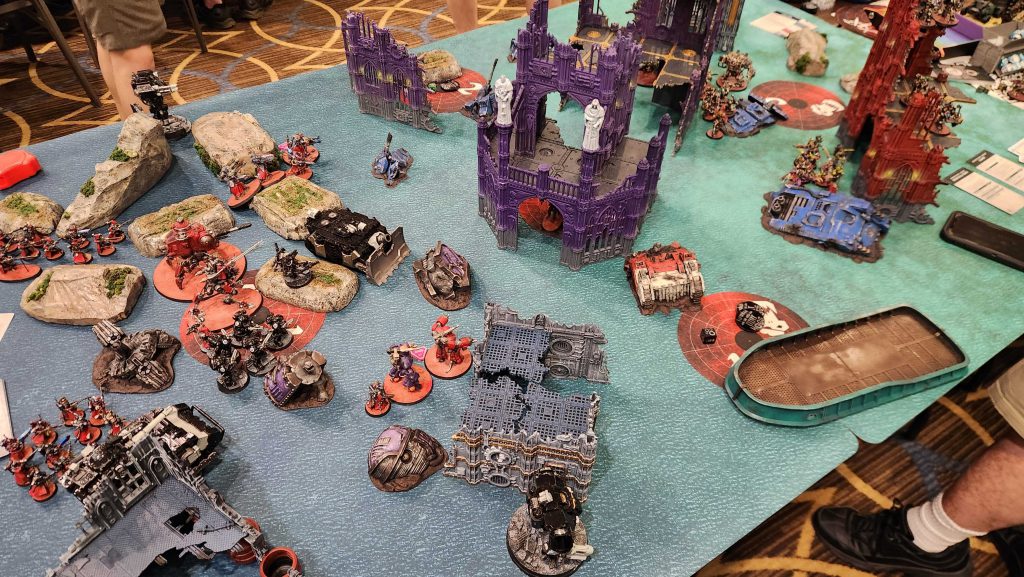
We've done a few others that I think worked OK - here are a few I think you can look at. Just remember that if you're doing anything that has a major impact on play, make sure your players have time to plan for it and are OK playing in those conditions - if your Ork player only has vehicles, don't push them into the scenario made for units that can FLY.
- In the flooded battlezone above, we alternated rounds of low tide (desert mat) and high tide (water mat, shown). While in high tide, INFANTRY and MOUNTED units without FLY were -2 to their Advance and Charge rolls.
- We've used choking smog style effects (-1 to hit if you're more than 12"/18" away) a few times, and it's good for tables where you have more sparse terrain or longer sightlines than you'd like.
- On that note, Nightfighting-like rules limiting line of sight distance are OK in some circumstances as well, particularly if you have really open terrain. I prefer "Dawn Raid" style rules for this, where round 1 is Nightfighting (18") visibility, Round 2 is dawn (24"), and rounds 3+ are daytime (full visibility), as this gives a melee player time to close but doesn't push things too far in their favor.
- For Cityfight missions with lots of elevated terrain, I like to introduce the Grapnel Hook Stratagem, a 1 CP stratagem that lets INFANTRY units move vertically at no cost for a single phase using a Normal or Advance move. I also like the Point-Blank Overwatch Stratagem, a modified version of the strat you can use after a unit finishes its Charge move, but the unit shooting can't fire [BLAST] weapons.
- On the flip side of the aerial combat boards, we've done heavy winds/rain/storm settings where units with FLY take damage as they're buffeted by the storm.
Difficult and Dangerous Terrain
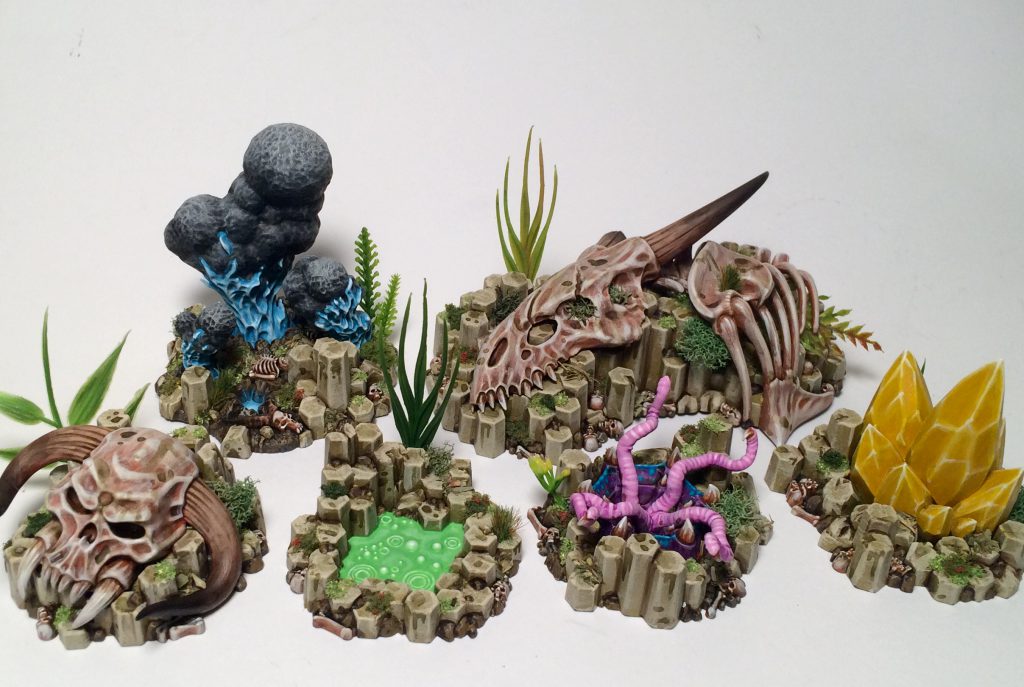 Primal Lair. Credit: BuffaloChicken
If you're doing lots of work with Theatres of War and custom battlezones, something I'd recommend is bringing back the concepts of Difficult and Dangerous terrain.
Generally speaking,
Difficult Terrain is terrain that impedes movement. Traditionally this has been something like -2" to unit Movement but I find this to often be a bit Too Much, particularly if other debuffs are thrown in or if a unit just has a lower Movement value. I instead tend to favor something like -2 to Advance and Charge rolls going through Difficult Terrain (if you don't have FLY), as this preserves the general idea of slowing down faster units without punishing slower ones too much.
On the other hand,
Dangerous Terrain is terrain that can actively kill you. It's good for making areas riskier to walk over, like Carnivorous Plants, Radioactive Pools, and Minefields. The general rule I'd suggest for Dangerous terrain is that units without FLY roll a D6 for each model moving through the terrain and on a 1, they take one mortal wound. This is more or less in-line with older versions of the rules, and you can play with it in fun ways if you want, making the roll -1 if the unit is Battle-shocked for example.
You can also combine the two, and if you do, I'd suggest that units falling back over Difficult Terrain treat it as Dangerous, while MOUNTED and VEHICLE units without FLY should treat difficult terrain as Dangerous.
Together, these two give you a ton of ways to model things like Scatter Terrain - Tank Traps are solid examples of Difficult Terrain which can become Dangerous for vehicles, while rivers, swamps and bogs, or dense forests can be difficult terrain.
Note that these rules have a big downside: They impede movement without necessarily affecting visibility, and so like the rivers example I gave in part 8 of the series, will naturally push the advantage to shooting/ranged units and armies. It's worth thinking about how you can combine these with features that block line of sight, or rules that limit visibility. If you want to use these for Forests and Woods, my general notion is that Forests and Woods be treated as Difficult, obscuring terrain (blocks line of sight to the other side), and units more than 2" from the edge of the terrain base cannot be seen by units outside the terrain feature unless they've made a ranged attack in the prior round.
Roads
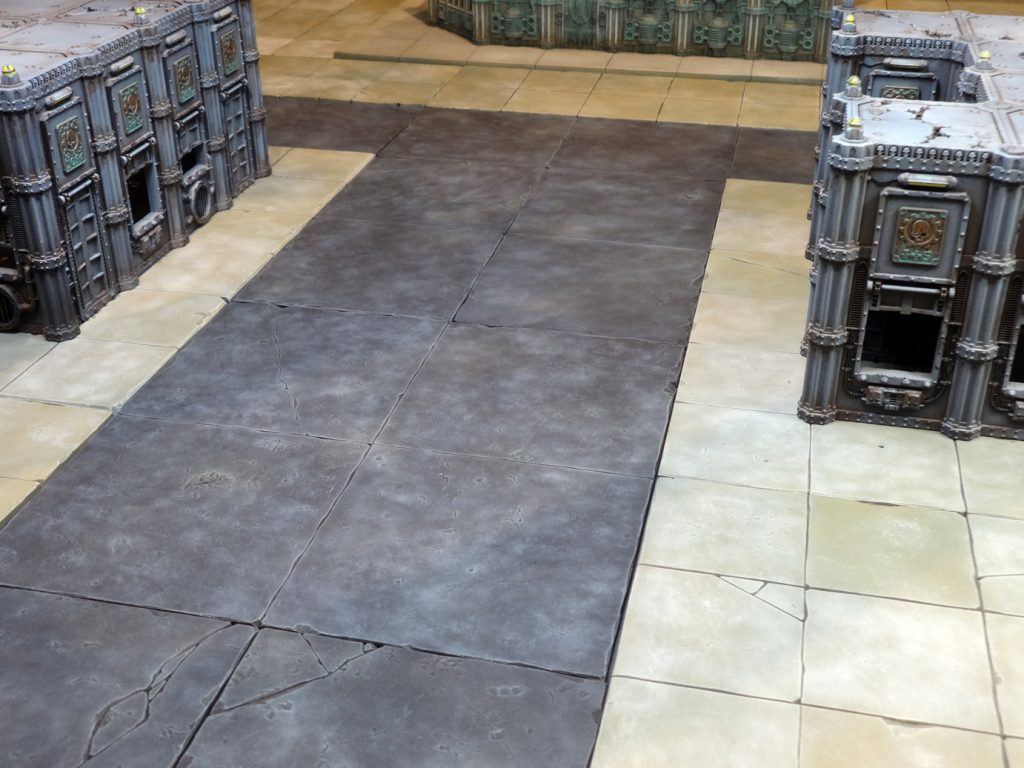 Modular road. Credit: Charlie Brassley
It doesn't have to
all impede Movement - I'm a big fan of having roads, even if they are a disaster from a "you're completely unprotected here" standpoint. My general notion there is that Roads are easy to move over and so you can give MOUNTED and VEHICLE units without FLY a +2" movement bonus if they start and end their move on a Road, and let units re-roll Advance and Charge rolls if they start and end their move on a Road.
Final Thoughts
That wraps up our series on Narrative terrain layouts and tables. Hopefully you learned something useful here, and it'll inspire your own games! If nothing else, I've wanted to impart the importance of having large, line-of-sight blocking terrain with clearly defined area footprints in your games. If you remember or take away nothing else from this series, take away the need for those types of features and you'll dramatically improve the quality of your narrative games. Otherwise, I'd like to thank everyone who commented on this series and shared questions and thoughts - it was helpful to read your feedback as I read this. And if you still have questions or things you'd like to see in the future, let us know! I'm always up for adding more at some point down the road.
Have any questions or feedback? Drop us a note in the comments below or email us at contact@goonhammer.com. Want articles like this linked in your inbox every Monday morning? Sign up for our newsletter. And don’t forget that you can support us on Patreon for backer rewards like early video content, Administratum access, an ad-free experience on our website, and subscriber-only content covering competitive Warhammer 40K!Thank you for being a friend.
 This website uses cookies. Learn more.

 Infinity N5 First Principles: Understanding the Outcomes of Face to Face Rolls
 Tactical Feedback: Timing the Go-Turn
 SRM's Roundabout to Adepticon 2026: Curd Is the Word