 This website uses cookies. Learn more.
This website uses cookies. Learn more.
This website uses cookies. Learn more.
Gaming | Warhammer 40k | Ruleshammer
"Within" is perhaps the most liberally used word in the whole 40k rulebook, with many different uses. Let's start by looking at a few rules that use it and how their uses differ.
Kustom Force Field: If this model is equipped with a kustom force field, friendly ORK units have a 5+ invulnerable save against attacks made with ranged weapons while they are wholly within 9" of it.
Alpha Warrior: You can add 1 to hit rolls for all <HIVE FLEET> Tyranid Warrior units that are within 6" of any friendly <HIVE FLEET> Tyranid Primes.
Volley Fire: Models in <Sept> units within 6" of any friendly <SEPT> Cadre Fireblades may fire an extra shot with pulse pistols, pulse carbines and pulse rifles when shooting at a target within half the weapon’s range.
INFANTRY units that are entirely on or within a ruin receive the benefit of cover. Other units that are entirely on or within a ruin only receive the benefit of cover if at least 50% of every model is obscured from the point of view of the shooting model.
Broadly speaking, all of these rules and scenarios fit into one of three categories:
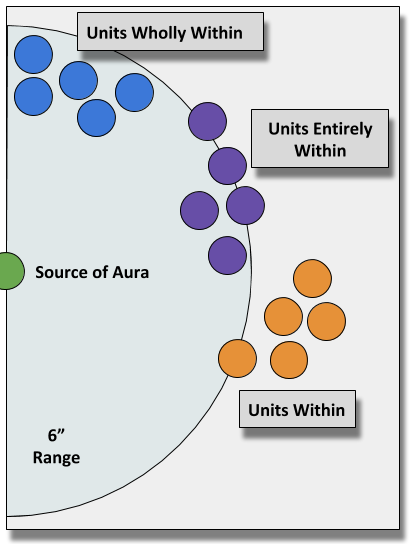
The Ork "Kustom Force Field" is a units wholly within ability.
Both the Tyranid "Alpha Warrior" and Tau "Volley Fire" abiilities are units within abilities.
Cover benefits received from Ruins is a units entirely within ability.
The keen eyed reader might have noticed some words extra in the Ruins rules though:
entirely on or within a ruin
In their infinite wisdom, Games Workshop are using a definition of word "within" that can seem counter intuitive. The easiest way to think of it that I've come across is that when you are measuring distances most people would not expect you to by default include the entirety of the two things; that is, the distance from London to New York is widely understood to mean "from where one of them ends, to where the other begins" wherever that line may be.
This runs counter to the other definition of "within": To be encompassed by or inside of. How do we know that this is definitely what GW intends with its usage? Once again we look at the FAQs:
Q: Can you clarify what the difference is between ‘wholly within’ and ‘within’ for rules purposes?
A: If a rule says it affects models that are ‘wholly within’ then it only applies if every part of the model’s base (or hull) is within.
If a rule says it affects models that are ‘within’, however, then it applies so long as any part of the model’s base (or hull) is within.
If a rule says it affects units that are ‘wholly within’ then it only applies if every part of every model’s base (or hull) in that unit is within.
If a rule says it affects units that are ‘within’, however, then it applies so long as any part of any model’s base (or hull) in that unit is within.
If a rule says it affects units if every model in that unit is ‘within’ then applies so long as any part of every model’s base (or hull) is within.
For example, units gain the benefit of cover if every model in the unit is either on or within terrain. So long as all the models in that unit are either on or partially within the terrain, they gain the benefit of cover.
Wait, where the heck did that "partially" come from??? This one word is the clearest proof of the fact that for cover in ruins, you need only overlap the area of the ruin "partially" to gain the benefit (assuming you pass the other criteria). This is why it's beneficial to have ruins on a base to clearly define the area or, if the ruins are unbased, to have a discussion with your opponent about the area counting as cover before the game begins and during movement (there's no rule against checking with your opponent to agree that you've moved to cover in case you want to change your move). Lets put all this together now using cover as an example (as it's often not thought of as an aura when, based on the rules, it seems like GW thinks it should be).
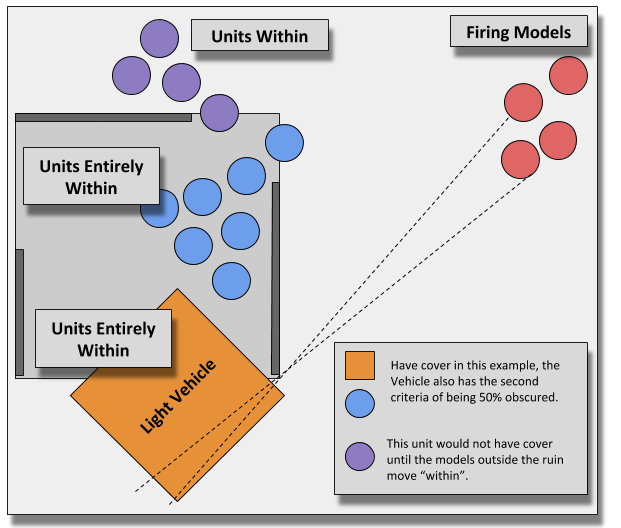
Fairly straightforward so far; remember though that with a lot of "to Hull" measuring, vehicles can be "partially within" cover by effectively just touching or overlapping part of the ruin. Getting 50% obscured is trickier and often only possible from a particular facing.
Note, however, that it is possible for a unit to gain the benefit of cover as it suffers casualties during the Shooting phase by removing those models that are not on, or within terrain. As soon as the last model that was not on or within terrain is slain, the rest of the unit immediately starts to receive the benefit of cover.
This is a direct result of the game rules being designed with attacks being "one at a time" as the default. It should be noted that cover is one of the few things that is constantly rechecked during a unit's shooting, I'll cover why range and LoS are not also affected in the same way in an upcoming article.
40k Rulebook FAQ
https://www.warhammer-community.com/wp-content/uploads/2019/09/30ead283.pdf
40k Core Rules
Chapter Approved 2019
https://www.games-workshop.com/en-GB/Chapter-Approved-2019-EN
Various Codexes
Tags: 40k | gaming | Tactics | Warhammer 40k | Ruleshammer | Vrekais

Thank you for being a friend.
 Infinity N5 First Principles: Understanding the Outcomes of Face to Face Rolls
 Tactical Feedback: Timing the Go-Turn
 A Brush With Greatness, Part 1: Introductions
Support us on Patreon to get access to our Discord and exclusive App features.
Thank you for being a friend.
Already a Patron? Login with Patreon.
Visit our incredibly official store on RedBubble.


Support us on Patreon to get access to our Discord and exclusive App features.
Thank you for being a friend.