On occasion you will meet a kindred spirit when it comes to thinking about Magic; while it is of course a game, there are people who treat it with an seriousness that invites some interesting new perspectives. I had an experience with one such individual recently, while at FNM, concerning a Commander I know is popular but whom I've never especially thought about:
Xyris, the Writhing Storm. This particular individual had built and rebuilt the Serpent ~5 or so times, and still lacked a version that delivered on the intended fantasy. Let's cover my approach. Xyris is one of 'those' Commanders, one which radically changes how we think about play in a free-for-all environment; alongside
Sergeant John Benton, the way people play when these are around is a fascinating study on what it means to be a rational actor, and why Magic lacks a permanent dominant strategy. For those unfamiliar, I'm referencing the Prisoner's Dilemma, and more broadly, Neumann's broad strokes on Game Theory as a whole. I believe we can construct a similar scenario as described in
Theory of Games and Economic Behavior to evaluate why so many Xyris decks fall short of what they actually aim to do: Incentivize your opponents to let you get in. What all of this will eventually lead us towards is the exclusion of (most) draw punishing cards in what I'd consider an ideal Xyris list, and towards the inclusion of cards like
Pyrokinesis/
Fury. How we get there though, that's the fun part.

This is part of a Goonhammer's shortform Magic series where I’m covering rapid-fire concepts about Commander that I couldn’t cover in a full Commander Focus, so if you like what you see, certainly let us know!
A Serpent's Legless Penalty Kick
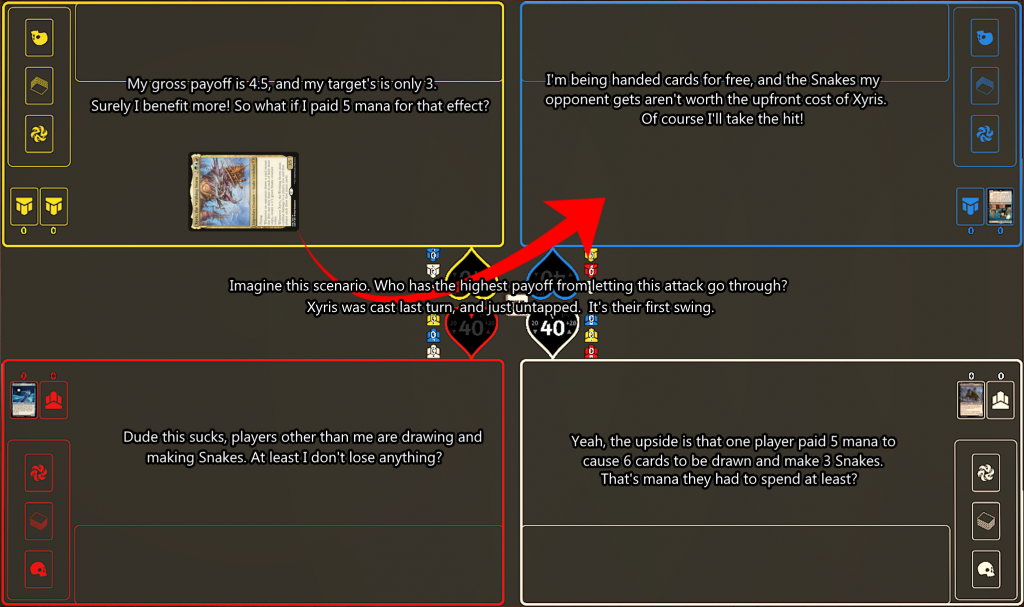 Having Flying does make Xyris implicitly harder to block, but imagine we can (or kill it) here.
What is a single card worth? How about a Treasure, or a Snake token? In order to qualify the choices made when looking at whether someone should willingly allow Xyris to connect, we have to associate values with the resultant effects—here, let's say a 1/1 is worth about ~0.5 mana, and a card is worth 1. These are our payoffs. Upon connecting with the Serpent, you see a gross payoff of ~4.5 mana, between 3 cards and 3 Snakes, while the player that took the hit sees a gross payoff of 3 mana, and the uninvolved parties see a gross loss apiece of ~7.5—two of their opponents are accruing advantage, and while nothing's happened to them, positive or negative, a benefit to two opponents is doubly a loss. Hold on though, because that number isn't quite right, as Xyris himself
costs something; a player begins this strategy set at a deficit of 5 mana. While in terms of gross exchange the controller is up 4.5 mana, their target 3, and bystanders -7.5, the net payoff (once accounting for opponents
with a direct change in mana, meaning bystanders are solely represented by the payoffs of their opponents) is respectively -3.5, +3.5, and -2.5 mana. Wait, what?
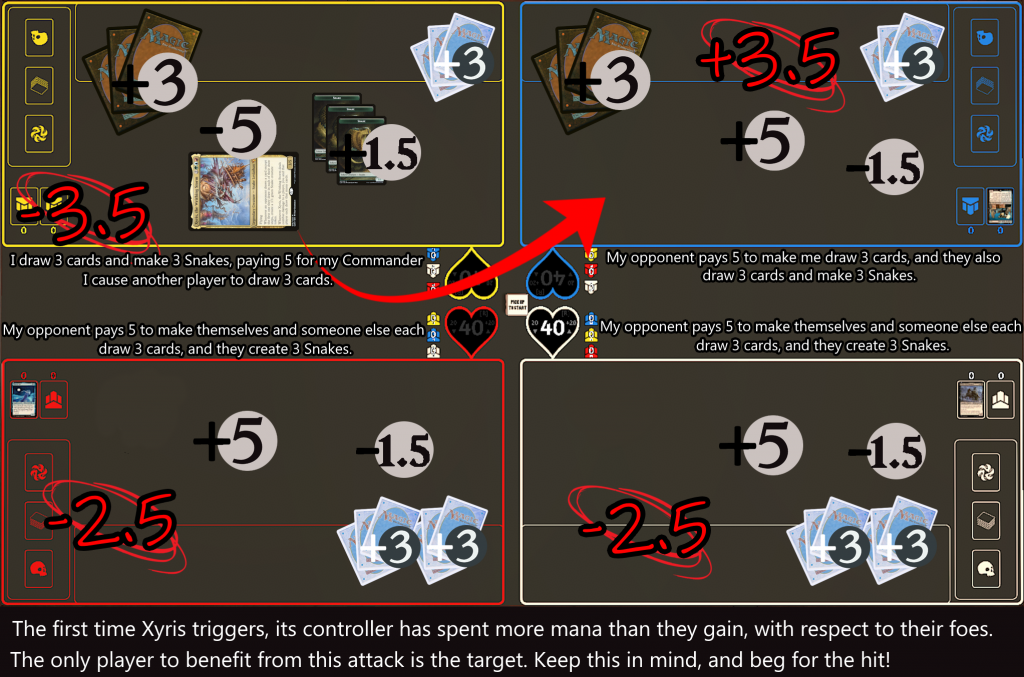 Turns out a 5 mana Commander that gives opponents cards isn't strictly upside. Or upside at all, the first time.
While the first Xyris combat damage trigger results in +4.5 mana net, between 3 cards and 3 Snakes, it costs 5 mana to start, and provides an opponent with a 3 mana payoff. The player with the lowest input receives the largest net payoff, and even bystanders are greater beneficiaries than the Xyris player for the first hit,
even though they aren't drawing any cards or making any Snakes. While this is theoretical, and therefore belies the ample context that comes with complex Commander game states, this model suggests the first rational player to be attacked by an unmodified Xyris should take the hit, all the time. But what about pump spells? There's a fairly famous video that covers a budget Xyris deck composed almost entirely of so-called 'pump' Spells, which buff Xyris to result in additional cards and Snakes. If you cast a Spell for {R} to give Xyris +3/+0, as an example (counting as ~2 mana for the mana spent *plus* it being a card itself), you'll be drawing 6 cards and making 6 Snakes, for a total of 6 mana and 1 card to pump (a cost of 7). The problem arises when you look at what your target gets, 6 cards for no cost—this takes your theoretical +2 payoff back down to -4, and after the dust settles, the target sits at a cool +4, between their 6 shiny new cards and your ~7 mana cost, reduced by your 6 cards and 6 Snakes. Poor bystanders, they're sitting at exactly double their previous loss, at -8.
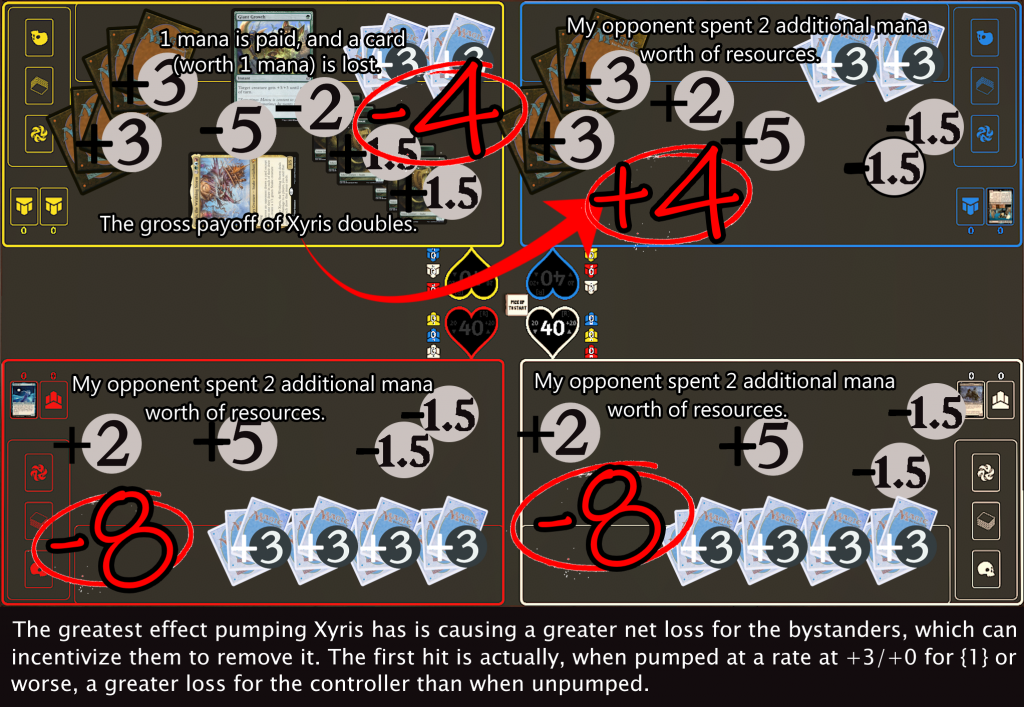 Visual noise aside, this is more an illustration of how mana is worth vastly more than power or Snakes, with Xyris.
At the going rate for pump spells like
Giant Growth, your resultant payoff for the first hit is actually
worse than a base power Xyris, as asinine as that sounds. The only pump spells at this rate or below you should even consider are those that provide an avenue to get to that juicy second trigger like Haste (at which point your payoff relative to your opponents looks
amazing), or that are
free, like
Invigorate. Increasing Xyris' power by 1 for the first swing is worth half as much as reducing the cost of your pump spell by 1, because changing that variable results in no additional payoff for the target of your attack. Shocker, free spells are great, but if you want some extra credit, calculate the necessary value placed on cards & Snakes to hit a Nash Equilibrium on combat damage. Jokes aside, while this is a
riveting thought exercise, you'll notice no actual loss in life was discussed here. Say it with me, life is a resource, and the only amount that matters is the final 1; I would sooner die to damage a thousand games than pay 1 extra mana, and I'm not kidding. As with any theoretical model though, once applied things get hairy. This vacuum of jotted-down math functionally doesn't exist in a real game of Commander, because the cards drawn by you and your target are likely of inequivalent worth to their respective parties. You've planned to play Xyris, and therefore have filled your deck with cards that benefit from the scenarios it creates—the only question is whether you believe your gameplan to be stronger than any given opponents'. If the answer is yes, your theoretical payoff is likely higher, but the number of times I've seen someone be given the game by taking some Xyris or John Benton damage and drawing into a combo is
non-zero. Xyris is not intrinsically a combo Commander, though you can flex that massed card draw in higher brackets (alongside Earthcraft and the like, to go mana-positive) to do a fairly good impression of one.
In a world without combo though, Xyris gets a good bit more nebulous, for while you can offset some of the lingering issues with net payoff by playing cards tailored to card draw & token generation, many of the ones seen in numerous Xyris lists are, to me, counterintuitive. In the case of permanents which double draws, deal damage on draw, etc, these add additional variables for the bystanders to remove your Serpent, and especially once the first hit's happened,
no rational opponent wants you to hit again if there's even a modicum of additional upside. Part of this is vibes-based, of course, but in most worlds you'll have been the only one of the pod to know Xyris' napkin math offhand. This is why I feel the best broad categories of cards to lean on, for Xyris, are those which flex your hand advantage...from the hand itself. The fewer confounding factors onboard, the less your opponents will fear known additional payoffs from Xyris' trigger. If you're doubling your Snakes or god forbid your draws, even that initial impact starts looking dire. If you can make use of the ample cards more than your target, by way of things like the
Kamigawa: Neon Dynasty Marches, or pitch spells like
Fury,
Foil, etc, your opponents lack the information to best evaluate what their payoff deficit looks like and need to make more assumptions—a scenario which benefits you. In short, don't let them figure out the math from cards onboard, take advantage of being the only player to know what your theoretical net payoff could be.
Snake Math
What does an ideal Xyris decklist look like, from my perspective, making these assumptions? Ample 1-mana dorks, followed by acceleration to 5 mana on turn 3, and rituals aplenty. The best way to get to your second trigger is to take an extra combat/turn, so we jam our deck full of those moreso than pump Spells, aside from maybe cards that represent ~2 cards apiece like
Reckless Charge &
Wild Ride. Instead of opting for effects which grant no maximum hand size, I'd instead find ways to use cards you'd otherwise discard, via effects or pitch-based interaction, and tie it neatly together with enough extra turn Spells to find one when you dig enough with the Serpent. All of my choices are made in the context of the values discussed earlier in the article, however, and your mileage may vary if you for example place a higher or lower value on Snake tokens.
The catch with this entire breakdown is that players aren't going to behave like rational actors in Commander, and being a social format, the game that's being played oftentimes isn't so much Commander as it is group politics. If someone's playing the worst deck at the table, you're far safer to give them extra cards because you likely receive a vastly higher theoretical value. Moreover, there's almost always room to make a deal to allow for the second Xyris connection, because people aren't privy to how bad the math is for them following an initially mediocre net value. After all, people love drawing cards, and are selfish actors more than rational ones (in your average pod). Moreover, if ever you reach a critical payoff on your second or later swing, instead of steering right into the woodchipper of your dominant strategy, opponents can just...kill Xyris. Magic is among the most complex games on the planet, and Commander is perhaps the most complex format within it. It's part of why Game Theory requires assumptions to operate, and exists mostly to illustrate best practices in a vacuum. I talk about Xyris today not just to cover a wildly interesting Commander, but to spur people to imagine their games as a series of value exchanges—that kind of clinical thinking won't necessarily improve your skills overnight, but will help you make fewer
wrong decisions game-to-game. When I mentioned bystanders to massive value swings, don't forget that you often take on that role, and it can benefit you immensely to disrupt players who aren't directly harming you. It's not personal to end the festivities if you aren't being included, value-wise! Their gain, after all, is your loss.
With my Pepe Silvia-esque ramble now concluded, what mechanic or Commander should I cover next on The Puzzlebox? This is a series built on rapid prototyping underutilized mechanics for Commander, and while I have a few ideas racing around my head, I'd love to hear more ideas from my readers!
Have any questions or feedback? Drop us a note in the comments below or email us at contact@goonhammer.com. Want articles like this linked in your inbox every Monday morning? Sign up for our newsletter. And don't forget that you can support us on Patreon for backer rewards like early video content, Administratum access, an ad-free experience on our website, and subscriber-only content covering competitive Warhammer 40K!Thank you for being a friend.
 This website uses cookies. Learn more.

 Goonhammer App and Patron Updates: April, 2026
 Contemptor Kevin's Combat Patrol Issue 46 Review
 Kill Team Tournament Report: Engage, Party, Repeat's March Madness 2026