The Puzzlebox is back, and the mechanic we're cracking open today isn't a mechanical one, but instead surrounds the approach to what happens
before a game of Commander. Despite taking only a couple minutes, often less, the brief conversation that ends with everyone's selection of Commander can be the difference between a game you'll excitedly recount...or begrudgingly relive. Though it's a common term attached to Commander, 'Social Format' doesn't even do justice to the importance of expectations, and the number of columns elsewhere on the internet diagnosing human-to-human problems in Magic's largest format should make that clear. You can't control how people behave, or react to your particular set of strategies, but you can account for potential scenarios and aim to avoid awkward situations. This is largely about 'blind' groups, such as at cons or your local LGS, though they can certainly be applied to your more tightly-knit group of players if you're looking to improve an internal meta! With that being said, I'd like to suggest three considerations when you sit down to a Commander pod: Attitude, Assumptions, and crucially, Adjustments.
This is part of a Goonhammer's shortform Magic series where I’m covering rapid-fire concepts about Commander that I couldn’t cover in a full Commander Focus, so if you like what you see, certainly let us know!
Adjustments
You can't control how other folks react to the decks you bring,
but there's a sweet spot to bringing Commanders that don't induce negative reactions, either before or during a game. During a pregame conversation, players will either be proactive or reactive actors in choosing their decks; often, the player with the fewest decks will be the most proactive, as their ability to adjust to their opponents is smallest. It's absolutely okay to arrive to a Commander night with a shiny new deck, and want to play with it, but
broadly your goal is to be a reactive party, and have enough of a deck selection to tailor your choice to the expectations provided by the other players. In short, let the player with the least choice (or greatest bias towards one deck) choose first, and fall in line accordingly.
While it's anecdotal, last year I purchased Uaono's 6-Deck (not sponsored), which has enough space for, surprise, 6 decks. I've brought this with me to cons, and every single FNM since then, and it's served me well not only in terms of protection, but selection. Having only six slots meant I had to travel not with a massive case of options, but a fairly-trim assortment of only my favorite or most relevant decks. What do I mean by 'relevant', though? I don't think just having decks for the most-played brackets (2-4) is enough, because while it's certainly better than the old system—or lack thereof—brackets hardly tell the whole story. This is why I recommend making a mental flowchart of sorts for your selected number of decks, asking questions that aren't just vibes-based. Let's see how that looks in practice.
Two Roads Diverged in a WUBRG Path
I've made little placards for the 6 decks in my core rotation at the moment, to briefly show what a normal line-up might look like. That being said, one of these decks is leaving the main 6 in place of another, so follow my logic as to how I made that choice.
Loading...
Across these 6 decks, there's three in Bracket 2, two in B3, and one in B4—that fits the rough breakdown of my local meta, though your mileage may vary, and you should tailor this to be a rough bell curve of your particular array of play experiences. Critically, there exists a 'Sixth Bracket' in my own experience, the Game Changer-less B2, for which I have Yue specifically designated as top of the B2 power curve. A ton of folks place their decks in that area, from what I've felt, so keep it in mind. A spread in overall power both between and within individual Brackets helps guide me towards my choice, but what's getting me to choose between Seymour & Gorex for a normal B2 game? It's combo-capability. I'm traditionally very much a combo player, so what differentiates these is that Seymour lacks them entirely, while Gorex sometimes wins games via
Eternal Scourge lines. Further up B2, you have Yue, who fundamentally lacks a "fair" wincon outside of a combo, so whether the people I'm with are cool with it or not, I can tailor my deck to their expected play experience. That said, B2-B4 all allow combos to some extent, so unless your playgroup's sworn off of them entirely don't be discouraged from some fun jank wincons.
I mentioned, though, that one of these decks is being switched up, and it's actually
Monk Gyatso; both he and
Harold & Bob, First Numens are combo strategies, but the main difference for me is that Gyatso is
also a Typal deck, here Eldrazi. I don't gel as much with Typal as I'd hoped, and want the ability to play a B3 deck in groups that might be a bit combo-shy, so while I'm keeping H&B as a beloved combo-heavy B3 list,
Edea, Possessed Sorceress is taking the airbender's spot by the end of the month. The way I've built Edea is much like Gorex, where your wins will usually be via actual damage, but sometimes a combo; once you get to B3, not having some sort of combo-adjacent endgoal can mean decks flame out, but Edea's usually just beating folks via combat. Your personal points of division might not be combo versus non-combo, it could be based on fast mana or not, perhaps even how easy it is to interact-with. Your goal, though, is to have a simple 2-solution question to ask, which can help your opponents point you towards the right deck for a given game. Having more than ~6-8 decks with you at a given time actually hurts this process, given you need additional clarifying questions, and we ideally want them to be as objective as possible. 'Does the deck have combos?' isn't vibes-based, it's true or false, and means no inference is necessary on your opponents' part. Give yourself room to adjust your deck choice for a game in ways that remove your biases as best you can, and adjust even prior to that by making meaningful choices in what Commanders to bring.
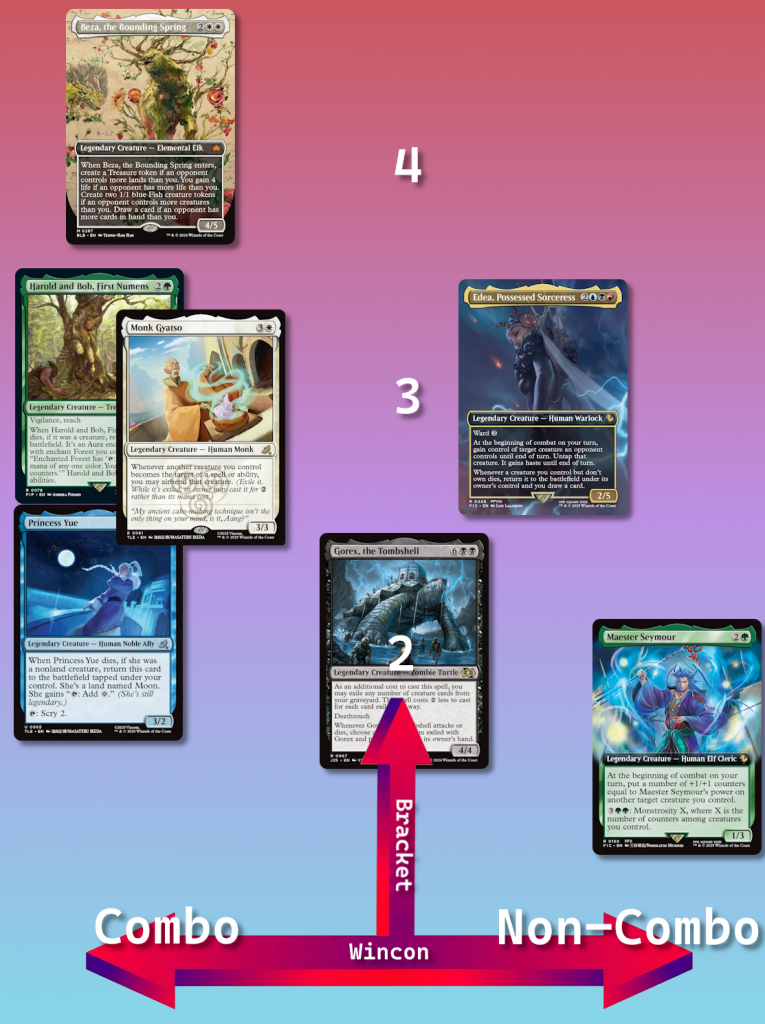
While a bit of extra work, actually pinning down where your decks fall along the pertinent axes is a great way of checking for...
redundancy. I arrived at that conclusion when I realized both Gyatso & Harold and Bob did similar build-up-then-combo gameplans, and I
far preferred the play pattern of H&B. From there, it was just a matter of filling an empty niche, just like a novel ecosystem, to provide the widest coverage for possible answers from your opponents. If any of the decks mentioned here interest you, they've each been covered before right here on Goonhammer! You can find links to those Focus articles at the end of this one.
Assumptions
There's a wager made by playing a Commander that people can have preconceptions about, your Ur-Dragons, your Yurikos, that further complicates your ability to adjust. Even if you tell someone who's had a bad experience with a powerful, well-known Commander that you're 'not X version of that deck', they're...not likely to fully believe you. Even if you're playing Urza vehicles, people will (often rightly) treat you as though you're playing Urza Power Scepter, and focus on stymieing your game plan. Therefore, if you're going to be treated as a scary version of a given Commander, why not play said version to match those assumptions? This is what I'd outline as 'Yuriko's Wager', that unspoken rule which guides powerful, known Commanders to wage an arms race against their own reputation. (
FTS note: Old heads will know this as the Rafiq Problem, after Rafiq of the Many. Yes that used to be a boogeyman.) I want to stress, there's absolutely nothing wrong with playing a Commander that's popular or independently strong: They're played a ton for a reason! These cards are often fun, flashy, and fairly straightforward to build (especially for new players), and the popularity of sites like EDHREC causes a cascading chain of popularity. Things will trend there, and more people will see them, causing a positive feedback loop.
There are a few ways to mitigate the foibles that come with playing a Commander like that, namely to simply shift them up in terms of power, with respect to your other decks. The higher power a pod is, the less side-eye you'll receive for playing a known threat, and it gives you the freedom to not find yourself tripped up by 'Yuriko's Wager', as I'd coin it. This means that, in Brackets like low B3 and below, it behooves you to play more obscure Commanders. Not only does this allow these jankier, more niche picks to find amazing homes, but I think we as a community should place value in bringing new experiences to the table for our opponents. If you can ensure every game in a blind pod has someone who's not yet played against your Commander, that's a win! This also means you're far more likely not to meet with the assumptions of a popular Commander, meaning people won't be wary of what you're bringing, before they see any of the 99. To summarize, err towards more obscure, fun Commanders at low brackets, and release your masterwork Korvold or Chulane list to those looking to play at higher power.
Attitude
Something I've learned by working in product development for a number of years is that more important than the content of a question is
why that question is being asked. If someone's asking whether you play free counterspells or not, is it because they're angle shooting to see if they can play a greedier combo deck, or that they want to select a deck that matches your ability to react while tapped out? You can (and should) ask for the context of questions like that, but it's also something that's worth getting silently skilled at. Read some body language, see if they're choosing between a couple options, and make a best guess about that 'why'. Commander is a social format, so your attitude, that outlook and ideally cheerful disposition, can smooth over a
ton of potential feelsbads. Even if you don't succeed at managing to adjust your chosen deck appropriately, or account for your opponents' potentially negative perceptions of a particular deck, being empathetic and able to navigate those situations with emotional maturity is paramount. It's just a game, and we came to play Magic—if someone in good faith needs to grab a basic instead of drawing, while 2 Land drops behind, I'll push for that 99% of the time. The more Magic we get to play, win or lose, is all for the better, and if it's a 4-player pod, I don't necessarily want one person left out of the chaotic fun. Be inclusive, be understanding.
I know this sounds like a lot for what amounts to ~90 seconds of your time before a game, but I do sincerely think the best stories come from pods that adequately manage their pregames. It's like Session 0 for Dungeons & Dragons, or playing by intent in Warhammer—good ground rules to set expectations, and acknowledge everyone there is in the business of having fun.
You can find articles covering all the Commanders mentioned in this article below:
With that being said, what mechanic or Commander should I cover next on The Puzzlebox? This is a series built on rapid prototyping underutilized mechanics for Commander, and while I have a few ideas racing around my head, I'd love to hear more ideas from my readers!
Have any questions or feedback? Drop us a note in the comments below or email us at contact@goonhammer.com. Want articles like this linked in your inbox every Monday morning? Sign up for our newsletter. And don't forget that you can support us on Patreon for backer rewards like early video content, Administratum access, an ad-free experience on our website, and subscriber-only content covering competitive Warhammer 40K!Thank you for being a friend.
 This website uses cookies. Learn more.

 Goonhammer App and Patron Updates: April, 2026
 Contemptor Kevin's Combat Patrol Issue 46 Review
 Kill Team Tournament Report: Engage, Party, Repeat's March Madness 2026