While you can make every archetype in Commander work, not every theme is destined for greatness. As a rough recipe, combine Wizards-mandated modern support with a coherent gameplan that doesn't ask for too much in return for a reasonable payoff, and ideally, top with fun-to-play cards that slot together with ease. For themes like Land Sacrifice or Charge Counters, we've seen a modern renaissance in
Edge of Eternities, and come Avatar there's been new life breathed into Clues (see my previous Nyla focus for details). Yet Avatar has one more bounty to give, for a theme so obscure most people forget it
is a theme: Quests (and Quest Counters). Debuting all the way back in the original
Zendikar, this style of permanent functionally went dormant all the way until
Fallout, a full 15 years after its inception. Highlighting the themes of fetch quests and repeated drudgery (sorry, Fallout 3 fans), this was a
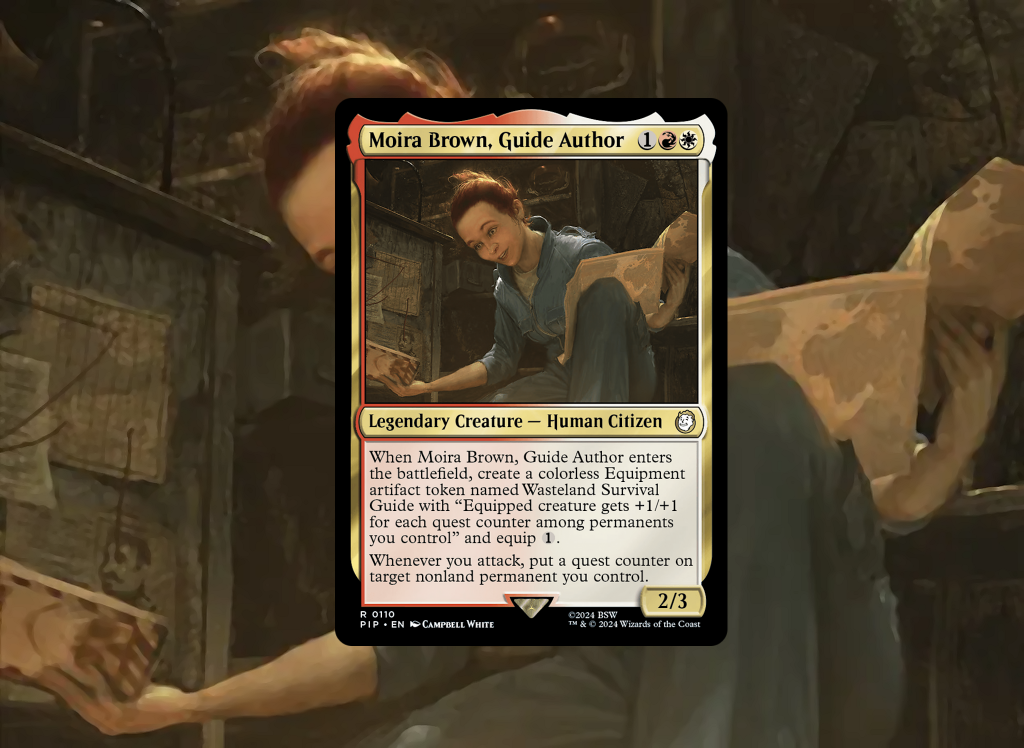
perfect flavor fit for the set, and provided us with today's Commander,
Moira Brown, Guide Author. However, only with two new excellent Ascensions courtesy of Avatar are we finally ready to make lemonade from this lemon of a theme. Let's take some notes.
 Credit: Wizards of the Coast
"Put a Quest Counter on Target Nonland Permanent You Control"
There are a total of 16 cards that use Quest Counters in Boros, and we're on a reasonable 14 of them, cutting
Pyromancer's Ascension &
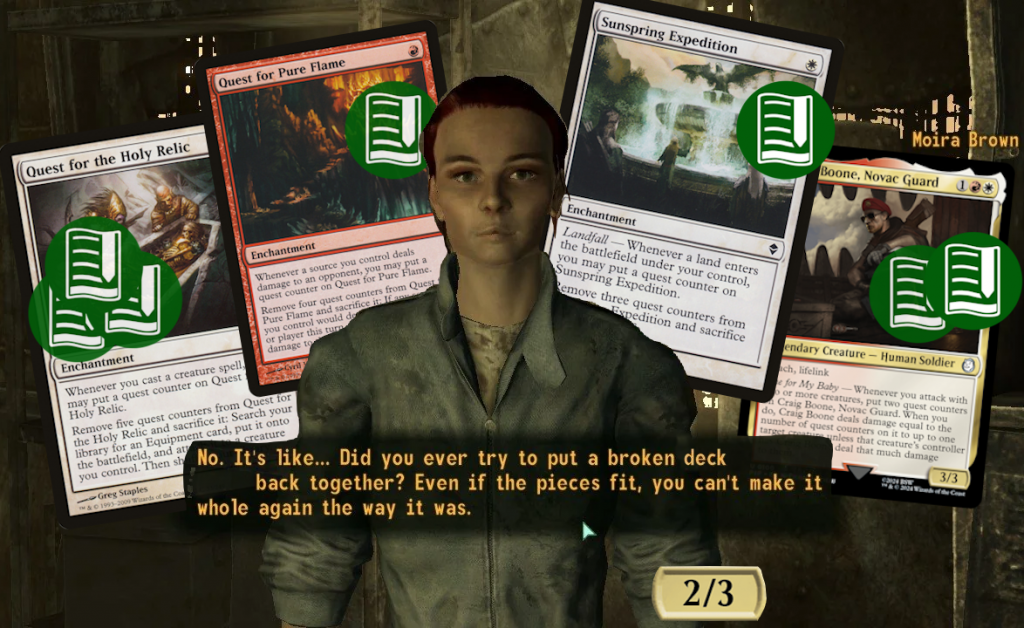
Quest for the Goblin Lord due to total lack of synergy. Of the Quests we are playing, three care about playing Creatures, two about lands, and a whopping seven care about combat—suffice to say, this will be an aggressive list. Let's start by talking about the Quests that pushed me over the edge to actually cover Moira,
Firebender Ascension &
Airbender Ascension. Each of these has a solid enough Enters effect that fuels their Quest Counter trigger: The Firebending token has an attack trigger, and if you Airbend your own Creature that's one entering. These cards feel natural to play, and have very little design friction; beyond that, they love sitting on the board, accruing counters, and pushing the power of Moira's Equipment up. Speaking of which, while Moira's payoff requires playing some...suboptimal cards, her Wasteland Survival Guide tokens quickly get out of hand and become jawdroppingly potent Equipment. By turn ~5, these can be providing +5/+5 or more, and only get scarier as the game goes on.
 The quest has how many objectives?
One more step back in time to 2024, and we have the numerous Creatures with associated Quests from
Fallout. These Commander decks doubled the number of legal Quest Counter-matters cards in Boros, but there's a reason you probably haven't heard of any of them until now save
Yes Man, Personal Securitron. While all of these are Legendary, they each have problems of requiring buildup from an inefficient starting point, and don't really begin feeling good until the mid-to-lategame, often well into the point where board wipes become a concern. That being said, the scaling enabled by cards like
Duchess, Wayward Tavernkeep &
Sierra, Nuka's Biggest Fan in the context of our Guide tokens is profound, and we can turn the corner faster than opponents might expect if they run out of chump blockers. Even if we don't, there is the king of pillowfort payoffs to contend with from the original suite of Quests:
Luminarch Ascension. Once this gets online, not only does it present accessible Flying attackers at Instant-speed, slapping a Guide on one of them can mean a clock that probably threatens lethal in 2-3 combats. Every time we're getting in, we ideally stack up power on our board to make getting in easier next time, increasing pressure and potentially threatening to pop a
Quest for Pure Flame after blockers. Doing Boros
stuff, in swarming, attacking, and making just enough land drops, should push our gameplan forward. Emphasis on 'should'.
Kessel Wolf Run
You'll notice from this discussion on quests that these don't really have explicit synergy beyond mentioning the term 'Quest Counter', and indeed that is part of why this theme is such a tough nut to crack. I like to term Commanders like Moira as 'design retcons', referring to the approach of tying together previously unconnected cards with a messy bow. Now, this isn't always a bad thing—Commanders like
Marvo, Deep Operative, responsible for 90%+ of the play of many Lorwyn-era Clash-matters cards—can be extremely successful in what they do. The issue arises primarily when either this retcon isn't supplemented with enough new tools (or a Commander that does the hard work for you) and therefore exists in a limbo of now waiting for
even more of the relevant keyword to be printed, potentially years down the line. The problem with these retcons from a deckbuilding perspective, in suddenly requiring people to evaluate old cards in new ways, is that those cards
being old and independent of one another prior to the new design creates gameplay that rarely feels 'intentional'.
Case in point, two of our Quests,
Quest for the Holy Relic &
Zektar Shrine Expedition, will in most games do nothing but sit on the board and accrue counters. Their utility comes from being powerful payoffs in other archetypes, but here, their mere existence as two in a tiny pool of batteries for Moira's ability justifies their play. That feels...weird, right? I understand of course Wizards' insistence that every mechanic eventually have a Commander for their diehard fans, but for the vast majority of players this presents a frustrating puzzle to both build
and play. As someone who loves a design challenge, this doesn't scare me off, but before we dive into what the rest of the list is doing I felt it was important to touch on Moira's position as one of these new breed of 'we printed a phrase once, how do we make that phrase an archetype' Commanders. Your mileage may vary with her contemporaries, but I think I've landed on something pretty neat for Moira herself!
Brown, Maiden Name Gutenberg
If you haven't been scared off by the previous section, let me highlight one bit of Moira's textbox: That Survival Guide isn't Legendary. Yes, while it might be penned by a Legend, the book itself is decidedly mass-producible, and we intend to flood the market. The simplest way to get this done is by flickering Moira herself, given she creates it as an Enters trigger; mainstays like
Ephemerate &
Phelia, Exuberant Shepherd are clear winners here, and we can see her recast from an
Avatar's Wrath via Airbend. Once we actually have a Guide, however, we can simply copy it instead of repeating Moira (which helps, given she has a tendency to die).
Three Blind Mice can give us two additional print runs, on top of a defensive pump near the end, and
Dutiful Replicator, while inefficient, can himself be flickered in the case Moira is gone.
Caretaker's Talent is also noteworthy, not just as a draw engine, but a mechanism to copy Guides, especially if we flicker it to reset the Class' Level 2 ability. The apex of our options, however, is a card I've wanted to find a good home for since its reveal:
Oltec Matterweaver. Talk about a perfect home, spitting out a new Guide for every Creature we cast.
 Enough with the reruns, already.
You can see clearly that we'll have more Survival Guides than your prepper uncle, but given they still have to be attached to our Creatures to matter, won't it end up as a huge mana sink? Fret not, because there's a number of ways to reduce that Equip cost to 0. Foremost among them is
Puresteel Paladin, which also serves as a compelling draw engine, but the ease of passing around Guides is actually more what we're here for.
Bladehold War-Whip not only serves as a 2/2 with Double Strike, but also makes Guides free to Equip (no minimum cost there) meaning we can suit its Rebel token up on the offensive, then pass Guides back to untapped Creatures as blockers.
Fighter Class not only finds other Equipment (How about a
Masterwork of Ingenuity to copy a Guide?) but also almost always reduces their Equip costs to 0, with the only Equipment in the deck boasting one too high to negate being
Blade of Selves, here to provide additional Enters triggers from Moira and Recruiters.
Counterplay and Counter Play
As discussed, while it's not difficult to get 1-2 Quest Counters on relevant permanents each turn, what's more important is increasing the rate at which they scale. In order to play aggro in Commander, there's a whopping 120 life to deal with (not counting Commander Damage), and that means these numbers have to be exponential in order to threaten combo strategies. Making multiple Guides is a good start, but let's talk about speeding up our Quest pace, and slowing down opponents. The primary means of doing so is via Proliferation; not only can Moira spread counters to any nonland permanent, giving us an extra target with each Proliferate trigger, but there's more than just Quests which benefit from a few extra counters. Whether we're putting an extra counter or two on a
Lion Sash or
Phelia, Exuberant Shepherd, or cracking a Saga early, there's just enough synergy to warrant some solid Proliferation. Especially in the case of cards that do it at Instant-speed, like
Staff of Compleation, we can even treat these triggers like combat tricks, making blocking all the more difficult. Furthermore, Wizards has been getting cute with how Proliferate is provided, with the flavor homerun of
Patrolling Peacemaker. While it's never guaranteed opponents will commit crimes every turn, when scuffles happen on the board it's never a bad thing to reap the benefits.
Contractual Safeguard lacks the word Proliferate, but it does spread Moira's counters to every Creature we have, making real Proliferates later on devastating.
 Think twice before you target something, yeah?
You'll quickly notice however that this list also has another key Proliferate target:
Tangle Wire. Yes, in order to make Boros Quest Aggro function, we're on stax (and plenty of it). While being Bracket 3 prevents us from playing the nastiest options like
Winter Orb, there's still a glut of good options which don't throttle mana. Next up, as my pick for 'card more people should be on, period' is
Vexing Bauble—at worst, it's 2 mana to draw 1, and at best it gives you insurance against interaction you didn't plan for, and fast mana if you're ahead in the turn order. For players who complain about free spells in Commander, this is your savior...as well as its grandfather,
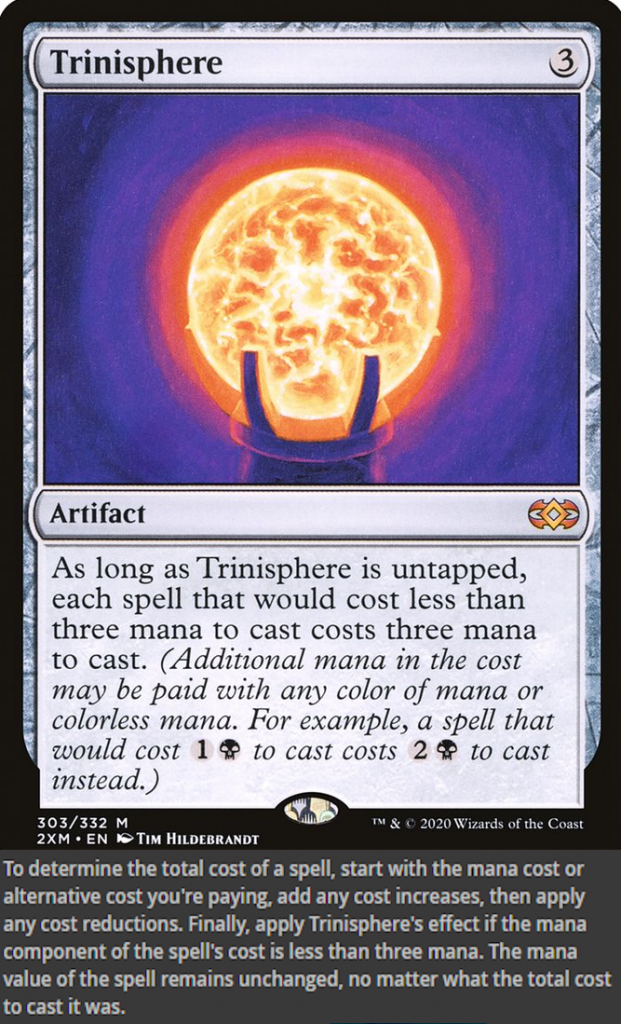
Trinisphere. A ton of our Quests come down before we'd slam a Trini, and afterwards our Creatures tend to average ~3 mana anyway. The downside to Trinisphere has always been that you need to play these expensive, tedious cards without cost reduction, and by virtue of what Moira benefits that's already been decided for us. Finally,
Cursed Totem dunks on mana dorks and hits few of our cards, meaning it's an easy inclusion. Playing with stax or hate in a list requires careful consideration of how it affects us versus the average opponent;
you are choosing to include these pieces, which means you know that the rest of your cards need to be planned around them. This allows you to affect opponents more than yourself, which we call 'breaking parity', a vital aspect of any list on cards like Trini or Totem.
 A brief reminder on how Trinisphere works.
Winning for Dummies
We've covered the engine for Moira, in Quests, and how to best make use of her payoff, stacking Guides & Counters, but what is the actual win condition? The boring answer would of course be 'combat damage', and in testing that definitely came through a couple of games. That being said, given investment into Trample is pretty high for B3, I wanted to lean on the most basic facet of this finicky Quest archetype: Moira provides
Power. At her core, once we wash away the varnish, this is a deck about making ludicrously big Creatures, and there are certainly paths to victory afforded by that truth. First and foremost, there are a ton of Creatures that directly translate power into a 'soft combo' which kills the table,
Giggling Skitterspike,
Gau, Feral Youth, &
Heartfire Hero. If we can meet their conditions, these end the game with enough power. For Heartfire Hero, we have a scant few sac outlets like
Lazotep Quarry, which funny enough also turns on Gau. Gau meanwhile has a number of cards with Flashback as well as Lion Sash, but even just recursion is enough to make his ability live.
Then, there's more generic options, chief among them being
Chandra's Ignition. Give a Creature a few Guides, target them, win the game. Less straightforward is
Gleeful Arsonist, which can put opponents in a headlock scenario that fully denies them access to non-Creature spells; at worst, it still provides pressure and survives a board wipe, and even benefits from Proliferate once its Undying triggers. Speaking of power-matters though,
Zenith Festival is an absolute godsend here, allowing us to translate power into advantage, digging for combo pieces and even triggering Gau. While it's been forgotten rather quickly following
Tarkir: Dragonstorm, it's always worth keeping the card in mind if your goal is big Creatures—we can simply suit up another untapped Creature post-combat to trigger it, not even losing out on damage. On that note, there is actually a traditional combo in this list, by way of
Crackdown Construct. This draft Uncommon from
Aether Revolt, when combined with an Equipment with Equip {0} and Equip cost reducer, gets infinitely large. Couple that with our power-matters pieces and you've got a win, although (hilariously) I've just smacked people with it as the capstone to an aggressive gameplan too. If you're combo-shy, I assure you the deck isn't too scary in that regard.
Example Decklist: Declassified Pod Survival Guide
I want to use this section to answer a question I've gotten from a few readers in the past: How do you decide, given proxies, whether a deck needs fetches or not? The short answer is that yes, these cards thin the deck by a miniscule amount, but the more realistic answer comes down to external synergies. Are there Landfall triggers? Do you care about Lands in the yard, via things like Delirium? Decks that are 2 or fewer colors absolutely don't need fetches to have ideal mana every turn, so unless you're pulling upon the secondary benefit of seeing more Lands hit your board and graveyard, it's okay to go without. If a deck doesn't need fetches, especially if it's Monocolor, you can spend some of your available 'opportunity cost' of less stringent mana requirements on tons of utility Lands (a deckbuilding strategy I'm very fond of). Here however, our manabase has to have fetches, even some available Artifact Lands, because these Quests require every ounce of our attention. For the few utility Land slots we have,
Diamond City &
Karn's Bastion are standouts, giving us the flexibility to spread counters around if there's nothing better to do with our mana.
Decklists are kept updated, and may change with set releases.
If you were trying to push this to Bracket 3, the first thing I'd do is add
Stoneforge Mystic &
Cloud, Midgar Mercenary. It's very difficult to raise the ceiling on a strategy like this, which is so dependent on questionable must-plays, but doing your best to coast on 1-2 Quests + Moira would likely be the way I'd approach it. That's less fun, and means you center less on the Quests themselves (thereby beginning to miss the point), but it certainly is doable. Stax pieces get better as you ascend the brackets, and as a quiet benefit, your hate pieces do very little to hamper honest B2 players, but are crippling to people with 'technical 2s', so enjoy that.
Jankbender Ascension
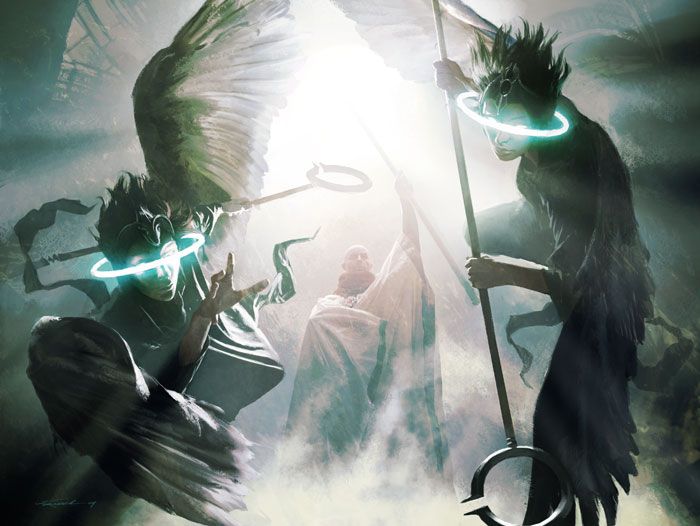 Michael Komarck lends a personal smallness to Zendikar's Angels, their charge being the figure in light.
Full disclosure: I've had Moira as a Commander in the back of my head for a while. When I did my sweep of
Fallout prior to
covering one of my all-time favorite Commanders,
Harold and Bob, First Numens, her unique grouping of the scattered Quest archetype also caught my eye. Despite this, the density requirements for Quest payoffs was just too low, requiring we play some truly awful cards, and I hesitated. While it may seem a small thing, getting two genuinely capable Quests in Avatar means a lot to a niche Commander like Moira, and even if Wizards hadn't planned for Quests on the whole to share connective tissue the fact more have arrived over time is a welcome thing indeed. You'll certainly see the bending Ascensions in your games, but here they're even more important; Commanders that make already good cards
even better feel amazing to play, and let those quality pieces really shine.
It's why I don't especially mind Wizards retconning these weird cards together in the modern design of Magic. In fact, that's perhaps the best shift in priorities to arrive with the format's dominance on the designers' conscious; everyone has their own terrible pet cards from back in the day, and Commander began as a Judge's format to show knowledge of the card pool and play the most unplayable bombs. While Commander might have some issues in being under the custody of Wizards as opposed to an independent panel, or in no longer being an independent format, the fact it's a core consideration when creating new sets has plenty of benefits as well. For every powercrept value-generating Legendary Creature that arrives in a precon, there will be dozens of outlandishly niche design retcons lurking in the wings, waiting for a time in spotlight.
Until next time, try not to die.
Have any questions or feedback? Drop us a note in the comments below or email us at contact@goonhammer.com. Want articles like this linked in your inbox every Monday morning? Sign up for our newsletter. And don't forget that you can support us on Patreon for backer rewards like early video content, Administratum access, an ad-free experience on our website and more.Thank you for being a friend.
 This website uses cookies. Learn more.

 Goonhammer Hobby Round-Up: March 2026
 Goonhammer Reviews: Tribal Conquest
 Conquest: Weaver Courts Gemred Knights and Scaile Dancers Model Review