Rare is it that Wizards will release a card intended for Commander that's not better than some obscure option from years prior. Power creep, a term we're all likely familiar with, is inevitable in a non-rotating format; with Commander being a huge chunk of all games of Magic currently played, that means the game designers reckon with this fact more and more often. I'm no stranger to power creep, having grown up with Yugioh, but what I feel may be more pernicious is 'ease creep', where the innate power of cards rises as the hoops one needs to jump through reduce in their difficulty. Folks, I
love jumping through hoops. The reveal of
April O'Neil, Hacktivist reminded me of a card I'd kept in the back of my mind for years now,
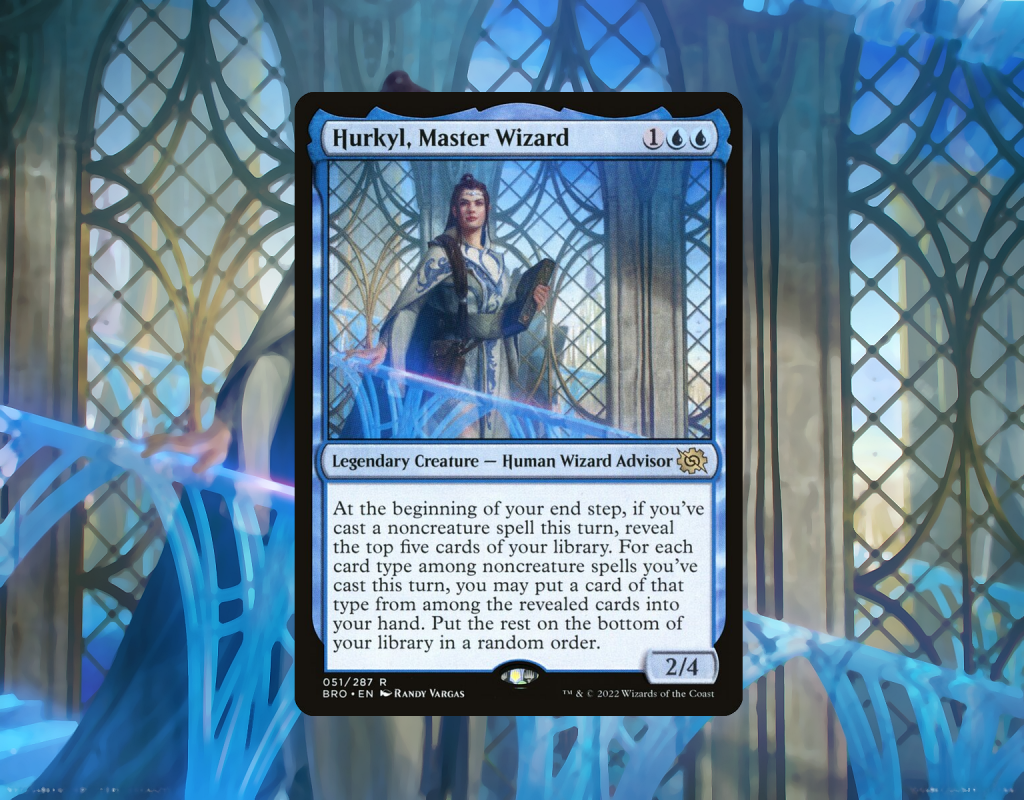
Hurkyl, Master Wizard, and in comparing them I feel we can have that discussion on ease creep, and why doing things the hard way can be both more fun & rewarding. I want to stress, I'm a fan of both designs, and they speak to a weird archetype in Monoblue that's rarely been touched-upon, but with the release of more Kindred cards imminent in
Lorwyn Eclipsed, and April in TMNT, I wanted to get ahead and cover Hurkyl before her archetype changes forevermore.
 Credit: Wizards of the Coast
"For Each Card Type Among Noncreature Spells"
Hurkyl's textbox is utterly filled with words vaguely gesturing to card advantage, but how it exactly works is important to cover before anything else. It's best to think of it as a system of inputs & outputs: If you've cast at least 1 noncreature spell, reveal the top 5 cards of your library, then for each type you can 'plug in' a card of the corresponding type from among those cards. Due to how types work while on the stack versus in a library, this means casting a
Lotus Petal does mean you could add an Artifact Creature to your hand, but not vice-versa. If you've cast an Instant or Sorcery, you could add
Commit//Memory, but if you only cast Commit, you're
committed to adding an Instant. If a card has two or more types, you can choose to 'plug it in' to either of them, meaning the more types present in the river, to use a poker term, the better odds you have of extracting maximum value.
This stands in contrast to April in a number of ways, even though there's certainly similarities. April of course counts herself (and Creature spells in general), and there's no need to 'plug' one type to itself, as she produces raw card advantage. Hurkyl does still have upside, if properly built towards, but the main difference it that she provides filtering instead of actual card draw. If you're 2 or fewer cards to your hand with either of them, Hurkyl gives you better selection, but as soon as that number hits 3, the math favors April. For this reason, we've hitched our cart to Instants & Artifacts, aiming to at minimum cast one of each on our turn, and with 20 apiece in our list it's virtually guaranteed we hit at least 1 card off of our Commander. Still, whether you're building around April or Hurkyl though, the other is likely a mainstay in the deck, and both benefit immensely from the least-used card type outside of Battles: Kindred (formerly Tribal).
Kindred Spirits
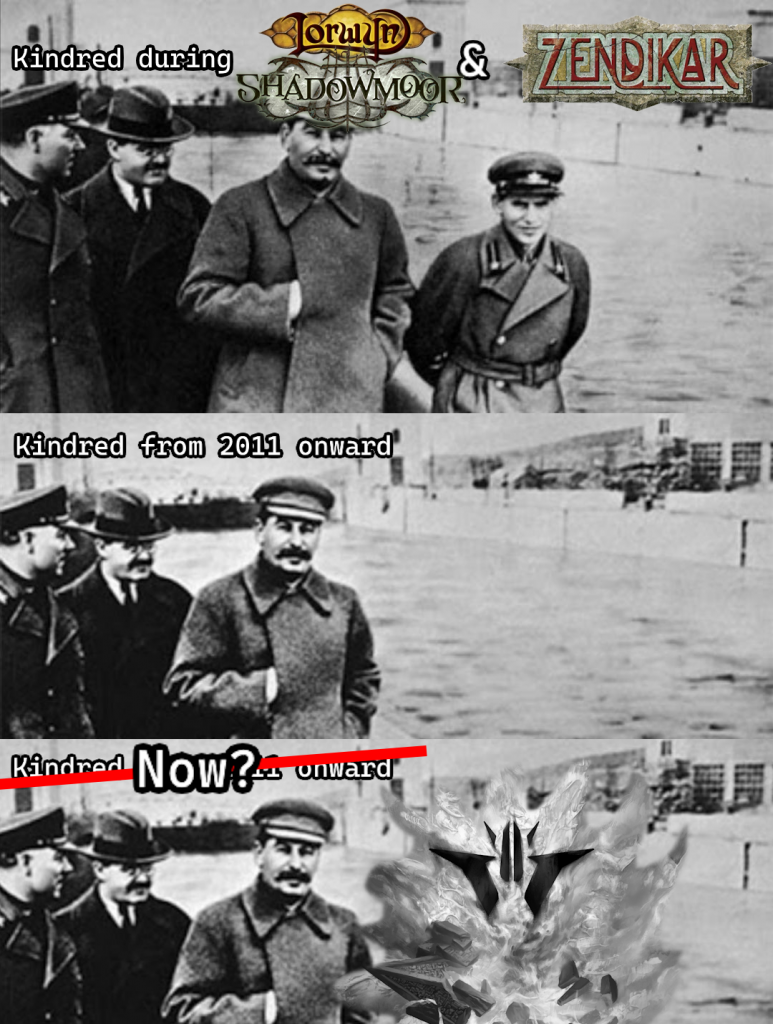 A card type famous for auto-defenestration.
Kindred was, for the most part, retired only 2 blocks into its lifespan. We learned during the design documentation for
Innistrad that there had been an internal decision to sunset the mechanic, but even in just
Lorwyn/Shadowmoor &
Zendikar, it left a lasting mark. We've seen it pop up in recent times, now rebranded with sporadic use when pertinent, and I suspect it will arrive once more in our return to its plane of inception, Lorwyn. Background aside, why is it any good here? Kindred is a mechanical glue, appearing on non-creature spells in addition to other types, but still tracked independently with Hurkyl. We can cast something like
Cloak and Dagger, and dig through our top 5 to add up to 2 cards, one Artifact, and one Kindred. What this provides Hurkyl is therefore obvious, allowing us to extract even more value from each trigger.
The Kindred cards themselves, coming largely from the era of the 2008 recession, don't all hold up well when viewed under the lens of today's power creep. Are we really playing
Wings of Velis Vale as a combat trick?
Aquitect's Will outside of
Eluge, the Shoreless Sea? The truth is that without cards like these, Hurkyl has an issue of boxing you in to just the card types you're casting; there are Kindred Artifacts just as there are Kindred Instants, giving you opportunity next turn to pivot what card types you'll be adding. Better still, since
Modern Horizons 3, there's been a few Kindred cards with inarguable card quality, with pieces such as
Kozilek's Command &
Eldritch Immunity being some we'd consider playing anyway. Not unlike
my coverage of Danny Pink, here we see a Monoblue Commander functionally use Colorless as a second color, though for an entirely different reason.
Magic: The Smattering
The thing that ties together both April & Hurkyl is in caring about card types, something we don't see with too much regularity in Blue. Yes, it's been a component of the color in sets with Delirium, or found in one-off splashy pieces like
Aminatou's Augury, but as a build-around its importance is resigned to these two Commander choices. With that in mind, there are cards which reinforce this identity from throughout Magic's history. In a similar vein to Aminatou's Augury,
Portent of Calamity asks you to bet how many cards you'll need to see 4 types among them, and if that risk pays off you get to win big. Once you start hitting X≥5, there's a good chance of freecasting
something, and we have some stellar targets. Also in the vein of caring about card types is one such target,
Emrakul, the Promised End. You'll often see the spaghetti monster reduced to around ~8 mana, and at that point it's quite the body to slam onto the board; little feels better than purposefully jettisoning a combo piece from an opponent, or using the aggro player as removal. The last of our card type payoffs is
Occult Epiphany, which honestly we're mostly casting for X=1 or 2. In an ideal world, we discard something like, say, an Artifact Land or Kindred Instant, and get some free Flying blockers with our filtering. It's a great way to make use of errant Kindred cards which may not be opportune cards to actually cast.
On those turns where we've cast 3+ types worth of cards, it's important to capitalize on Hurkyl's trigger, as often we only count on getting 1-2 potential adds with her ability. This is where a number of trigger doublers enter the picture, helping to dig another 5 cards deeper and smooth out variance that comes with an effect like hers.
Roaming Throne is the one everyone should be familiar with, but both
Stronic Resonator and the newly-printed
Peter Parker's Camera help reinforce this package. Beyond Hurkyl, we're also looking to copy a few other available triggered abilities, such as the Enters of
Invasion of Arcavios or our alternate, in April. Using the Camera especially, we can also double down on land tutors, which in Blue can only mean some flavor of silliness. In our case, it's Loci.
Locus Pocus
The Locus Lands versus Tron Lands has been a civilized debate since their printing in Mirrodin, and has only accelerated as support for nonbasic Land types grew in
Modern Horizons 3. While each has you assemble a combination of 2-3+ lands for a huge boost in Colorless mana generation, as soon as you begin to copy their strongest member (Here,
Cloudpost), the Locus lands win out over the long run. These even led to bannings back in the day, headlining the infamous 8Post—a deck which still manages to occasionally crop up in Legacy. Aside from Cloudpost, which obviously scales well, what other Loci are there? You have
Glimmerpost, the second set of 4 posts in the aforementioned deck, and two newcomers,
Trenchpost &
Planar Nexus. If these were the only cards in this suite though, it'd be too inconsistent for Commander.
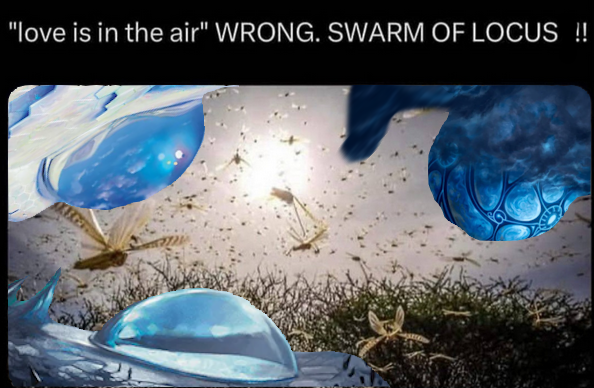 Moses really ought to enunciate better.
This is where it comes time to mention all the means Blue has to copy lands, a shockingly deep pool for what is ostensibly a color pie break.
Vesuva &
Thespian's Stage are ones you should know of, and
Echoing Deeps can help kickstart the package if Cloudpost somehow gets milled early on.
Copy Land is the cheapest Spell copy for one of these, but
Relm's Sketching &
Flash Photography are flexible options, and often enough just result in more Cloudposts. With lands that tap for multiple mana, we also enjoy cards like
Snap &
Frantic Search, which often go mana-positive once our engine is online. Doubly useful is the fact we can cast them before Hurkyl on her first turn, enjoying a trigger during the End Step given they're effectively free if used correctly. All this Colorless mana, life, and potential mill isn't being used for good though; while Monoblue has a wealth of possible wincons, here we're playing the long game. The long, long game.
Jailhouse Lock
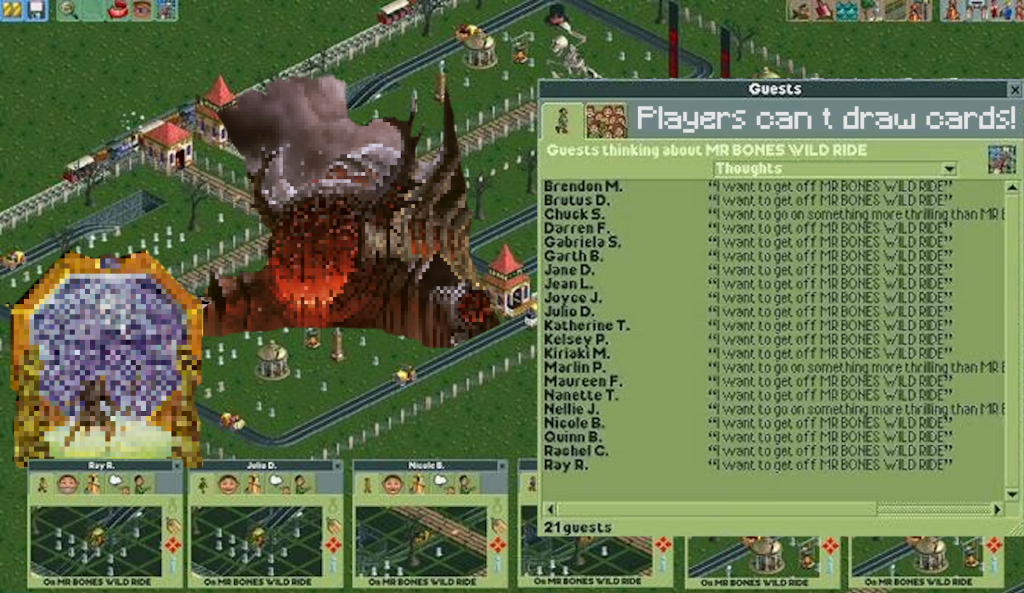 The ride only ends when the game does.
With our propensity to add both Instants & Artifacts to our hand, you'd have likely thought the win condition of this deck centered on the classic interaction between
Isochron Scepter &
Dramatic Reversal—a good idea, but think meaner. We're instead honing in on the fact that Hurkyl doesn't draw cards, meaning we can make ourselves the only ones who functionally
can. This is by way of
Omen Machine &
Possessed Portal, and to a lesser extent,
Narset, Parter of Veils. These to some extent each lock all players from drawing cards, though at lofty mana values and with stipulations aplenty. The good news is that whichever one you sink, they work wonderfully with wheel &
Time Twister effects, though it may not be so wonderful for your opponents.
Coupling something like a
Windfall or
Time Spiral with these is a great way to lose friends, but win games. It strips all players of their cards (outside of you and 1 card per opponent, with Narset), and Hurkyl then allows you to refill your hand each turn. The 'hardness' of this lock varies from piece to piece, but the goal is to place yourself in a position such that Hurkyl breaks parity and puts you way ahead on advantage compared to your opponents. To actually cast cards as large as 6 or 8 mana, there is the possibility of just jamming them with a few Cloudposts worth of mana, but that's far from the only means. Cheating these out is the name of the game, and cards like
Argivian Restoration can reanimate them following a quick discard. They're also premier pieces to hit off of an Aminatou's Augury or Portent of Calamity, and we can ensure they're in our top ~8 cards with pieces such as
Brainstorm &
Long-Term Plans. It's realistic to actually get these onto the board, but settling in for a long game is tough when everyone almost immediately wants you dead. That's when it's key to move onto the next stage.
Once the lock is secure, you need to empty the board, and broadly, the wipes we play leave our locks alive after the chaos.
All is Dust &
Selective Obliteration leave Colorless and Monocolored permanents, respectively untouched, and
Season of Weaving puts a token copy of the lock piece onboard to ensure we can recast the original if it's removed. You could even play
Flood of Tears, to similar effect, but you get the gist. Play lock piece, and then wipe the board and wheel everyone, in either order; that's the play pattern which leads to our endgame. In order to actually win, there's beats by way of Emrakul, milling people out ever so slowly with Trenchpost, or a simple
Triskaidekaphile win.
Example Decklist: Hear it Hurkyling
To the best of our ability, Hurkyl here is always trying to get a trigger on the End Step of the turn she's cast, usually 2 or 3. This means we're playing a glut of 0 mana Artifacts, functionally free Instants/Sorceries, and means of ramping such that you may even have spare mana when she hits the board. Notably, Hurkyl doesn't need to actually 'see' you cast a noncreature spell, merely that it has been cast. Cards like
Lotus Petal & Moxen therefore provide immense upside when used to ramp into Hurkyl the turn they're played. This is a nod to two underappreciated mana rocks,
Mox Tantalite &
Sol Talisman. While not fantastic when Suspended beyond the first couple of turns, they can be a massive boon in ensuring Hurkyl gets her triggers, lining up these ramp Artifacts to coincide with her hitting the board, or even ramping out Hurkyl herself. Another card better here than most is
Sensei's Divining Top, as putting on the top of our Library means we not only can secure an Artifact trigger, but always get it back while netting a card in the process.
Decklists are kept updated, and may change with set releases.
One thing we're not on is Extra Turn spells, but I want to stress that you can absolutely add them if shifting towards more Sorceries over Instants. Similar to Eluge, the more turns you take with Hurkyl, the more filtering you have access to, but in Bracket 3 we're unfortunately not allowed to chain those Turns together. The acceleration provided can be great, but by that same token they're less potent than they could be in Bracket 4...but frankly I think Bracket 4 Hurkyl is
ambitious. I would at minimum stick with Bracket 3 given the synergies with lock pieces & need for tutors, but April can absolutely cruise at Bracket 2 as a
The One Ring-esque piece in the Command Zone.
Hoops McElroy
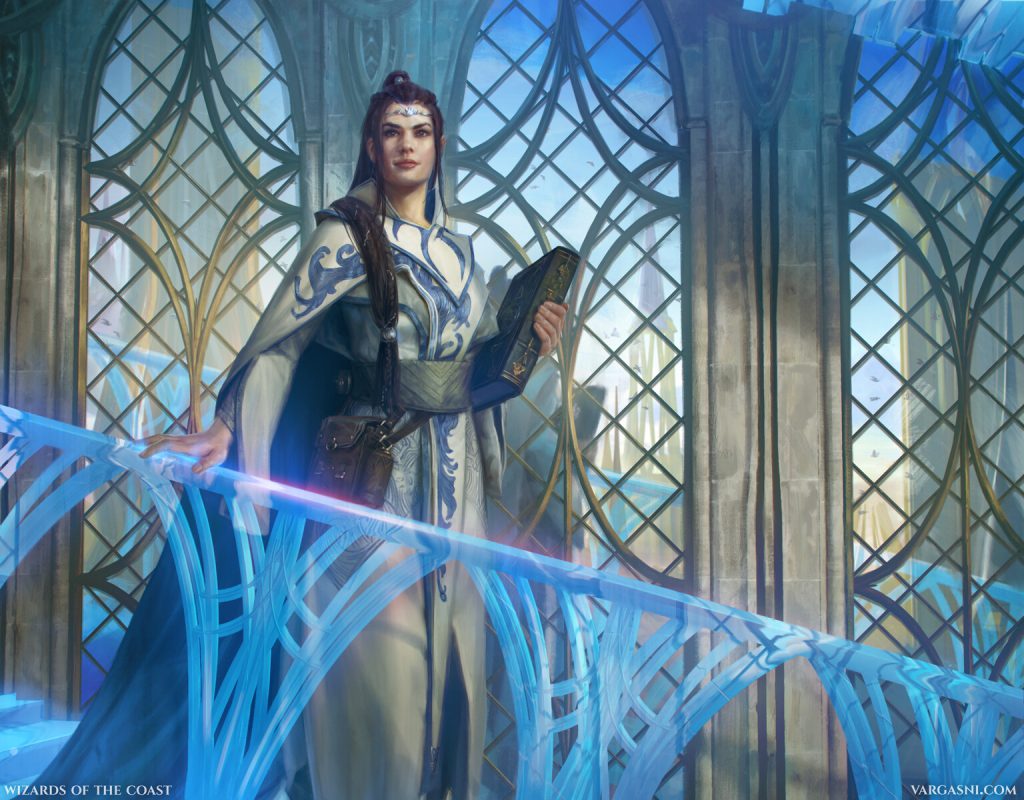 Randy Vargas captures the magic of Tolaria here with a gorgeous glow.
Two roads diverged in a Blue wood, and happy, I could travel both. Not to pastiche Frost so blatantly, but the hidden message in that poem is the same here: People too often misconstrue nonconformity's celebration as a means to diminish the path more traveled. I am a special sort of masochistic Johnny that takes unique, difficult to manage Commanders as a challenge, and while it is my deepest honor to share findings like this Hurkyl list with you, dear reader, it may be found more compelling to proceed with
April O'Neil, Hacktivist. You get to worry less about specific ratios and percentage chances to hit a given card type, and instead have the chance to revel in the fact that
Stream of Unconsciousness is very often an
Ancestral Recall. The hoops to jump through are fewer, and the return is far more consistent. The reason ease creep exists is because it often helps reduce the sheer mental load needed to concoct a list akin to the one featured here, because plugging in so thoroughly to Magic is no full-time job for most. Popular, snowball-y Commanders are so because they feel good to play—the fun is readily found.
That's not to say my mission to deliver deep dives on Monocolor Commanders with fewer decks on EDHREC than Pantone colors added to their library in 2025 is all for naught (the benchmark is 294, for reference). I wouldn't bring focus to these cards if there wasn't fun to be found, or unique play patterns to experience; while it might take a bit more digging, navigating the tempo of getting the right number of Hurkyl triggers is a ton of fun, and the interplay between holding up interaction versus gambling for a potential card in hand is extremely engaging. When the river flips and you wish you'd have cast that extra Sorcery, seeing the board wipe you needed in Hurkyl's reveal pile, that's a moment that makes for exhilarating Commander gameplay. The opportunity to fail, the gamble, that's the real difference between Hurkyl & April. You could just draw 3 cards, but a Hurkyl pile could be anything! It could even be 3 cards.
Until next time, Hurk is on a roll.
Have any questions or feedback? Drop us a note in the comments below or email us at contact@goonhammer.com. Want articles like this linked in your inbox every Monday morning? Sign up for our newsletter. And don't forget that you can support us on Patreon for backer rewards like early video content, Administratum access, an ad-free experience on our website and more.Thank you for being a friend.
 This website uses cookies. Learn more.

 Goonhammer Hobby Round-Up: March 2026
 Goonhammer Reviews: Tribal Conquest
 Conquest: Weaver Courts Gemred Knights and Scaile Dancers Model Review