In the game Hades, you take the role of a petulant son, fighting his way from the depths of the underworld, a task with neither end nor boredom. For years after its release, I admired Hades' art direction, its voice acting, but with absolutely awful reaction speed and an apathy towards action games it was akin to peering at a novelty through some storefront window. This fall, with much encouragement, I absolutely blitzed through this game—one I thought out of reach—and finally understood the beauty of an
excellent roguelike. As with many experiences in games beyond Magic, it got me thinking about how I could achieve that feeling in this king of card games, endlessly replayable runs and difficult choices, seeking synergies as a game went along. To that end, I believe I've found my Zagreus, in the form of
Feldon, Ronom Excavator. If you wished
Imodane, the Pyrohammer gave you card advantage, or wanted to see Monored's take on
Doomsday, you've come to the right place. There is no escape.
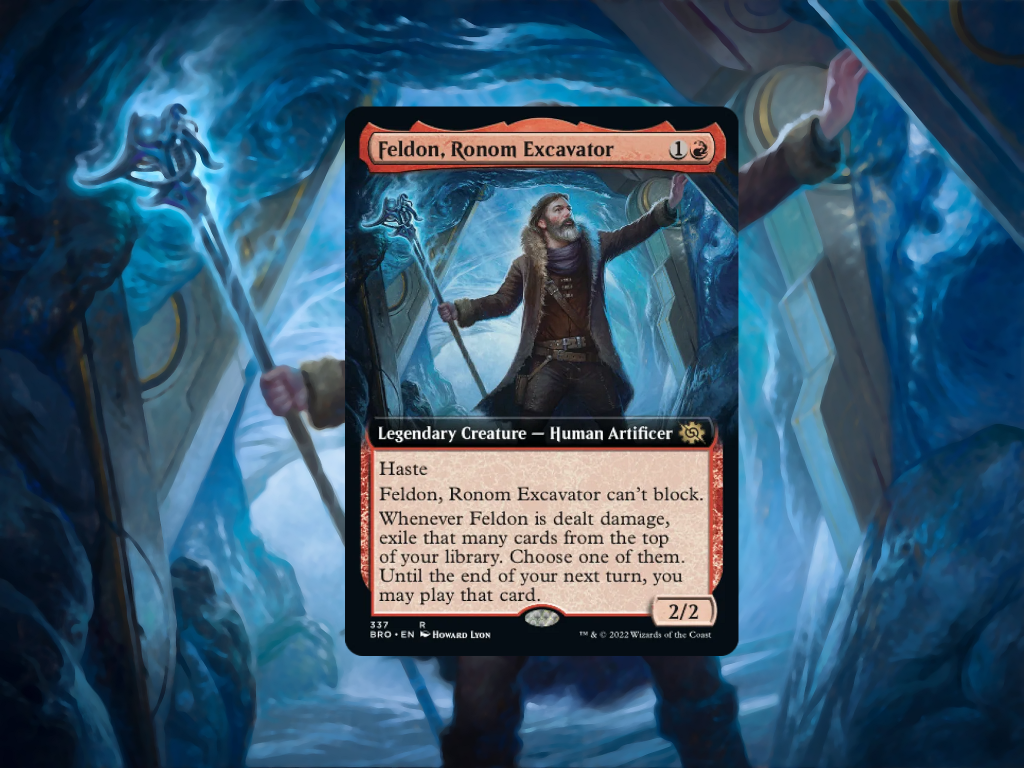 Credit: Wizards of the Coast
"Choose One of Them."
Let's start by stating that Feldon here isn't the most obvious candidate for the Command Zone. Sporting a shape, as an aggressive 2/2, that doesn't tend to enmesh with the format's midrange identity, Feldon will find himself dead on the ground with only 1 card to his name if handled improperly. Certainly, if an opponent blocks with their
Jodah, the Unifier your Commander will die, and while you get to pick your favorite card from among 6+ in that scenario the rest are inextricably lost to exile. That's the beauty of it. Feldon often requiring you to pick the single best card from exile from a batch puts you in a tough spot—do you take this boon, or that?
Party Thrasher or
Runaway Steam-Kin? In forcing you to make a genuine choice that feel of a roguelike is embodied in a card which
surprisingly has more going on than appears so. You get until next turn to cast the chosen card, so you can readily tap out, and given Feldon has Haste cards such as
Nemesis Mask can push opponents to give you a massive swath of cards to choose from. In fact, sending Feldon into precarious situations is one of the better means of churning through cards in your library, as in a roundabout way this deck operates much like a self-mill strategy...with much less accessibility.
You've Been Caught Stealing &
Impact Resonance both make ample use of the fact that Feldon is so accident-prone, and while you're incentivized to keep your opponents' boards thick with Creatures, being able to wipe them away with a moment's notice is duly appreciated.
Casting from exile is among the most supported of Red's modern archetypes, and since the popularity of Prosper they've included ample goodies in every set. Feldon's favorite among these come in the form of Spells which cheat a bit against their intended design context,
Delayed Blast Fireball &
Ultimate Magic: Meteor. Each of these has Foretell, which is an upfront cost of {2} to cast them later from exile, their secondary effects being stronger when cast beyond the hand. With Feldon however, we're often ripping them off the top directly from exile, saving 5 mana on a massive 5 damage Fireball, and destroying potentially 3 Artifacts or Lands with Meteor. These are facilitated by exile-specific ramp, like
Interdimensional Web Watch & everyone's favorite Lizard Wizard,
Party Thrasher. Cards like
Fury,
Cave-in, &
Pyrokinesis are also stellar hits to exile, given we can cast them for free with the alternate cost, making immediate use of them. Feldon does graciously allow us to play cards exiled with him until our
next End Step, so we get a little reprieve if we run out of mana, but always remember to damage him before making a land drop, as he's a stellar means of consistently hitting Lands! Furthermore, while we exile all these cards, be on the lookout for either
Squee, the Immortal or
Eternal Scourge, who ideally end up there for a lategame combo we'll cover in a bit.
Pings Big & Small
 Damage to oneself is the mechanism and goal.
Feldon rewards two disparate types of damage dealt: 1 at a time, once per turn, or an absolute truckload all at once. In the first instance, Feldon is able to survive without issue, and impulse draws a single extra card per turn, up to 4x per turn cycle; this feels great given you're not strapped to choose from among a tantalizing selection. There's a wealth of these cantrip-adjacent cards, from the actual cantrip
Rile to the 'basically
Street Wraith'
Gut Shot. In terms of repeatable means of doing so, however, we're largely relying on two cards that care about color:
Defiler of Instinct &
Molten Nursery. Each of these can effectively allow either Red Permanents, or Colorless Spells, to cantrip by targeting Feldon on cast; not only does this also provide a means of dealing with small problems on the board, but it also turns an infinite combo into an actual win condition. Until we suit up Feldon with some form of protection or way to survive the cataclysmic damage we're throwing his way, the midrange portion of the strategy is just trying to gently poke the old man for 1 damage, 4 times per turn cycle. That's nothing to slouch at when it comes to advantage, even if we need to be gentle about not accidentally sending him to an early grave.
That being said, if all you're doing is getting a few extra impulse draws each turn you may as well be playing
Prosper, Tome-Bound—no, we're in it to use Feldon as a one-man Red
Dig Through Time, or potentially even more. Many of the same suspects as are used in Imodane appear here, your
Chain Reactions, your
Shivan Meteors, but they've been re-contextualized. Instead of chunking out opponents, here they're giving us a 'soft tutor', looking through a huge percentage of our Library to find an ideal combo piece or answer. The cards feel significantly different in that regard, though through
Pain for All or
Donna Noble you can hit the same highs. 'Soft tutors' like this were far more impactful in the previous iteration of the Commander Brackets, admittedly, and I'd be lying if I said it feels less cool now to pseudo-tutor given the limits upon them have been relaxed. Mechanisms by which one could
approximate a tutor used to be what all shrewd deckbuilders strove for, now they're just a gimmick. In that regard, this list eschews the previous limit and thus is close to a high B2/low B3, and can be readily adjusted to be more or less consistent.
Invincibility Frames
When you're Indestructible, no amount of damage is enough to be lethal, and Feldon here has plenty of punishment to take. As is true in the game itself, a form of limited invulnerability helps you make the most of our playstyle, and here that arrives primarily in the form of Equipment.
Mithril Coat is, by a wide margin, our best option for this although we'd never turn our noses up at a
Darksteel Plate or
Hammer of Nazahn. Each of these suits up Feldon with an immunity to classic board wipes, and with Red's potent but scant suite of redirection tools ala
Deflecting Swat (newly off the Game Changer list) he can survive even things like
Swords to Plowshares. Even if we're without Feldon himself, any of these Indestructible effects and our big damage cards work just as well with
Expedited Inheritance, turning
all Creatures, for both you and your opponents, into mega-Feldons. This is sadly optional, so we can't mill anybody out, but word to the wise—casting this Enchantment too early will lose you games. While it's all fun and games to slam your own Creatures with meteors, when it causes an opponent to impulse draw 10 or more, it's less peachy.
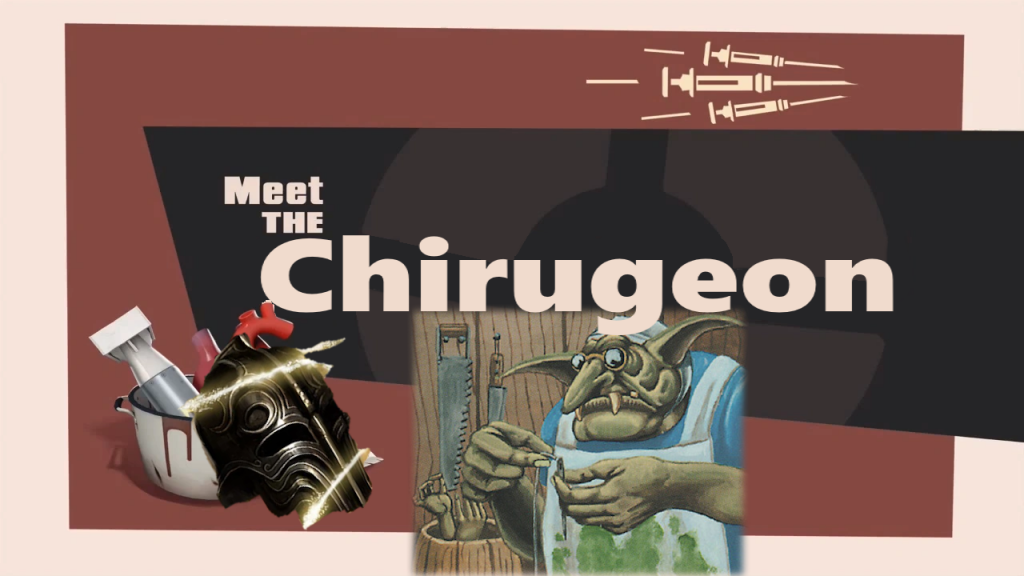 Doctors are known for self-sacrifice.
Actually finding these cards is what we'll spend the majority of the early game on, looking to jam a
Reckless Handling and pray, but the best means of getting Feldon protected actually comes in the form of a funny typal synergy: Goblins. Yes, these rag-tag ne'er-do-wells come equipped not only with solid consistency, but also several ways to get Feldon online. The most obvious pick is
Goblin Engineer, which can bin and return a Mithril Coat over the course of two turns, but
Goblin Chirugeon actually does the same at a quicker pace. See, when we preempt a big damage spell by regenerating Feldon, he fails to die but still takes the damage, unlike if he were to have a Shield Counter or similar. This does take a sacrifice, but if we think of Chirugeon as, at worst, a 1 mana spell that gives Feldon a single instance of Indestructible for the turn that's
still worthwhile. Couple these two with the fact that both
Goblin Matron &
Goblin Recruiter are fairly cheap and you can plan extensively for the Goblin toolbox.
Skirk Prospector serves as an alternate sac outlet for Squee, and given the way Feldon works with the top card of your deck, Recruiter can line up the majority of an endgame even before your Mirror line (More on that later). Finally, we have
Goblin Sharpshooter to cap this off, turning deaths into advantage by way of Feldon, or sniping away the board. Of the few people to build Feldon, you see a lot of pingers like this, and in my view this is the only 'classic' Tim-style card that meets modern power criteria.
Aspect of the Devoid
It has become in my estimation a rote order of business to include Colorless' best hits in my Monocolor decks, but what can I say—there's always some juicy synergy to be had, for very little effort. As a crash course in why this becomes commonplace, one of the major boons of playing Monocolor is the fact that you can play a greedily high number of utility lands.
Tyrite Sanctum,
Abstergo Entertainment, even literal
Desert all see inclusion here, because the strain on our color requirements is far less when there's only one Color to worry about. Due to the fact we already have lands that produce Colorless mana, it becomes a question of whether any of those cards are playable, and as described before,
Molten Nursery is
eminently playable indeed. To make use of this, we're loaded up on plenty of Colorless tools, a full ~40% of the nonland cards.
Nearly all our Artifacts are colorless, for one, with stellar inclusions like
Bender's Waterskin to pay for
Pyrohemia once per turn, but we're actually on a bevy of Colorless Instants & Sorceries as well. I'm a huge fan of
Null Elemental Blast here, giving us the ability to stop many Commanders before they even hit the board, and all for 1 mana. Philosophically similar,
Ghostfire Slice is 99% of the time going to be a strictly better
Lightning Bolt, and
Eldritch Immunity is great at providing protection while not causing Equipment to fall off, given their Colorless identity.
Roguelite
 Some sweet perks, there.
While this list aims to embody the feeling of a roguelike, that's not to say we're without deliberate references to the source material. Just as Zagreus receives his ideal perks from the Mirror of Night, so too do we require one of my favorite endgame Artifacts:
Mirror of Fate. With this, and
Karn, the Great Creator, we turn the cards thought forever-lost with Feldon into what amounts to
Doomsday in Monored. Feldon helps us 'crack' the pile, by being dealt damage and flipping the necessary card to view the rest of the pile, being
Grapeshot. Yes, Grapeshot here isn't necessarily a wincon, but a way to turn Feldon into a Storm of impulse draw. From there, we grab rituals, mana-positive Artifacts, and eventually line up a win with infinite casts of either
Eternal Scourge or
Squee, the Immortal and the necessary mana offsets. Feldon helps 'mill' us into the right cards to put back with Mirror, and even if we exile it early an in inopportune time, Karn can fetch Mirror itself as redundancy.
Even if the combo is out of our grasp, that doesn't mean this deck is defenseless. Where there is big damage, there's means of translating it to a kill, and we can use both
Pain for All &
Donna Noble to brutalize opponents as Red is wont to do. There's always
Dawnsire, Sunstar Dreadnought to chunk Feldon for 100 and either kill the table, or ensure we can exile & play Mirror. In short, at our very worst we deal an absolute ton of damage, to both Creatures and potentially players, and having the same means to reduce someone's life to 0 be our path to a combo win feels excellent.
Example Decklist: The Caning of Feldon
For anyone looking at a guide to this actual play pattern, you're often fairly comfortable casting Feldon on 2, because at worst he'll likely go card-neutral, and doesn't feel very bad at all to cast for 4 in the midgame. You'll toss him at opponents, daring them to block, and the deck transitions to the midgame as soon as you either get a 1 damage ping engine online, or find access to a protection piece. Then, everything escalates—more card selection, more damage, with fewer fears of knocking Feldon over with a stiff breeze (or magmaquake, same difference). Once you've seen enough of your deck, you can decide which target for the combo you'll be pursuing, between Squee, Scourge, or even
Flameskull (though the latter is awkward). Just make absolutely sure not to pass up on both of either Karn or the Mirror; while one can get the other, if both are exiled and unplayable you're softlocked out of the combo beyond very lucky draws. Of special note are your lands which exile the yards,
Scavenger Grounds &
Abstergo Entertainment. These can get critical pieces into exile, where they're shockingly more accessible than the Graveyard, a lot of the time.
Decklists are kept updated, and may change with set releases.
You've likely noticed this list has a lot of tutors for being Bracket 2, and that comes down to the drop on restrictions for that portion of deck building. We here at Goonhammer feel as though the previous restrictions made for a more meaningful differentiation between Bracket 2 & 3, and certainly you can either power this list up with some Game Changers & faster mana, or power it down by removing nonessential tutors (largely within our manabase). This list is a canvas to which your own touches should be added, though one I've had personal success with in testing. If you were paring down to 3 tutors, I'd cut to Reckless Handling, Goblin Recruiter, & Goblin Engineer.
Death to Chronos
 Howard Lyon imagines Feldon closer to Shackleton than Indy, and just as doomed.
In Magic we value
choice in every facet, with Commander being a format of the broadest choices imaginable, and advantage being measured in ones' number of cards with which to play out a turn, every game action a point of decision. Much unlike a roguelike, being able to recur options we discarded or were rid of early on in a game is what separates a deck's ability to push through a grindy midgame, towards the final moments; building deliberately around the ability to not play out of the graveyard, out of zones where cards were lost (beyond Mirror itself) was as fun as it was purposeful. My choices genuinely mattering is a thrilling new feeling for someone who tries to play for every outcome, have lines to victory from nearly every late gamestate, and it helps to do it with a Commander that is so deeply underplayed.
The philosophy of Red as a color, to go quickly and play impulsively, is not generally one that translates well to Commander, but meshes perfectly with the gameplay of a roguelike. You don't have time to be sad about losing access to the 15 cards you chose not to cast, there's damage to be dealt! It's a mindset you need to embody to have fun with a deck like this. To that end, for players trying to get over the sour feeling that comes from seeing opponents mill your Library, this deck might be educational: Those cards weren't real, liquid advantage anyway. Work with what you have, not what you could have, and you'll
have a lot more fun.
I've not actually had a chance to play Hades II yet, though knowing my experience in dragging my feet before the first, I should get to it sooner rather than later. Playing games outside of my comfort zone of turn-based strategy can be a breath of fresh air, and as you've seen can teach fun lessons about play patterns within that genre. Roguelikes stem, at their core, from games that lacked save features, from the very earliest days of gaming; every session at the arcade, or more rarely, ones' home console would be a new session of play. That ephemeral nature, of things being gone outside of maybe a scoreboard kept on burnt-in screens or thumbtacked sheets, meant something. In Commander maybe it's okay to, with polyphemic focus, bare down on your opponents without worry for recursion. You're already playing Red, and the worst thing that can happen is that you'll need to play another game of Commander. Not so bad, is it?
Until next time, don't forget to pet Cerberus.
Have any questions or feedback? Drop us a note in the comments below or email us at contact@goonhammer.com. Want articles like this linked in your inbox every Monday morning? Sign up for our newsletter. And don't forget that you can support us on Patreon for backer rewards like early video content, Administratum access, an ad-free experience on our website and more.Thank you for being a friend.
 This website uses cookies. Learn more.

 Goonhammer Hobby Round-Up: March 2026
 Goonhammer Reviews: Tribal Conquest
 Conquest: Weaver Courts Gemred Knights and Scaile Dancers Model Review