In The Lore Explainer, we take a deep look at the lore behind our favorite games, movies, and books, and talk about the story behind them and sum up what you need to know and how you can find out more. Today we’re heading back into the world of Trench Crusade with part two of our deep dive on the Iron Sultanate. Part one is here.
The Iron Sultanate are the first and most fearsome line of defence against the forces of hell. While Pilgrims and Warriors flock to combat from all over Western Europe and Beyond, The Sultanate sits within sight of the very heart of the corruption the Crusaders unleashed. Not content to sit safe behind their mighty walls, the Sultanate creates weapons, art, monsters and heroes to defend the faithful and reclaim the holy places. With the conflict against hell opening into a new and more deadly phase, it’s time for us to dive back into the real-world inspirations behind the Great Sultanate of the Invincible Iron Wall of the Two Horns that Pierce the Sky and dig into why historical grounding gives it such an interesting place in the world of Trench Crusade.
This article is part two, covering Alamut and going through the units in the Sultanate roster.
Note: As last time, I want to note I am by no means a scholar of Islamic history or religion! I’ve done a lot of reading in the area but am no expert – I’ll do my best here, but please, please get in touch if there’s something wrong. I’ll use BCE/CE dates throughout for ease of reading.
The Assassins
The Forces of Hell are not fearless. They know fear well, having been taught it by the Assassins. They are killers beyond compare, able to warp time to their mercy, appear in two places at once, warped by mystical rites and alchemy to be taller, faster and stronger than a moral man. Equipped with poison blades they strike out to cripple the forces of Hell - and elsewhere - with surgical, terrifying violence.
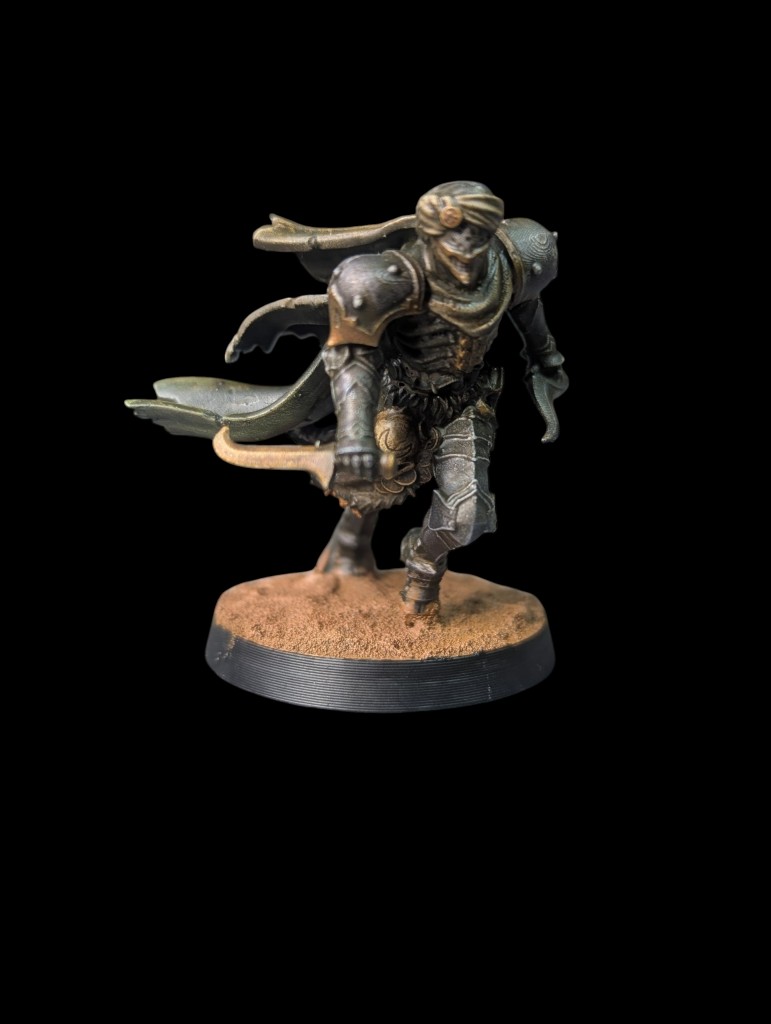 Iron Sultanate Assassin. Credit: Urr
"The Assassins" are probably the most mythologised aspect of Medieval Islamic history. Most people know of - or think they know of - a mysterious warrior sect living on a high mountain, striking fear into the Islamic and Christian worlds alike with dedicated, highly skilled assassin-warriors. Their reputation and the myths that surrounded them gave rise to the word we use for murder for political purposes - they have had a huge impact on imaginations the world around. Trench Crusade takes every myth of the Assassins to the absolute extreme.
The reality of the Assassin Order - extremely debatable name there - is very different. There's elements of the Trench Crusade story that are rooted in reality; the Assassins did live in a series of mountain castles, including Alamut and Masayaf, and they did commit political murders around the Levant. They were mystics, Nizari Isma'ilist Muslims, a sect of Shia Islam that is still extant today. The history of the Assassins is intimately tied to sectarian struggles within Islam and the Fatmid Caliphate, when in the 11th century - just before the timeline of Trench Crusade - the execution of the Caliph-apparent Nizar ibn al-Mustansir split the Fatmid caliphate into two opposing halves. This was part of the chaos that allowed the Crusaders to seize large areas during the First Crusade, and fits in with the Trench Crusade timeline, with the emergence of Nizari Isma'ilism predating the Templar atrocity in Jerusalem.
Isma'ilist power begins to emerge and concentrate regionally in Iran and Syria, with the figure who would become known to history as the Old Man of the Mountain, Hasan Sabbah undergoing a religious conversion to mysticism and sizing the castle of Alamut in 1088. The establishment of the Isma'il state of Alamut followed shortly after, kicking off the Nizari-Seljuk wars. Faced with an overwhelmingly powerful opponent in the form of the Seljuks, Sabbah and his commanders took inaccessible and forbidding fortresses, and struck back against the Seljuks with guerilla-style attacks - most particularly assassinations. The areas Alamut ruled over were largely Shia, often very remote and easy to defend - while castles and fortified areas were lost to the Seljuks, there was an effective stalemate in conventional terms.
During the first few decades of the 12th century, the Nizari Isma'ilists led by Sabbah and others expanded into Syria and across Persia where they continued to strike at the enemies of their sect through political murder, targeting foes whose deaths would weaken anti-Isma'ilist action. They killed Caliphs, Generals and Governors, occasionally facing popular rebellion or military disasters. Their high point of power (and threat) was probably around 1130 with the assassination of Caliph al-Amir Ahkam. They continued to be a significant force in the politics and conflict of the region across the 12th and 13th centuries, occasionally allying with Crusaders and Knightly Orders against the Seljuks (and vice versa), occasionally working for hire and gradually becoming an openly vital part of Syrian and Persian politics - a far cry from the shadowy killers of myth. Their power and killings slowly dwindled with the loss of strongholds to Mamluk and Mongol armies until the beginning of the 14th century, by which time they had ceased to exist as a quasi-military order.
Their reputation (and myths) don't come from their actions so much as the experiences of those who encountered the Fida'i, the - for want of a better term - public facing aspect of their war machine. The Fida'i were the assassins themselves, dedicated, trained, deeply involved in mystical Islamic theology and dedicated to their task. They were most likely not high all the time - or any of the time - and this seems to come from Marco Polo, inveterate bullshitter that he was. Murder for political reasons was incredibly common in the Levantine and Crusader states, the difference here being that the Fida'i, upon occasion, would give their lives up to achieve it - the name comes from the Arabic for "sacrifice", and would eventually give us Fedayeen. Increasingly specialised and trained, the Fida'i became legendary, with virtually any murder being ascribed to their seemingly supernatural dedication and ability.
The myths of the Assassins are impossible to address without talking about Orientalism and religious discrimination. They were not superhuman murderers gifted with impossible resolve from strange rites and heavy drug use, but the reality doesn't make as compelling a story. A smoke-wreathed mystical cult of fanatical killers is exactly the kind of thing that drove western Christian mythmaking about the Islamic world - creating and furthering the Assassins concept is a process of othering, where the unpredictable and terrifying East produces murderers with mystical abilities and otherworldly dedication. In a world where the religious fanatics driven on by exhortations of their priests and popes came from West of Constantinople, it was - and remained - important for the nascent imperial project of the Crusades to say the
real weird killer guys weren't
us, and weren't the noble frenemies of Saladin et al, but those other guys, the weird ones that no one likes. The myth, spun out of what was, when you think about it, a series of admittedly very impressive killings reinforces the idea that out there, beyond the realm of Christian law, men are monsters.
The Old Man of the Mountain
Brooding over the unassailable and invisible fortress of Alamut is the Old Man of the Mountain, Master of Knives, a near-mythical being that holds the Seal of Solomon and commands the Assassin order with relentless focus.
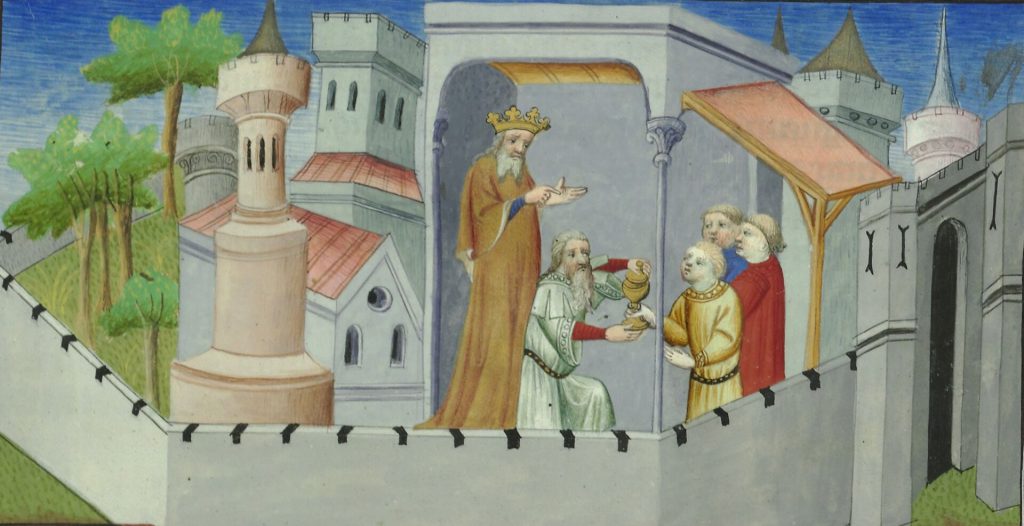 The Old Man of the Mountain, as depicted in The Travels of Marco Polo. By Maître d'egerton. Paris, France. - This file comes from Gallica Digital Library and is available under the digital ID btv1b52000858n/f41, Public Domain, https://commons.wikimedia.org/w/index.php?curid=11816812
As briefly mentioned above, the legendary Old Man of the Mountain was, in real life, Hasan-i Sabbha, ruler of the Isma'ili state. A scholar, mystic and possible polymath (you get some real interesting people coming out of Persia in the 11th century!), he ruled over the state of Alamut for around 30 years. After an incredible journey through the Islamic world, he established his base of power in the fortress of Alamut in 1088-90, and - legend has it - stayed there for the rest of his life. After his death, he was succeeded by Kiya Buzurg-Ummid, who became the next Old Man of the Mountain - a very possibly horrifically garbled translation of the simple title of "Elder". The legend comes from Marco Polo, who described a single Old Man of the Mountain as a malevolent scheming figure sending out wave after wave of killers from a single fortress. If you've haven't read the Travels of Marco Polo, it's worth noting this was one of his most true to life anecdotes - not a ringing endorsement of his reliability as an author.
The Seal of Solomon, held on a chain around the neck of Trench Crusade's Old Man of the Mountain, is an important part of Jewish and Islamic Mysticism. The ring, a pentagon or star inscribed with dots around it, gives the bearer the power to command and speak with spirits and demons - vitally important in the world of Trench Crusade! It's a good example of a confluence of various myths, a possibly-Roman story conflated with legendary Scholar-King Solomon, loaded up with Alchemical significance, translated into Western ideas of the Occult and now, finding its way into Trench Crusade.
Alamut
The Fortress of Alamut lies outside the Iron Wall, beyond the protection of the faithful. It is unassailable, impossible to locate accurately, let alone assault. It is protected by warped time and space, mystical standing stones, raging rivers and sheer cliffs. The Home of the Eagles is a prize target for the forces of Hell, but, in the long centuries since the horror unfolded, no army has come close to taking it.
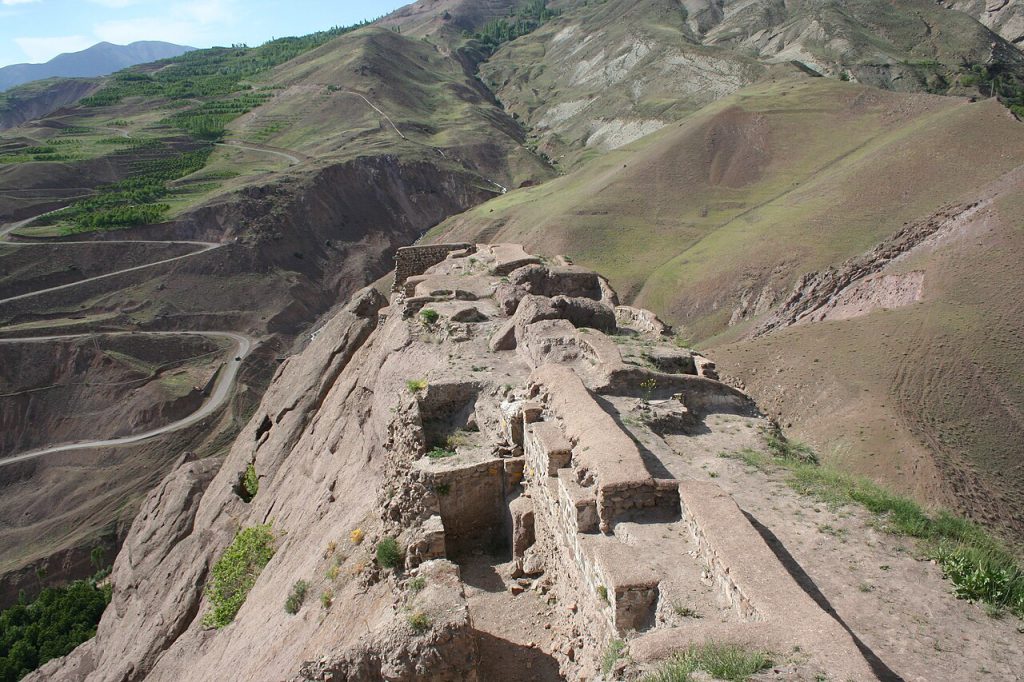 The ruins of Alamut - By Ninara from Helsinki, Finland - 2008iran. Iran, Alamut Castle, CC BY 2.0, https://commons.wikimedia.org/w/index.php?curid=63936104
As far as has been revealed so far, Alamut is the sole bastion of Islam outside of the great wall - a handy metaphor for the Assassins being outside of the main Shia and Sunni sects of Islam. Alamut as an isolated fortress definitely has a lot going for it in reality - it was considered unassailable and stands - albeit ruined - on its narrow spur of mountain to this day. Founded in the 9th century after the ruler of Daylam noticed an eagle perched on a particularly impressive chunk of mountain, it was an impressive and forbidding fortress and part of a network of local fortifications, expanded constantly throughout the period of Isma'ili prominence in the area. No serious military threat encroached on the castle until the Mongol conquests in the 1250s, allowing Alamut to develop as an intellectual centre with a flourishing tradition of scholarship.
Even the Mongols struggled to take the castle, with a series of sieges, assaults and periods of isolation until its final fall in 1256. The castle, and area, declined in importance over the centuries following until - almost inevitably - it was excavated by British Archaeologists and the contents sent to the British Museum.
The Roster
With the core concepts and inspirations behind the Iron Sultanate (hopefully!) explained, it's time to have a look at individual units and their kit to look at their historical antecedents. As we've covered Jabirean Alchemists, Takwin, and the Assassins at length, we'll use this to talk about the other (slightly less fantastical!) units in the roster. The standard humans of the Iron Sultanate are heavily based in the Ottoman Empire, drawing many terms, pieces of equipment and troop types from the several centuries of Ottoman dominance of Anatolia.
Yüzbaşı
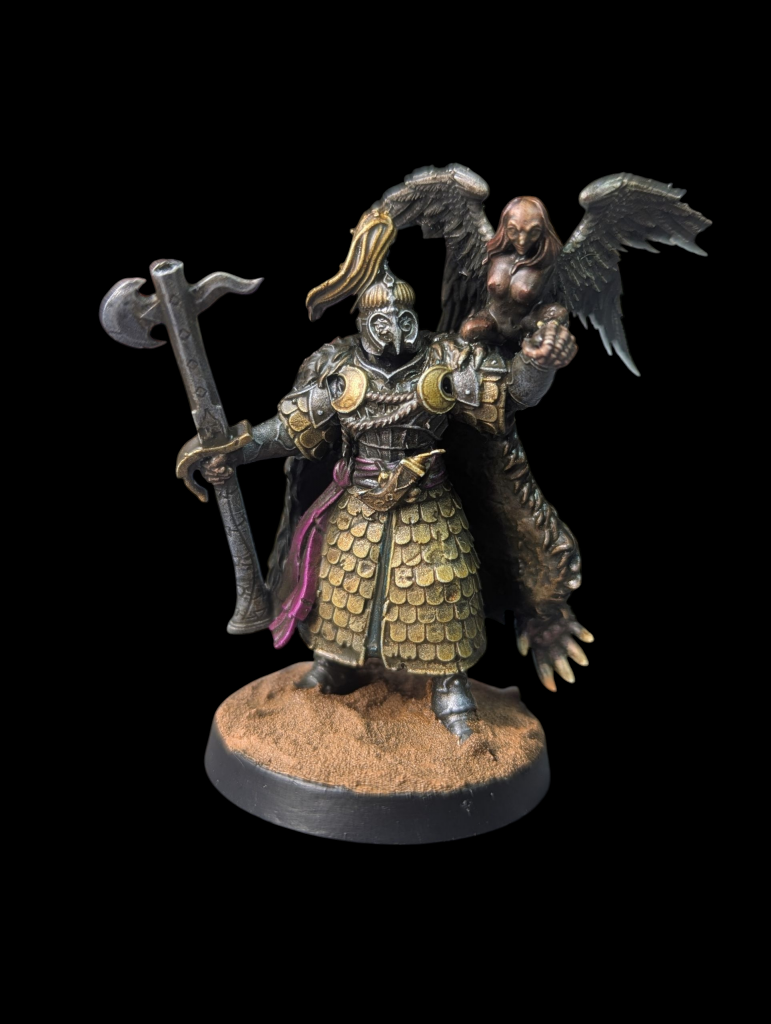 Iron Sultanate Yüzbaşı Captain. Credit Urr
The Yüzbaşı are the field officers of the Sultanate, leaders of warbands that journey beyond the Great Iron Wall. They are equipped with the best the Sultanate can offer, enhanced and trained by Alchemists, Mystics and Scholars to present the best possible physical, intellectual and spiritual leadership. They are cold and terrible opponents, determined to carry out their missions at any cost.
Iron Sultanate Yüzbaşı Captain. Credit Urr
The Yüzbaşı are the field officers of the Sultanate, leaders of warbands that journey beyond the Great Iron Wall. They are equipped with the best the Sultanate can offer, enhanced and trained by Alchemists, Mystics and Scholars to present the best possible physical, intellectual and spiritual leadership. They are cold and terrible opponents, determined to carry out their missions at any cost.
One of my absolute favourite Trench Crusade things is that the leaders of the Iron Sultanate warbands are just called "Captain" in Turkish - a Yüzbaşı Captain is "Captain Captain." We know from last time that the Iron Sultanate has a heavy Turkish influence from their Seljuk beginnings, and the leaders being a straight-up Captain is a good confirmation.
Officers of the Classical Ottoman army are probably the closest real life inspiration, Janissary and "regular" Captains and leaders bedecked in armour, culturally obsessed with hunting and equipped with swords - again, the "Kilij swords" of the Iron Sultanate translating as "Sword sword" from Turkish to English. The form seen on Sultanate models is closest to the 15th-18th century form of the sword, common in Ottoman armies of the period.
Azeb
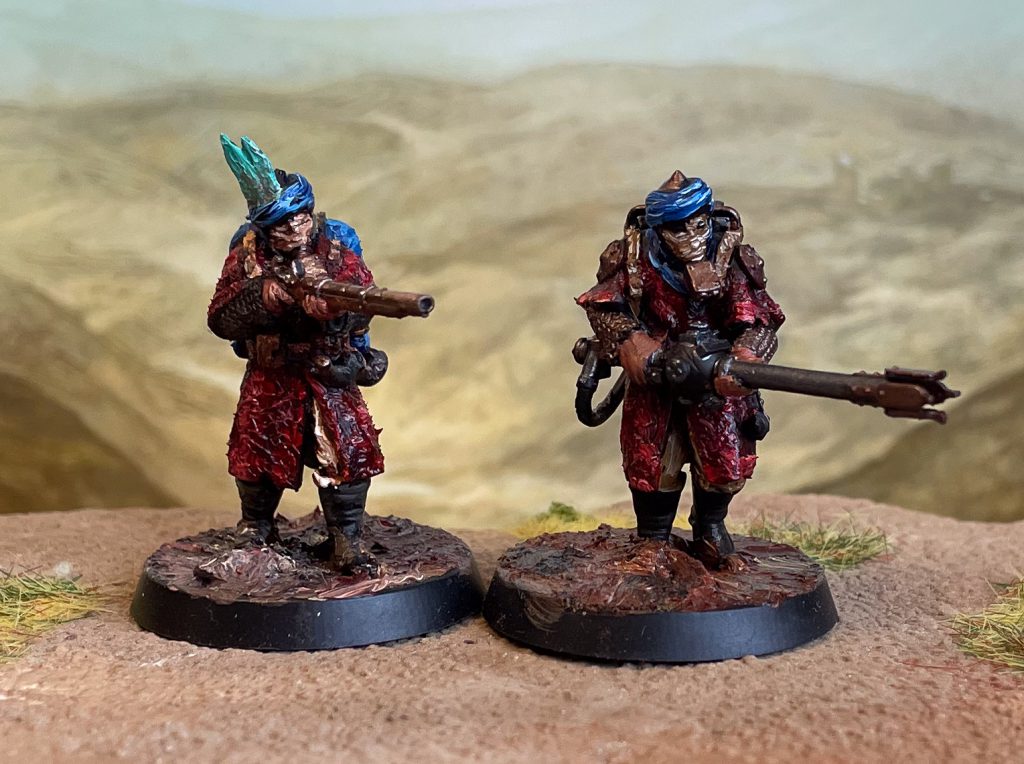 Azebs
Azebs
Another good example of a twist on history, the Azebs were a form of light infantry and irregular soldier in the Ottoman army. As garrison troops in later periods they would fight as musketmen, but throughout their existence in Ottoman armies they were primarily ranged skirmishers who fought ahead of the cannons and heavy janissaries that formed the hard core of the armies of the empire. In that, they're the perfect historical basis for the Trench Crusade unit who operate in a very similar manner - particularly if you spend the ducats to upgrade their skirmishing abilities.
The Sapper of Trench Crusade is a specialised Azeb soldier who is practiced in demolition, artillery and explosives. Again, this isn't far off history - Sapper was a common role that Azebs could take up in Ottoman Armies, particularly in building the temporary military forts called palanka. Ottoman armies were famed - until reorganisation in the 19th century - for their artillery and siegecraft.
Janissaries
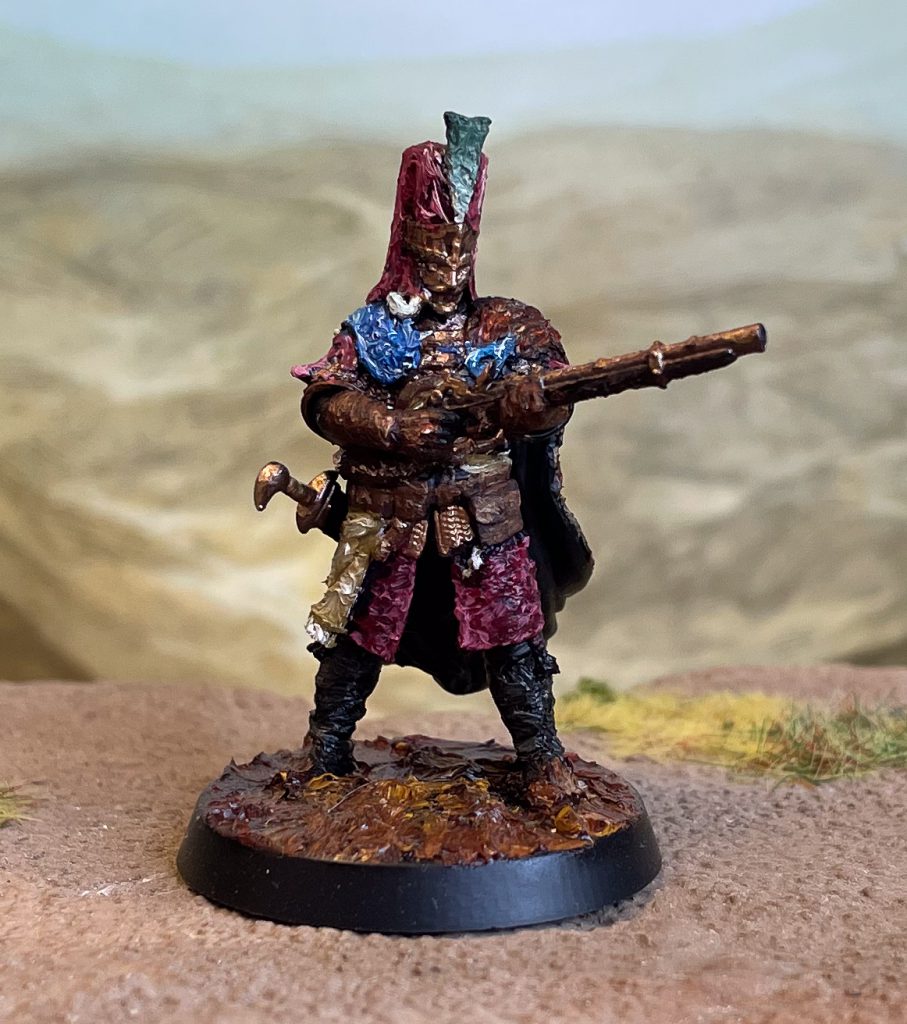 Janissary
The heavy, mailed hand of the Sultan of the Faithful, the Janissaries are fortified by faith, armour and alchemy to shock, awe and kill the armies of Jahannam. Wherever the fighting is fiercest, the Janissaries will be found - holding the line with sword, shield and jezails.
Janissary
The heavy, mailed hand of the Sultan of the Faithful, the Janissaries are fortified by faith, armour and alchemy to shock, awe and kill the armies of Jahannam. Wherever the fighting is fiercest, the Janissaries will be found - holding the line with sword, shield and jezails.
The Janissaries were the elite of the Ottoman Empire, initially child slaves forcibly converted to Islam and trained as a military force to act as the household troops of the Ottoman Sultan. They were - at least at first - considered to be absolutely loyal to the Sultan, forming his closest guards. The history of the Janissaries is fascinating - and five hundred years long - but for a significant part of the 14th to 18th centuries, they were given the flashiest uniforms, had the most regular pay and pioneered the use of coordinated firearms. They were the anvil the enemies of the Sultante broke upon, as light cavalry slashed at the flanks and heavy cannon bombarded the opposing army. As time went on, they transitioned slowly into a reactionary political and administrative powerhouse that served their own interests at the expense of the Sultanate. Eventually, the Janissaries were forcibly disbanded - and massacred - in the 19th century.
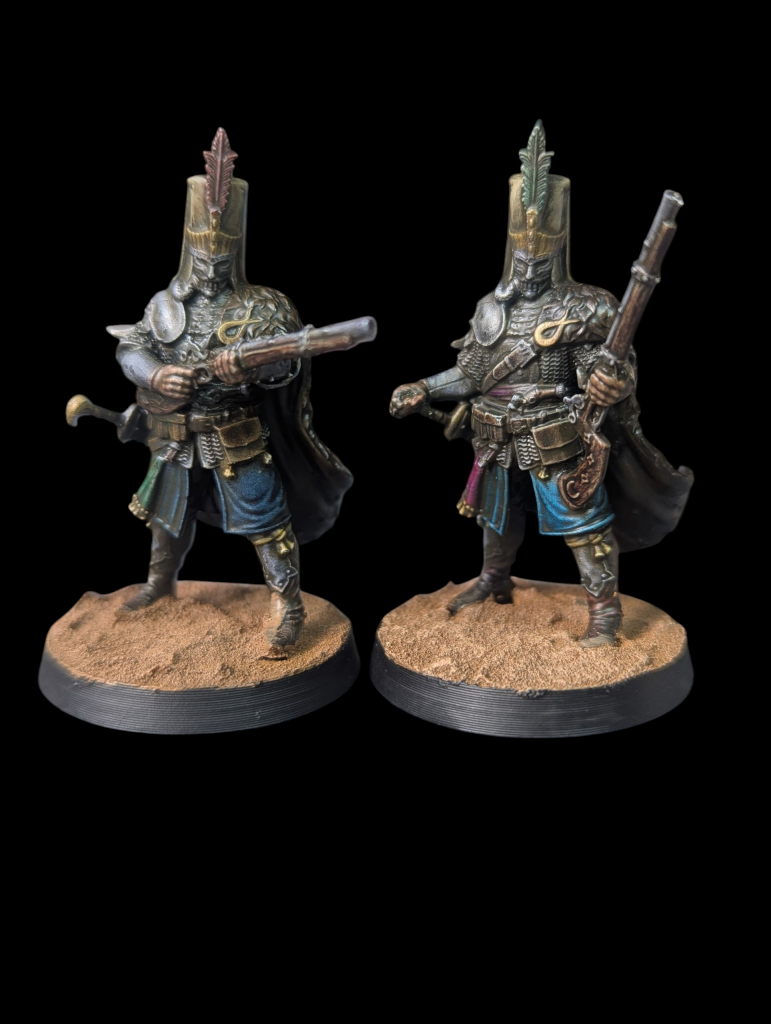 Iron Sultanate Janissaries. Credit: Urr
Their equipment and look in Trench Crusade is an excellent grimdark twist on the various uniforms and kit of the Janissaries. The enormous knives - the Yatagan of the Corps, the muskets and fusils, even the high headdresses - all pull from 15th-19th century Janissary uniforms. Their recruitment - children stolen from the "desolate northern and eastern marches beyond the Iron Wall" - also matches, with early Janissary "recruitment" coming from the Balkans and other fringes of the Ottoman empire.
In the Fidai of Alamut sub-list, Dervishes replace Janissaries as the hard fighting core of the Warband. They are based, very clearly, in the "Whirling Dervishes" of Sufi Islam. Whirling is a form of active, body focused meditation on the nature of God and has no real world military or violent purpose! It is, as described in the Warband list, hypnotic to witness!
Mamluk Faris
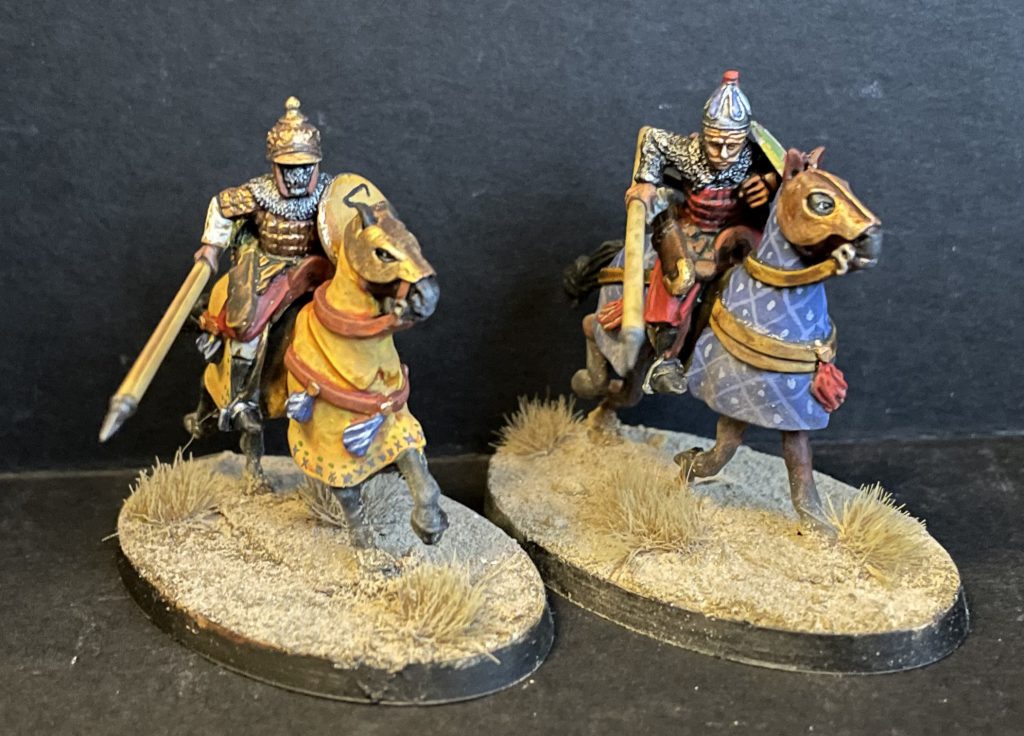 Historical Mamluks. Footsore Barons' War: Outremer Credit: Lenoon
The Mamluks are the last remnants of the Fatmid empire that stood against the first waves of demons unleashed in the Great War. They guard the decayed remains of Egypt, fighting a fated and hidden war against the occupying demons. They are mercenaries and horsemen beyond compare, equipped with the last of the automaton warhorses they have used for centuries.
Mamluk Mercenaries were another vastly important slave-soldier group in Medieval Islam. Based in Egypt and Southern Syria, they were established first under the Abbasid Caliphate, quickly becoming a vital part of the Abbasid, and later Fatmid, armies. Slave soldiers were a key part of the power struggles in the levant from the 10th century onwards, eventually growing to overthrow dynasties and place their own upon the thrones of Egypt, Syria, Iran and Iraq.
In Trench Crusade, the Mamluks take a suitably grimdark take on the 13th century Mamluks - a caste of nobles and knights in Egypt who fight from horseback. Their code of furusiyah (or furusiyya) is shared between Trench Crusade and history, a knightly/chivalric-style code of behaviour and martial discipline adopted by the Mamluks from Egyptian nobility. Adherence to the codes of furusiyya marked out the tactics and lives of the Mamluks during the height of their power, so it's unsurprising that the remnants of the group in Trench Crusade are sticking close to the teachings of their forebears.
The Sipahi, the Defenders of the Iron Wall variant of the Mamluks, are - fittingly - the Ottoman equivalent, professional and heavily armed cavalrymen, more integrated into the standing armies of the Sultanate.
The Iron Sultanate
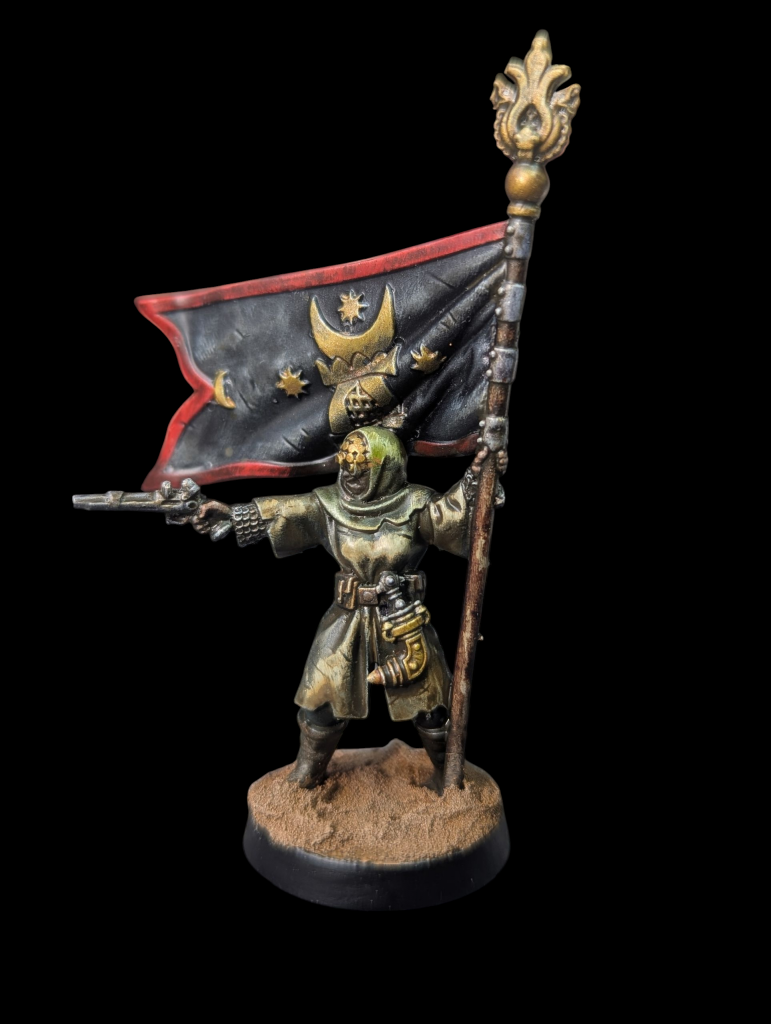 Iron Sultanate Azeb. Credit Urr
The use of real life history as inspiration is one of the great things about Trench Crusade. Unlike many other alt-histories, it isn't just a translation but one deeply rooted in the themes, concepts and stories of the areas it draws from. The Iron Sultanate will hopefully see more expansions, models and lore - and, when it does, it'll hopefully be as interesting and tied to history as everything published so far.
Have any questions or feedback? Drop us a note in the comments below or email us at contact@goonhammer.com. Want articles like this linked in your inbox every Monday morning? Sign up for our newsletter. And don’t forget that you can support us on Patreon for backer rewards like early video content, Administratum access, an ad-free experience on our website and more.
Thank you for being a friend.
 This website uses cookies. Learn more.


 Goonhammer Hobby Round-Up: March 2026
 Goonhammer Reviews: Tribal Conquest
 Conquest: Weaver Courts Gemred Knights and Scaile Dancers Model Review