Riff Tamson has reignited my love for Shatterpoint in ways I hadn't anticipated when Atomic Mass Games first spoiled him months ago. This article focuses on list-building considerations and innovative strategies with the Scoundrel tag and Riff Tamson. While the 'Terror from Below' box initially made a modest splash at Grand Tournaments, Riff has recently been making waves (fish pun intended) across multiple GTs with creative list construction that has rekindled my passion for this game. In the article, we will examine considerations for Riff’s squad, his squad pairings, and some general tips when playing him. Hopefully, you’ll walk away with the same enthusiasm for this quirky, evil, bi-pedal, space Shark.
For context, I have been playing Star Wars Shatterpoint since the release of the game two years ago. I started my miniature gaming hobby in 40k during 7
th and 8
th edition of the game, when each individual model had different load out options. This made list building and tweaking a fun hobby as much as the painting and playing aspect of the game. A few years ago, I switched to more skirmish style games, and I landed on Marvel Crisis Protocol because the squad building rewarded finding synergistic lists. For the first year of Shatterpoint, I felt that list building was usually constrained to pairing to pre-constructed boxes/Strike Teams together to make a squad. We’ve seen boxes such as Lando Calrissian, Hondo, and the bounty hunter unit pack open list building around the Scoundrel keyword. However, Riff Tamson builds upon those great units and empowers Scoundrel supports in a unique way that the game hasn’t explored yet.
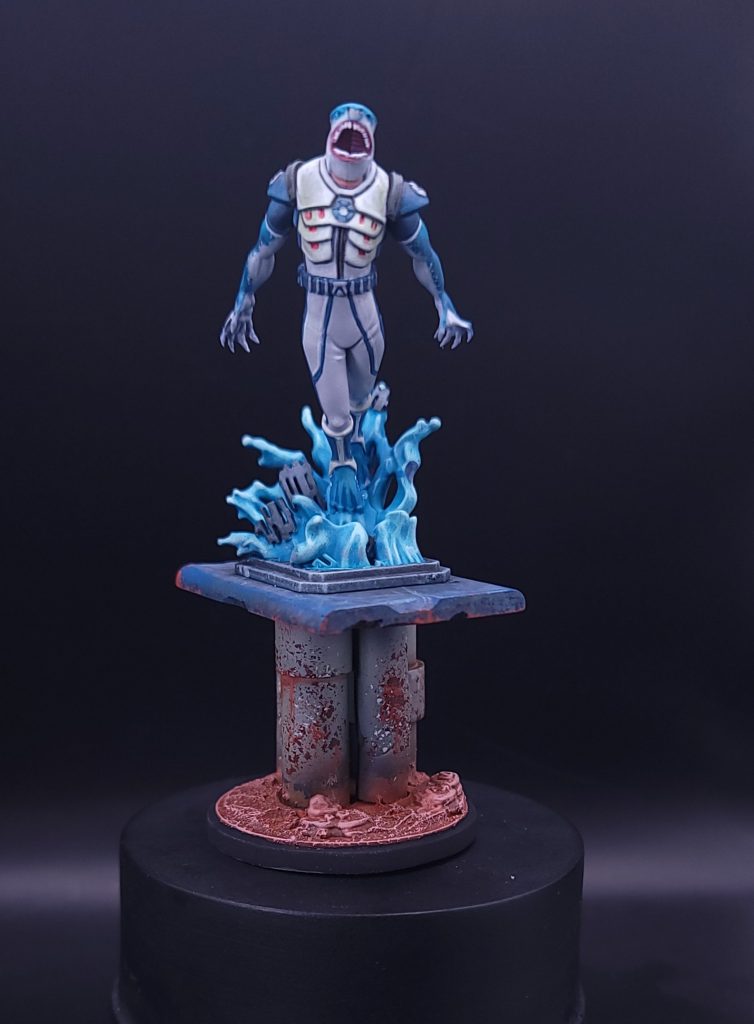 Riff Tamson painted by Zeke Sudbury, with a custom crafted base
To dive deeper (more intentional fish puns) into list building, we will start with an overview of what this primary brings to the table. When Riff was first spoiled, I felt that the character had mediocre rules. He’s a primary that cannot move other models on this turn, brings only two force, has conditional/range limited force refresh, and conditional/range limited bonus attack dice. In addition, his active ability “Death from Below” and the Savagery tree felt like another Darth Vader, Jedi Hunter type character. His play pattern seemed to be a linear play of running at an enemy to wound them, which isn’t exactly what Separatists needed in the game. However, Riff’s kit brings in a few elements that we don’t typically see. The bonus dice from his Identity “There’s Plenty of Suffering to Go Around” is not limited to combat attack actions, whereas other dice adding and fixing abilities or coordinated fire type effects typically are limited . Riff players are regularly getting 3-4 extra dice on these out of activation attacks. Additionally, the Blood in the Water ability is a free reactive that plays off both Separatists and Scoundrels. It is important to note that Riff’s jump does not have to be in any specific direction, such as towards an enemy. We should also note that you still get the jump, even if you cannot reach melee range of the enemy character that your support attacked.
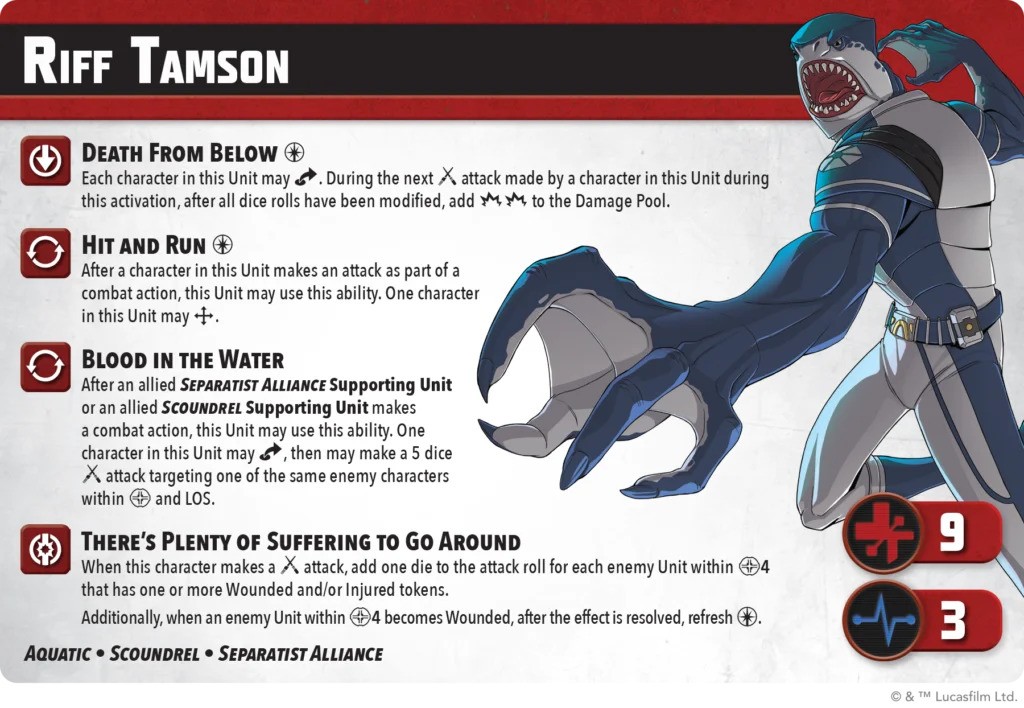
Out-of-activation movement in Shatterpoint is incredibly important for ensuring that you can flip a point and keep scoring points. This effect coming from support units, which have evolved into some of the most important activations in your deck, is rare.
Scoundrel Support Options
Let’s breakdown some of the support choices that can be paired with Riff. While the Aqua Droids and Separatists will also trigger Riff’s abilities, I’m more interested in exploring the Scoundrel tag and the list flexibility we can get across all of Star War’s eras and iconic characters. Knowing that Blood in the Water incentivizes us to bring supports that can bring ranged attacks with shoves, have great mobility, and can set up wounds, we want to look for “playmaking” supports. These are the supports that typically have an extra dash or advance on their card, and potentially more movement in their tree. The extra movement can be used to split up the unit to outnumber someone on a point once Riff jumps in from Blood in the Water. In addition, since we usually want to use the Shatterpoint activation on our supports, we need supports that are survivable in the current meta.
Baze Malbus and Chirrut Imwe
We will start with the obvious meta boogeymen in Shatterpoint right now. Baze and Chirrut are a fantastic 5-point unit that have put up incredible results in the competitive scene. At worst, Baze and Chirrut are a force neutral unit, meaning they will generate the force they need to fuel their kit from their tactic ability. At best, they can refresh a force or two to fuel the rest of your team. Their flexibility and speed from “We’ve Been in Worse Cages Than This One” can allow them to spread out and impact multiple points with Riff supporting them. Additionally, both of their trees have an expose condition on the third step, which further improves Riff’s follow up attacks. The flexibility, offensive capability, and Steadfast bodies make Baze and Chirrut the gold standard for Scoundrel supports currently.
Han and Chewie, In It For The Money
Han and Chewie are another 5-cost support with extremely high playmaking potential. Immediately after the May update to Shatterpoint, Han and Chewie found a home in an innovation list feature Cad Bane and Cassian Andor, where their offensive expertise and large dice pools were leveraged to efficiently wound enemy models. Between “Hit and Run” and “Look Out, He’s Loose”, these models can cover a large portion of the board and fill the “playmaker” criteria we set. This unit also brings a force refresh on a wound, which plays well into our game plan with Riff. However, Han and Chewie tend to be a force intensive unit, which can be hard to justify when we’re working with a low starting force pool. In addition, their lackluster defensive expertise and low ranged defense dice makes them quite fragile. Once wounded, a Riff team might struggle to pay for their force abilities. In a straight comparison to the Baze and Chirrut, Han and Chewie are not as reliable of an activation , but have higher potential.
Weequay Pirates
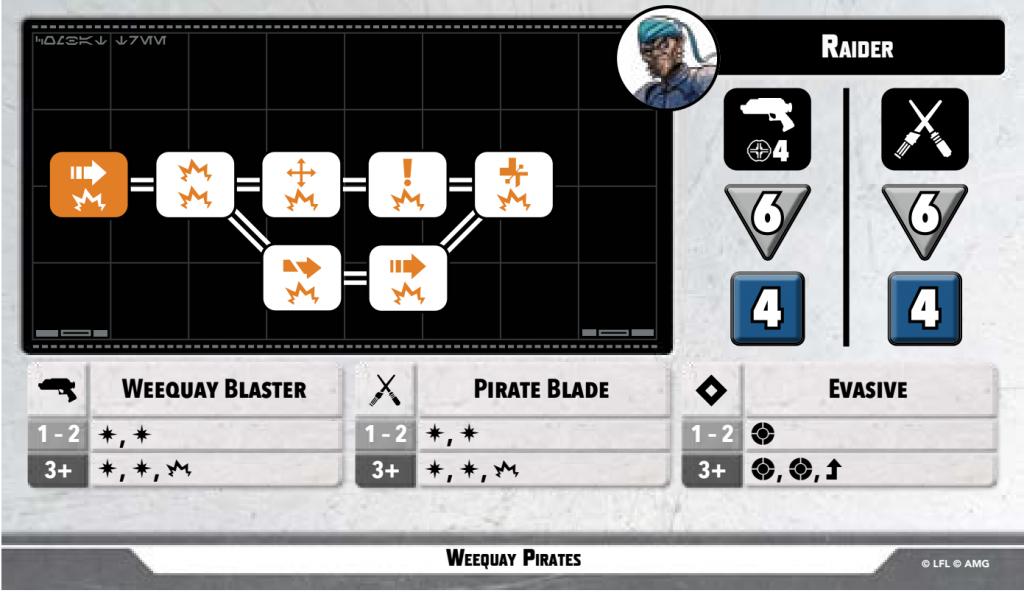
The Weequay Pirates received a few small, but impactful changes in the May update, which have skyrocketed them to one of my favorite support units in the current state of Shatterpoint. They gained one dice on both their ranged and melee attacks and gained an extra strike in their expertise charts. These combined changes help them climb their combat tree more often and effectively. A shove on the first step and a reposition on the third step helps fit that “playmaker” support we’re looking for with Riff. Like Baze and Chirrut, the Weequays also bring an expose condition on their tree for Riff’s follow up attack. Getting to the fourth step in a combat tree is a bit difficult for supports, but Pack Hunter makes their dice surprisingly consistent. Steadfast is another incredibly important ability for helping our list stick on points. Finally, Weequays can be played across multiple eras, which drastically increases list building flexibility.
Covert Mandalorians
Covert Mandalorians are another fantastic playmaking style support. Their unit card brings a jump, a potentially free focus, and Impact or Sharpshooter as needed. The offensive expertise from ranged attacks helps bring a large number of strikes in the attack roll to overwhelm the opponent’s block rolls. The biggest drawback to Coverts is that their Era is limited to only a couple primary options. Additionally, once wounded, their activations become hard to fuel with our low force economy. At only 7 health and 4 ranged defense dice, the can be focused down very easily.
Lando and R2-D2, Inside Job
Lando and R2 get an honorable mentioned because they fill a niche by being a three-point support unit with the Scoundrel tag. With their “Mingle” ability, they can also split the map and control both side points in Sabotage Showdown turn 1, much like Baze and Chirrut. Importantly, if this is done with a Shatterpoint card, this prevents them from being attacked at range. “Element of Surprise” can help them roll larger dice pools, but progressing through their tree feels reliant on good dice because of their bad expertise chart. In addition, once wounded, the force economy for this unit can be hard to afford.
Honorable Mentions
There are a few other supports with the Scoundrel tag to consider. In my experience, these options are outclassed by other options in their respective eras, but could have potential synergies with other secondaries that improve their performance. The generic
Bounty Hunter unit serves a similar role to the Weequays at being a generic keyword unit with access to multiple eras and a good combat tree. The Bounty Hunters are slightly outclassed by Weequays because they have one less health, no steadfast, and offensive expertise that has not aged well in the current state of the game.
Echo and Tech did not get the Clone health buff in the May update, and have fallen out of favor for other options in many of their lists. They tend to suffer from low dice pools and mediocre expertise charts. In addition, as we discussed with Covert Mandalorians, 7 health is a low threshold for wounding, especially in a world with Captain Cassian Andor using “This Town is Ready to Blow”.
IG-11, Assassin Droid is a unit that I have not personally tried with Riff yet, but could have potential. IG-11 brings a flexible combat tree that can hand out expose, shoves, and extra movement. His defense dice and expertise provide strong resilience for a support. However, potentially having him Defeated early due to a bad roll on his “Victory Through Combat is Impossible” ability would be detrimental to our core plan.
Wing Guard have a great set of abilities on their character card. Steadfast with 8 health, the ability to roll 8 dice in melee, and a free reserve are very important abilities. However, they suffer from poor offensive expertise and shoves being 3 steps into their tree.
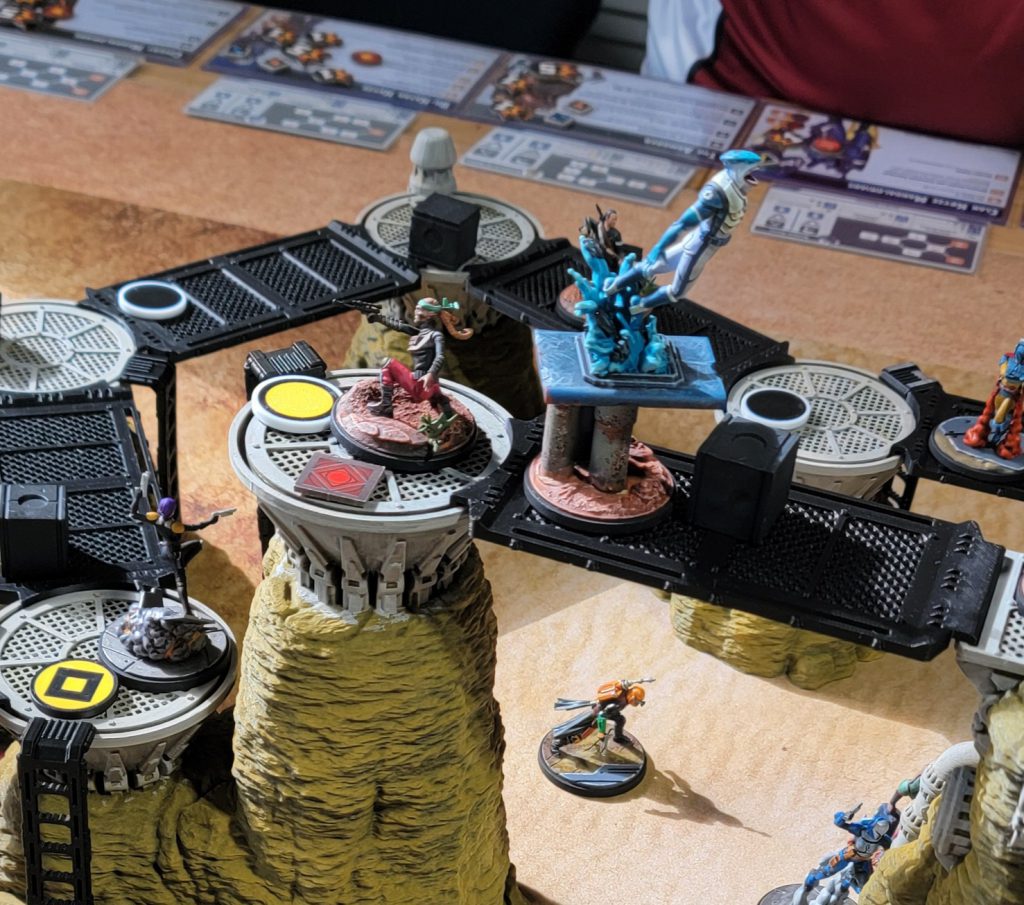 Riff Tamson and Weequay Priates towering over enemy Mandalorians
Primary Pairing Options
With our Scoundrel supports narrowed down to a few options, we can look at the primaries and establish a more focused plan. Because the Weequay Pirates are the only “Fall of the Jedi” era scoundrel support, they will be tied to Riff Tamson’s squad. Our second primary needs to be someone with the “Age of Rebellion” or “The New Republic” eras. From the list of available units in these areas, the ones that best fit our game plan are
Captain Cassian Andor,
The Mandalorian,
The Armorer, and
Cad Bane, Notorious Hunter .
Cassian has been the primary I’ve played the most with Riff Tamson, and is my personal favorite pairing. The nine squad points gives plenty of flexibility for bringing playmaking units like Baze and Chirrut or Han and Chewie. The revenge trigger side of his identity can help us hold onto points during the slower, grindier matchups, whereas the Shatterpoint portion of his identity plays well with enabling our supports to achieve their full trees. Finally, “This Town is Ready to Blow” is an incredibly strong ability that further enables Riff’s Blood in the Water attacks but lowering the effective health pool of enemy units. The biggest drawback to Cassian is that he brings two force, meaning our total available force is only four.
The Mandalorian pairing brings a tanky model with dice-less displacement to our list. Since our list is focused on inflicting wounds to enemy models, having an option to push an enemy off a point without having to wound them is an important consideration. The Mandalorian is also a tanky model that can be hard for most lists to displace or wound. His revenge trigger allowing a double recover and then removing conditions from all Scoundrels plays well with the rest of our models. The extra force that this character brings also gives our list some lenience on force usage.
The Armorer pairing is only viable if we choose Coverts as our scoundrel support for the second squad. The Armorer’s identity helping their force economy solves on of our issues with the Coverts. Additionally, the Riff squad could look at taking Gar Saxon as a secondary to better enable the Mandalorian characters in this list.
The
Cad Bane pairing again brings 9 squad points for maximum list building flexibility . This pairing has the highest potential for wounding power and force refreshing. A list with Cad, IG88, and Bounty Hunters will throw a large attack dice pool . However, Cad Bane’s “No One Gets Between Me and My Job” shares the same trigger as Blood in the Water, and has some counter-synergy with our plan. In addition, this portion of the list seems to be a win-more situation , where we double down on the force refresh and wounding goals, without shoring up any of our weaknesses.
Secondary Options
After narrowing down Riff’s list to Riff Tamson and the Weequay Pirates, we need to find a secondary unit for that squad that can shore up some of our weaknesses. As we pointed out when first investigating Riff’s card, we rely on wounding/ shoving models with attacks to flip points. We can decide to lean further into this wounding mindset by taking characters with consistent attack rolls, such as
Crosshair. We can also look at
Jang Fett, who despite seeing a small nerf in the May update, still fills a role by bringing dice-less displacement and more force refresh. Honorable mentions go to
Wrecker and
Gar Saxon. Wrecker can provide Protection to all of our team to help provide our grindier, wound focused game plan. Wrecker’s “I Wasn’t Sneaking” ability also provides us a way to wound enemy units outside of combat, which would matter in the Kanan matchups. Gar Saxon has potential if we decide to lean into the Covert or The Mandalorian pairing.
In the non-Riff squad, our secondary pairing will depend on which primary we ultimately decide to bring. Cassian’s nine-squad point limit will let us play a four-cost , such as
Ezra Bridger or
Dengar, the Demolisher. Ezra pairs well with Cassian’s revenger trigger identity to help protect points with this tie-breaking ability. Dengar is a unit that does not need to use force, and can reliably hold a point on his own. The free reserve ability for him, Jango, or The Mandalorian can also help the low starting force pool. If we decide to lean into the Mandalorian aspect of the list,
Bo-Katan brings more out of activation movement, healing, and protection to the team. Finally, three-cost supports, such as
Bossk, Single-Minded Slayer or
Gwarm, could have potential when we want to bring The Mandalorian with a 5 point supporting unit.
Putting It All Together
Taking what we’ve laid out as options thus far, I’ve put together 3 lists that I find mesh well on the tabletop and enable Riff Tamson.
Option 1
Primary: Riff Tamson
Secondary: Jango Fett, Bounty Hunter
Support: Weequay Pirates
Primary: Captain Cassian Andor
Secondary: Dengar, The Demolisher
Support: Baze Malbus and Chirrut Îmwe
In this first list, we’re throwing theme out the window as we aim to fully enable Riff and our supporting units to carry the game. Dengar is chosen as the secondary in order to reserve him or Jango for free and help our force economy. I’ve personally played this list in a local sixteen-person tournament, where I went 3-1. In my games with this list, I am typically spending 7-8 force in the first struggle, despite only starting with four force. I’ve also seen the list inflict 9-10 wounds on the opponent in a game. It can struggle on extremely spread out mission layouts, such as First Contact and Never Tell me the Odds.
Option 2
Primary: Riff Tamson
Secondary: Gar Saxon, Merciless Commander
Support: Weequay Pirates
Primary: The Mandalorian
Secondary: Bo-Katan Kryze
Support: Covert Mandalorian
The second list we’ve put together utilizes the Mandalorian keyword to provide more out-of-activation movement through Gar Saxon and Bo-Katan. They can help reposition The Mandolorian to hold down points. This list will require careful positioning of the Coverts, who are prone to getting wounded early.
Option 3
Primary: Riff Tamson
Secondary: Jango Fett, Bounty Hunter
Support: Weequay Pirates
Primary: The Mandalorian
Secondary: Bossk, Single-Minded Slayer
Support: Baze Malbus and Chirrut Îmwe
The final list is one that I feel optimizes our game plan of wounding enemy models, while providing strong revenge triggers via Mandalorian and Bossk, as well as dice-less displacement on both sides of the map.
Playing the List
The supports are the all-stars in our list. We generally want to use the Shatterpoint card on them as much as possible, and we want their plays to be impactful. That tends to mean we don’t necessarily want to draw them first, and with only 4-5 force, reserving early can be risky. Therefore, it is important to note that we can still declare a combat option with a support unit even if there are no legal targets for us to attack. This will allow Riff to jump up the board earlier at the cost of giving up a potentially more impactful second action on your supports, like Take Cover.
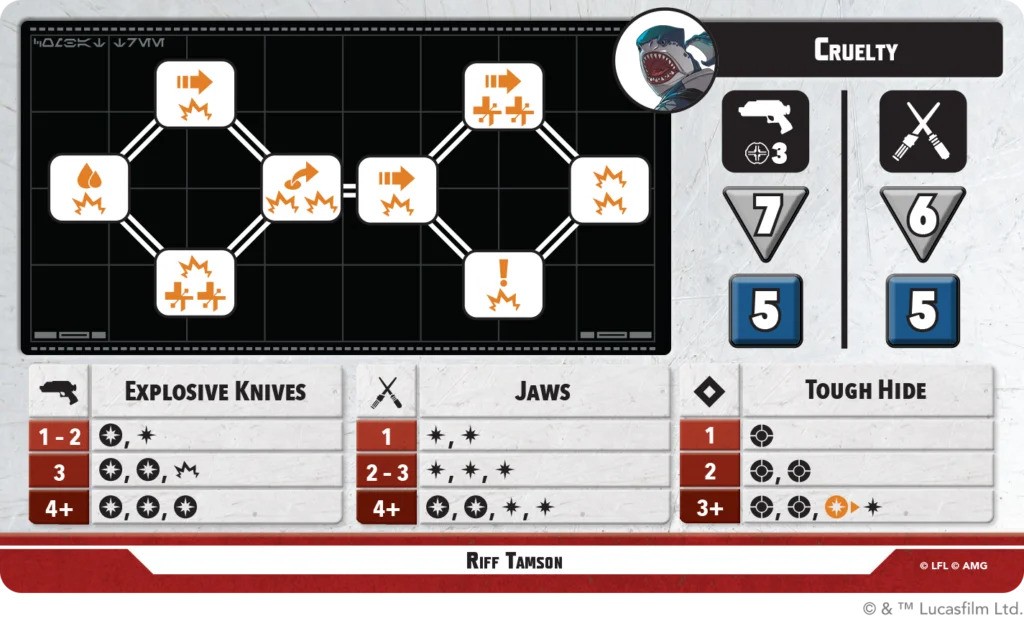
Riff Tamson’s two stances play drastically different, and knowing when to use each one will help you succeed with his Blood in the Water attacks. I heavily prefer the Cruelty stance for Riff. This chart has great melee expertise, a shove on the second step, and a jump on the third. As hinted earlier when we discussed the Coverts, we’ve seen a few models in recent releases with expertise charts that tend to favor more strike results instead of pure crits (Ki-Adi Mundi, Ahsoka, Fulcrum, and Covert Mandalorian). Against models with ways to mitigate critical results as their defensive expertise, the increased number of strikes can be used to overwhelm the number of blocks enemies can roll. Riff can easily get 2-4 steps on his Blood in the Water attacks , and push through the extra damage needed to wound someone or the jumps needed to an important objective. I will use the Savagery side of Riff’s stance when I need him to kill something in one attack during his activation, such as when attacking Clones under General Obi-Wan. Obi-Wan’s identity to heal and dash back onto a point is less effective if I can wound them with one attack roll.
For mission selection, we want to choose Sabotage Showdown or Shifting Priorities. This list lacks the out-of-activation movement, speed, and infiltrate deployment needed to success on Never Tell Me The Odds and First Contact mission packs. My personal preference is to play Sabotage Showdown. The potential for force refresh from the mission can help smooth out some early force problems. In addition, by the second struggle, models tend to clump more towards the middle, giving Riff more targets to attack and more potential dice. Shifting Priorities can also be a fine mission pack because Riff’s Blood in the Water can help him easily navigate between the midline objectives.
With all three list options listed out above, the game plan should be to get wounds early and decisively win out a struggle. However, the lists also benefit from the longer and grindier games of Shatterpoint. Riff’s incidental healing on his Cruelty tree and The Mandalorian’s ability to remove conditions add up to increased resilience in long struggles. Learning when to give up on a struggle can also help you better setup and plan around Cassian’s “This Town is Ready to Blow” ability if you are using this primary instead.
Final Thoughts
After taking most of the summer off from the game, Riff has featured in nearly 90% of my recent matches. I recognize this list-building approach isn't for everyone, as there's no cohesive thematic thread across units, and these lists require 5-6 different Shatterpoint boxes. However, for veteran players who've been with the game since the beginning, this flexible approach offers a refreshing way to engage with Shatterpoint's strategic depth.
I want to credit the players who inspired this article. Christopher 'Pure' Samson, who recently won LVO with Riff in his Premiere list, has been pioneering Riff-led Scoundrel lists for months. Scott 'Evil Houdini' B performed impressively with a Cassian and Riff list at Nova. Players like Duncan 'Godlyness' and Donavan, the self-proclaimed Shark King, have demonstrated the viability of running the Riff Tamson box as a standalone squad.
However you choose to approach Riff Tamson, I encourage you to put this goofy, evil space shark on the table and discover what makes him such a compelling commander. The water's fine—dive in."
Have any questions or feedback? Drop us a note in the comments below or email us at contact@goonhammer.com. Want articles like this linked in your inbox every Monday morning? Sign up for our newsletter. And don't forget that you can support us on Patreon for backer rewards like early video content, Administratum access, an ad-free experience on our website and more.Thank you for being a friend.
 This website uses cookies. Learn more.


 Infinity N5 First Principles: Understanding the Outcomes of Face to Face Rolls
 Tactical Feedback: Timing the Go-Turn
 SRM's Roundabout to Adepticon 2026: Curd Is the Word