Many thanks to Games Workshop for providing us with an advanced copy of Darkwater for review. Additional thanks to my wife - an avid boardgamer and enjoyer of dungeon crawlers - for helping me with this review.
The followers of Nurgle have overrun the Jade Abbey, seeking to corrupt the Everspring. Four brave heroes stand in their way, on a quest to rid the Abbey of archvillain Gelgus Pust's minions. Does Darkwater stand out among Warhammer Quest games, and dungeon crawlers in general?
Unboxing Darkwater
The Rules
- Rulebook & quick-start sheet.
The core rules got a bit of a shakeup from previous modern Warhammer Quest games. More on the rules below - but the short version here is that things have been streamlined a bit. Think of the book as walking you through the critical path; the complexity lies in the cards.
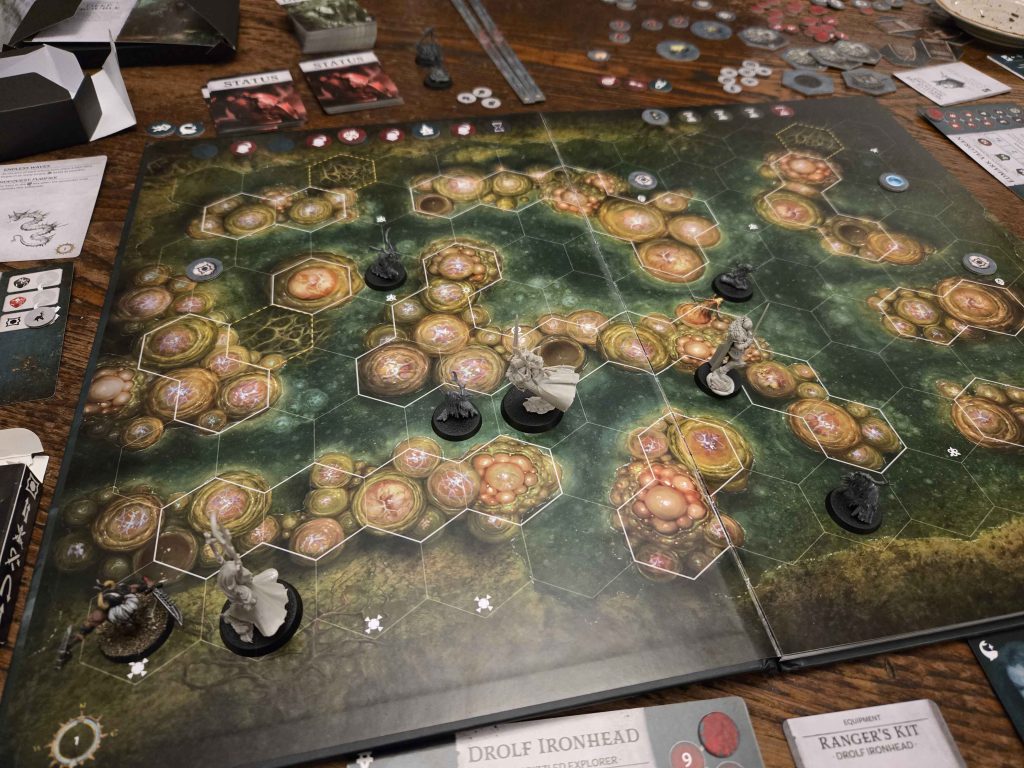 I gave some hero and enemy minis to another GH writer to paint. Please enjoy my proxies.
The Map Book
- A box-sized book that folds out into the battlefields of Darkwater.
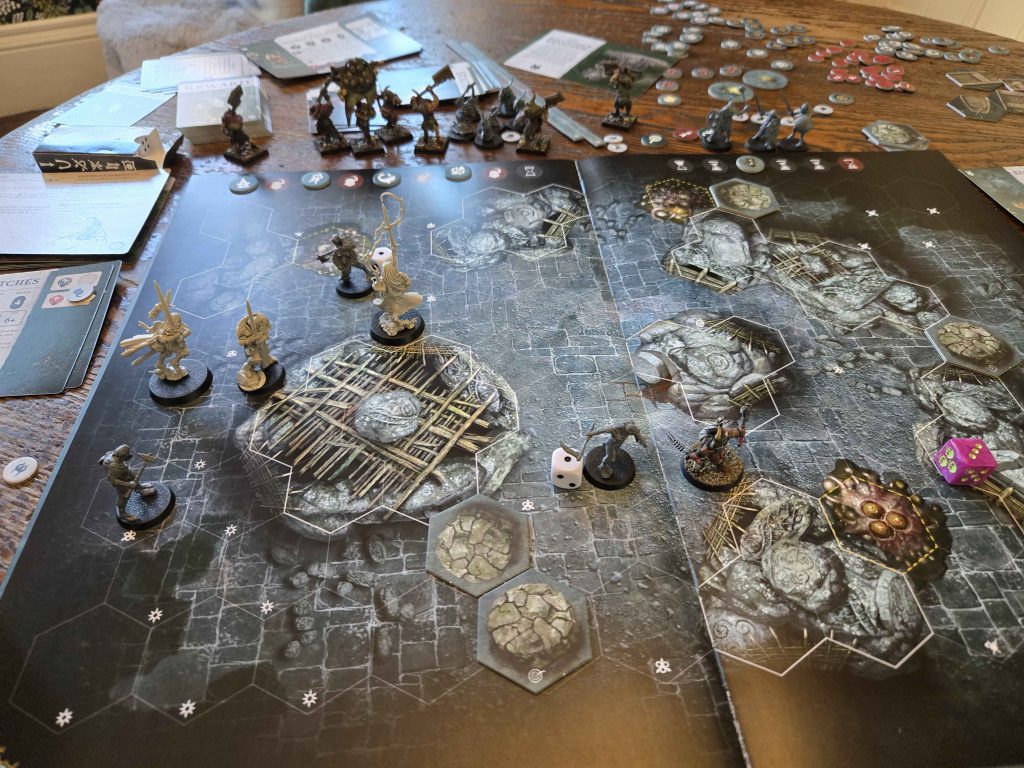
I was skeptical of the move from tiles to a book, but they really knocked it out of the park here. It is enormous.
Cards
- Hero Cards for each of the seven playable characters.
- Equipment and rewards cards for the heroes.
- Core Action Cards that represent the basic things heroes can do each round.
- Enemy Cards for all of the foes you face.
- Encounter, Event, and Boss Cards that contain the rules for the scenarios that you will play.
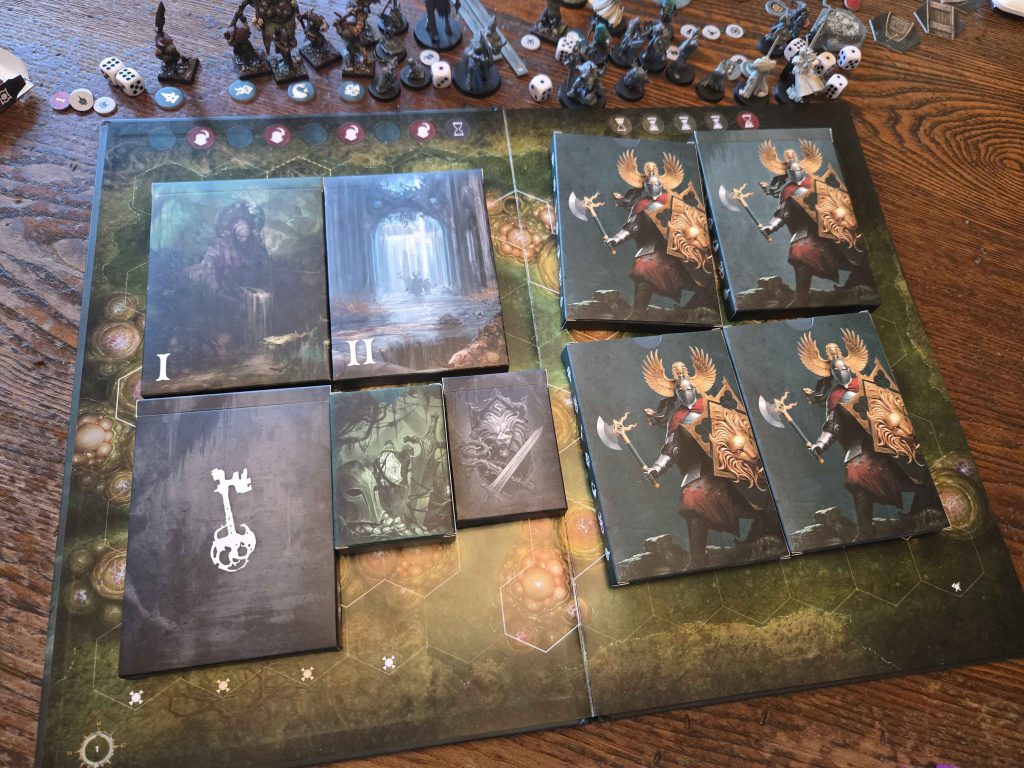
Cards handle the game scenarios & objectives, outline enemy behavior, and represent the loot players get to upgrade. Setup and teardown is very easy - as you generally just need a couple of cards to figure out the map page number, deployment, perils, and win condition.
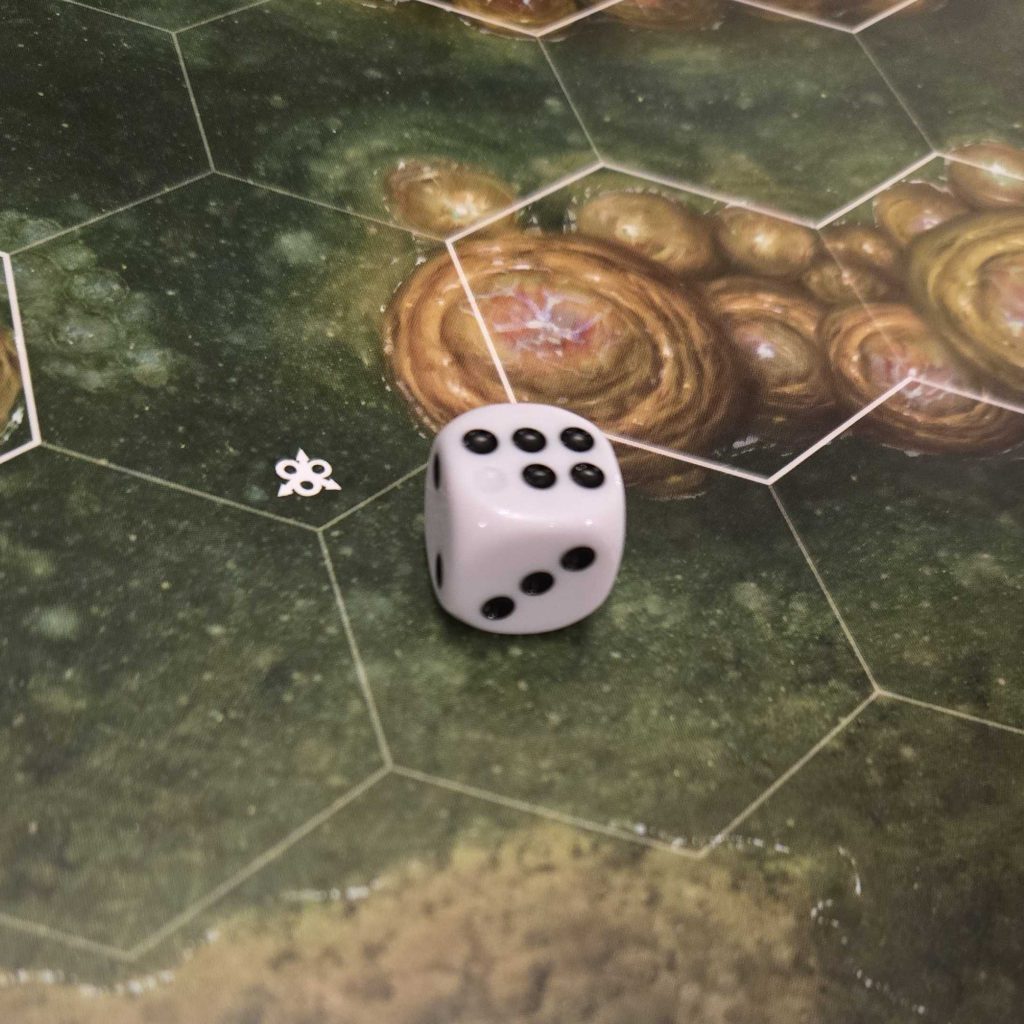 If you are a Nice Dice Enjoyer, bring your own D6's.
Play Aids
- Piles of tokens that represent status, initiative, hazards, and bonuses the models have.
- Deck Boxes
- Boxes for each Act's encounters, events, and bosses.
- 4 boxes, so each hero can keep their hero card, equipment, and rewards stashed between games.
- Small boxes for used and available rewards cards.
- Boxes for SECRET things you unlock as you go.
- Two custom dice for enemy actions, and some buck-average white-and-black 12mm D6's
GW has included deck boxes with a few sets, and it's a nice touch. I didn't open the box and immediately start thinking about needing an MDF organizer. You will need a bag for tokens, however.
Miniatures
This box is HEAVY - while I was too impatient to grab a scale, it felt on par with the beefier boxed games GW has released. If you are looking to give
Darkwater as a gift, unboxing is definitely a spectacle. Like the recent Kill Team and Underworlds sets, this one is neatly organized, with cards each sealed into envelopes - organized by category and type and covered with nurgley art.
With the map book on the bottom - and the cards in a couple of layers above - there is plenty of room for all the miniatures to fit inside the box for storage - just be careful about tipping it over.
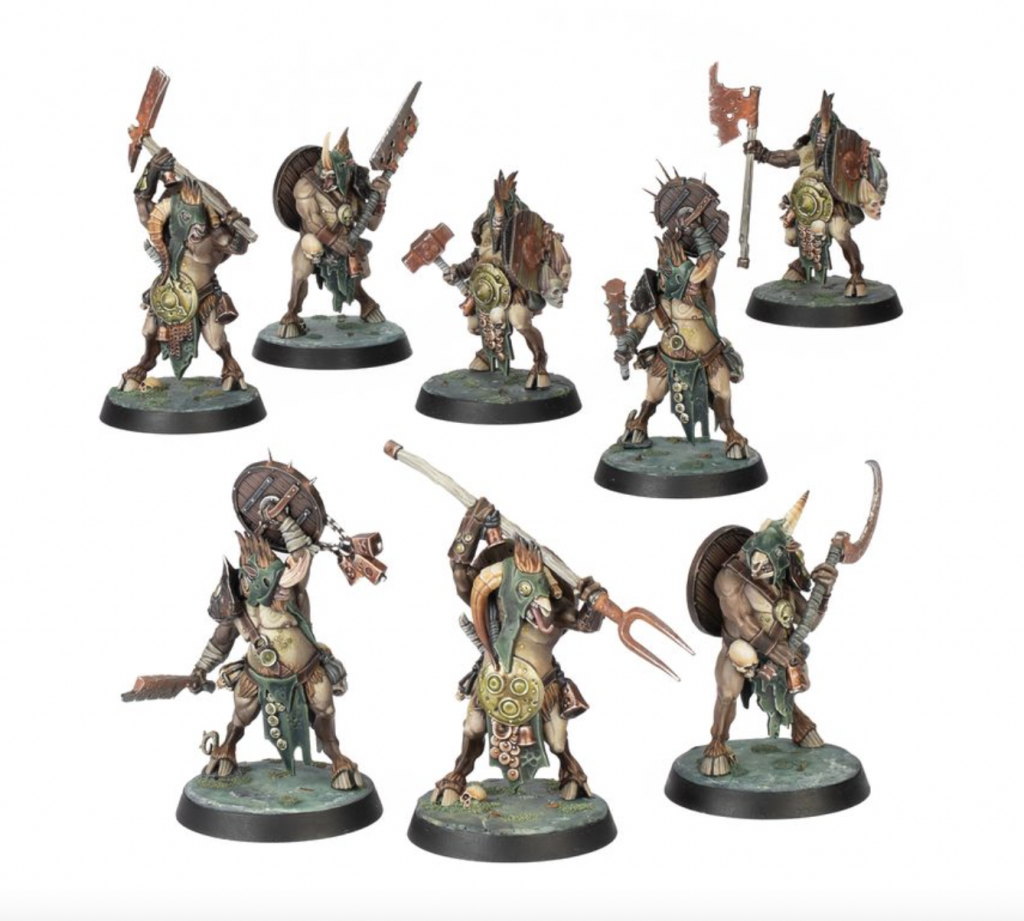 Pestigors. Credit: Games Workshop
The Rules
This is a living review of the game through the end of Act 1 (of 3). I intend to follow up when I have progressed further or beaten the game.
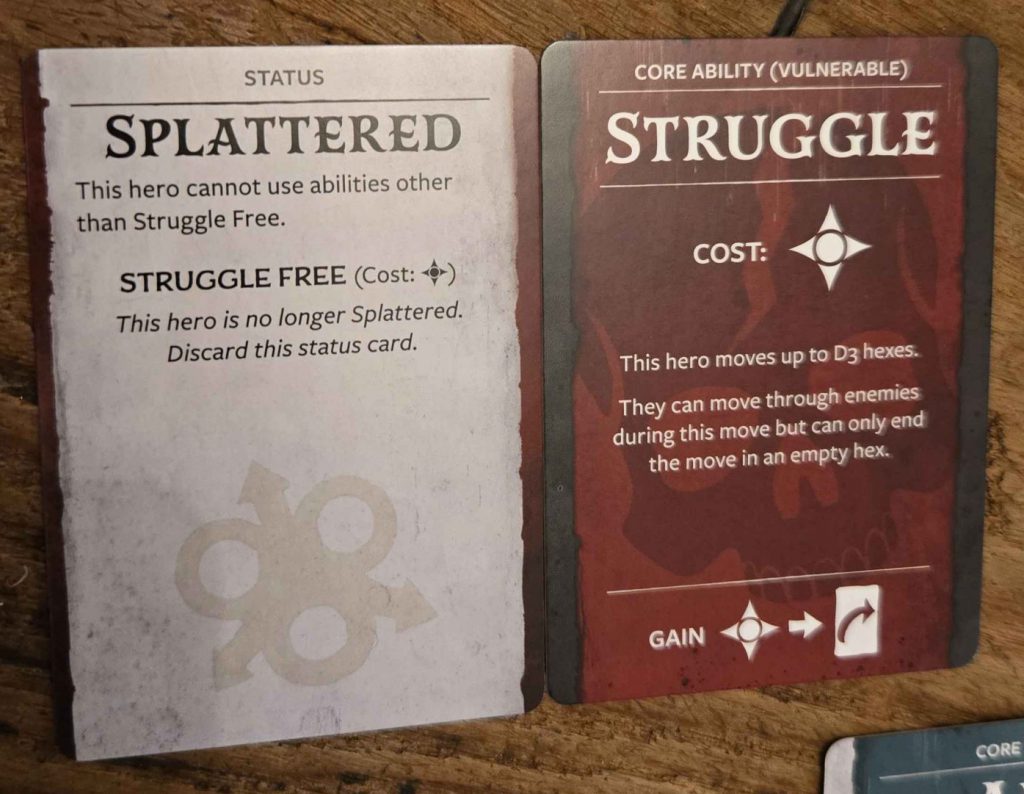
Darkwater shakes up the Warhammer Quest formula by switching to a simpler core action mechanic. Each hero has three actions they can take, and gets the equivalent of three actions per activation. This is explained in a way that my wife and I found a bit clunky. You have a card to represent each action, and "tap" it for a turn to gain the action resource. This game is a bit of a
">space hog, we opted to use tokens to track actions instead and kept one set of these cards between us for reference. There is an alternate set of available actions if you are on death's doorstep, so keep your action cards handy.
The standard actions are: move, attack, and aid. Aid is used very sparingly - generally to stabilize a dying hero or untangle a friend. Most heroes move D6, which can definitely get very swingy. If you want to shell out two action points, your hero can move a guaranteed 6 spaces. Attacks tend to hit on 3s, and crit on 6s, and offense can feel quite feast or famine. Each successful attack on an enemy applies damage. If the enemy has armor, it reduces your number of applied damage by one. If you have one success and no armor, the enemy takes one damage. If you have one success and the enemy has one armor, the attack has no affect. If you have a success (one damage) and a crit (two damage), this overwhelms the armor rating of one and deals two damage to the enemy.
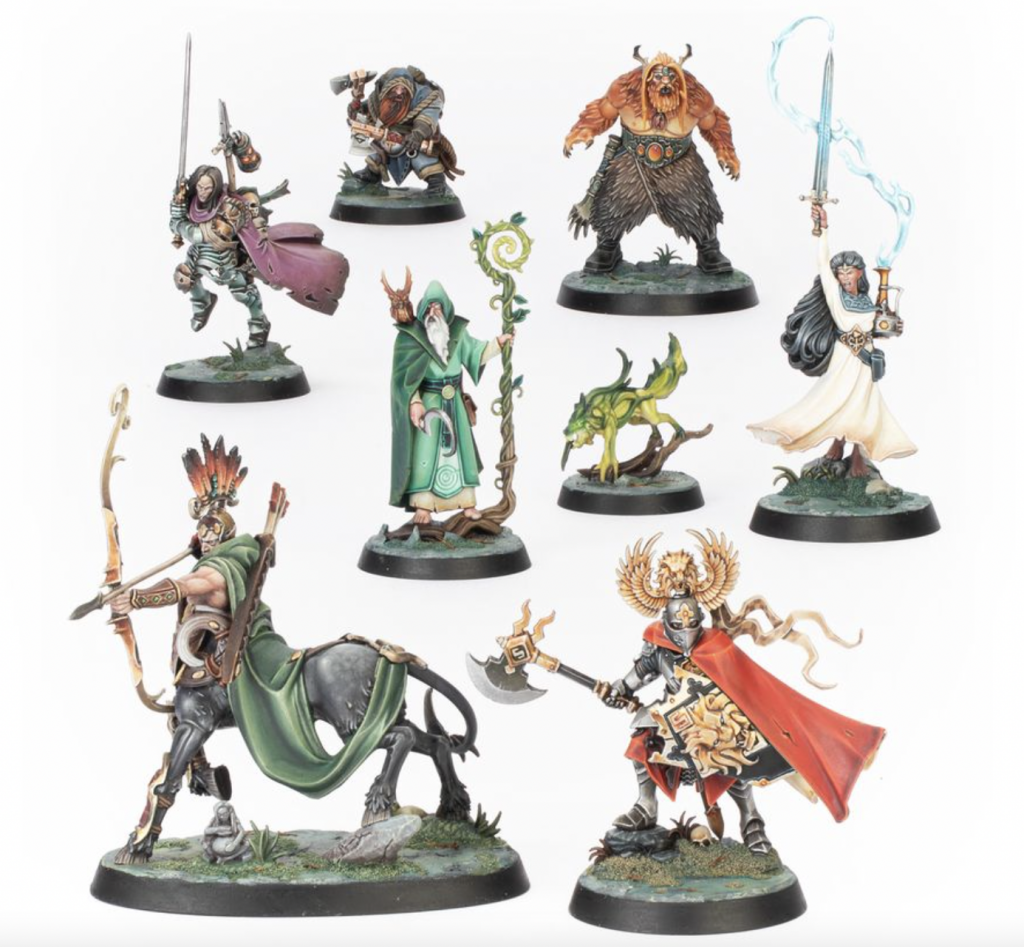 Heroes. Credit: Games Workshop
When you open the box, four of the seven heroes are available to play. Edmark Valoran is the leader of the tutorial mission. He is a knight of Hammerhal who turns good defense (3+ save) into offense. Every time you make a save, roll a D6 - on a 5+ you deal one damage back to the enemy that attacked you. Bren Tylis is up next - a mercenary whose special ability lets her pick a dice category to reroll that turn - move, hits, or saves. Inara Sion uses the elemental power of water to deal ranged damage, and to summon a waterspout that can impede the enemies' path. When strong enemies are in the mix, controlling enemy movement AND having a ranged attack is excellent - but her save is 5+, leaving her very vulnerable to enemies. Last up is Drolf Ironhead, slow and steady. His move is a static 3, but he has the ability to pass through one blocked hex per turn.
Speaking of hexes - even though the last two Warhammer Quest games were also on hexes, this one feels a bit like a Warhammer Underworlds co-op board game. This is completely unscientific and completely vibes-based. Maybe it's the simpler moment-to-moment gameplay loop.
Dice are significantly streamlined from the past two games. Gone are the success dice that I always found a bit hard to read. Everything is done via a D6 (or D3). Many actions use standard D6's, enemy behaviors are governed by two custom dice. These dice determine if the enemies move, attack, do both, can't crit, auto crit, and so on. Each die has a face for a special ability, an image that I suspect will be burned into players' minds. In the intro scenario, this result means that the ghostly-deer-looking Mire Kelpies will barf on a hero in range, forcing them to burn an action to break free. Scarier enemies have some pretty horrifying effects, like a charging attack or applying a curse from afar.
Setting Things Up
Unlike games that have a more traditional down-the-line initiative system, your foes will activate in between each hero's actions. Smaller enemies activate in groups, meaning that the closest four little guys will be moving / attacking / barfing in between each go. This can get deadly very quickly, even with smaller enemies. Sticking together and playing to your strengths is key! Each type of enemy activates in the enemy turn, but the leader (whoever goes first) chooses that order - so there could be some creative play having the little guys go first. At the end of the entire battle round (all heroes have activated, and the enemies have gone after), move the marker on the top right side of the enemy card down to the next row, or back up if it is marked as such. This means that the enemies have patterns you might need to watch out for... you might want to save your frontal assault for the turn after if the big bad is more likely to auto-crit or start shooting off curses. This is pretty clearly mentioned in the instructions, but left out of the quick ref - so don't forget!
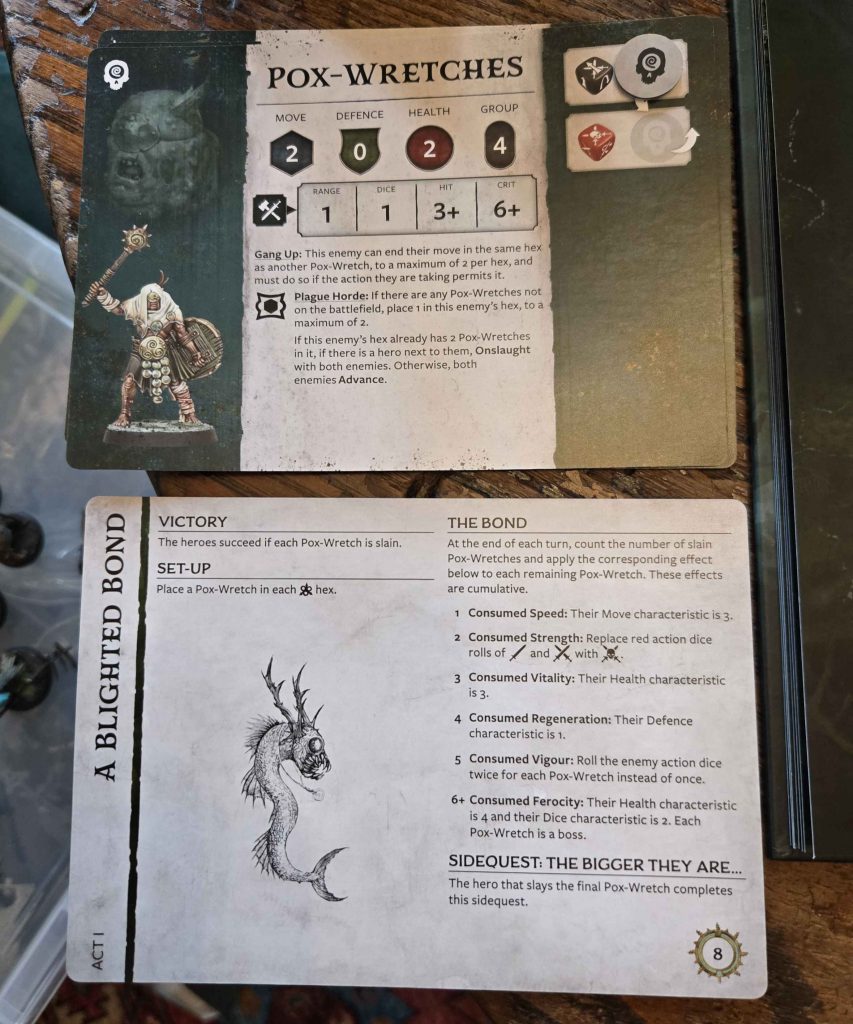
The map and enemies are laid out in Encounter cards. Each card tells you which map page you are playing on, the enemies you will encounter, where everyone will deploy, special rules that may be active, and how to win (or lose). Scenario rules can supersede regular rules as written! Enemy cards list the key stats - how far can they attack, how many hexes do they move, do they have armor, how many health does each have, and how many of this enemy will activate when it comes up in the initiative order. Some enemies may crit on a lower roll than six, so keep an eye on that stat. The cards also list the passive abilities (two Pox-Wretches can occupy one hex) and the dreaded special action dice result - in this case, a lone Wretch summons a dead friend to their hex!
Playing the Game
You can play one-off skirmishes, but the real meat of
Darkwater is playing a campaign. Round up zero to three friends and pick your heroes and leader. Then you make a deck from the Act 1 cards: pick a boss fight (based on the flavor text, no peeking), and randomly select 14 cards from the set of encounters, events, and respites. Encounters are the fights as described above. Events may involve a non-combat adventure; sparring with your fellow heroes, choosing which shrine to pray at, or attempting to grab some extremely cursed loot. Respite allows the crew to heal, at the cost of not risking it for some sweet loot. To choose your next move, draw two cards from the top of the deck you made. You can choose to play either of these scenarios based on the flavor text. There is a serious risk-reward balance here. Playing it safe might keep your heroes fresh, but you will arrive at tough encounters without building up a stock of rewards - cards that give your heroes extra abilities.
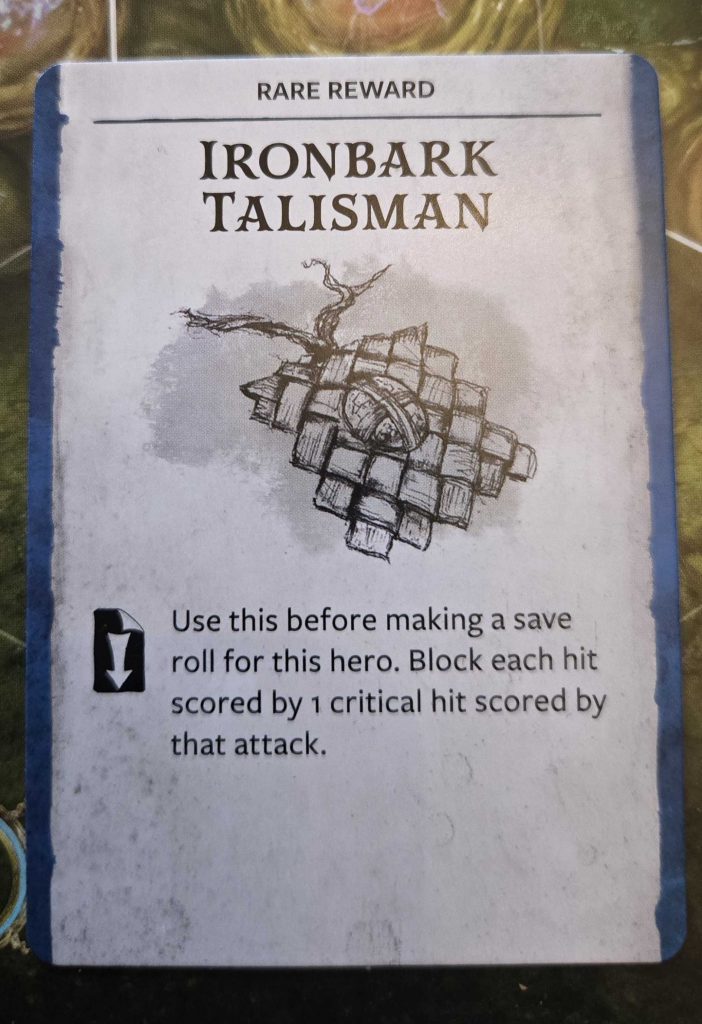
Depending on how well your crew handles the encounter (or event), you will get a set number of rewards cards dealt out between the heroes. You can typically choose one from your hero's pool (though some abilities may let heroes take more). There are rarity levels of rewards, common, uncommon, rare, and so on. Higher rarity rewards tend to have larger effects, but they may not always fit into your character's playstyle. A reward card might let a hero move two extra hexes, or get an extra attack, or gain an additional action if no one else can see them.
Unlike some of the more punitive Warhammer Quest games, you get two shots at a mission before you fail the campaign. I cannot tell you how many times that someone just drew a bad card, rolled poorly, died in recovery, and ended a campaign in Blackstone Fortress. My groups always had houserules around things out of your control. One particularly tough mission in
Darkwater had rising water that progressively slowed the heroes down more each turn (except for Inara, she LOVES water). I needed a crit on my last movement to win and got it. If I hadn't made it, I would have hated having my campaign end because most of my heroes beefed their move rolls in the first round.
A Blighted Bond might have been the spiciest encounter that I played in my tour of Act 1. As you kill Wretches, they power-up. This leads to some grim math by the end - each Wretch is rolling the enemy die TWO times. As you activate four wretches at a time with two actions each, they kept coming back faster than I could kill them. This was definitely a big difficulty spike, and it took me a second try to win the encounter. Heroes do not fully recover - they heal 6, so the redo is not without a cost.
If you manage to finish 7 missions and the boss, you have beaten the act! There are multiple act-end bosses and a large pool of encounters, which will be great for replayability. I did a couple of extra missions to sample the variety that was available. For the board game design heads, I had a roughly 85ish% success rate across this, taking into account a loss in
A Blighted Bond and a rough time in an event. The boss fight I picked was fun, though some mechanics were a bit vague. An enemy spawned inside of a wall with two ways to move out. I rolled a die to choose the direction, as both ways were an equal distance to a hero. Should we have maxed threat and gone in the direction of the weaker hero?
Aliens: Another Glorious Day in the Corp lays this out pretty explicitly, but your crew will have to make the call here.
Things I Liked
- The map book is fantastic. The size is impressive and the art is some of the best GW has done for game boards.
- Simpler action economy. I will miss rolling destiny and action dice, but I like that the player turn complexity comes from the board state and gear you've picked up.
- Quick setup and teardown. You can dump out the hero deck boxes, open the act pack, and set up the book - and you are ready to play. Blackstone Fortress and Cursed City felt very picky when it came to cleanup.
- The models are fantastic. Some of the best Nurgle models ever made. The minis alone would sell me this box.
- The missions (mostly) maintain a difficulty and risk balance. An experienced board gamer, dungeon crawler, or wargamer should be able to hold their own in most scenarios.
- Being more forgiving is good. Heroes needing to fail a scenario twice to lose is a much fairer way than two bad rolls and it's over. Having a continue is nice!
Things I Didn't Like
- The map book is too big to fit into a standard backpack. Other games could get broken down into backpack / army bag storage, the big honkin' book needs something special. Don't get me wrong - I LOVE this book, but transporting it safely may be a pain.
- Losing granularity in basic actions. Having multiple options (and success criteria based on range, etc) for attacks in BSF was exciting. Dice are dice - and this may be an early game problem before gear piles up - but some heroes felt like playing to their strengths & weaknesses wasn't very exciting if they keep failing hits. There was little else in the action economy to do aside from moving my waterspout around. Maybe I am just salty about failing NINE 3 ups in a row with Inara.
- No trading (so far). I enjoyed going to the trader, but I certainly won't miss needing three different books to play the game.
- Onboarding was tough. At time of writing, the QR codes for the how-to-play videos go to an announcement for the game. We found that the Quick Start sheet was lacking some important things, and the rulebook was a bit too light (19 actual rules of pages). Some basic stuff was easy to miss, or hard to understand. Take your time and read the entire book a couple of times before you play off of the quick ref.
- Some of the wording on the rules / cards is confusing. I'm sure things are written to be lawyerly, but my wife and I ran into some real headscratchers. Having an experienced player that says "oh that means X" will definitely help, but not everyone will get into this game with a friend in the know. Having to keep re-reading a card definitely took the wind out of our sails. Some cards have similar wording to others, or re-use some keywords in a way that was confusing at first.
Some Additional Details
- The map book is 22"x17" fully laid out. We played on a 44" round table and only needed about 3/4 of it. You can probably play on a decent-sized coffee table, but it's better if the board and cards have a bunch of space around it - especially if you have multiple players.
- If you know what you are doing, encounters can be quick! Once the main stuff clicked and we stopped getting hung up on the wording of cards, missions got quicker and quicker. Save for difficulty spikes and the boss fight, it felt like you could get into a groove and mayyybe knock out Act 1 in a long afternoon?
- The models on two sprues (tokens, kelpies, wretches, & pestigors) have two different build options for each body. This is standard GW kit stuff, just a heads up if you are new to the hobby. You definitely want them to look different.
- Assembly is pretty easy if you know your way around a Warhammer kit. If you are new to the hobby, this might be an adventure. Goonhammer has plenty of articles and ">videos to get you up to speed. Use plastic glue, get some cheap-but-nice nippers, and be patient! These are among the easiest Warhammer models to prepare and build.
Did We Like It?
I am all about this box from a model perspective. Even without the game, this is an impressive box for the nurgle enjoyers - containing some of the best models in the range. In terms of gameplay, I think the initial clunk of onboarding dampened our enthusiasm quite a bit. Both my wife and I didn't feel particularly motivated to keep rolling after our first couple of missions. Even with the gorgeous maps and fantastic models, the early going felt either too stiff or too punishing. As a dungeon crawler fan, I wanted more "hell yeah" moments. I stuck with it through the end of the act, and did enjoy the rest of the time I played - but I was left wanting more. At times I found myself longing for the paranoia of the Aliens game, or the deeper non-combat that Eldritch Horror / Mansions of Madness covers. This feels like a bit of deja vu, as my initial reaction to Cursed City was very similar. I hope this review can help folks get into the game a bit easier, and make their experience more enjoyable.
If I had to rank it against the other modern WHQ games, I would put it way above Cursed City, but not up there with Blackstone Fortress. Stay tuned for a review update as I take on Acts 2 and 3.
That all said, I think there are tons of folks looking for a solo adventure, game night indoctrination, or just a quick bite... that will be all over this game.
Darkwater is also prime real estate for a mod that adds a game master and removes the enemy AI. I'm sure we will see Edmark and Gelgus patroling the hexes for many years to come.
Have any questions or feedback? Drop us a note in the comments below or email us at contact@goonhammer.com. Want articles like this linked in your inbox every Monday morning? Sign up for our newsletter. And don’t forget that you can support us on Patreon for backer rewards like early video content, Administratum access, an ad-free experience on our website and more.
Thank you for being a friend.
 This website uses cookies. Learn more.


 Goonhammer Hobby Round-Up: March 2026
 Goonhammer Reviews: Tribal Conquest
 Conquest: Weaver Courts Gemred Knights and Scaile Dancers Model Review