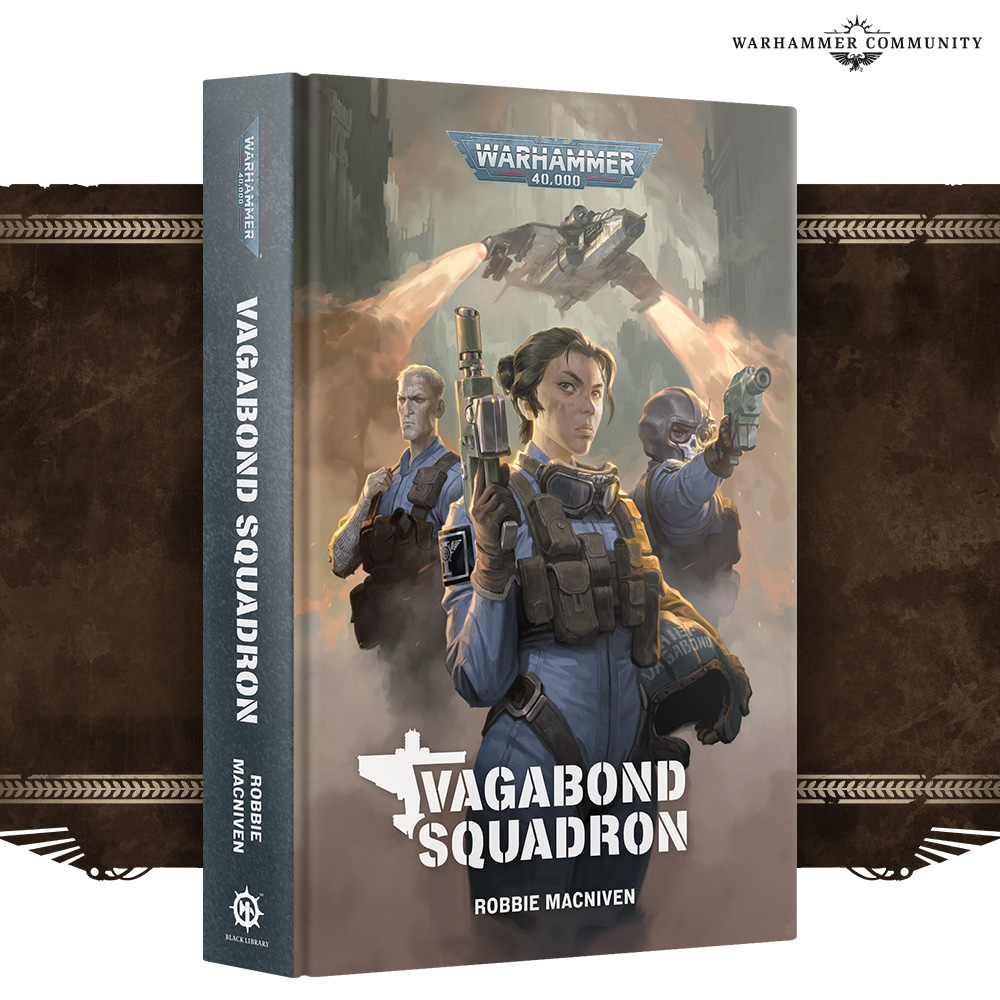
 Image credit: Games Workshop
In 2006,
Apoptygma Berzerk released the album
You and Me Against the World, an album that in a single stroke divided the fanbase. While the previous decade had seen the Norwegian (mainly one-man) band mature from early gothic-tinged EBM into a smoother futurepop sound, the rock-influenced 2006 release seemed to come out of nowhere
1.
Being such a departure from the band's apparent trajectory,
You and Me... was certainly no small gamble. Would the fans follow along for the ride, or would they have to rebuild a fanbase more into the new sound? For Apoptygma Berzerk, it was undoubtedly a bit of both as the album proved their most commercially successful venture to date. But it also posed an interesting question, one asked many times before and since of bands who endure over the course of years: is it better to stick with what you're comfortable and familiar with, or to strike out in new directions?
Music history is littered with bands that damaged or nearly cratered what they'd built with something either ill-conceived or ill-received.
Celtic Frost's glam-metal flirtation
Cold Lake in 1988.
Metallica's Load (1996).
Korn's Path of Totality (2011). Of course, the opposite is true as well, such as Radiohead's Kid A (2000) or
David Bowie's Low (1977).
For writer Robbie MacNiven,
Vagabond Squadron is a similar roll of the dice. After a couple of years of writing short stories for the Black Library, he made a big splash in 2017 with a trio of novels:
Dawn of War III,
The Last Hunt, and
Red Tithe. It was July's
Red Tithe where we began to get sense of MacNiven's strengths in crafting Astartes stories focused on mysterious and enigmatic Chapters like the Carcharodons and Exorcists (in 2024's
Oaths of Damnation).
Vagabond Squadron is MacNiven's
You and Me Against the World, and like that album it didn't entirely come out of nowhere either. "Despite this being my tenth Warhammer 40,000 novel," he notes in the Introduction to the book's Special Edition, "it is actually the first where ordinary, unaugmented humans are the main protagonists, rather than the Adeptus Astartes..."
"I've long had an interest in military history2, so the Imperial Guard have always been a favorite faction, and I knew from the beginning of this particular project that I really wanted to explore the tribulations of an all-too-human, all-too-fallible cast of largely unremarkable combatants who, though good at what they do, are still a very long way away from the hyper-indoctrinated super soldiers I usually write about."
The Story
The campaign against the Orks on Kanai Terius isn't going well, and a bold offensive to split the Ork offensive between two cities has not only floundered, but left an entire army group encircled in a pocket. The ground fighting is fierce and bloody, the skies little better.
Into this cauldron fly the Vagabond Squadron, elite Valkyrie pilots of the 901st Tactical Wing. These aren't fighter jocks; the vertical-takeoff-and-landing (VTOL) capabilities of the Valkyries ensure that their missions have more concrete objectives beyond mere air superiority. When you need a kill squad of Tempestus Scions inserted behind enemy lines to take out a high-value target, or a platoon extracted under heavy enemy fire, the Vagabonds- and squads like them- are the right tool for the job.
When squadron leader Capt. Cassandra Elza gets a disturbing set of top-secret special orders, it kicks off a chain of events that will see them having to risk everything not only to prevail against the Orks- but just to survive.
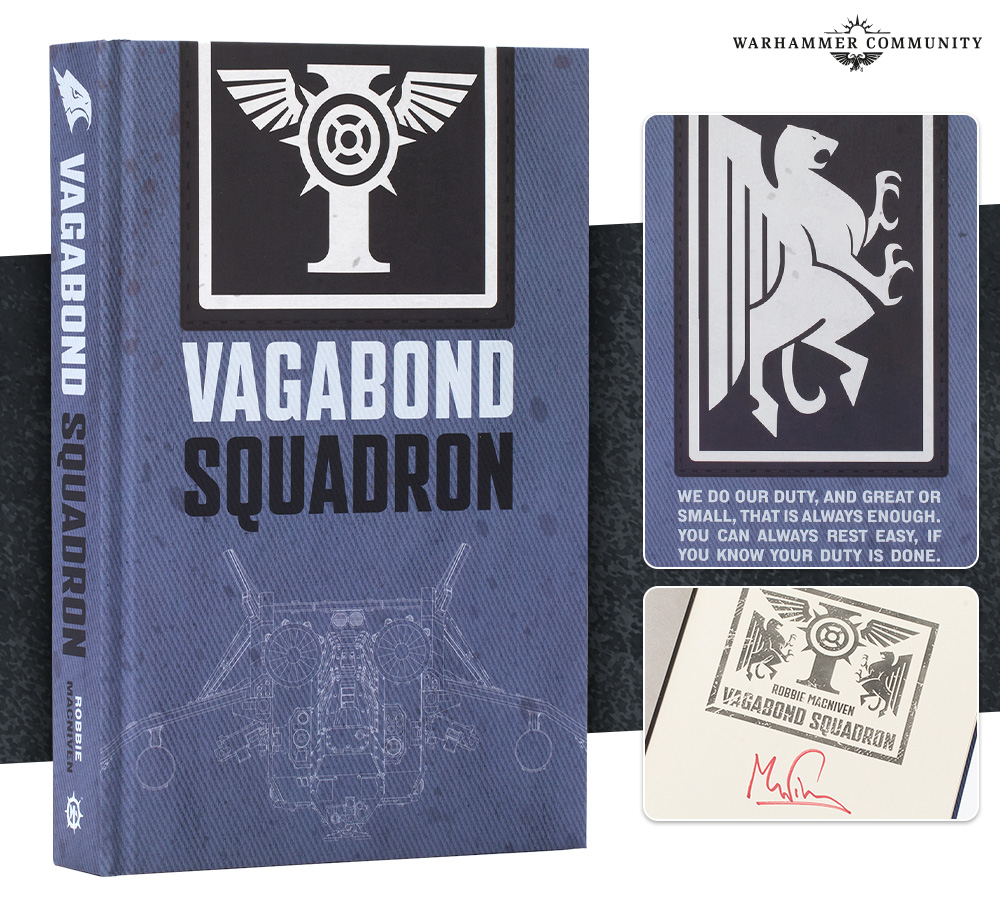 Image credit: Games Workshop
Pulling It Off
Having read (and enjoyed)
Red Tithe and
Oaths of Damnation, I was a little wary going in to
Vagabond Squadron. In both those earlier novels, they largely peaked in their premise. MacNiven was riveting as he introduced the Carcharodons and Exorcists, two very intriguing Chapters but whose initial introduction and mystery tended to regress into lengthy bolter-fight action sequences as the story progressed.
To be fair, MacNiven could well be a victim of his own success given how much I found myself wanting to learn more about the Chapters rather than just turning page after page of fight scenes (ever the trap of Astartes-centered books in particular). But I was prepared to find an uneven experience in
Vagabond Squadron, and to MacNiven's great credit I only found myself once wishing a fight sequence would wrap up so I could get back to the plot.
One of the smartest choices he made in sketching out the novel was in keeping the point of view firmly one-sided. "Writing about ork air power was something else i had wanted to do for awhile," he notes, "though unlike my past novel featuring orks-
Blood of Iax- I decided against including any xenos point of view, focusing instead on the brutal, bestial threat they present from the perspective of the Aeronautica's hard-pressed aviators."
Perhaps more than any other faction, Orks carry a certain baggage with them when they move from the background into the foreground. You don't need to lean all the way into the kind of silliness you get with a primary-POV Ork perspective, but the pure savage menace they can present is somewhat diminished once the beasts start talking. Good books take advantage of that to find an entertaining middle ground, such as with
Rob Young's Leontus: Lord Solar (
review)
3.
MacNiven wisely keeps the Orks as faceless antagonists throughout
Vagabond Squadron, and in so doing extracts every bit of threat from them to drive the story forward.
The other strength he brought to the story was in doing his homework.
"I also wanted to... make everything as tangible and realistic as possible, from the Valkyries themselves and the way they handle, to the way the command structure functions, right down to the interactions between aviators, how they speak to each other in and out of combat, and their thought processes both during aerial engagements and during those almost equally difficult, tense periods of waiting and recuperating in between. I read and absorbed the accounts of real-world military pilots in an effort to find some deeper verisimilitude that I could layer onto the familiar grim darkness of the setting that we all love."
Vagabond Squadron is filled with even the smallest details that bring the story roaring to life. How the aircraft handles in combat. The perils of being a heavy gunner providing flank support. The pinging of munitions off the hull as ground fire finds its focus on the Valkyries inbound. The result is a very gritty, you-are-there kind of tale that easily takes its place amongst some the better Astra Militarum stories out there. Paired with some strong character work and an "anyone can die" approach to his assembled cast, MacNiven keeps the pages turning and
Vagabond Squadron never wears out its welcome.
Final Thoughts
If the book suffered from anything, it was a factor outside of MacNiven's control: the cover. The Special Edition was seen as particularly underwhelming, but even the standard-edition cover art (by
Vladimir Krisetskiy, who has done plenty of other work for Warhammer and Magic: the Gathering) was noted as being a bit more movie-poster style and less "grimdark."
In this case, those judging the book by its cover are only shorting themselves, as Vagabond Squadron is not only terrific, but it showcased Robbie MacNiven as a talented voice in telling the stories of the Imperial Guard and Aeronautica. This is a gripping war story, and MacNiven keeps the pace moving without getting overly bogged down in the kinds of action sequences that saw his previous Astartes-focused works tend to drag towards the end.
It also gives him a great opportunity to show off some of his military strategy background. Astartes stories don't tend to be mass battles involving huge numbers-
Red Tithe took place entirely upon a prison planet, for instance. When MacNiven describes the cut and thrust of different mass armies going up against one another, not only does his experience make it clear and easy to follow, but you may even feel like you're learning along the way- not unlike the siege tactics woven through
Graham McNeill's classic
Storm of Iron.
Vagabond Squadron is quite different, then, than MacNiven's previous novels, and a terrific ride throughout. The story is grippingly-paced, with a page-turning variety of scenes and set pieces that remain engaging and compelling. From dogfights in the air to refueling actions on contested ground, the pilots of the Squadron (and their more terrestrial counterparts) made this one a page-turner.
As some of his finest work to date, I hope MacNiven sticks around the common barracks for awhile longer. The Astartes will be there- they always are- but tales like this are much harder to come by. Having made the pivot from his old sound to the new, there are plenty of great albums ahead!
Footnotes
- Perhaps it shouldn't have. A track at the end of Welcome to Earth (2000) seemed to prep fans for a transition of some kind, with Stephan Groth quietly announcing, "Listen up. Keep your eyes closed. This is the end of the first phase. Now it's time to move on."
- MacNiven's being a touch modest here. He's got a Master of Letters in War Studies, a PhD in the American Revolutionary War, and has written six books for Osprey Elite's line of illustrated military history line.
- Young's POV positioning allows for a small bit of dialogue between his main character and the Orks, enabling one of the hardest lines in recent memory ("just another Ork").
Have any questions or feedback? Drop us a note in the comments below or email us at contact@goonhammer.com. Want articles like this linked in your inbox every Monday morning? Sign up for our newsletter. And don't forget that you can support us on Patreon for backer rewards like early video content, Administratum access, an ad-free experience on our website and more.Thank you for being a friend.
 This website uses cookies. Learn more.


 Goonhammer Hobby Round-Up: March 2026
 Goonhammer Reviews: Tribal Conquest
 Conquest: Weaver Courts Gemred Knights and Scaile Dancers Model Review