Are you looking for a game that you can play with anyone, anywhere with minimal set up time or other overheads? Do you want to play a character-focused game with a persistent and ongoing narrative? Well, friend, rejoice because Crazy Uncle Krux has something good for you. Just don’t tell your parents I gave it to you.
Sudden Conflict is a hybrid Boardgame/Wargame soon to be published by a Melbourne-based team of creators. It’s a 3v3 Character Brawler with unique mechanics that is easy to learn and hard to master with a depth that comes from the different team compositions and ability interactions.
We would like to thank the team at Sudden Conflict Games for sending the Goonhammer team each of the three Core boxes to review.
The Settings (Yes, Plural)
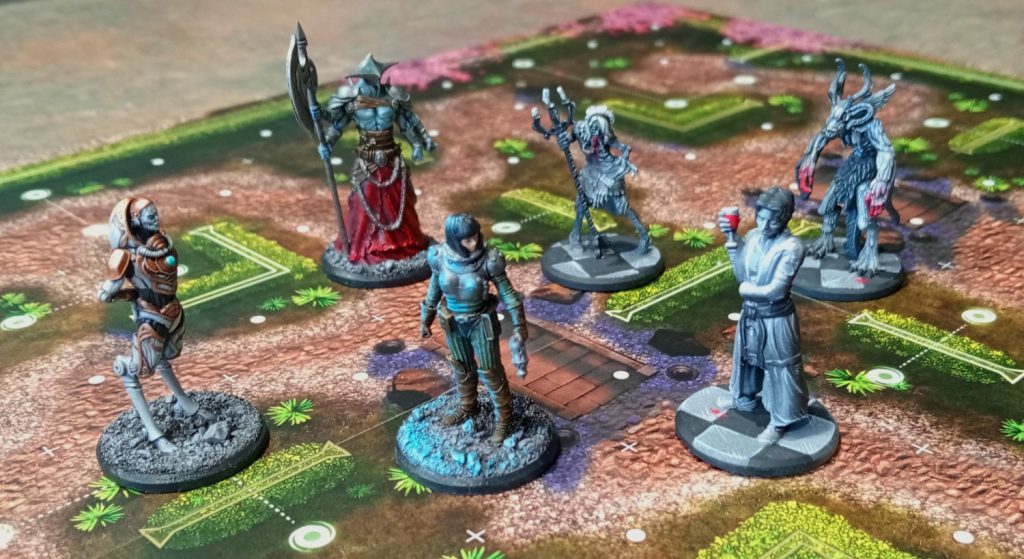 A game of Sudden Conflict playing out
Sudden Conflict is a game that has multiple different settings/realities, all linked by a series of clues and an emerging narrative that will come together as you read the accompanying narrative/stories, as well as future expansions. There are three ‘realities’ available to explore on release: Ukyo, Valrona and the Galactic Throne.
Valrona is a renaissance-era reality, with a missing Empress and all of the politics and court intrigue that accompanies a power vacuum. The Black Forest, once a place of calm and beauty, is now a dark place filled with horrors that need to be pushed back. On top of all of this, we have the Ashen Plague sweeping through the land, robbing the world of the young, as well as leaving any survivors sterile.
Characters of note within the Valrona setting include: Nikola Marcellus, a decadent noble who got caught doing one too many cheeky things and got his head cut off for it. (Un-)Fortunately, it didn’t stick and now he’s looking to make that everyone else’s problem. Dame Sapphire, a slightly-less decadent noble (or at least one who has taken steps to ‘manage her reputation’) who is pulling the strings of the delicate balance of power in Valrona. It is important to note that her ‘I did not cause the Ashen Plague’ shirt has people asking a lot of questions that are already answered by her shirt. Gulmar the Ashen Bound, a Frankenstein’s Monster that yearns for the freedom to explore the world rather than murder people on behalf of its dark master (Nikola, Nikola is Gulmar’s dark master).
In nerd-culture shorthand, Ukyo can be described as Redwall meets Teenage Mutant Ninja Turtles in Feudal Japan. It’s a romantic-era setting, where the tension between a burgeoning industrial revolution and the natural world. The Imperator sleeps, dreaming of a thousand other worlds drifting towards each other amidst a sea of infinite nothingness. While she slumbers, the Emerald Masters rule in her stead, claiming to know her will through Observation Spheres (I would, perhaps, suggest that these Emerald Masters are in fact Wizards Pondering Orbs). In order to manufacture and maintain these Orbs, the Emerald Masters must enslave the populace of Ukyo. This has not gone over nearly as well as one might think. Rebellion blossoms in the outskirts, as rumours that the Black-Blade (Kuro-Kinzoko) has been found by a peasant hero who will free Ukyo from the tyranny of the Emerald Masters.
My favorite characters from Ukyo include: Ophella, the two-headed prophetess Turtle with a Bo-staff. She’s also possibly the villain of this reality, having spent centuries manipulating each and every Imperator for her own ends. Kotai, the unlikely peasant hero that “found” the Black Blade (which is a funny way of saying ‘murdered the previous owner despite their kindness to him’), is a Tiger ready to kick ass and chew Dango, and he’s all out of Dango.
The Galactic Throne sits at the end of the universe, time has run its course, the stars are fading and refugees from dead and dying worlds are fleeing to the last few bastions of civilisation. Unfortunately, the Empress Melar (her business card says Galactic Tyrant but, listen, don’t worry about it) is deciding who does and who doesn’t get to huddle around the last few campfires in these dark times. The only thing that keeps the lights on (figuratively and literally) is the Infinity Matrix, an arcane device that consumes other realities to keep this one intact. The Caladorian Rebellion seeks to wrest control of the Infinity Matrix from Empress Melar and undo the untold harm she has done to this universe (and all the others).
Characters you might find compelling in the Galactic Throne include: Heather Sing, Space Ranger with a mild case of Protagonist Syndrome. Heather is here to save the universe and apologise later. Arlax-Jorl is my favorite character in this setting and is, I joke, a failed Anime Protagonist. He was the last hope of his reality, sent to stop his universe from being eaten by the Infinity Matrix with all the hopes and dreams of his family, friends and entire universe behind him (this is Shonen as hell). However, he failed (arguably less Shonen as hell). Now he is enslaved by Empress Melar, doing her bidding while his soul writhes and screams in torment. Cool.
A game of Sudden Conflict playing out
Sudden Conflict is a game that has multiple different settings/realities, all linked by a series of clues and an emerging narrative that will come together as you read the accompanying narrative/stories, as well as future expansions. There are three ‘realities’ available to explore on release: Ukyo, Valrona and the Galactic Throne.
Valrona is a renaissance-era reality, with a missing Empress and all of the politics and court intrigue that accompanies a power vacuum. The Black Forest, once a place of calm and beauty, is now a dark place filled with horrors that need to be pushed back. On top of all of this, we have the Ashen Plague sweeping through the land, robbing the world of the young, as well as leaving any survivors sterile.
Characters of note within the Valrona setting include: Nikola Marcellus, a decadent noble who got caught doing one too many cheeky things and got his head cut off for it. (Un-)Fortunately, it didn’t stick and now he’s looking to make that everyone else’s problem. Dame Sapphire, a slightly-less decadent noble (or at least one who has taken steps to ‘manage her reputation’) who is pulling the strings of the delicate balance of power in Valrona. It is important to note that her ‘I did not cause the Ashen Plague’ shirt has people asking a lot of questions that are already answered by her shirt. Gulmar the Ashen Bound, a Frankenstein’s Monster that yearns for the freedom to explore the world rather than murder people on behalf of its dark master (Nikola, Nikola is Gulmar’s dark master).
In nerd-culture shorthand, Ukyo can be described as Redwall meets Teenage Mutant Ninja Turtles in Feudal Japan. It’s a romantic-era setting, where the tension between a burgeoning industrial revolution and the natural world. The Imperator sleeps, dreaming of a thousand other worlds drifting towards each other amidst a sea of infinite nothingness. While she slumbers, the Emerald Masters rule in her stead, claiming to know her will through Observation Spheres (I would, perhaps, suggest that these Emerald Masters are in fact Wizards Pondering Orbs). In order to manufacture and maintain these Orbs, the Emerald Masters must enslave the populace of Ukyo. This has not gone over nearly as well as one might think. Rebellion blossoms in the outskirts, as rumours that the Black-Blade (Kuro-Kinzoko) has been found by a peasant hero who will free Ukyo from the tyranny of the Emerald Masters.
My favorite characters from Ukyo include: Ophella, the two-headed prophetess Turtle with a Bo-staff. She’s also possibly the villain of this reality, having spent centuries manipulating each and every Imperator for her own ends. Kotai, the unlikely peasant hero that “found” the Black Blade (which is a funny way of saying ‘murdered the previous owner despite their kindness to him’), is a Tiger ready to kick ass and chew Dango, and he’s all out of Dango.
The Galactic Throne sits at the end of the universe, time has run its course, the stars are fading and refugees from dead and dying worlds are fleeing to the last few bastions of civilisation. Unfortunately, the Empress Melar (her business card says Galactic Tyrant but, listen, don’t worry about it) is deciding who does and who doesn’t get to huddle around the last few campfires in these dark times. The only thing that keeps the lights on (figuratively and literally) is the Infinity Matrix, an arcane device that consumes other realities to keep this one intact. The Caladorian Rebellion seeks to wrest control of the Infinity Matrix from Empress Melar and undo the untold harm she has done to this universe (and all the others).
Characters you might find compelling in the Galactic Throne include: Heather Sing, Space Ranger with a mild case of Protagonist Syndrome. Heather is here to save the universe and apologise later. Arlax-Jorl is my favorite character in this setting and is, I joke, a failed Anime Protagonist. He was the last hope of his reality, sent to stop his universe from being eaten by the Infinity Matrix with all the hopes and dreams of his family, friends and entire universe behind him (this is Shonen as hell). However, he failed (arguably less Shonen as hell). Now he is enslaved by Empress Melar, doing her bidding while his soul writhes and screams in torment. Cool.
If you want to read more about the setting,
there are several short stories available on the Sudden Conflict website.
Models and Sculpts
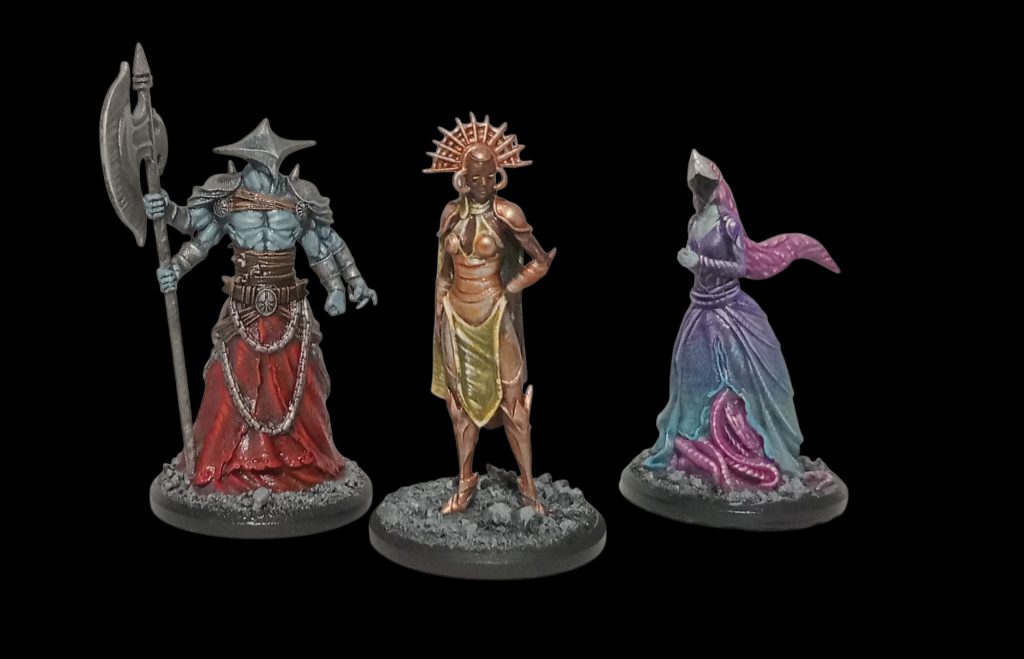 Sudden Conflict - The Empire of Melar (photo courtesy of Musterkrux)
Sudden Conflict's sculpts are all lovely. They've clearly been rendered with care to ensure that each set of miniatures is a part of coherent aesthetic. The Ukyo models all have period-accurate armour and clothes, I adore the retro-futurism with a hint of Space-fantasy you get in the Galactic Throne set and the humble heroes of Valrona are giving serious courtly intrigue vibes, which I am absolutely here for. My call out for favorite model is either Ophella, the two-headed turtle, with her cool design and the mix of textures on her model or Contessa Bly, driven mad by staring into the abyss. I love her courtly attire and demure pose with a cheeky mass of tentacles peeking out from the bottom of her dress.
Sudden Conflict - The Empire of Melar (photo courtesy of Musterkrux)
Sudden Conflict's sculpts are all lovely. They've clearly been rendered with care to ensure that each set of miniatures is a part of coherent aesthetic. The Ukyo models all have period-accurate armour and clothes, I adore the retro-futurism with a hint of Space-fantasy you get in the Galactic Throne set and the humble heroes of Valrona are giving serious courtly intrigue vibes, which I am absolutely here for. My call out for favorite model is either Ophella, the two-headed turtle, with her cool design and the mix of textures on her model or Contessa Bly, driven mad by staring into the abyss. I love her courtly attire and demure pose with a cheeky mass of tentacles peeking out from the bottom of her dress.
The models came to us as 3D-printed resin, they required very limited cleaning (approximately 30 seconds per model with a scalpel and file) and the resin used is quite hard, with multiple models surviving being dropped 3-4ft onto carpet without any damage. That's not to warrant that they'd survive a drop onto a hard surface but, honestly, there aren't many metal or GW-plastic models that love that trip either.
Of the 18 models reviewed, only one of them came with a bend in the resin that I considered correcting and even then it was minor enough that I just left it in the end.
On first glance, I was worried that the resin had lost some of the crisp details on the renders (as seen on the website and in the game manuals) but once I painted the models I found them to hold more than enough detail to work with, as you can plainly in the photos provided in this review. These models look great with a lick of paint on them.
I felt like the models are perhaps a bit smaller than I'd like (having grown accustomed to a larger scale as well as a few recent games played in 54mm) but I recognise that larger models would cost more, and then trickle down to requiring a larger gameboard, possibly shipped in larger boxes. All of which adds even more cost to the game, so on the balance of things, I'm fine with the scale.
Gaming Materials
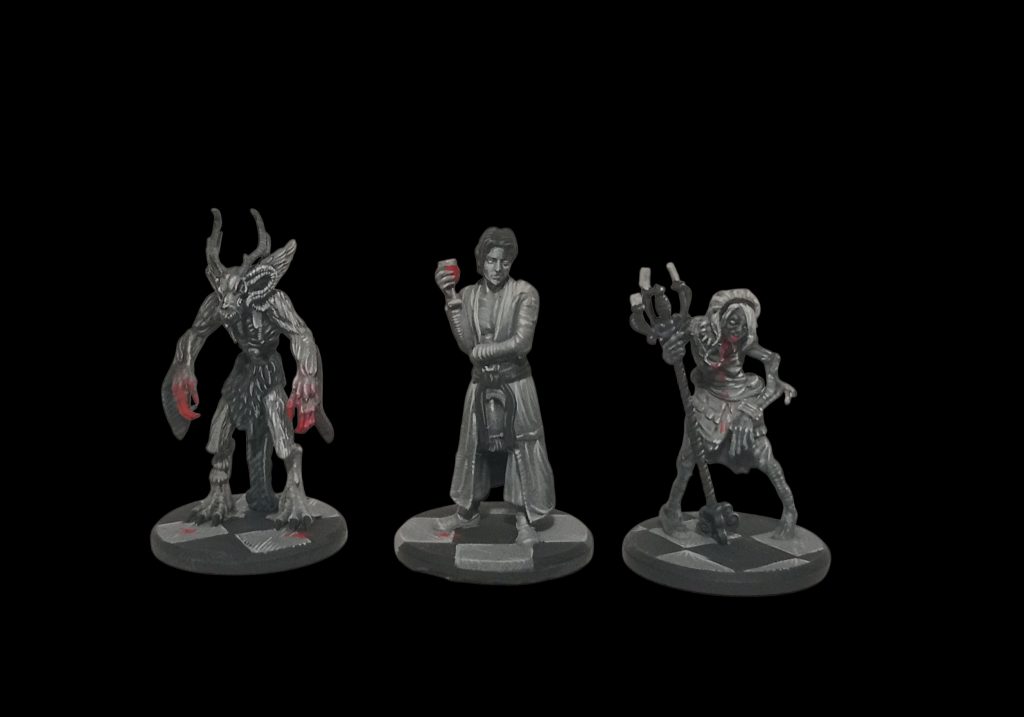 Sudden Conflict - The Tryptic Vile (Photo courtesy of Musterkrux)
The game boards are quite nice, built from a heavier cardboard than you might expect, which I think will contribute to a greater longevity. The image quality on the boards is very nice. Though, I feel like the demarcation of terrain/occupied zones isn't immediately obvious to a first-time player.
The character cards are lovely, whatever material they're using here is a higher quality than your standard cardboard. It has a textured satin finish, which makes them look and feel like a premium-quality product. The layout is well designed, every statistic, icon and rule is easily read and understood.
The dice are a smooth plastic, 6-sides with half of them having 'Successes'. They're perfectly serviceable dice, they don't feel cheap or nasty but neither are they possessed of the weight and sturdiness you might expect from, say, Casino Dice. I've joked that with 50% of facings being a success, each dice is just a coin-flip. Which is fine, building a game around binomial distribution is a good way to have a reliable bell-curve for your rolls. Just random enough to be interesting but not so utterly uncertain that the game swings wildly about.
The box is quite small and portable, and feels solid enough. I like the size of the box, as it makes it easier to transport in addition to other gaming materials, feels like a great way to slide a game of Sudden Conflict in between rounds of another game at a tournament, or anywhere you have 30-60 minutes free. This really helps sell the game as an accessible and low-commitment time investment. My personal hell is spending 30 minutes setting up the pieces for an insanely complex boardgame, spending 30 minutes playing it before someone gets jack of it and quits, forcing the entire table to then spend another 10-15 minutes packing the game up. In that same time, you could have played a full round of Sudden Conflict through to completion and I think that's just swell.
Sudden Conflict - The Tryptic Vile (Photo courtesy of Musterkrux)
The game boards are quite nice, built from a heavier cardboard than you might expect, which I think will contribute to a greater longevity. The image quality on the boards is very nice. Though, I feel like the demarcation of terrain/occupied zones isn't immediately obvious to a first-time player.
The character cards are lovely, whatever material they're using here is a higher quality than your standard cardboard. It has a textured satin finish, which makes them look and feel like a premium-quality product. The layout is well designed, every statistic, icon and rule is easily read and understood.
The dice are a smooth plastic, 6-sides with half of them having 'Successes'. They're perfectly serviceable dice, they don't feel cheap or nasty but neither are they possessed of the weight and sturdiness you might expect from, say, Casino Dice. I've joked that with 50% of facings being a success, each dice is just a coin-flip. Which is fine, building a game around binomial distribution is a good way to have a reliable bell-curve for your rolls. Just random enough to be interesting but not so utterly uncertain that the game swings wildly about.
The box is quite small and portable, and feels solid enough. I like the size of the box, as it makes it easier to transport in addition to other gaming materials, feels like a great way to slide a game of Sudden Conflict in between rounds of another game at a tournament, or anywhere you have 30-60 minutes free. This really helps sell the game as an accessible and low-commitment time investment. My personal hell is spending 30 minutes setting up the pieces for an insanely complex boardgame, spending 30 minutes playing it before someone gets jack of it and quits, forcing the entire table to then spend another 10-15 minutes packing the game up. In that same time, you could have played a full round of Sudden Conflict through to completion and I think that's just swell.
Gameplay
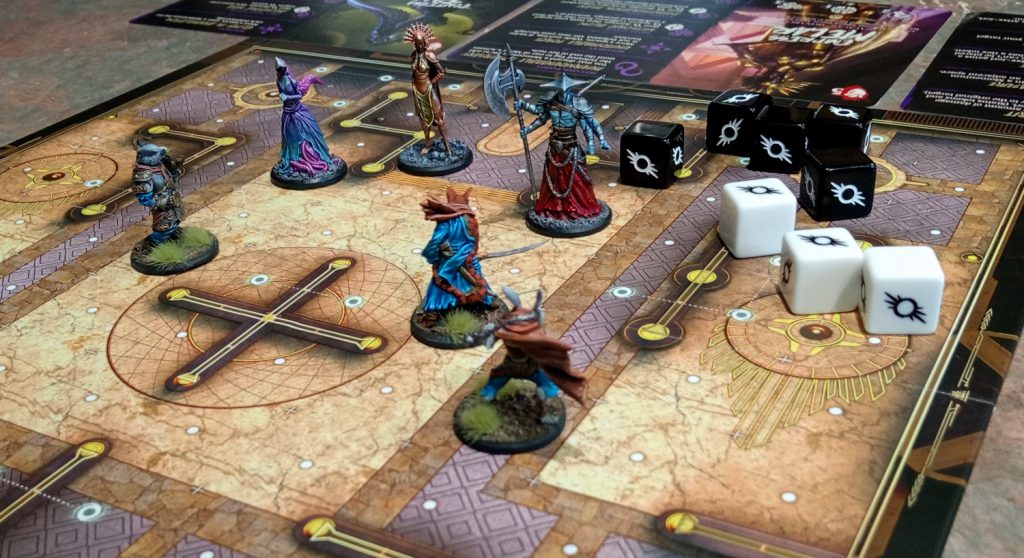 A game in progress
To set up a game of Sudden Conflict, you pick which board/map you’re going to play on and then each player selects their team of three characters. You can pick and choose from the various sets, mixing up characters from different factions and realities (and discovering wild interactions within your teams is great fun). Then players alternate placing characters in unoccupied deployment zones.
Then you determine initiative and the game progresses in alternating activations (I Go, You Go), with each character having two (2) Action Points to spend during their activation. During an activation, each action costs one Action Point and each action can only be attempted once per activation (unless otherwise noted).
There are a variety of types of Actions, but starting with Attacks, you’ve got Melee (adjacent) and Ranged options. Generally, you’ll roll dice equal to the Action’s attack value (5 is the highest dice count I’ve seen attached to an Attack so far) and your opponent rolls dice equal to the relevant Defence (Attacks are typed as Mind, Body and Soul, and resisted by the correlated Defence stat), with every character having 1,2 and 3 being their Defence stats. This means there’s always a gap in the armour, and every character can be dragged down by the right attacks.
Not every action needs to be an attack, there are Movement skills, buff and debuffs. All adding to the tactical depth of the game. At the moment, there are three core ‘status effects’ featured in the game: Glory (add one die to your next Action that requires a dice roll), Anguish (remove one die, to a minimum of one, for your next Action) and Hex (the inflicting player chooses one non-Passive Action, it cannot be used until the owning Player spends an Action point to clear the debuff. The Ukyo core set introduces Stagger (cannot spend Momentum next action nor spend it rolling for defense) and Poise (gain a Momentum due), while Valrona has Bless and Curse, which demonstrates that the game is intended to grow in time and introduce new status effects and mechanics. Brilliant.
A game in progress
To set up a game of Sudden Conflict, you pick which board/map you’re going to play on and then each player selects their team of three characters. You can pick and choose from the various sets, mixing up characters from different factions and realities (and discovering wild interactions within your teams is great fun). Then players alternate placing characters in unoccupied deployment zones.
Then you determine initiative and the game progresses in alternating activations (I Go, You Go), with each character having two (2) Action Points to spend during their activation. During an activation, each action costs one Action Point and each action can only be attempted once per activation (unless otherwise noted).
There are a variety of types of Actions, but starting with Attacks, you’ve got Melee (adjacent) and Ranged options. Generally, you’ll roll dice equal to the Action’s attack value (5 is the highest dice count I’ve seen attached to an Attack so far) and your opponent rolls dice equal to the relevant Defence (Attacks are typed as Mind, Body and Soul, and resisted by the correlated Defence stat), with every character having 1,2 and 3 being their Defence stats. This means there’s always a gap in the armour, and every character can be dragged down by the right attacks.
Not every action needs to be an attack, there are Movement skills, buff and debuffs. All adding to the tactical depth of the game. At the moment, there are three core ‘status effects’ featured in the game: Glory (add one die to your next Action that requires a dice roll), Anguish (remove one die, to a minimum of one, for your next Action) and Hex (the inflicting player chooses one non-Passive Action, it cannot be used until the owning Player spends an Action point to clear the debuff. The Ukyo core set introduces Stagger (cannot spend Momentum next action nor spend it rolling for defense) and Poise (gain a Momentum due), while Valrona has Bless and Curse, which demonstrates that the game is intended to grow in time and introduce new status effects and mechanics. Brilliant.
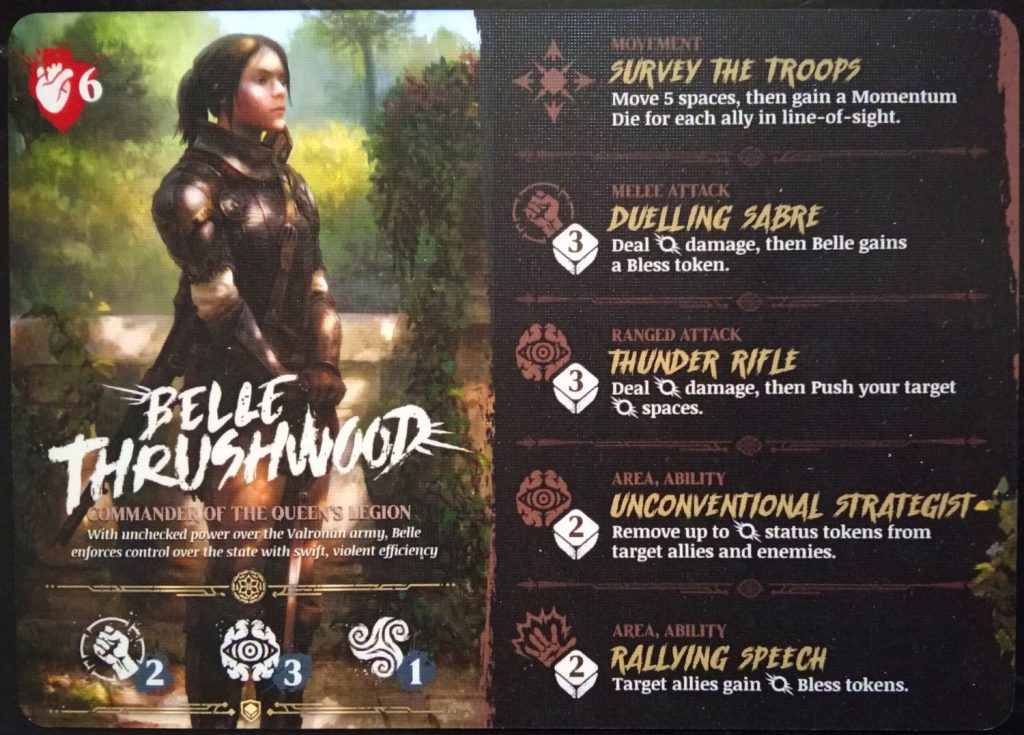 Stat Card for Sudden Conflict
At this point, the game will seem relatively familiar to most people who play tabletop of board games. Where it departs from the norm and demonstrates its Unique Value Propositions is in the Momentum and Defeated mechanics.
Momentum (Lose a bit now to win big later): Momentum is a dice resource that you build up through a variety of sources (including: rolling an Action test and getting no successes, losing initiative, or simply ending a turn with no Momentum). Because Attack values can be relatively similar to Defence values, momentum may be the key to breaking through your opponent’s defences and knocking out a character. As a rubber-band mechanic (ie. something that helps a player who might be in a disadvantageous position), it’s good to see that players can stay in the game regardless of their luck. Holding onto your momentum and knowing when to use it (to deliver a knockout blow, or the inverse, keeping a character in the game by massively buffing their defence dice) is going to prove to be the factor that separates the winners from the …Not-Winners.
Defeated (Down, but never out): With only three characters per team and knock out being a win condition, one might be worried that games might be decided by outrageous early-game alpha strikes. Thankfully, Sudden Conflict introduces the Defeated mechanic, where a character that has been reduced to zero hitpoints remains an active participant in the game, albeit with a limited set of allowed actions. This is cool, it keeps everyone in the game (avoiding the Negative Play Experience, NPE, of getting locked out of the game by early casualties) and feeds into the drama/narrative of these critical conflicts, with heroes slumped up against walls, bleeding out, and making their final Hail Mary to save the universe. This is a really cool mechanic that not only helps balance the gaming experience but feeds into the story-telling aspect of the gaming experience. To my immense amusement, we note that our good friend Nikola Marcellus can recover from the Defeated state with a little luck. If a beheading isn’t going to stop him, what else ya got?
Stat Card for Sudden Conflict
At this point, the game will seem relatively familiar to most people who play tabletop of board games. Where it departs from the norm and demonstrates its Unique Value Propositions is in the Momentum and Defeated mechanics.
Momentum (Lose a bit now to win big later): Momentum is a dice resource that you build up through a variety of sources (including: rolling an Action test and getting no successes, losing initiative, or simply ending a turn with no Momentum). Because Attack values can be relatively similar to Defence values, momentum may be the key to breaking through your opponent’s defences and knocking out a character. As a rubber-band mechanic (ie. something that helps a player who might be in a disadvantageous position), it’s good to see that players can stay in the game regardless of their luck. Holding onto your momentum and knowing when to use it (to deliver a knockout blow, or the inverse, keeping a character in the game by massively buffing their defence dice) is going to prove to be the factor that separates the winners from the …Not-Winners.
Defeated (Down, but never out): With only three characters per team and knock out being a win condition, one might be worried that games might be decided by outrageous early-game alpha strikes. Thankfully, Sudden Conflict introduces the Defeated mechanic, where a character that has been reduced to zero hitpoints remains an active participant in the game, albeit with a limited set of allowed actions. This is cool, it keeps everyone in the game (avoiding the Negative Play Experience, NPE, of getting locked out of the game by early casualties) and feeds into the drama/narrative of these critical conflicts, with heroes slumped up against walls, bleeding out, and making their final Hail Mary to save the universe. This is a really cool mechanic that not only helps balance the gaming experience but feeds into the story-telling aspect of the gaming experience. To my immense amusement, we note that our good friend Nikola Marcellus can recover from the Defeated state with a little luck. If a beheading isn’t going to stop him, what else ya got?
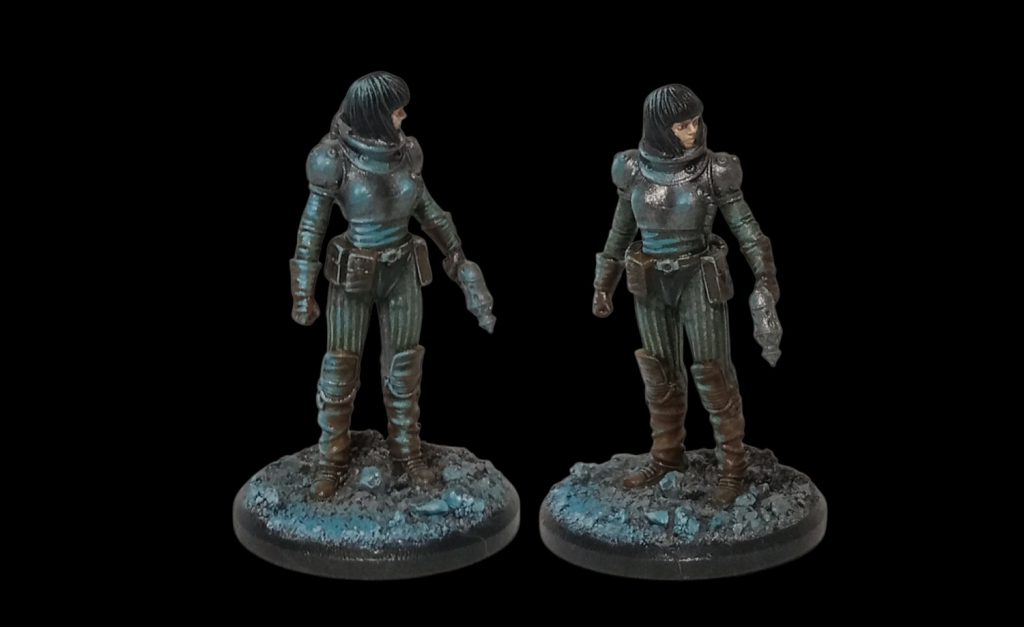 Sudden Conflict - Heather Sing, Space Ranger (Photo courtesy of Musterkrux)
Things we like about the game:
- Accessibility: This is an easy game to learn, it’s easy to transport, set up and pack down. The game plays as quickly as you want, you can smash out a game between rounds at a wargaming event or you can sit down and have a leisurely evening rolling dice with a friend and a bottle of something mildly expensive.
- Unique mechanics: Momentum and the Defeated (Down but not Out) mechanics are a really good way of ensuring that both players are in the game for the entire progression. There’s nothing worse than whiffing an attack roll, so getting a bonus for those missed opportunities that you can bank and then later spend on your Big Swing is a nice balancing factor for the game.
- The scale of the setting: By giving us a multi-verse setting, Sudden Conflict isn’t limited to just fantasy or science fiction, there’s no limit to the stories that can be told in Sudden Conflict. This isn’t a One-and-Done funding round for Sudden Conflict, there are more stories to tell and more characters to meet.
Things we’d like to see develop:
- Objective-based play: While keeping the game accessible and easy to learn is a good mantra, I’d like to see win conditions other than Total Party Kill introduced in future. Different game modes will increase the variety of play and longevity of the game.
- Optional Tournament or Organised Event rules and support: The developers have said that this is an option if there’s demand for it but they’d prefer players to tell them how they want to experience the game. This is a balanced approach and I applaud it but I’ll confess I do think that the long-term success of a game like this relies on the addition of an events or competitive framework that people can use to build local communities.
Final Thoughts
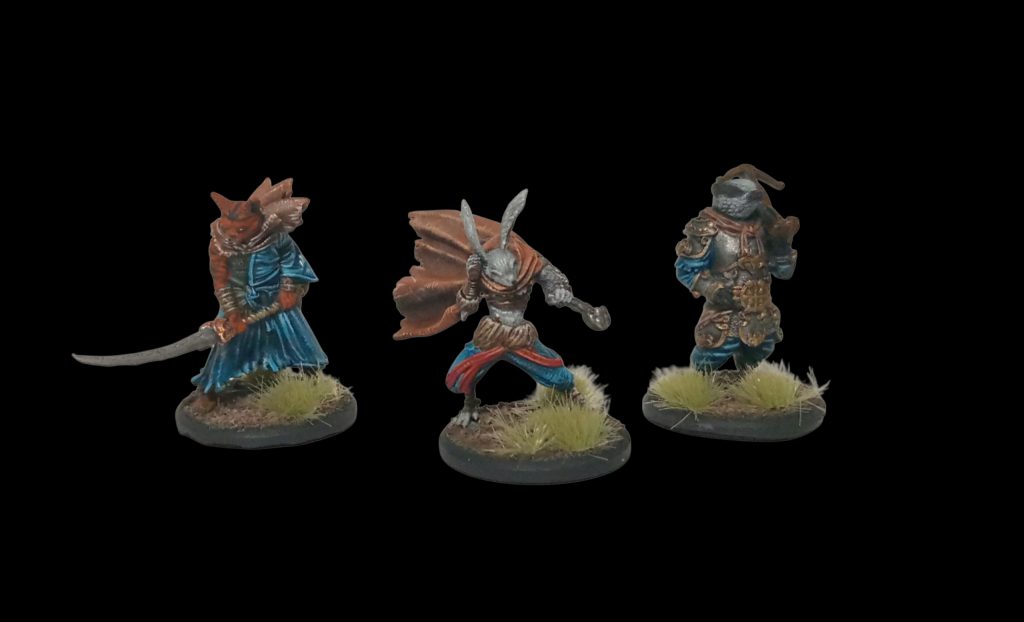 Sudden Conflict - Heaven's Liberators (Photo courtesy of Musterkrux)
These days, we’re all time poor. More and more I find myself looking for games that I can easily transport, teach and then enjoy with friends. With no significant overhead in getting people to understand this game it’s easy to get buy-in and engagement from the people you want to play games with. Whether these are people who already have a Primary Game or whether you’re recruiting people who are new to gaming, Sudden Conflict is a great option for building up a network of people to play games and spend quality time with.
I’m looking forward to learning more about the various realities, as well as the stories and narrative that accompanies them. As a character-focused game, it’s nice to be painting 3 models to get game-ready instead of 50+ for a larger wargame.
It’ll be great to see more expansions come out and experiment with new team compositions and potentially even new rules/interactions. I’d love to see some degree of organised events evolve for Sudden Conflict, as tournaments and competitive events can be the key to a game building sustainable interest and growth.
Sudden Conflict will be available on Gamefound in early 2026, with three core sets (Ukyo, Valrona, and the Galactic Throne) as well as two Character Expansion packs (Solaris and the Exiled).
Have any questions or feedback? Drop us a note in the comments below or email us at contact@goonhammer.com. Want articles like this linked in your inbox every Monday morning? Sign up for our newsletter. And don’t forget that you can support us on Patreon for backer rewards like early video content, Administratum access, an ad-free experience on our website, and subscriber-only content covering competitive Warhammer 40K!
Sudden Conflict - Heaven's Liberators (Photo courtesy of Musterkrux)
These days, we’re all time poor. More and more I find myself looking for games that I can easily transport, teach and then enjoy with friends. With no significant overhead in getting people to understand this game it’s easy to get buy-in and engagement from the people you want to play games with. Whether these are people who already have a Primary Game or whether you’re recruiting people who are new to gaming, Sudden Conflict is a great option for building up a network of people to play games and spend quality time with.
I’m looking forward to learning more about the various realities, as well as the stories and narrative that accompanies them. As a character-focused game, it’s nice to be painting 3 models to get game-ready instead of 50+ for a larger wargame.
It’ll be great to see more expansions come out and experiment with new team compositions and potentially even new rules/interactions. I’d love to see some degree of organised events evolve for Sudden Conflict, as tournaments and competitive events can be the key to a game building sustainable interest and growth.
Sudden Conflict will be available on Gamefound in early 2026, with three core sets (Ukyo, Valrona, and the Galactic Throne) as well as two Character Expansion packs (Solaris and the Exiled).
Have any questions or feedback? Drop us a note in the comments below or email us at contact@goonhammer.com. Want articles like this linked in your inbox every Monday morning? Sign up for our newsletter. And don’t forget that you can support us on Patreon for backer rewards like early video content, Administratum access, an ad-free experience on our website, and subscriber-only content covering competitive Warhammer 40K!
Thank you for being a friend.
 This website uses cookies. Learn more.


 Goonhammer Hobby Round-Up: March 2026
 Goonhammer Reviews: Tribal Conquest
 Conquest: Weaver Courts Gemred Knights and Scaile Dancers Model Review