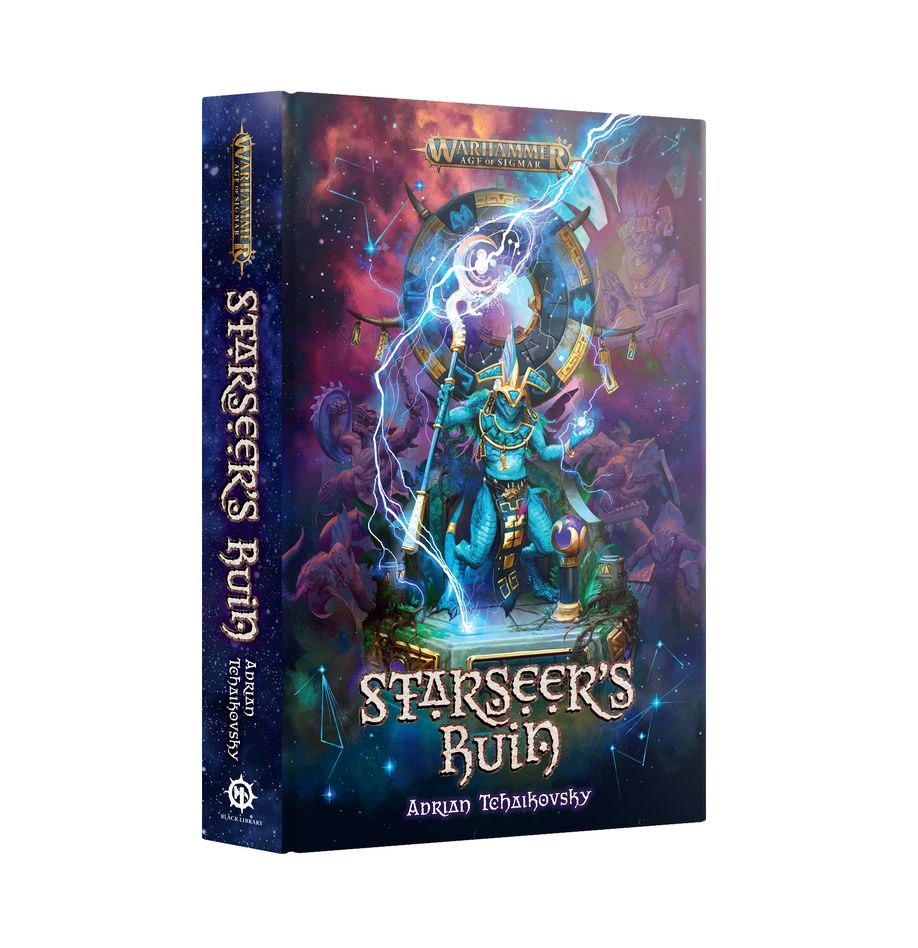
 Image credit: Games Workshop
"Buddy films" have a long and storied tradition in cinema that goes back at least to the 1930s with Laurel & Hardy, but that extends even further back in literature. The central conceit pairs two people of widely differing composition, finding entertainment and amusement generally first in their discordant clashing and then ultimate reconciliation.
Popular culture is filled with them. The
Rush Hour franchise paired Chris Tucker with Jackie Chan.
Lethal Weapon's Mel Gibson with Danny Glover.
Toy Story's Woody and Buzz Lightyear. Walter Matthau and Jack Lemmon's
Odd Couple.
Thelma & Louise.
Men in Black.
Enemy Mine.
Turner & Hooch.
There's a reason it's such an enduring formula- it
works. That doesn't mean that you can just take any two characters and throw them together; like any other essential element of the writer's craft, it takes skill to execute this kind of character work. If there's a writer in the Black Library that may be in a class of his own with it, it's surely
Adrian Tchaikovsky and it's woven throughout his latest,
Starseer's Ruin, to terrific effect.
A Great Plan
Tchaikovsky has a fairly modest portfolio for the Black Library. He debuted in 2021 with the 40K short story
Raised in Darkness, moving up to a novel with the well-received
Day of Ascension the following year. In the past two years he's moved more into Age of Sigmar stories, including the novella
On the Shoulders of Giants (
review) and the short story
Written in Stars (the latter featuring Irixi, the Seraphon protagonist of his latest novel).
Starseer's Ruin doesn't exclusively focus on the reptilian Seraphon by any means, but their culture and spirituality are the book's central plot driver. The Seraphon, you see, are sort of the Calvinists of the Mortal Realms, believing that everything that will unfold in this life is predestined and ultimately leads to the destruction of Chaos and harmony in the world.
That Chaos will ultimately be defeated is never in doubt, but where mortal agency matters is in how quickly the world manages to get there. By learning of events to come, the mortal races can effectively immanentize the eschaton and hasten that long-awaited day. While you think such certainty would allow them some lassitude, quite the opposite is true.
This
matters to the Seraphon, because if they can pull forward that day of reckoning by even a single year, that's an entire year less of suffering across the world at the hands of Chaos. Their struggles to find these clues to the future are filled with gravity and urgency, and failure has very real consequences (even if you can console yourself somewhat by pondering that perhaps you were
meant to fail).
When the opportunity arises to recover a lost piece of Seraphon prophecy, Irixi the Starseer is dispatched to recover it. But the threads of fickle fate are a funny thing. On the very day he arrives at the ruins, so do others with their own interests and motivations for being there. A detachment of Freeguild soldiers, an elder Stormcast Eternal chasing the last threads of memory before his next reforging sees him sequestered away in a Ruination Chamber
1, and- worst of all- a verminous horde of predatory Skaven hell-bent on performing an evil ritual in the ruins.
If you imagine a proverbial match getting dropped on this tinder-box confluence, you have the essence of
Starseer's Ruin.
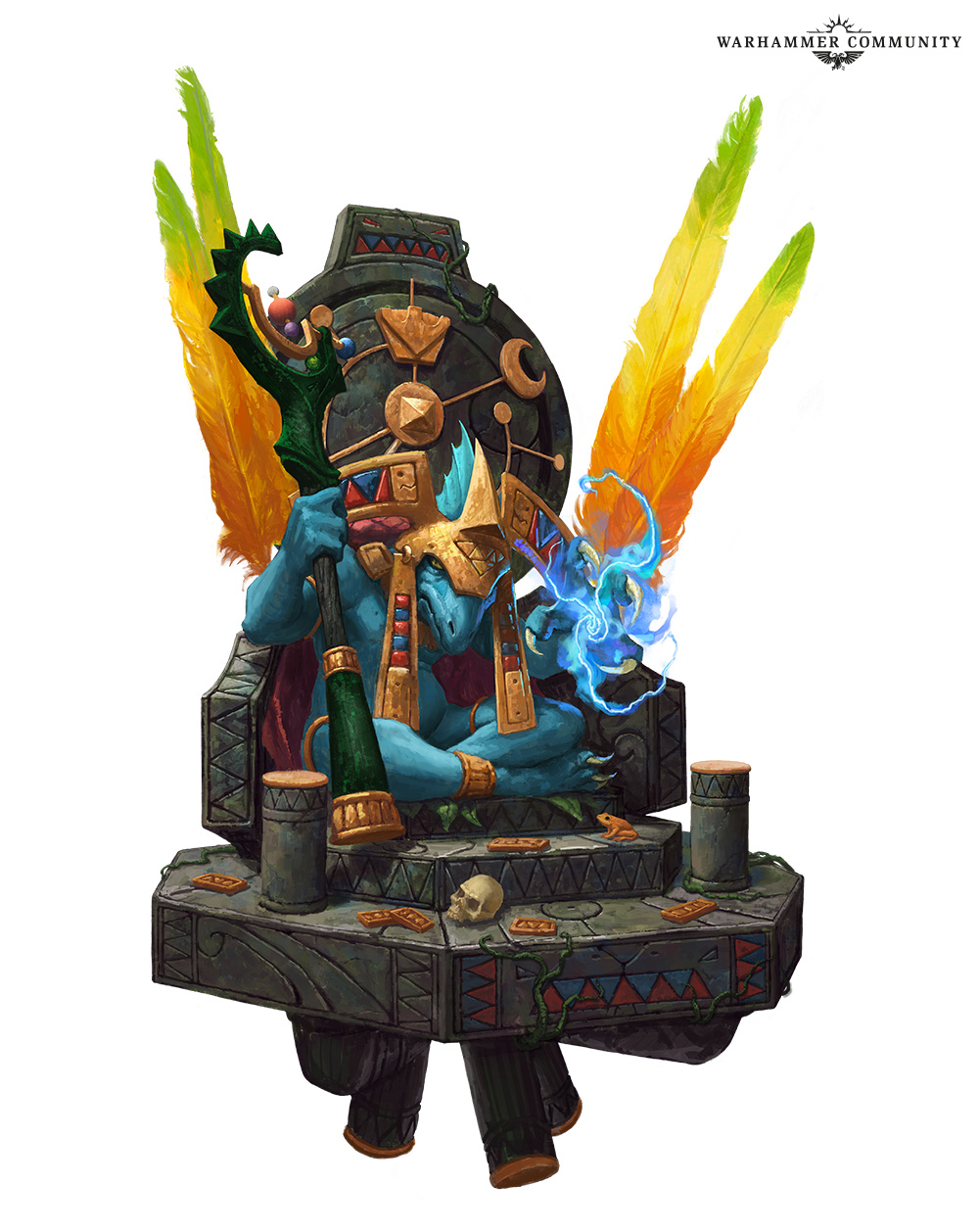 Image credit: Games Workshop
A Sonnet of Rhymed Couplets
Now, imagine a six-sided die made of transparent crystal. If you hold the '1' up to your eye, you can see the '6' on the other side, both faces superimposed over whatever it is you happen to be looking at beyond the die. That metaphor, strained as it admittedly is, is the heart of what makes
Starseer's Ruin work.
See, now imagine the same die, but instead of a '1' you see the face of Irixi, the Seraphon Starseer, and there on the '6' is that of Perlo, Freeguild mage. For '2' and '5,' you have Freeguild hunter Stanner and Seraphon scout Oaxmal. '3' and '4' give you Vael, the Stormcast Eternal, as well as Gokumet, the Saurus Oldblood. Each of these three unlikely pairings represents an alignment of characters that drives the story forward- and offers its significant emotional depth.
Starseer's Ruin isn't a buddy movie per se, but rather
three of them in one as circumstances find unlikely alliances forming in the wake of the Skaven threat. Tchaikovsky masterfully bounces around from one point of view (POV) to another, letting you experience the unfolding story of these personalities and their connection to one another as the plot moves inexorably forward.
The contrast of these pairs, as they learn to understand one another and work together, is the soul of the story, and it's here where Tchaikovsky's masterful character work really shines. Each of the central six have well-developed personalities and backstories, ones that he doesn't bring out in isolation of one another so much as in the overlap of each pairing. Through Perlo you learn about Irixi...and through Irixi- alien as he seems- Perlo is more fully revealed. And there isn't a bad pair in the bunch, either- each of them are gripping and engaging in very different ways.
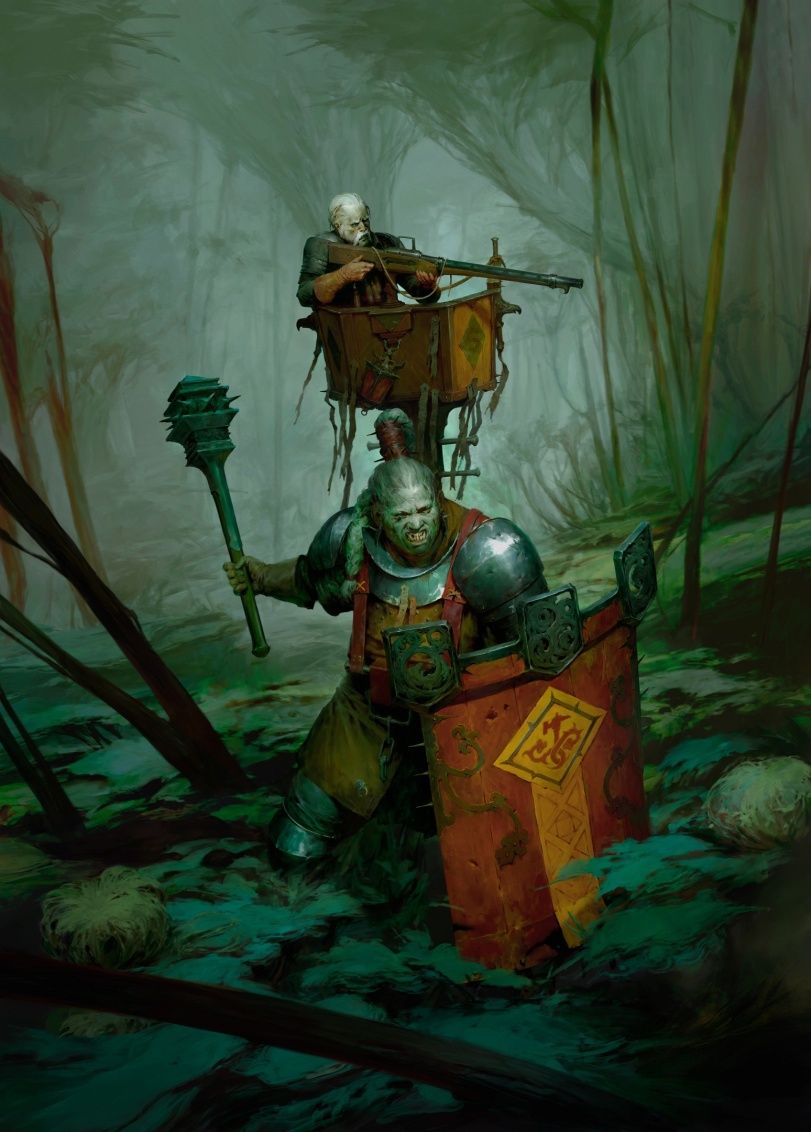 Image credit: Games Workshop
On the Shoulders of Otherness
Tchaikovsky excels at this cross-revelation, the unfolding of a mutual understanding of the
human and the
other. His novella
On the Shoulders of Giants, which
in my review I called 'top-tier reading,' explored the surprisingly-deep relationship between a human Fusilier and his Ogor companion. He has a knack for getting into the mind of his nonhumans in a way I've seen few others manage. There was a lot I enjoyed about
Evan Dicken's Shade of Khaine, but note this
from my review of that book regarding its Ogor character, Splendid:
Splendid was an interesting contrast deserving of a mention, a brute savage of a gourmand who was amiable and charming (as Ogors go). While I enjoyed how he was written, he didn’t quite capture the same element of
other-ness that Adrian Tchaikovsky did so masterfully with
On the Shoulders of Giants (review
here). Splendid is a character who
happens to be an Ogor, while Tchaikovsky’s Slobda felt more like an Ogor character. When Tchaikovsky’s very human lead character notes that his Ogor companion was "a child of a different god entirely," you feel that in a way I didn’t really pick up on in
Shade of Khaine.
Tchaikovsky doesn't just write characters, he
inhabits them- and he's got the writing chops to translate that experience onto the page
2.
A Fading Soul
One of the book's biggest surprises- and most impactful narratives- involves the Stormacast Eternal, Vael. When I was a new reader to the Age of Sigmar property, I found the Stormcasts to be fairly dull and uninteresting. If you're effectively immortal, if you can rise and fight after dying time and again... where are the stakes? Sure, maybe there's a consequence to losing a battle, but "golly, when I died for my thirty-fifth time we failed to save the village" doesn't really pull me in in terms of a character's emotional impact.
As I learned more about the cost of that reforging, however, my opinion quickly shifted. There's a genuine tragedy in having physical immortality, but at the cost of the erosion of one's being and soul. The Astartes of 40K have no shortage of tragedies of their own, but despite early criticism of the Stormcast as "Fantasy Space Marines" Games Workshop has done a terrific job of imbuing them with an identity- and tragedy- all their own.
Vael's struggles through the course of
Starseer's Ruin are as much about that which dwells within him as much as whatever happens to be on the business end of his hammer. An Eternal of the First Forging, there is very little left of the man he once was- just enough to remember that he once was
someone. His coming to terms with that- and the oblivion that likely lays beyond it- is one of the story's most poignant threads.
 Image credit: Games Workshop
Final Thoughts
It's probably not too early to say that
Starseer's Ruin is not only my choice for my Age of Sigmar Book of the Year, but a shortlist candidate for my Black Library Book of the Year as well. It's just that good.
Over the course of this year for Age of Sigmar, I've focused on accessibility as a standard of measure for its novels. This may not be entirely fair to the property, but I make no secret that as a longtime 40K reader I'm a latecomer to this side of the divide. Books that stand alone rather than being based on lore foreknowledge are a bit more prized as a result. That may not be entirely fair, but it does reflect the state of the readership of the Black Library, where fantasy hasn't been an equal partner in the relationship for years.
Starseer's Ruin stands on its own and is a terrific gateway book to the amazing property. Combine that with Tchaikovsky's incredible character work and the delight of seeing unlikely pairs come together to tackle adversity, then throw in a terrific villain in the darkly comedic mold of classic Skaven antagonists, and you've got an absolute gem of a book.
Footnotes
- Stormcast Eternals are effectively immortal, returning to the heavens when killed to be reforged by Sigmar. The great tragedy of this is that with every reforging, a bit of who they were in life is lost to them. Eventually after enough deaths in service to Sigmar, they lose all memory of who they once were at all. When this happens, when there's nothing left of the original person and their soul cannot be recovered, they are sent to live out their days in the Ruination Chamber.
- Need more proof? Check out his portrayal of an arachnid civilization in the extraordinary, Arthur C. Clarke Award-winning 2015 book Children of Time. Tchaikovsky has a gift for taking the fantastical and outlandish, and grounding it in the real and the plausible.
Have any questions or feedback? Drop us a note in the comments below or email us at contact@goonhammer.com. Want articles like this linked in your inbox every Monday morning? Sign up for our newsletter. And don't forget that you can support us on Patreon for backer rewards like early video content, Administratum access, an ad-free experience on our website and more.Thank you for being a friend.
 This website uses cookies. Learn more.


 Goonhammer Hobby Round-Up: March 2026
 Goonhammer Reviews: Tribal Conquest
 Conquest: Weaver Courts Gemred Knights and Scaile Dancers Model Review