A thank you to Osprey Publishing for providing a copy of the rules for us to review.
Anyone that knows me knows that I love a weird little skirmish game. That's how I found myself scrolling through the wargame rules section of Osprey Games (yet again) and stumbled across Hide, Stone, and Bone bringing us here. I've already talked about this game briefly on the inaugural episode of the Other (Other) Gamescast podcast that will be running monthly for patrons through Patreon and I expect to be talking about it a lot more in the February episode. In short: it's fun! If you're looking for a prehistoric campaign system for wargaming where you'll be fighting against rival tribes and hunting down massive beasts on each season's Big Day while keeping track of food stores and your aging warband's members then you're in the right spot.
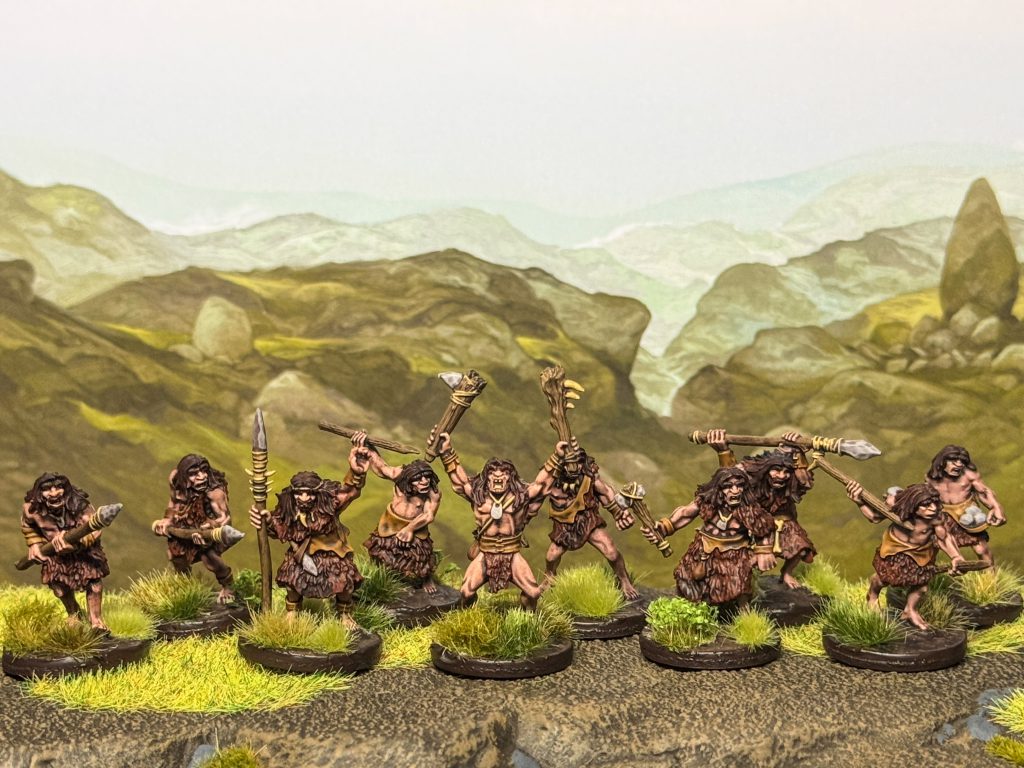 North Star Cavemen Clan - Credit Bair
(Pre)Historical Accuracy
Before I get too into the weeds of the game itself, a note from Lenoon about the accuracy of many aspects of the rulebook for the Neolithic era.
Lenoon: Thanks Bair! First off, this is a Palaeolithic game, not a Neolithic one - the Palaeolithic (Old Stone Age) ran from around about 3 million years ago to somewhere around 12,000 years ago depending on where you are in the world. Hide, Stone and Bone covers Eurasia from 120,000 to 40,000 - more or less the period of coexistence in some form between Neanderthals and Homo sapiens. This was, once, my period, so I was very excited to have a look.
I'm not going to nitpick on historical accuracy here because this is a game where you can easily have a Neanderthal facing off against a Tyrannosaur, but I thought there were a few things worth looking at.
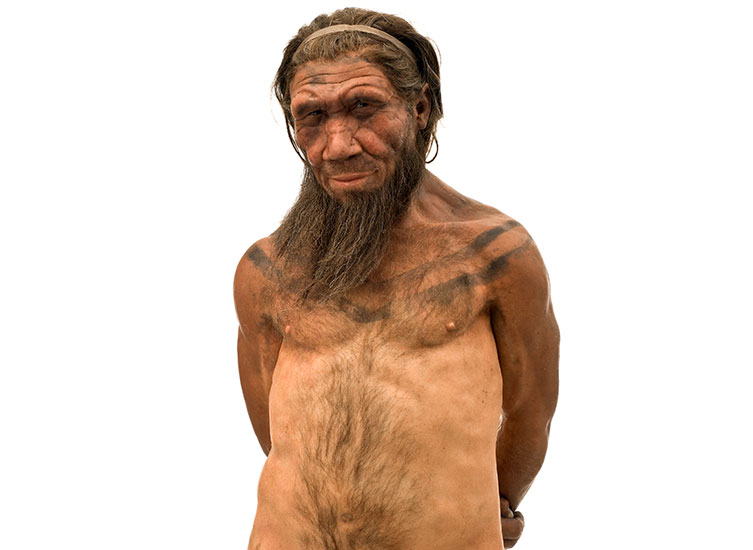 A reconstruction of a Neanderthal having a fairly good day. Credit: Natural History Museum
First off, we've got two species here - Neanderthals and Us. In game, Neanderthals are tougher and stronger than Homo sapiens, while we are more inventive, generally cleverer and more flexible on the board. Neanderthals are occasionally thought of as ambush predators which covers the tougher and stronger bit while sapiens were - and are - runners, capable of incredible feats of endurance. For a game where you need some kind of stat differentiation, not half bad.
This is also the rare - if not unique - game where your campaigns see you invent new technologies as you progress. The Palaeolithic is a very inventive time, and aside from stuff like rockets and fractional distillation I'm going to go out on a limb and say that we end up with the majority of the really important discoveries by about 12,000 BCE (do not @ me on this, Vlex). The things you can invent in this game are absolutely all over the place - the "invention" of the sharpened stone axe is arguably 2 million years ago, the spear thrower turns up around 400,000 years ago, and then the quiver is possibly only 3,000 years old. It's a really weird melange of different things that make no real sense, but the alternative would probably be a table consisting of fifty different types of flint arrowhead (I'd be up for playing this game), or splitting it along the lines of
Clark's Modes of stone tool production which would make for a more elegant solution. I do like the fact that you can reverse engineer inventions from other bands - no matter what
Brad Gravina says, I will always believe in Chatelperronian Acculturation theory.
Palaeolithic peoples probably did end up getting in the kind of scrapes the game plays with - both against prey and predators and against other tribes. Neanderthals and Sapiens didn't have a genocidal war against each other (making more love than war, probably), but there are scattered bits of evidence for conflict between groups of peoples. The first big conflicts we have evidence for happen later on - Qadan and
Nataruk (damn right I'm linking it, I bloody excavated it) stand out as potential massacre sites but post-date the game by tens of thousands of years.
The next - and last, this is getting long - bit is in the prey animals. We all want to hunt a Mammoth and a Wooly Rhino, I get it, but no rules for horses, reindeer, berries, various whelks, boars, rabbits leaves us thinking of the Palaeolithic as the time of the big game hunters, instead of the time of "eat everything we can get our hands on". Give us rules for hunting the
mighty mushroom or eating a diet of 90% reindeer meat.
Sorry Bair, I said I wouldn't nitpick and I did: overall, fun, pulpy, accurate enough, do not get me started on the comical size of the flint on most palaeolithic models.
Hunting, Gathering, and Procreation
When you put together your warband your first choice is between humans (early homo erectus hominids) or Neanderthals which each have their own stat line and caloric intake needs. You get to spend 200 Moons on your starting warband between youths, young adults, adults, and elders and are encouraged to include both men and women in your warband to make...adding more members to your tribe later on a bit easier. Moons is the currency in game because there is no
currency in this period so the only thing you actually have to spend is time! Time spent gathering, crafting, and getting older. Time is fickle and it comes for us all and so it did for the cavemen of our ancestry as well.
If you want to fully randomise your warband between then grab some D10's and get to it. This brings us to one of my favourite lines in the rulebook "For those who want a truly random band, roll a D10 to determine type, for Humans (Neanderthals move straight to sex)..." and it goes on to tell you to use evens or odds to determine which humans are hunters or gatherers; Neanderthals don't have the option between the two which is why skip right on ahead to the next part, determining the sex of each warband member.
You don't get a lot of choice of weapons early on and will need to spend time between games inventing new ones. Starting equipment is as simple as stone knives, fire-hardened spears, clubs, carrying bags, and fur cloaks. Other, far more advanced weapons, such as javelins, stone clubs, and bows can be invented to be crafted later on. For sake of trying more of the rules out immediately we also started with fire-hardened javelins for some ranged weapons. That's not strictly necessary since throwing rocks is something anyone can do at any time anyways and you
can simply throw any weapon you're carrying, but might not want to.
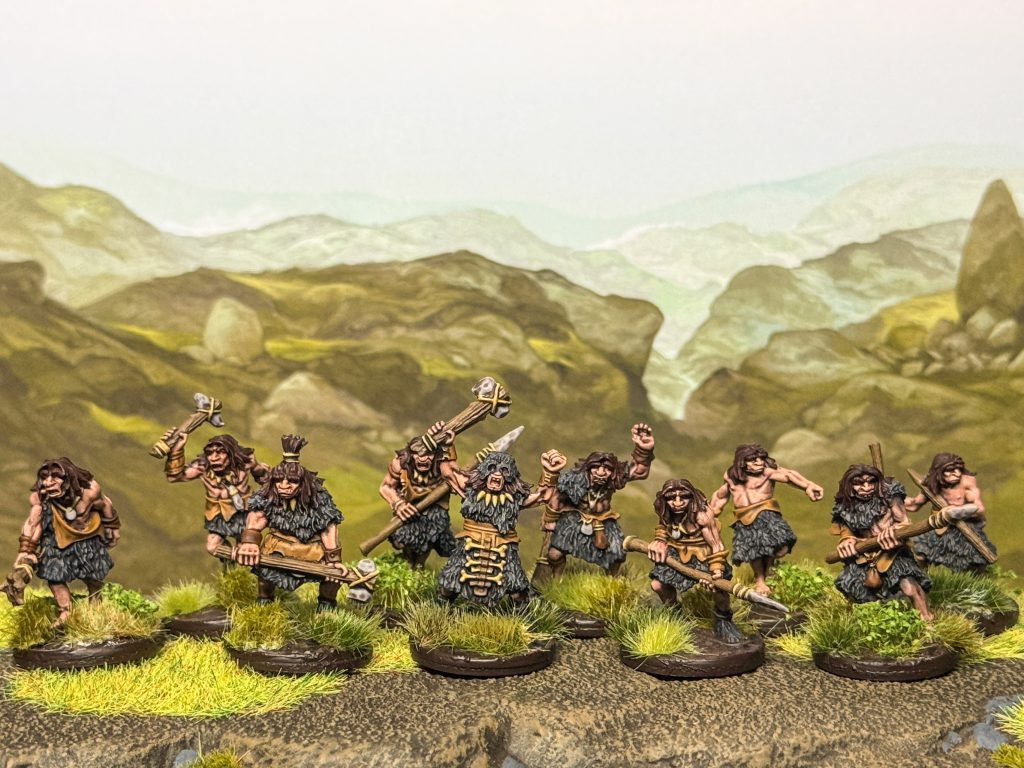 North Star Cavemen Clan - Credit Bair
How old your warband members are changes their stats slightly too with youths (thankfully) being non-combatants entirely and not able to take place in any tabletop games, instead helping gather food or craft until they're older. Young adults have lower toughness but higher agility, adults have a one-in-ten chance of become and Elder after each winter, and elders have lower stamina and movement but can be shamans. All fairly simple and makes enough sense! You need to make sure that you have enough food to feed all of your warband members throughout which can be obtained by gathering or hunting game, there are solo play rules with reaction tables for the beasts or you can have another campaign player take control of one for you to hunt. Neanderthals need a larger caloric intake than humans so while they may be stronger fighters they need to consume about twice as much as a human warband will need to to survive, especially those colder months.
The metal models shown above from
North Star are not the most accurate ones, but give a nice wide range of various weapons. The STL files from
Wargames Atlantic offer more accurate proportions and weapon sizes if that's your preference!
Big Days
During each season you spend three Moons per warband member crafting, inventing, or gathering food as part of the End of Season Activities; it's three because there's roughly three moon cycles per season, I wish this had clicked in my brain more quickly than I care to admit. This is also when you'll find out if any of your youths have grown to young adults, if any procreation has happened giving you more youths, modify your band's extinction points, and see if any beasts have been driven to extinction. In our test games we managed to fully eradicate all cave bears with a very lucky (unlucky?) few rolls. Oops?
You also declare your next Big Day! Big Days are once per season and can involve hunting down game for added food stores or attacking another band in your campaign. If you do go looking for a fight there's a chance your band is first hit by a random predator encounter and will need to fight off wolves, sabretooth cats, bears, or more before getting to the real fight. Which of course might cause some untimely deaths, your fault for wandering out where there's giant animals trying to kill you!
Alternatively, instead of attempting a Big Day one season you can simply have a nice Quiet Season if yours is the warband closest to extinction or with less than half the amount of extinction points than the leading warband. That'll give you some time to recoup, recover, and gear up for the next season. You make one of your fellow campaigners play a Hunter scenario and take control of the beasts. Afterwards depending on whether the beasts won or lost a number of your band will count as having been involve and gain experience accordingly without the possibility of death.
Once that's all finished and tidied up you move to the End of Season Activities above and get read for the next season! One thing I do really like here is that food is more abundant in the summer and you'll need more food to get through winter, any fur cloaks you craft reduce the extra food needs in winter and if you gather and/or hunt enough food you can save it across to the next season. It's said that war is won with logistics and your cavemen are
always at war here, so keep your weapons sharp and your food stores healthy!
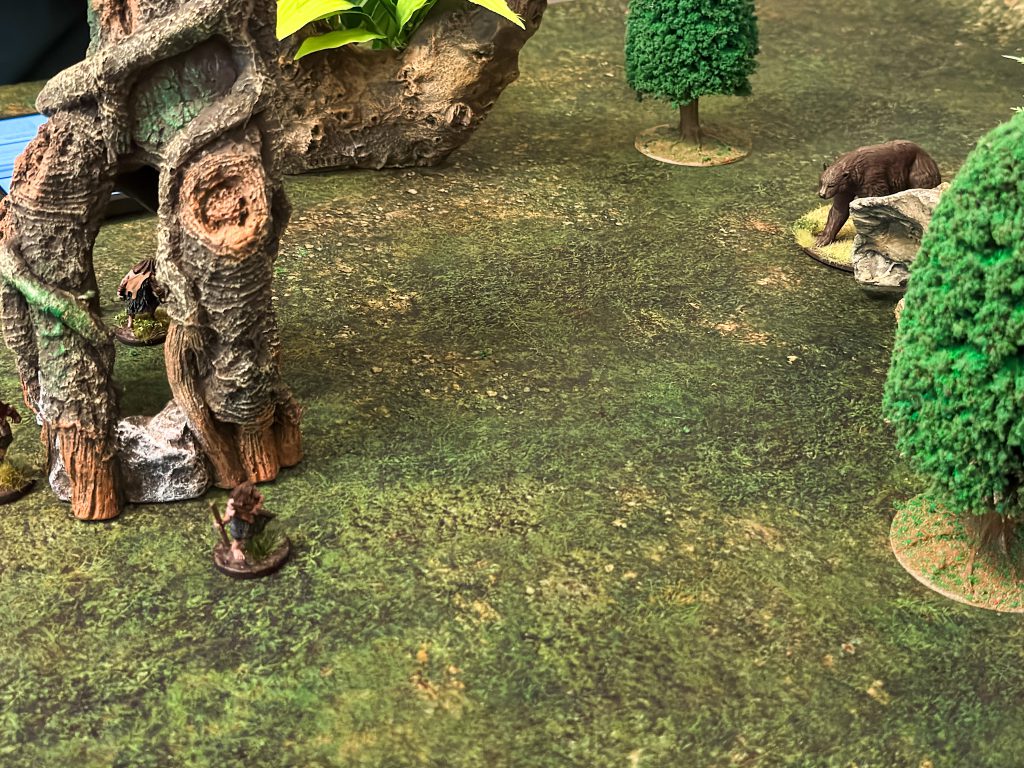 A short faced cave bear wanders out of his dwelling, coming across a band of Neanderthals getting too close for comfort
Scenarios
There's three kinds of scenarios to play: Raids, Hunting, and Hunted. These are pretty self explanatory and use a number of different tables to set it up. When conducting a Raid you roll to see if it's an Ambush, Resource Raid, Capture, or something else. In a longer campaign I think it'd be cool to simply choose the kind of Raid you want to fight, maybe with some limitations so you're not just constantly taking supplies away every single Big Day. These different raids let you steal enemy supplies, capture enemy band members, and more.
When you go on Hunting scenario you randomly determine the kind of beasts your band has found to hunt down for meat and furs ranging from a great beast, stumbling across a nest, running into scavengers, or accidentally coming across a more dangerous creature! Massive beasts will include things like woolly mammoths or rhinos, great apes, aurochs, or if you're playing a World Below campaign other, more scaly, creatures. I'll talk about World Below later on. Herd animals include bison and elk to hunt down and will put a few on the table to be snuck up on. More dangerous game are the same sort of beasts you'll encounter during Hunted scenarios when your band is on the backfoot needing to survive against a predatory animal instead, including cave bears, sabre-toothed tigers, or packs of wolves.
Regardless of the scenario the same broad principle applies: don't die and do some damage. It's a wargame, after all. The former is usually easier said than done, though, and your band members won't just be dealing with wounds but also intense levels of stress making it more difficult to perform in-game as the scenario goes on. We used skull tokens to represent stress and as you can see, it can get out of hand. We had to start using big white dice as a stand in because we ran out of stress tokens. Man, I wish I could simply run out of stress in real life.
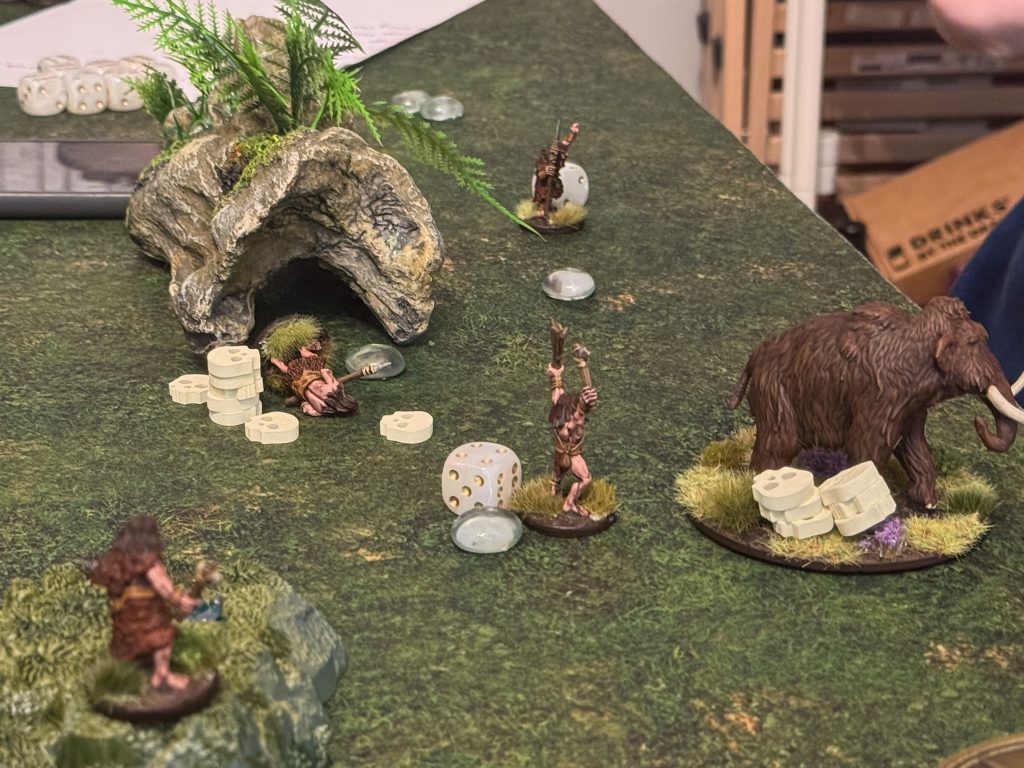 That's a lot of stress tokens...
Actually Playing
All of that's well and good but how is the game
actually played, I hear you demanding? Well that's a great question and here is where I need to be honest and tell you that this isn't a super tight rules set when it comes to that part. There were more than a few times where we weren't fully sure how to do something or felt that we were maybe missing a small part of the rules. Thankfully we're also not (complete) idiots so figured stuff out and agreed how we wanted to do stuff that just made the most sense instead.
First things first is table size and terrain. The recommended size is a 4'x4' board but with some recommendations on how to play on a smaller 3'x3' instead. We played on a 4'x3' board and found that it was more than big enough, taking into considering some of the smaller table rules. Terrain ranges from big rock formations that you can climb up and down (or possibly fall off of!) to area terrain like forests, marshes, streams, and anything else you'd expect to find out in the wild. We kept it pretty simple with big pieces that would block off movement and line of sight and some big rock formations to climb up onto to throw rocks from. For a first couple of games this felt plenty good, for any more I'd want to start playing with a river running down part of the board or some swampy bogs to make movement potentially a bit more interesting.
Broadly speaking this is an alternating activation game where each player will just take turns activating one of their models and spend their stamina points on moving, making attacks, grappling other hominids, hiding, throwing weapons, or looking for a nearby rock to throw if they don't have one but want to stay out of the fight as best they can. There's also the choice to try and mount a beast but that didn't work out at any point for us because
someone couldn't roll good enough to make it happen or if he did then failed at every turn to stay on the mammoth.
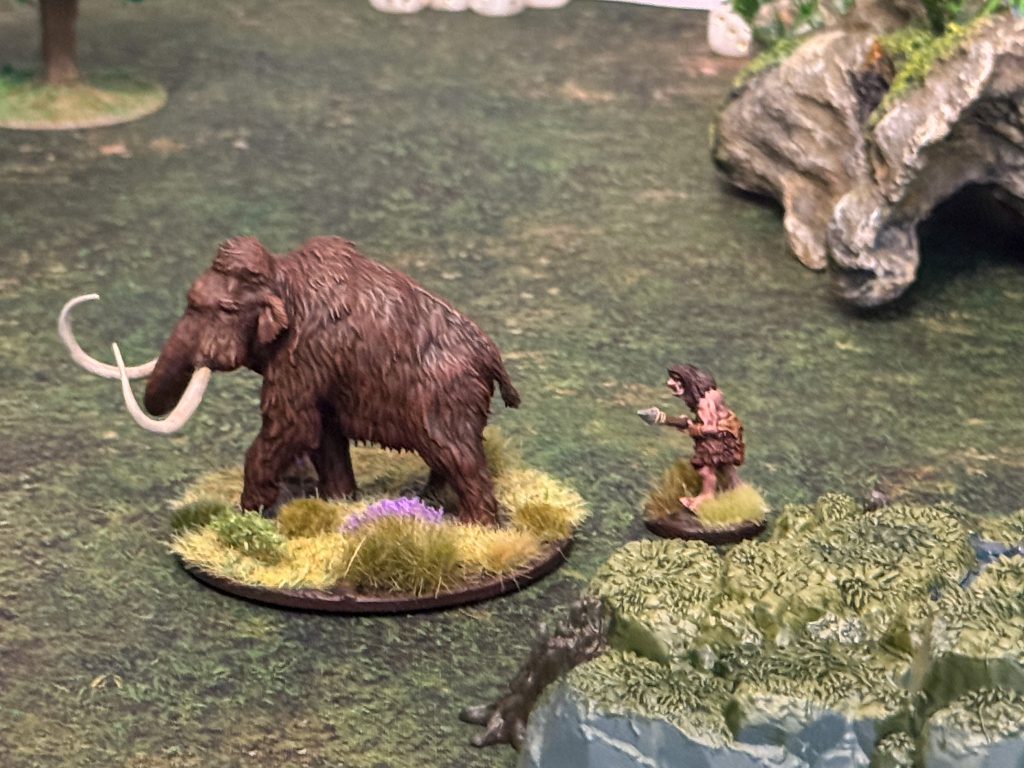 Trying to mount a mammoth, without much success
Fighting is very quick paced, against other hominids once a fight between two models starts it'll keep going until either one of them is dead or is cowardly enough to step away from it (if they're able to!) whereas with beasts, due to their size, a hominid fighting a beast and winning that initial fight will automatically back away as it starts to buck and frenzy. Typically speaking hominids have just two wounds each while larger creatures like mammoths have up to six making them difficult to take down.
The game is played by using D10's most of the time with D5's being request often, this is just a D10 roll halved and rounded up, much how a D3 is done with a D6 dice. Most often these will be opposed rolls for fighting with each playing rolling a single D10 and doing some math depending on the weapon they have in hand, their base attack value, and any other of a number of modifiers that could come into play. In a fight the winner of that roll off rolls to see if they wound their opponent, hominids will be wounded on a 4+ or 5+ while beasts will need at least a 7+ with larger ones like mammoths needing a 9+ on that D10 making them difficult to take down. Natural 10's on the initial roll do automatically inflict a wound as well so if you're lucky enough when making attacks, including ranged ones, as my friends and I saw in our test games you could run a giant bear to extinction pretty quickly!
One of the game's biggest mechanics to keep track of is stress. Whenever a model is hit, wounded, or any number of things befall them they become stressed. Simply being too close to a large beast like a bear or mammoth will cause stress too! It is
very difficult to remove stress and...maybe a little too difficult. It certainly helps games end quickly! Beasts will take stress but the larger ones aren't as easily affected by it which makes plenty of sense. To remove stress you need to be outside of any effective charge or ranged weapon ranges during your activation, not the easiest thing to get out of since rocks can be thrown at 12" and beasts can charge up to 13"! There are skills to gain that will help reduce stress too at least. When a model activates if it has three or more stress tokens it has to test for bravery and has a decent chance of running away, using up its activating in cowardice and running off the table if too close to the board edge! There's no coming back from going over the board edge, once a model is off the board it's gone. At one point one of our poor guys was knocked prone and had a stack of eight stress tokens on him. He was off the board shortly after.
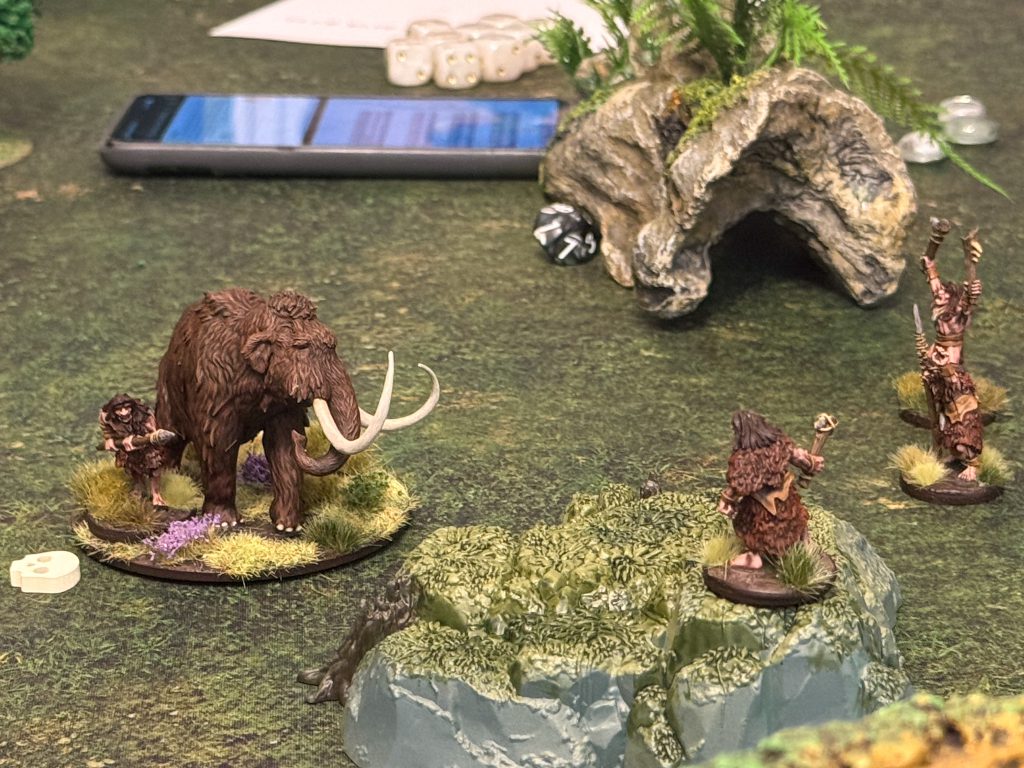 Successfully mounted the mammoth while his friends cheer him on and try to stay out of the way of the rampaging beast
Even with needing to learn most of the rules on the spot and playing with a couple friends who hadn't read the rules beforehand our first game lasted under and hour and the second dragged on for a bit longer but still concluded in a pretty timely manner. The first was being hunted by a bear which went down
very quickly after some very lucky natural 10's on hit rolls with ranged weapons and the latter took much longer with a clear lack of rocks for throwing and the band trying to get on top of the mammoth repeatedly with very little luck, falling right back off whenever they could before getting any attacks in. The true Neolithic experience summed up in two games. Accidental extinction and abject failure.
The World Beneath
This whole section is
completely optional and skipping it does not mean you're missing out on anything if you're wanting to play a far more historical campaign or game. This is basically Journey to the Centre of the Earth or Ark Survival on the tabletop. Introducing dinosaurs, giant gorillas, and pulp adventurers. This is a whole host of rules to allow a slightly more modern band of humans discovering a world where prehistoric beasts roam, dinosaurs still exist, and more intelligent foes like Gigantopithecus (possible ancestor to yetis or Big Foot) or precursor humans are the main threat.
Across these few pages you'll find stat blocks for raptors, "sharp tooths", giant ants, and Under-Dwellers (bronze age Egyptians, Lizard-folk, etc) to represent just about anything you want to using this system. I actually like this quite a lot, adding some fun pulp fiction to this setting takes nothing away from playing purely historical games but adds something different to those wanting to play out hunting down a t-rex with rifles with a warband of hunters, scientists, and fatale charmers. Lots to play with here of different stat blocks and skills across your models with a whole host of newer weapons to take down these exceptionally dangerous beasts with.
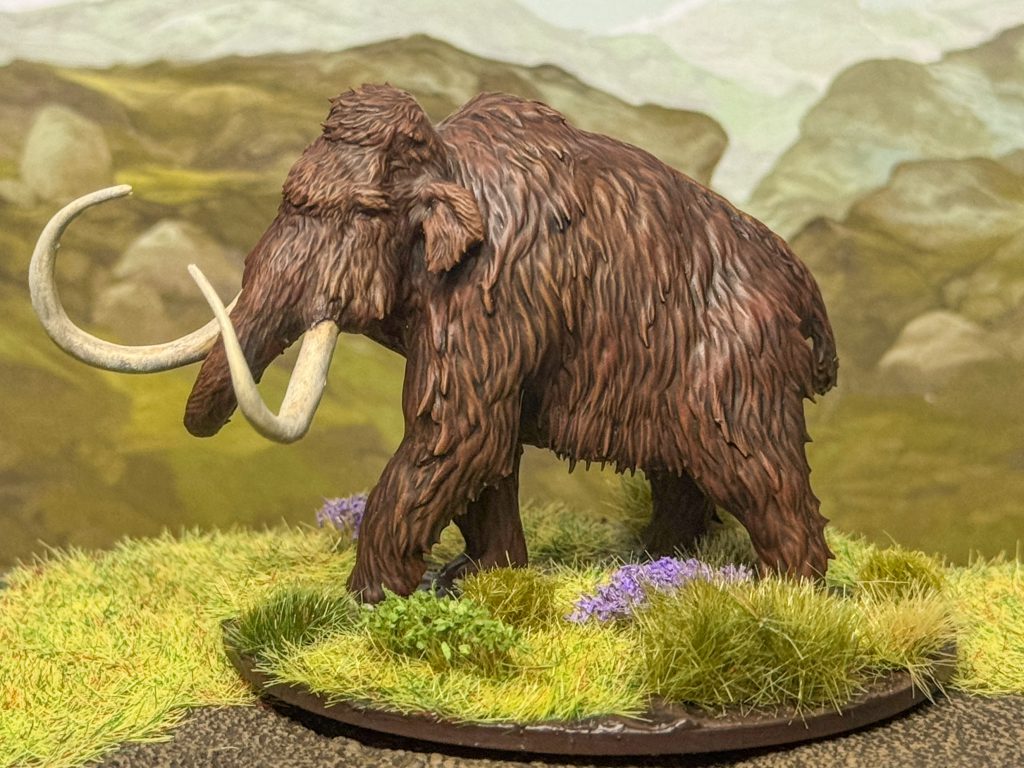 Dino and Dog Woolly Mammoth - Credit Bair
Extinction for Some
Throughout a campaign you might find you keep driving different animals to extinction making it far more difficult to actually find enough food to feed your growing band of rag tag prehistoric hominids or you might find that your own people are going extinct! Do your best and you might get lucky enough that neither happens.
All in all this is a pretty fun system with the unclear-parts being easily talked over by a group of players and figured out as you go. The games play pretty quickly, there's solo rules for hunting down (or being hunted by!) various beasts with instinct tables to roll on, and fights feel pretty satisfying. A D10 system also just allows for a pretty big variety in outcome and we were howling with laughter time and time again as hominids tried climbing on the back of a rampaging mammoth as it kept moving around the board trampling anything in its path throwing off any that managed to get on top swiftly!
If you're wanting to play a campaign-based game a little more (pre)historically then this has just about everything you could want to keep your spreadsheets busy keeping track of all of your food, equipment, inventions, and level of extinction for your band.
Have any questions or feedback? Drop us a note in the comments below or email us at contact@goonhammer.com. Want articles like this linked in your inbox every Monday morning? Sign up for our newsletter. And don’t forget that you can support us on Patreon for backer rewards like early video content, Administratum access, an ad-free experience on our website and more.
Thank you for being a friend.
 This website uses cookies. Learn more.

 Goonhammer Hobby Round-Up: March 2026
 Goonhammer Reviews: Tribal Conquest
 Conquest: Weaver Courts Gemred Knights and Scaile Dancers Model Review