On the night of May 27th, 1754, a group of young men made their way through the wilderness. It was an unusually dark night. Rain clouds pressed low over the woods, soaking soil, coat, and hat alike. The ground sucked at boots. Powder horns were wrapped in oilskin. Muskets were clutched not like weapons, but like reassurance. Their objective was clear.
Somewhere ahead, in a rocky glade, a small French diplomatic party was encamped. Soldiers, officers, interpreters, and guides. The British had sent a detachment to intercept them, and at the head of that detachment was a young officer with almost no experience, poor maps, but a name that would become very famous indeed; George Washington. The skirmish at Jumonville Glen was not a battle. It was barely even a firefight. It was a confused encounter in the rain, fought at close range, followed by panic, misunderstanding, and a diplomatic incident that spiraled out of control.
Within two years, Europe was at war. Within twenty, Britain’s colonies would be in rebellion.
 Credit: Jackie Daytona
The French & Indian War is not a massively popular tabletop period; which is a bit strange, because it might be the most important “small” war in history. This is where the American colonies first experienced being a pawn in imperial strategy. London issued orders for European-style warfare: supply lines, formal engagements, lines of battle, stuff we all know from Napoleonics, while the reality in North America was something very different. Dense forests made structured formations impossible. Roads barely existed. Supply lines were crucial and contested. Subsequently, colonial troops learned hard lessons. British regulars discovered that volley fire was useless in the guerilla style warfare used by Native nations. Those same Native nations, meanwhile, found themselves pulled into a conflict of a much bigger scale, no longer seasonal warbands or raids, but continent-spanning campaigns backed by empires.
Punitive expeditions burned villages. Women and children were not spared here, and the best you could hope for was kidnapping and eventual assimilation. What had been a regional conflict became the opening theater of the Seven Years’ War - the first truly global war, stretching from Canada to the Caribbean, and from India to West Africa.
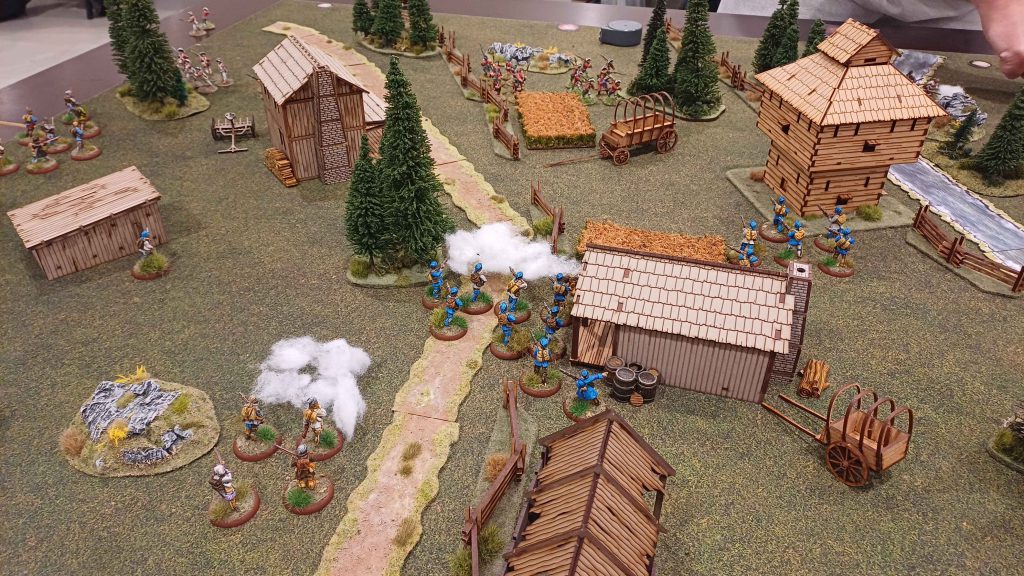
Despite all this, the bulk of the actions were small scale affairs, like the Jumonville raid. With fifty men per side, it is a perfect conflict to model in 28mm, and Muskets and Tomahawks gives you some interesting mechanics to get to grips with the tactics of the time.
Credit: Jackie Daytona
The French & Indian War is not a massively popular tabletop period; which is a bit strange, because it might be the most important “small” war in history. This is where the American colonies first experienced being a pawn in imperial strategy. London issued orders for European-style warfare: supply lines, formal engagements, lines of battle, stuff we all know from Napoleonics, while the reality in North America was something very different. Dense forests made structured formations impossible. Roads barely existed. Supply lines were crucial and contested. Subsequently, colonial troops learned hard lessons. British regulars discovered that volley fire was useless in the guerilla style warfare used by Native nations. Those same Native nations, meanwhile, found themselves pulled into a conflict of a much bigger scale, no longer seasonal warbands or raids, but continent-spanning campaigns backed by empires.
Punitive expeditions burned villages. Women and children were not spared here, and the best you could hope for was kidnapping and eventual assimilation. What had been a regional conflict became the opening theater of the Seven Years’ War - the first truly global war, stretching from Canada to the Caribbean, and from India to West Africa.
Despite all this, the bulk of the actions were small scale affairs, like the Jumonville raid. With fifty men per side, it is a perfect conflict to model in 28mm, and Muskets and Tomahawks gives you some interesting mechanics to get to grips with the tactics of the time.
What You Actually Need to Play
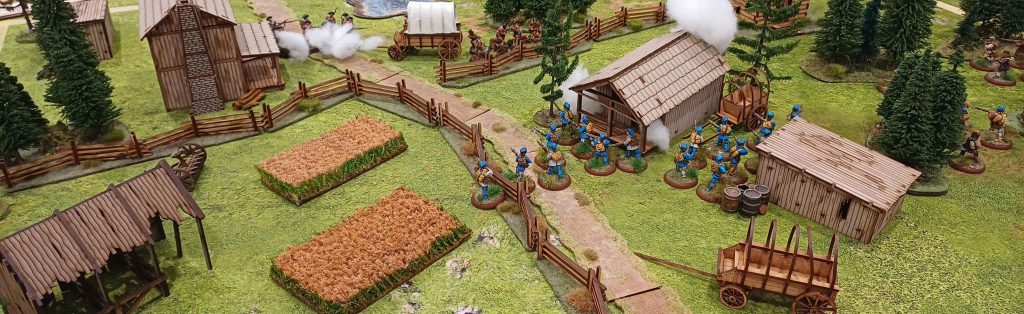
You may know Studio Tomahawk from such games as Saga, or V for Victory. Both set out to do very different things, and Muskets and Tomahawks (or M&T), first published in 2012 and now in its second edition released in 2020, is very different from those games indeed. At its core, it's a skirmish ruleset designed around individual models. You are not moving regiments. You are managing people, be they frightened militia, confident rangers, disciplined regulars, or warriors who understand the forest far better than you ever will. You will typically field 30-50 models, which in this case can be translated to a box of Perry miniatures. While the 4x4 board size is manageable to most people, you will need a lot of terrain to optimize the game, and has the added benefit of making it look good.
Apart from that, you will need the rulebook, a supplement book of your choice, with the appropriate deck of cards. Studio Tomahawk does not provide these in digital form, so you’ll have to order these. The game uses ten sided dice (D10), and all measurements are given in inches. Tokens are available, and recommended.
The book itself is straightforward, well laid out and readable, and the Redcoats & Tomahawks supplement expands the system beyond the French & Indian War into the American Revolution and even the War of 1812. The engine handles all three seamlessly because, historically speaking, they are the same problem: small forces fighting dispersed warfare in difficult terrain with relatively similar weapons. Shakos and Bayonets tackles the Napoleonic wars, and an upcoming expansion Kepis and Bayonets will let you play out conflicts from 1850 onwards. We will cover these books and how this impacts gameplay in a later article.
 Credit: Jackie Daytona
Command and Control
Most miniature wargames simulate command by giving players control. Muskets & Tomahawks simulates command by taking control away. That sentence explains almost every reaction people have to the game - it's possible you'll either really like it or really dislike it.
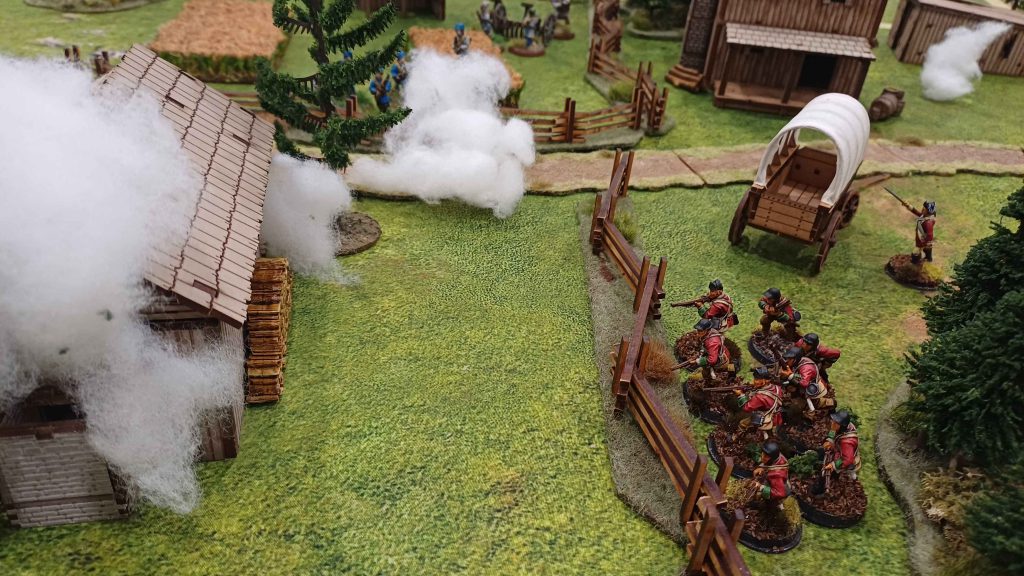
Instead of alternating turns, the game runs on an activation deck. Every player gets three cards, and alternating, can play one card or use command points. There are times where you will be in a situation where you can only play your opponent's cards! Different troop types activate when their card appears, as do officers. Sometimes the turn ends early. Sometimes a unit activates twice. Sometimes not at all. Your carefully prepared ambush might trigger too early. Your elite troops might not activate at all. Your militia might suddenly rush forward at the wrong moment. This is not a flaw, but a design feature. Using the card activation system forces uncertainty and it works really well. The game stops feeling like a tabletop contest and starts feeling like a command problem: you are no longer executing a plan. You are reacting to events.
If you want to know what it is to be an 18th-century officer trying to manage unreliable men in confusing terrain, look no further. It is possible, through canny leadership, to control the tempo. Every time you play a card that lets your enemy activate a certain troop type, you gain a command point. You can use these instead of playing cards to order a unit, put them on overwatch, or hold a card back. It turns into a bit of a combo playstyle, where you have to manage your own expectations and play the cards at the right time, maybe supplemented by command points to maneuver and prepare a unit so they can deliver a devastating volley. Since anything that gets activated only gets to take one action, you will have to plan ahead.
 Credit: Jackie Daytona
So when someone goes “I don’t like games with card activations”, the best games, like for example, Soldiers of Napoleon, give you options, rather than a tit for tat “oh no I haven’t been able to activate for ages”. You will have to master timing in chaos. You will also have to stop thinking in turns. There are three clock cards in the deck, and all cards get reshuffled after the third clock is played. With action points influencing gameplay, you will not have the same amount of cards as your opponent in hand after a couple of activations, and you draw new cards when your hand is empty.
Credit: Jackie Daytona
So when someone goes “I don’t like games with card activations”, the best games, like for example, Soldiers of Napoleon, give you options, rather than a tit for tat “oh no I haven’t been able to activate for ages”. You will have to master timing in chaos. You will also have to stop thinking in turns. There are three clock cards in the deck, and all cards get reshuffled after the third clock is played. With action points influencing gameplay, you will not have the same amount of cards as your opponent in hand after a couple of activations, and you draw new cards when your hand is empty.
Combat
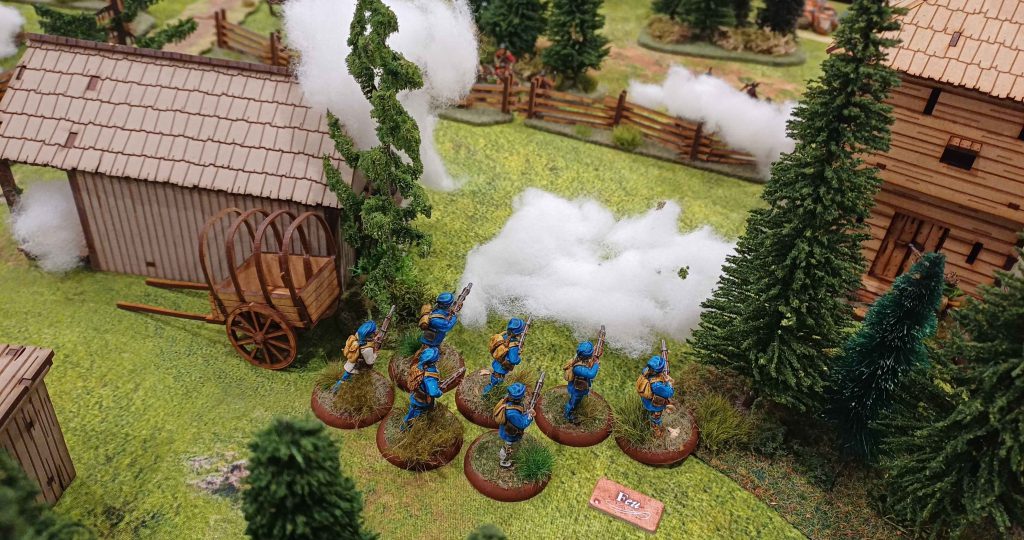
Whether shooting or charging, first you’ll have to see the enemy. The FIW was a conflict known for stealthy movements and ambushes; the spotting mechanic works perfectly here and you don’t even have to roll a die. Basically, you can see everything on the table, with a range of 96”. So a soldier in a bright red coat will be very visible in an open field. But if he’s in woods, you have to subtract a couple of columns from the table. Suddenly that spotting distance is only 24”. Put some hedges or carts in the way and your spotting range drops down to 12”.
 Credit: Jackie Daytona
Or you can use hidden movement, with two markers, one of which is a decoy. The natives trait not only gives you an extra inch of movement on the standard four, but also makes you automatically harder to spot. You are not moving into range, you are moving into awareness.
There aren’t that many special rules you need to keep track of, but they do add a lot in gameplay terms. In that regard every unit has three stats: Shooting, Aggression, and Defence. Shooting is rolling over or equal the stat, followed by a kill roll to see if the shot incapacitates. Range plays a big role as shooting with unrifled muskets at long range means you’ll have to roll an 8 or a 9 on that D10. And that 0 actually means zero, not ten! At short range firefights are quick and devastating. Volley fire is subject to some conditions, like being formed up as a unit, but it creates a fire corridor that stretches the front of the unit up to 16 inches, and can really ruin your opponent’s day. You'll have to spend two actions reloading, but it's worth it.
Credit: Jackie Daytona
Or you can use hidden movement, with two markers, one of which is a decoy. The natives trait not only gives you an extra inch of movement on the standard four, but also makes you automatically harder to spot. You are not moving into range, you are moving into awareness.
There aren’t that many special rules you need to keep track of, but they do add a lot in gameplay terms. In that regard every unit has three stats: Shooting, Aggression, and Defence. Shooting is rolling over or equal the stat, followed by a kill roll to see if the shot incapacitates. Range plays a big role as shooting with unrifled muskets at long range means you’ll have to roll an 8 or a 9 on that D10. And that 0 actually means zero, not ten! At short range firefights are quick and devastating. Volley fire is subject to some conditions, like being formed up as a unit, but it creates a fire corridor that stretches the front of the unit up to 16 inches, and can really ruin your opponent’s day. You'll have to spend two actions reloading, but it's worth it.
Reloading is something that's always a bit difficult to implement without slowing play down. Apart from volley fire, you can opt to do a regular shooting action, where everyone in the unit can shoot and have one reloading action, or do a hasty shot with half the models in the unit, with a penalty, but without reloading. This works fine, and what you get is a deadly maneuvering and trying to get close enough to make the most of your shooting.
Melee feels even dirtier. It’s simultaneous, first making an aggression roll, followed by defence rolls, and isn’t always the best option. Morale is a big thing in these small skirmishes, and whatever happens, the defender in the melee has to roll first on the morale table.
Morale
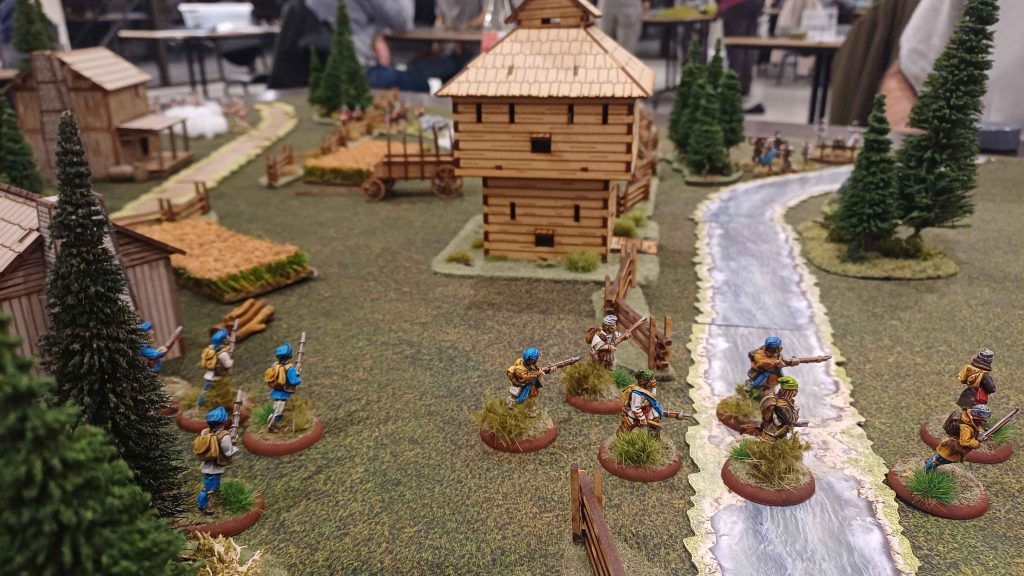
Black powder firefights do not end decisively. They sputter, collapse, and fragment. Unlike SAGA, units do not fight to the bitter end. They fight until their mettle is spent. Every time casualties fall, a unit is on the wrong end of volley fire, or melee happens, you’ll need to test your discipline. Troops can be trained, skirmisher, native, recruit, warrior or conscript. Each of these traits will give a different reaction when being put under pressure. Most of the time they’ll recoil. The more casualties a unit takes, the harder this becomes and you have to hope it doesn’t become a rout.
 Credit: Jackie Daytona
This ties into the overall design: regulars prefer formation fighting. Skirmishers exploit terrain. Native warriors rely on stealth and ambush. Militia are unpredictable but useful. The balance lies more in the historic behavior than in combat strength. Timing and knowing when to strike will let you win a game. The game design here is a nice example of "less is more", simulating the challenges of positioning, morale, detection. We haven’t even discussed the scenarios yet, which put even more pressure on the situation. Every expansion has different scenarios and they don't hold back on the historical front either. Destroying settlements or going after civilians was a tactic used by both sides, so you'll encounter it here as well.
Credit: Jackie Daytona
This ties into the overall design: regulars prefer formation fighting. Skirmishers exploit terrain. Native warriors rely on stealth and ambush. Militia are unpredictable but useful. The balance lies more in the historic behavior than in combat strength. Timing and knowing when to strike will let you win a game. The game design here is a nice example of "less is more", simulating the challenges of positioning, morale, detection. We haven’t even discussed the scenarios yet, which put even more pressure on the situation. Every expansion has different scenarios and they don't hold back on the historical front either. Destroying settlements or going after civilians was a tactic used by both sides, so you'll encounter it here as well.
Final Thoughts
While individual rules are simple, interactions can be more complex than you think. First games feel chaotic, but you won’t have to memorise tables and the spotting mechanic isn’t something you have to do every five minutes. My second game went a lot faster than my first, and subsequent sessions all went pretty smooth. Flipping round the book won’t happen often after a couple of games. This makes it a nice club game, taking 2-3 hours of relaxed play.
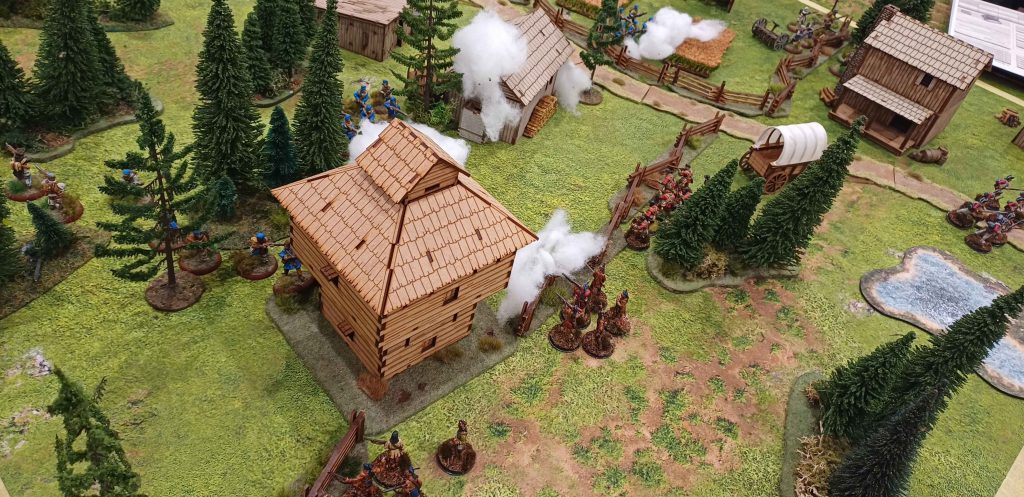
Expectations matter. Sometimes you do get a bout of swinginess after a bad shuffle. People deeply ingrained in the IGOUGO systems expecting a fair fight can be frustrated, as things will escalate, and you have to release control, but war in the period was just as unpredictable. In my opinion it’s emulated rather brilliantly in this ruleset. Friction, command abilities, information and initiative drive it.
 Credit: Jackie Daytona
The bar of entry is also relatively low. Apart from the aforementioned Perry miniatures North Star figures has some excellent starting boxes for every period, with 300 points to get you started. The all-metal sculpts are nice and characterful, especially the flight from Moscow range. North Star stocks the ruleset as well, making it an easy one-stop shop. In North America, Badger Wargames stocks everything you need. Starting this game won’t break the bank and will give you some nice modelling opportunities as well. If you seek warmer climes Perry Miniatures has released this Peninsular skirmish box, which is excellent as a starter. You just need the rulebook and one deck of cards for two players. There is also a handy only tool to build your skirmish force with: easyarmy.com
Credit: Jackie Daytona
The bar of entry is also relatively low. Apart from the aforementioned Perry miniatures North Star figures has some excellent starting boxes for every period, with 300 points to get you started. The all-metal sculpts are nice and characterful, especially the flight from Moscow range. North Star stocks the ruleset as well, making it an easy one-stop shop. In North America, Badger Wargames stocks everything you need. Starting this game won’t break the bank and will give you some nice modelling opportunities as well. If you seek warmer climes Perry Miniatures has released this Peninsular skirmish box, which is excellent as a starter. You just need the rulebook and one deck of cards for two players. There is also a handy only tool to build your skirmish force with: easyarmy.com
Terrain should not be that much of a problem if you have trees, bushes, or some fences. Miniature pine trees are cheap to get and base as well. Bonus points for a log cabin, or, if you're ambitious, a fort.
I look forward to the next expansion, which will give me an excuse to paint up some zouaves for the American Civil War. If you don’t want to paint up 300 line infantry and just want to get to the good stuff and game with it, or want a nice small painting and modelling project; Muskets and Tomahawks will give you a good time, and a good idea on how these conflicts and skirmishes played out.
Have any questions or feedback? Drop us a note in the comments below or email us at contact@goonhammer.com. Want articles like this linked in your inbox every Monday morning? Sign up for our newsletter. And don't forget that you can support us on Patreon for backer rewards like early video content, Administratum access, an ad-free experience on our website, and subscriber-only content covering competitive Warhammer 40K!
Thank you for being a friend.
 This website uses cookies. Learn more.

 Goonhammer Hobby Round-Up: March 2026
 Goonhammer Reviews: Tribal Conquest
 Conquest: Weaver Courts Gemred Knights and Scaile Dancers Model Review