Today the Historicals Team takes a peek behind the curtain of an active Kickstarter, looking at preview materials for the Come Out Fighting platoon-scale game of WW2 combat!
Kickstarting a project is a massive risk. More than the potential financial issues that can result from unanticipated shipping costs, crowd-funding anything involves a certain level of
putting yourself out there. That's why we at the Historicals team were blown away when game developer John Carnahan offered to let us see under the hood how the proverbial suasage is being made, giving us access to his preliminary working documents for
Come Out Fighting, which even now has a
campaign running on Kickstarter. This is pretty cool, and in this article I'm going to talk about some of my first impressions from reading through all of the provided material.
Note: This review is based on the materials as they are at this very moment, but rules writing is very much a moving target. Understand that details may very well change between now and final release. I'll try to keep things to broad strokes, which are more likely to survive than specifics like unit firepower stats or morale factors. Thanks to John Carnahan for offering us a review copy free of charge.
A Whole New Dimension
John is very up-front about the fact that
Come Out Fighting is a sort of spiritual successor to the boardgame
Band of Brothers. In his estimate it shares about 70% of its DNA with that game. Released in 2011, the original
Band of Brothers is a traditional board wargame with all that that implies - hex maps and unit chits, baby! For those of us who grew up on some of the old Avalon Hill strategy wargames, this kind of thing takes us back. Some of these games are fabulously intricate and complicated (looking at you,
Campaign For North Africa), but depending on the unit scale of the action being modeled, many of these strip away some of the logistical nightmare and rivet-counting complexity to focus on the action itself, and
Band of Brothers very much falls into this latter, more streamlined category.
What really distinguishes
Come Out Fighting, then, is its dimensional shift from a 2D representation on a map to a 3D game played with miniatures. Much of the work that John has already put into his design deals with the intricacies of moving from a hex grid (where calculating distances, line of sight, cover, etc. are very easy) to a tabletop without these kinds of arbitrary markings.
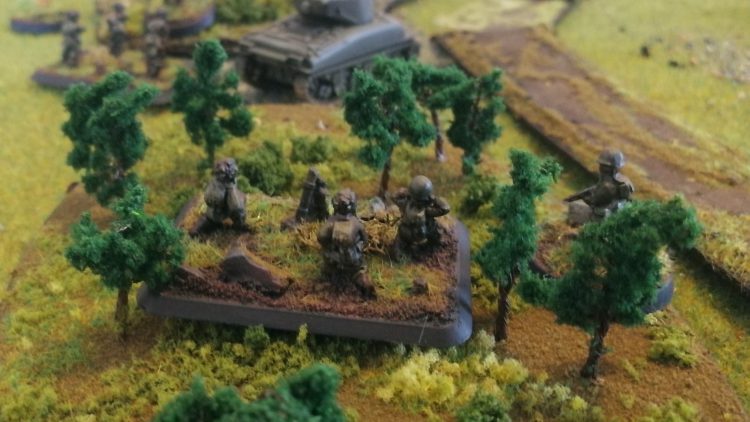 15mm ww2 minis on a shared base textured with Vallejo texture paste. These are exactly the kinds of units you'll be using in "Come Out Fighting" - way cooler than cardboard chits! (credit Lupe)
The game is intended to be played with 15mm miniatures (though I am already thinking about how we could play it at 28mm), and specifically uses multi-figure bases for infantry squads just like
Flames of War. In fact, if you had a FoW army, you could probably play
Come Out Fighting with very little additional outlay (always a strong selling point for historical wargames). Rectangular bases (the rules recommend 40-50mm wide and 20-30mm deep for infantry squads) provide facing, which is critically important for determining what your squads can see and shoot at (more on this later).
In order to preserve some of the tightness of its discretized hex-and-chit roots, these rules spend a far amount of time dealing with the kinds of edge cases that will inevitably come up on the tabletop: what happens if my base crosses elevation levels, which one am I on? How does line-of-sight in the presence of slopes work? What happens if my base is only partially in cover? And so on.
Aside: One of the things I noticed immediately with these rules is that they make a distinction between "visual" cover and actual cover. Visual cover prevents you from being spotted as easily, but doesn't really offer hard protection against bullets. This is something that a lot of other rule sets tend to hand wave over, but by keeping this distinction Come Out Fighting opens up some interesting possibilities for the "slow and careful" approach - units in visual cover which do not fire themselves can benefit from the "Quiet" status, which makes them harder to hit. I can already see American GIs carefully advancing through wheat fields...
Movin' Along...
Another area of the rules that require a fair amount of coverage are the movement rules, again because the absence of hexes means some other method of adjudicating where and how far units can move is important.
Because units have facing and facing is important, unit movement is broken down into two separate stats: Total movement distance (in cm) and the number of facing changes (up to 180 degrees each) that a unit can make over the course of its movement. So when moving, each of your units is going to proceed in a series of linear sprints, possibly changing direction between them. This is a nice way to preserve the importance of facing and differentiate between nimble units like infantry squads versus slower, more cumbersome units like AT guns.
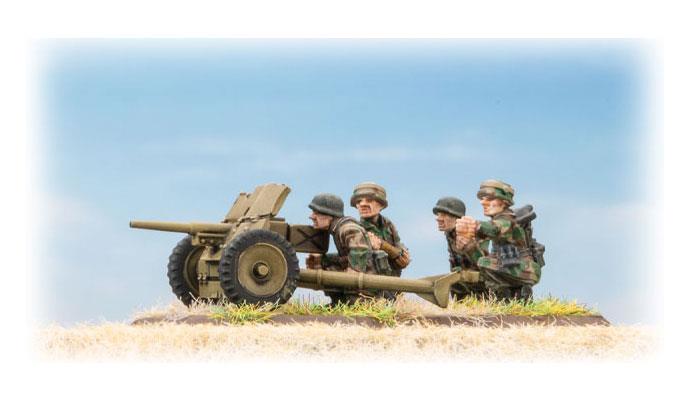 Fallschirmjäger 37mm AT gun crew in 15mm scale. These weapons are harder to maneuver into position and are more susceptible to being flanked than ordinary infantry squads. (credit: Battlefront Games)
Like any good modern wargame,
Come Out Fighting leaves open the provision for "Opportunity Fire," which means that if an enemy unit moves in line-of-sight of one of your units that has not yet activated, you get the opportunity to shoot at them during their movement. There are a couple of important caveats here, however, and it is at this point that I think the rules have an opportunity to see some changes prior to final release. Currently, the check for whether Opportunity Fire is allowed comes at discrete points along the movement route spaced every 10cm the unit moves, but this feels like it has the potential to slow the game down and I suspect a simpler solution is under development. One aspect I really do like, however, is that a unit performing Opportunity Fire can make a facing change to bring the enemy unit into its arc
unless that enemy unit has a higher "Field" rating. This is kind of a cool way of discriminating between units with good fieldcraft versus those without, as veteran units are more likely to be able to move to "get the drop on" less experienced units, and are less likely to be flanked themselves. This I like!
Another aspect of movement that seems like a clever way of handling the realities of moving miniatures in terrain is the rule for how to move an infantry unit (which while on a single base should be remembered is comprised of humans who in reality could arrange themselves in any formation) through a gap that is too small for its base. The elegant solution is simply to penalize the unit one of its facing changes. Oh, and pro-tip: don't be the victim of Opportunity Fire when you are moving through a narrow gap like this - it's gonna hurt!
Finally, just because your unit moves doesn't mean it can't still shoot once it gets where it's going. Units which remain stationary fire with a higher Firepower value, but another important distinction between unit types will be the difference between their "Direct Fire" and "Other Fire" modifiers, i.e. how well they can fire on the move.
"Target is Bracketed, Fire for Effect!"
Speaking of firing, another interesting aspect of these rules is the concept of being "bracketed" by your opponent's fire. A "bracket" is simply a 10cm square, centered on and extended from the front of your unit's base. It can be "walked" all the way out to your unit's maximum fire range, and describes their arc of attention/fire. If at any point along this line your bracket encompasses at least three corners of your opponent's base, you can fire at them without making a facing change. You can of course change facing, but doing so comes at a penalty to your firepower rating.
This is an interesting mechanic, because it reflects the idea that as your range to target increases, it gets much harder to maintain peripheral situational awareness. And of course if you change facing to deal with a very close target, you potentially open up your unit's flank. While I think it's going to require some helpful diagrams and examples in the final rules, I can already see the effect this is going to have on the importance of fire-and-maneuver.
When it comes to inflicting damage, you will compare your unit's applicable Firepower stat - plus all modifiers for cover or other situations, plus a random chance element (more on this shortly) to the target unit's damage table, which each unit has. This simple, color-coded table has effects for firing, melee, and morale effects all in one easy place. It took me a second to figure out how it was supposed to work, but once I got it it's pretty slick. And again, this is a nice way to differentiate between units, as you can encapsulate some fairly subtle variations here to reflect particular training, doctrine, or equipment. Or in the case of vehicles, reflect differences in armor protection from various directions.
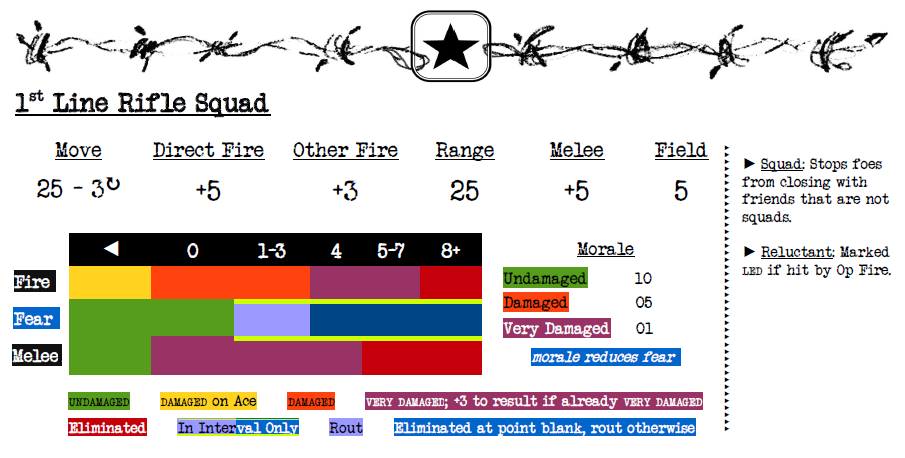 There's a lot going on here, but once you get the hang of it, these tables communicate a ton of information in a pretty compact format, showing how your units are affected by both fire and melee, as well as how they will respond to shock or fear effects. (credit: John Carnahan)
Crucially, this subsumes all of the other stuff that many other rules systems try to break out into different mechanisms. Whereas in other games you might make separate rolls to hit, penetrate, or save for any given attack, Come Out Fighting bundles that all together. There are other factors (infantry often has to make a morale check to expose themselves long enough to fire, and vehicles and AT guns have a "Proficiency" rating that works in a similar fashion), but once you can get a shot off everything else is handled in one simple step. This is very much a "design for effect" rather than a "design for cause" mindset, and greatly streamlines combat resolution.
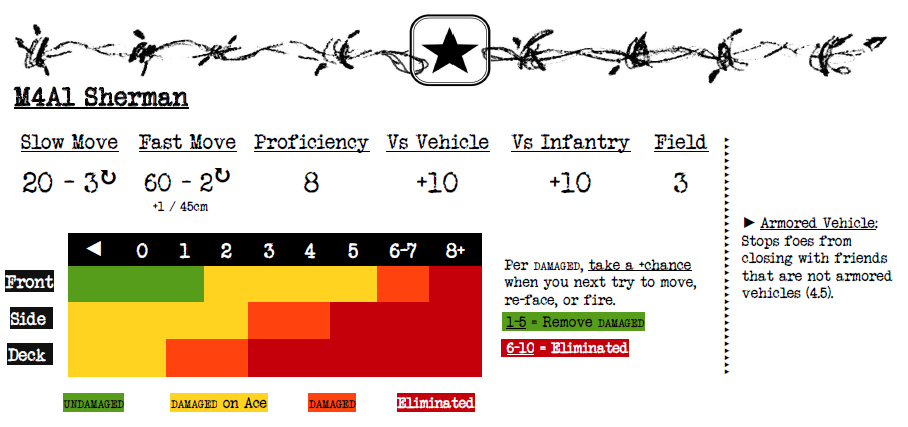 Vehicles work a little differently, but use the same principle (compare the column result of a single number to the appropriate row in the table to determine the overall effect). Vehicles are immune to Fear, so instead these rows reflect the differences in armor facings. (credit: John Carnahan)
Importantly, damage to infantry is only temporary. In the game's "Interval Phase," damage markers can be removed. This is automatic and doesn't require the kinds of "rally" actions that many other games have. Further, a unit can carry at most two "Damaged" tokens. That said, if a unit is Damaged or Very Damaged, its morale takes a hit and it is much more likely to balk - fail to do what is asked of it when activated - or be eliminated should it be subject to further abuse.
Units and Activation
As a platoon-scale game with multi-figure based squads, in a standard game each player is controlling only a handful of units (3-6 core plus reserves). This makes some of the fiddliness of the movement and firing rules easier, as you're not trying to do it for loads of units in your turn.
Activation is simple - each game turn you have a number of activation chits equal to the number of your units on the table (or due to enter this turn if coming on from reserves) plus 2. Depending on your force allocation, you may get additional activations. Players take turns activating units, but importantly activation chits can be "held" rather than used to activate a unit. Held chits can be spent to allow units to change facing and/or engage in Opportunity Fire. This gives us the interesting tension between wanting to spend your tokens to move before your opponent can react, but wanting to hold some back to react to what your opponent has planned. Putting these kinds of difficult decisions in the players hands is always good design in my opinion.
Card Decks
No good wargame is complete without an element of random chance to spice things up and make play less predictable.
Come Out Fighting doesn't use dice, but rather standard playing cards. Each player brings a deck, with each contributing their numbered cards and one of their Jokers to the same "Chance" deck, and their face cards and their remaining Joker to the same "Generals" deck.
The Generals deck is used to determine things about the game itself - who is attacker/defender, how big your force is, what additional assets are available to you (fun stuff like additional activation resources, better scouting, or foxholes), and what each side's primary objective is. In addition, there is a clever drafting system where players take turns picking cards, but then can allocate those cards to their force as they see fit. Both face value and suit are important - pulling that Jack of Clubs might allow you to be the attacker in the scenario, but the Queen of Diamonds might offer a better mix of units. Crucially, the objectives are not symmetric, and will be different for the attacker and the defender. I like this, as it means accomplishing your own objective doesn't necessarily keep the enemy from accomplishing theirs - you might have to do additional work to come out of the game with a clean victory.
The numbered cards form the "Chance" deck, and it is this deck that is used in place of dice to modify various values. Whenever a unit needs to take an action - firing, melee, morale check, etc., it almost always applies a "Chance" card to the process, usually as a subtractive modifier (though for Morale checks it's the card value minus the unit's current Morale level that determines the effect). As such, if your final Firepower after all modifiers is a 5 and you draw a 3 from the Chance deck, your final fire effect is a 2. This value is then compared to the unit's damage table. For instance, if you're shooting at a German infantry squad (and why wouldn't you?), that would result in them getting a "Damaged" token. Straight forward and relatively simple.
Lest you think that pulling cards like this allows you to count cards and stack the odds in your favor, a pull of a Joker means you shuffle the discard pile back into the deck - clever! And if you ever pull an Ace, your opponent gets to draw an additional Sergeant card for future use...
Sergeants
Sergeant cards are a separate thing that allow you to activate unit special rules, take out-of-turn activations, or do things you ordinarily wouldn't be able to do. Crucially, each Sergeant card has multiple abilities, but only one of these can be used when it is played. More interesting and meaningful decisions for the players.
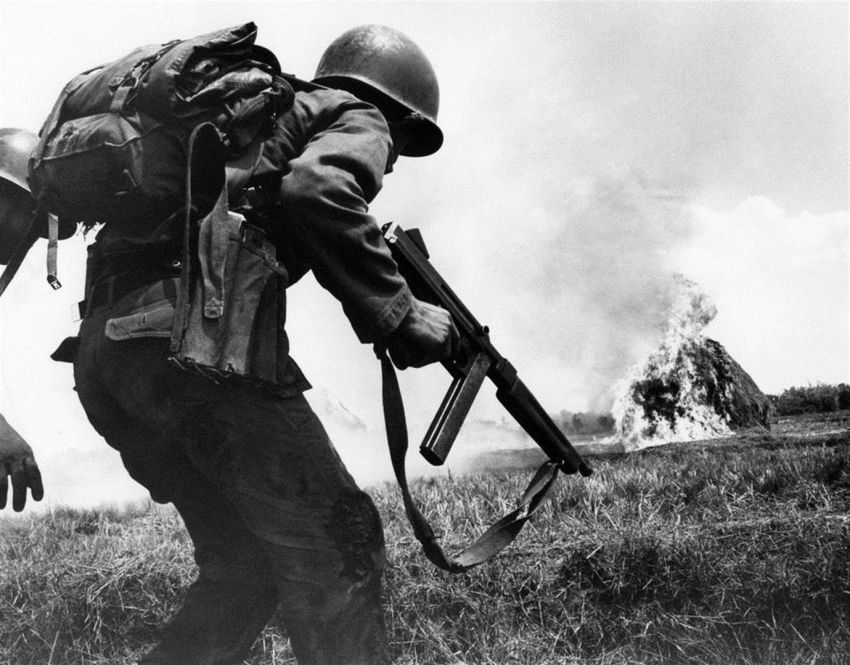 Sometimes, it is the quick thinking and determination of a level-headed NCO that gets a stalled advance back on track. Remember, Sergeants run the Army! (credit: wikimedia commons)
I think Sergeants have the ability to be pretty clutch in the right situation, and using them well is going to make for some great drama during the game. Players that use them well will have an advantage over those who ignore, squander, or underutilize them.
Campaign Play
Anyone who read my recent review of TFL's updated second edition of
At The Sharp End knows that I love campaign play in wargames. Telling a compelling story is one of the things I look for in any tabletop wargame, and
Come Out Fighting builds this experience in from the ground up with its "Memoir" mode.
The Memoir system uses a pretty interesting mechanism that combines an in-game element - where your actions and opportunities during play allow you gain or lose certain abilities - with a clever out-of-game element that introduces a mini-game that tests the player's ability to associate cues with information. In the conceit of the system, your avatar in the game (no doubt a noteworthy officer or NCO) is trying to remember the lyrics to a song that reminds him of happier times. Along the way, lessons he learns give him mnemonics to help remember verses of the song, as well as provide hard-won experience that just might keep him alive to the end of the war (benefits in future games in the form of additional Sergeants cards). Traumatic losses might see him unable to recall certain lyrics anymore.
At the end of the campaign, players arrange their cards lyrics unseen, using only the mnemonic reminders they've added to the cards along the way. Each verse that is in the correct order relative to those that come before and after it scores additional victory points over and above those gained by completing objectives and winning games. I think this is the first time I've seen this combination of in-game and out-of-game elements and it's an intriguing mix. I love RPG elements in wargames, and this one lets players tell a story with a lot of personality along the way. I look forward to seeing how this gets fleshed out in the final version.
Finally, though it was not present in the materials I had access to, the rules do make mention of a system for solo play, a decision engine called ENIGMA - very thematically appropriate. It can sometimes be hard to get wargames to the table, especially if you don't live in a place with an active WW2 gaming scene. As such, I always have a soft spot for any game that makes allowances for solo games.
Overall Impressions
Currently the game is very much focused on Normandy and the fighting on the Western Front in '44-'45. The review materials only had unit rosters for the Americans and Germans, following the exploits of the US 761st Tank Battalion - the legendary Black Panthers. But much like how the
Band of Brothers game started out following the 101st Airborne before expanding to many other theaters and forces (to now include Russians, Germans, and British in a variety of different locations an eras of the war), I suspect that even if the original release of
Come Out Fighting stays focused on Normandy that it won't be long before additional force org charts and unit rosters become available. In many ways, these kinds of expansions are easy once you've done the hard work of designing and play-testing your core rules.
It's also important to reiterate that this project is still in the early stages. John has done a ton of work already, but in some sense getting your ideas down on paper and writing rules is only the first step. Art, layout, copy editing, play testing - all of this takes a tremendous amount of time, effort, and dedication.
All tabletop wargames exist on a spectrum. In all honesty, there are some elements of the current state of
Come Out Fighting that seem a little fiddly to me at first blush, but there's
absolutely an audience for that kind of detail. Similarly, there's an audience for well structured campaign play, RPG elements, and solo support. If the initial materials are anything to go by, I think this game is going to have a lot to offer folks on a variety of locations along that spectrum, and I think the final product that comes out of the Kickstarter is going to even more to offer.
If this review piqued your curiosity, I highly recommend shooting over to the
game's Kickstarter page and reading more. Huge thanks again to John Carnahan for being willing to give us a sneak peek. Showing the world your creation is a scary thing at the best of times, more still when it's still very much under construction. Kudos to him!
Have any questions or feedback? Drop us a note in the comments below or email us at contact@goonhammer.com. Want articles like this linked in your inbox every Monday morning? Sign up for our newsletter. And don’t forget that you can support us on Patreon for backer rewards like early video content, Administratum access, an ad-free experience on our website and more.
Thank you for being a friend.
 This website uses cookies. Learn more.


 Goonhammer Hobby Round-Up: March 2026
 Goonhammer Reviews: Tribal Conquest
 Conquest: Weaver Courts Gemred Knights and Scaile Dancers Model Review