A while back we talked about Altar of Freedom, an excellent fast-play grand tactical scale game. Today in Goonhammer Historicals we were lucky enough to have a chat with the game's designer, Greg Wagman, who next to making games, is also a contributor for LittlewarsTV. We talk games, game design and get a sneak peek at what’s coming up!
GHH: The first question is a bit of a cliché, but everyone always wants to know; how did you first get into miniature wargaming?
Greg Wagman: I was lucky enough to grow up in a family where we were always playing games — board games, card games, you name it. So I’ve been into gaming for as long as I can remember. As I got older, in middle school and high school, I started getting more interested in strategy games. I really started as a board gamer: Diplomacy, Risk, Axis & Allies, and some of the old Avalon Hill hex-and-counter games.
My first miniatures game, though, was Warhammer. A friend of mine in middle school was really into it and introduced me to the hobby. High Elves were the first army I ever bought. I was really bad at painting, and to be honest painting still isn’t my favorite part of the hobby, although I’ve definitely gotten better at it. I really enjoy the strategy side of gaming, and these days I probably enjoy making terrain the most.
Like a lot of people, I started with Games Workshop: Warhammer, a little bit of 40K, but in high school I finally discovered historical wargaming. I didn’t even know that historical miniatures existed. I was in a local hobby shop buying some Warhammer, and in the front display case there were a few beautifully painted 28mm World War II figures. I asked the shop owner what they were and who played with them, and he told me some guys met in the back of the comic shop on Wednesday nights to play World War II games.
So the next Wednesday, my mom dropped me off at the comic shop, I wasn’t even old enough to drive, I was about 14, and there were two guys in the back playing a World War II game. That was it for me. I never really went back to Warhammer after that. I was all in on historical gaming. And, amazingly enough, those two guys I met that first night are still people I game with today. They’re still involved in our club.
GHH: Games Workshop still tends to dominate how many people first encounter miniature wargaming. Do you think it has become easier today for players to discover the wider hobby beyond that sphere?
Greg Wagman: I think it’s probably harder now to be unaware of what else is out there, just because social media and the internet make everything more visible. But when I was finding historicals, back around 2000 or 2001, social media really wasn’t a factor. You relied on trade magazines, White Dwarf, and whatever your local hobby shop happened to stock. That basically determined what you played.
Even now, though, I think Games Workshop still exists in its own bubble. I’m still fond of some of their games. I actually got back into Games Workshop for a while through the Middle-earth Strategy Battle Game. That’s a really solid ruleset — probably the best Games Workshop game I’ve ever played. It must be close to twenty years old now, and it’s still going strong. There’s still a big following, still tournaments, still releases. It’s also a very welcoming community, which I think helps a lot.
GHH: That kind of accessibility and streamlined design seems to be something many modern skirmish games aim for. Have you had a chance to try Pillage, and what did you think of it?
Greg Wagman: Yes, we’ve tried it in the club. We enjoyed it. It’s very easy to play and very fast. Four of us got through a multiplayer game with maybe 15 to 20 models each in less than two hours, which is great.
From a design standpoint, though, I wouldn’t say there’s anything especially revolutionary about it. It’s very lightweight. But sometimes that’s exactly what you want. Sometimes you just want to sit down at the club and play an easy two-hour game, and Pillage does that very well. It’s not going to challenge you in a major way, for better or worse, but it’s perfectly fine at what it does. It’s a true beer-and-pretzels game.
GHH: That actually leads nicely into Altar of Freedom. One of the things I love about it is how accessible it is, even though it’s a grand-scale 6mm historical game. I’ve put it in front of people who didn’t play historicals, and they were into it almost immediately. They were playing the battle, not struggling with the rules.
Greg Wagman: That was definitely the goal. I think every game has to have a thesis. If you’re going to write a game, you need to start by asking yourself: what is this game trying to represent? What problem am I trying to solve? What do I want the player to experience?
The best games, in my opinion, are games where you can immediately explain what they’re about in one sentence. One of my all-time favorite games, completely unrelated to the American Civil War, is Crossfire, a World War II company-level game by Arty Conliffe. Crossfire has a very clear thesis. The moment you play it, you understand what makes it tick: it’s about setting up crossfires, interrupting your opponent, and dealing with a unique initiative system.
That’s what I wanted for Altar of Freedom. I wanted the central organizing principle to be clear and meaningful.
Littlewarstv Gettysburg game behind the scenes Credit: Greg Wagman, LittlewarsTV
GHH: So what problem were you trying to solve when you designed Altar of Freedom?
Greg Wagman: I wanted to solve a problem for myself, first and foremost. Our club only meets for about three hours at a time. Everybody’s in and out in three hours. I really wanted to play full American Civil War battles — not just Little Round Top, not just the Wheatfield, not just one section of a battlefield. I wanted to play Shiloh, Antietam, Gettysburg, the whole battle.
That probably comes from my board gaming background. I’ve always loved the grand sweep of operational-level battles. But if you want to do that in miniatures, especially for the American Civil War, there just aren’t that many options.
Our club played a lot of Fire and Fury, and I love Fire and Fury. I think it’s a really good system. But you are not playing a whole battle with it in three hours unless it’s a very small one. So there just weren’t many rulesets that did what I wanted.
One game I did find and really liked was Volley & Bayonet by Frank Chadwick. I love that system. It’s a broad black powder game that can cover everything from the American War of Independence to Napoleonics, the American Civil War, even the Franco-Prussian War. But it had one thing I felt was missing for Civil War gaming: a command-and-control system.
There’s essentially no command friction in Volley & Bayonet. The rules even say that the friction comes from having a big multiplayer game, which is true! If you have eight players around the table, that naturally creates coordination issues. But if you’re only playing with two to four players, which is often the case, where does that friction come from?
And for me, as someone who’s really studied the American Civil War, every account from divisional, corps, and army commanders talks about the same thing: coordination, and the difficulty of coordination. That’s a huge part of the war. So I wanted a game where that friction was baked in. I wanted the player’s job not to be micromanaging musket fire or artillery fire, but trying to manage command, control, and timing — trying to get everything to move together. That’s the thesis of Altar of Freedom, and the bidding activation system is built entirely around that.
GHH: Was that initiative and bidding system a very deliberate design choice from the start?
Greg Wagman: Absolutely. It was central to the whole design. That’s really the heart of the game.
GHH: On the other hand, what did you have to leave out to make that thesis work?
Greg Wagman: That’s a really important question, and I think it’s one of the things that separates experienced game designers from novice ones. When you’re a novice game designer, you want to put everything in. The temptation is to write a 100-page or 200-page game that simulates every possible detail.
A good game designer learns that you have to pick your emphasis. You can’t do everything. Nobody wants to play a 200-page game that tries to model every aspect of warfare in equal detail.
In the case of Altar of Freedom, the sacrifice I had to make was in combat resolution: the actual process of resolving how units fight on the table. If players are going to spend meaningful time on command and control, on allocating points and coordinating divisions, that takes time. And if I’m working backward from a three-hour play window, I have to cut time somewhere.
The obvious place to cut it was combat. Earlier versions of Altar of Freedom had a more involved combat system. It used D10s, had more modifiers, and gave players a few more tactical choices. I stripped all of that out because it simply took too long. In Altar of Freedom, you’re going to roll a lot of combats over the course of a game. If every one of those takes too long to resolve, the whole thing becomes a four- or five-hour game, and that defeats the purpose.
So yes, that was the trade-off. Over the years, people have said, “I love the command-and-control system, but I prefer the combat in some other game.” And honestly, I often agree with them. If I had five hours instead of three, I might have designed the combat differently. But I went in with a very specific design constraint, and there was no way around making that compromise.
Littlewarstv Gettysburg game behind the scenes Credit: Greg Wagman, LittlewarsTV
GHH: There’s a couple of D10 variants floating around online. Is that related to the earlier version you cut?
Greg Wagman: No, not really. I’ve seen a couple of those variants, and one of them is actually pretty good. But the D10 versions I’ve seen mostly just replace the D6 with a D10 while keeping most of the same modifiers. Since Altar of Freedom is an opposed roll system, that just introduces more variability. You get bigger swings in results, which can make the game faster and more decisive. Units break more dramatically, and that can be fun.
The original D10 version I had in development before publication was different. In that version, before each combat, you could choose a sort of “stance” for your unit from a separate chart. It gave you a tactical choice in every combat, which sounded interesting in theory, but in practice it slowed the game down too much. Players had too many little decisions to make.
So the D10 versions people use now aren’t really the same as that older version. They’re just harder-hitting variants of the published game.
GHH: On a personal note, the three-hour format really matters to me as well. At our club, we play in roughly three-hour windows, and it’s hard to find historical games that fit that.
Greg Wagman: I don’t think you and I are alone in that. I think that’s one of the reasons Altar of Freedom became popular and still sells well more than a decade later. The hobby has moved in that direction. Twenty or thirty years ago, the idea of getting together all day Saturday to play Gettysburg was much more common. But the hobby has shifted. People have less time, less space, and fewer people have giant permanent tables in their basements.
I think that’s part of why skirmish gaming has become so popular: smaller tables, fewer figures, shorter playtimes. The problem for me is that I’m not really a skirmish gamer at heart. I want battles! Big ancients battles, big Civil War battles, big historical battles in general. And it’s genuinely hard to find rules in any period that let you do that in two or three hours.
Credit: Greg Wagman, LittlewarsTV
GHH: Smaller scales also seem to be becoming more accepted. Grand-scale games feel like they’re having a bit of a moment again.
Greg Wagman: I agree, and I think that’s a really good thing. There’s definitely more openness to smaller scales now than there used to be. Warlord’s Epic scale ranges have helped a lot with that, and there are multiple companies moving in that direction.
People want big battles, and small-scale figures make those battles practical. In terms of time, money, and table space. That stigma around smaller scales does seem to be fading, and I’m very happy about that.
GHH: Looking ahead, where do you think game design is going next? What’s the next frontier?
Greg Wagman: I think the next big frontier is the marriage of game design with the revolution in 3D printing. We’re only at the very beginning of that.
One of the guys in my club told me about a co-worker who wanted to print an orc. He wasn’t a sculptor, didn’t know anything about 3D modeling, and didn’t even own a printer. He found a picture of an orc online. It was just a front-facing image, not a miniature, just a graphic. And he used AI to generate an STL file from it. Then he sent that STL to a print farm, and it printed successfully. He ended up with a 28mm orc miniature that looked just like the image.
I don’t know what that means long term for companies that rely on producing miniatures in the traditional way. For licensed fantasy or sci-fi properties, there may be IP protections. But in the historicals space, nobody owns what a Roman legionary or a World War II German soldier looks like. That’s going to change things dramatically.
I think we’re heading toward a future where rulesets and STL files are bundled together, or where game systems connect directly to print farms. That could make the hobby much more accessible.
What’s interesting is that a few years ago, people assumed the future meant everyone would own a 3D printer at home. I’m not sure that’s actually where we’re headed. I got rid of mine. I know other people who did too. Printing is its own hobby. But using a print farm? That’s easy. Email a file, get your figures in the mail a week later. That feels much more likely to become the norm.
GHH: Do you worry that AI might damage the craft side of game design?
Greg Wagman: I understand the concern, but I don’t think game designers are in immediate danger. At least for the foreseeable future, creativity is not AI’s strongest suit. It can be a useful brainstorming partner, and I’ve used it that way. But it’s not especially good at putting together an original, functional design.
For fun, I once asked ChatGPT to write me a Roman chariot racing game. I gave it a few design priorities and asked it to produce a full ruleset. It did. I probably could have copied and pasted it into a document and uploaded it somewhere. But it wasn’t good. Honestly, I’m not even sure it would have worked properly as a game.
That said, it did include a couple of interesting ideas that made me stop and think. So as a brainstorming tool, I think it has value. But as a replacement for actual game design? No, I don’t think we’re there.
GHH: There does seem to be a strong resistance to AI in the hobby.
Greg Wagman: Definitely. We saw that ourselves on the Little Wars TV channel. A few months ago, one of the guys in the club used ">ChatGPT to generate a Napoleonic scenario, and we played it as written just to see what would happen. We filmed it for the channel as an experiment. We wanted to see if AI could write a decent scenario, or if it would completely fall apart.
People hated it! We got a lot of angry comments, people saying they were unsubscribing, asking how we could do this, saying AI had no place in the hobby. It clearly touched a nerve much more deeply than I expected.
So yes, there is definitely strong resistance to AI in this hobby. I’m not even judging that, I understand why people feel uneasy about it, but it’s very real.
GHH: Are you working on anything at the moment?
Greg Wagman: Always! I’m always working on something!
One project I’m close to finishing is a scenario book for ancients focused on Julius Caesar in Gaul, written for Age of Hannibal but adaptable to other ancient systems. I’m also developing a campaign system to represent a long, multi-year campaign like Caesar’s Gallic Wars.
I’ve also been working with another guy in the club on a Starship Troopers game. We both love the book and the movie, and we’ve been developing that system for about two years now. That one is finished, and we’re hoping to put it out this year.
Longer term, I’ve also been working on a big Napoleonic battle game. You had asked me before we recorded whether there might ever be a Napoleonic version of Altar of Freedom. I’ve thought about that off and on for years. Someone I know is going down that route, and I’ve talked with him and offered feedback, so he has my blessing to pursue it.
As for me, I got inspired to go in a slightly different direction. It’s still a big-battle Napoleonic game, still trying to do something like Waterloo in three hours or less, but it doesn’t share the same principles as Altar of Freedom. It’s built around a different central idea. I’ve been working on it for about a year, and I’m probably at least another year away because playtesting takes a long time.
GHH: So there really is a big Napoleonic project in the works?
Greg Wagman: Yes, though I haven’t talked about it much because I’m still ironing out some major issues. But it comes from the same basic challenge that led to Altar of Freedom: can I do Waterloo in a satisfying way in three hours? And, just as importantly, do I actually have something new to say?
There are already lots of Napoleonic games, and some of them are really good. To me, the only reason to write a new one is if you have a new perspective or mechanic to bring to the table. I think I’ve found one, so I’m chasing that down.
GHH: Playtesting seems hugely important there.
Greg Wagman: It is. And outside playtesting is especially important. It’s one thing to playtest in your own club, where everyone already understands how you think and can ask you questions. It’s another thing entirely to send the rules to someone else, somewhere else, and see whether the game works when you’re not there to explain anything.
Good playtesters are invaluable. You want people who will try to break the game. You want people who will tear it apart constructively. I’ve had plenty of people come back with vague praise. “Oh, we had a good time”, which is nice, but not actually very helpful. What you really need are people who can identify weaknesses and tell you exactly where the design fails or gets exploited.
Playtest of Live Free or Die scenario Credit: Greg Wagman, LittlewarsTV
GHH: What kinds of games are you enjoying right now?
Greg Wagman: Our club is pretty eclectic, so we’re always playing different things. That’s great because it keeps everyone inspired and exposes you to new periods and systems, but it also creates a challenge: if you only play a game a few times a year, you end up relearning it every time.
A good example would be O Group by Dave Brown. There are a couple of guys in our club who really like it, and it’s a good World War II game, but it’s not a beer-and-pretzels game. If you only pull it out once in a while, you’ve forgotten a lot by the time you come back to it.
Credit: Greg Wagman, LittlewarsTV
That’s one reason shorter, more immediately playable rulesets have become so popular in our club. Pillage is a good example of that. You don’t need to remember much from the last time you played. You can just sit down and go.
Board games have also become a lot more popular in our club over the last year or two. We always liked them, but we used to only bring miniatures to club nights. Now there are usually a couple of people off in a corner playing a board game as well.
GHH: Is there a game you played recently that really surprised you?
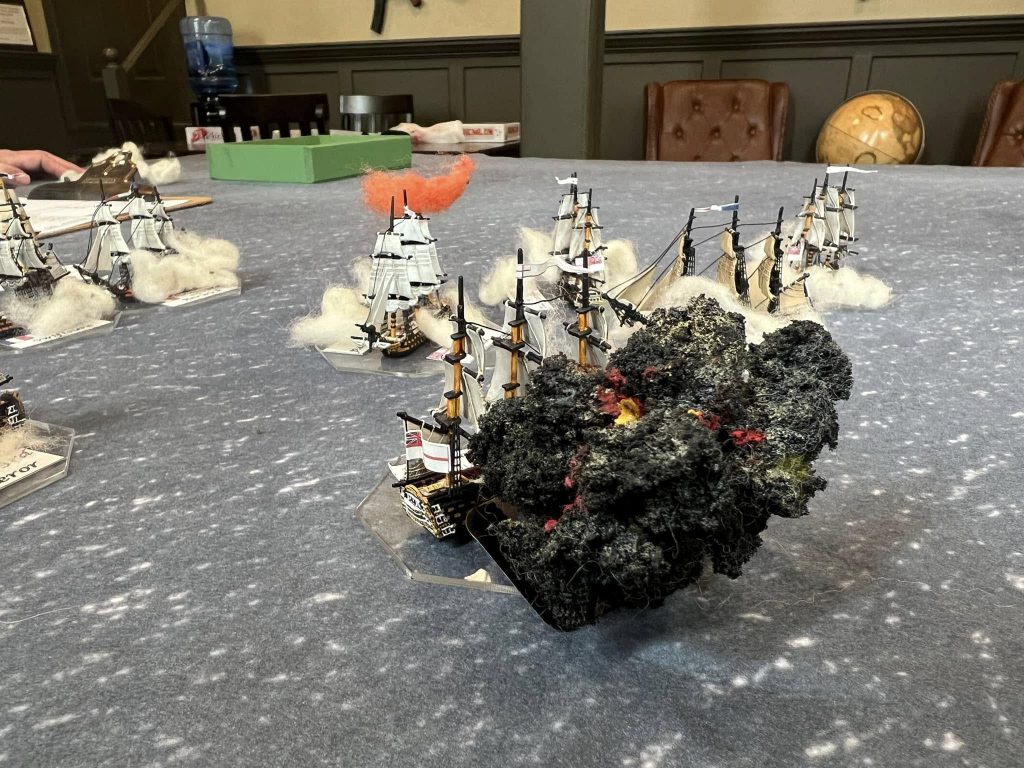
Greg Wagman: Yes. Very recently, we played an Age of Sail game for the first time in about two years. Traditionally, we’ve used Fire As She Bears, which is a fun and relatively lightweight system. This time, though, we tried something new: Form on the Admiral’s Wake by Brian DeWitt.
It’s only about ten pages long, and it immediately interested me because it seemed like a slightly more streamlined cousin to Fire As She Bears. We had around twenty ships on the table, and we were able to resolve the entire battle in about ninety minutes.
Credit: Greg Wagman, LittlewarsTV
That’s very fast for an Age of Sail game, and everybody had a great time. One of the most fun aspects was that critical hits are fairly common, and every wargamer loves a critical hit! In our game, one ship exploded completely in a magazine explosion, which was fantastic. It was a great reminder of why short rulesets have become so popular in the club: people don’t want to do a pile of homework before a club night. With a game like that, you can hand somebody a quick reference sheet, explain the basics, and be having fun almost immediately.
GHH: I feel like small-scale and 6mm games don’t get nearly enough attention. There are so many great systems out there, but the spotlight still tends to fall on 28mm skirmish gaming.
Greg Wagman: I think that’s absolutely true. One of the joys of small-scale gaming is that you can do things that just don’t look right in larger scales. I’m working on a project for Historicon right now based on Caesar at Alesia. That’s an enormous battle not just in troop numbers, but in the sheer geographic size of the battlefield. Caesar’s siege line ran for miles.
I’m building a custom table for it right now, and honestly the table is the time-consuming part. The armies are 6mm, so they’re actually relatively quick to do. And that’s what I love about smaller scales: you can represent something truly massive and have it still look convincing. You can’t really do the full Battle of Alesia in 28mm without it becoming absurdly compressed or just looking wrong. In 6mm, though, you can evoke the whole thing. That’s where those scales really shine.
GHH: Thanks so much for taking the time to talk to us!
If you want to see more of Greg’s work in action, you can follow the LittlewarsTV channel here. There is a ton of quality content for the discerning historical gamer. Not only are there awesome style="font-weight: 400;">battle reports to check out, but campaigns and reviews as well. My personal favorite: a ">Pyrrhic war campaign! You can also support their work on Patreon.
If you want to try one of Greg’s games and embrace the glory that is small scale big battle wargaming, you can find Altar of Freedom here, as well as the excellent Age of Hannibal ancients ruleset.
Have any questions or feedback? Drop us a note in the comments below or email us at contact@goonhammer.com. Want articles like this linked in your inbox every Monday morning? Sign up for our newsletter. And don’t forget that you can support us on Patreon for backer rewards like early video content, Administratum access, an ad-free experience on our website, and subscriber-only content covering competitive Warhammer 40K!
 This website uses cookies. Learn more.
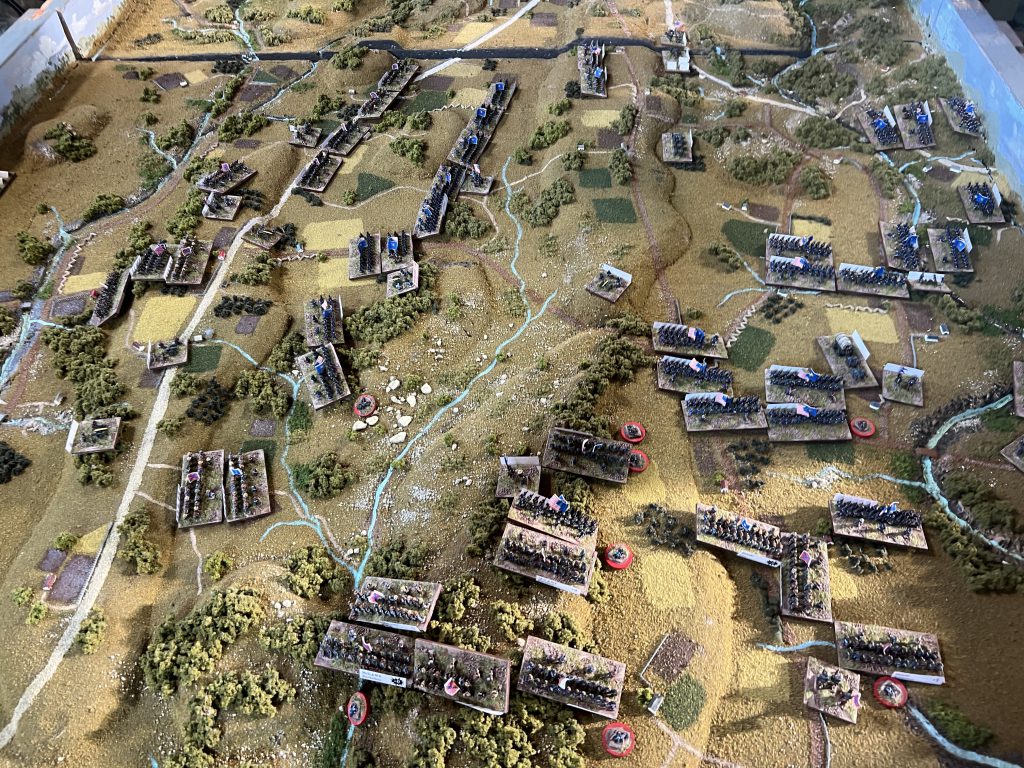 Littlewarstv Gettysburg game behind the scenes Credit: Greg Wagman, LittlewarsTV
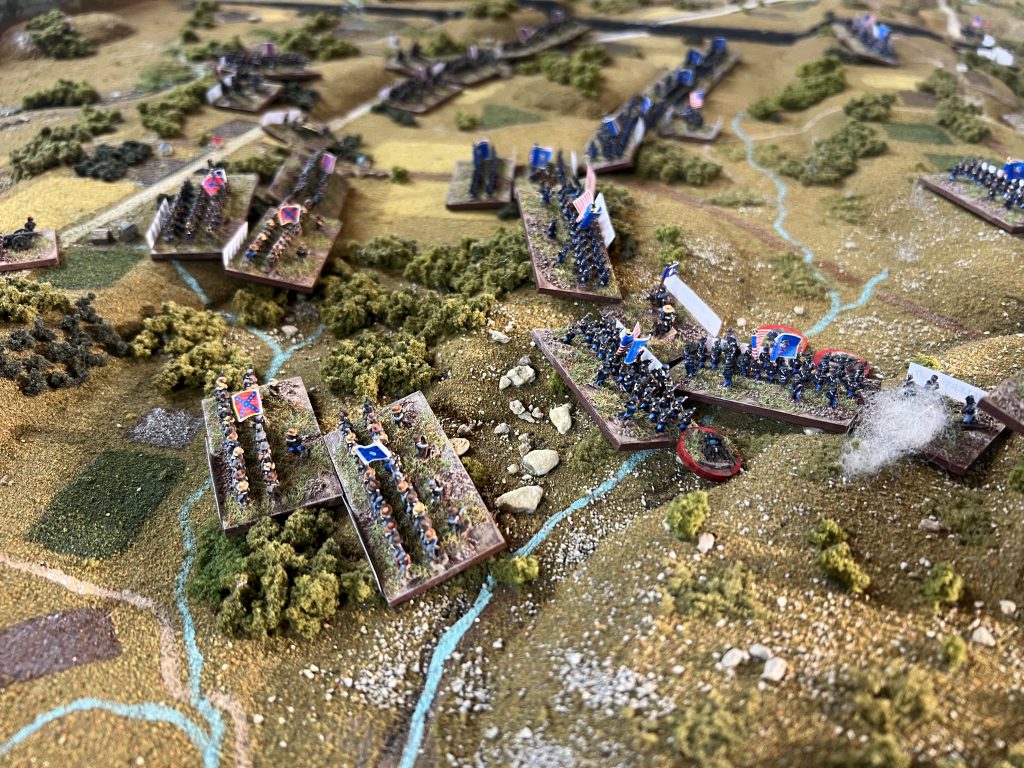 Littlewarstv Gettysburg game behind the scenes Credit: Greg Wagman, LittlewarsTV
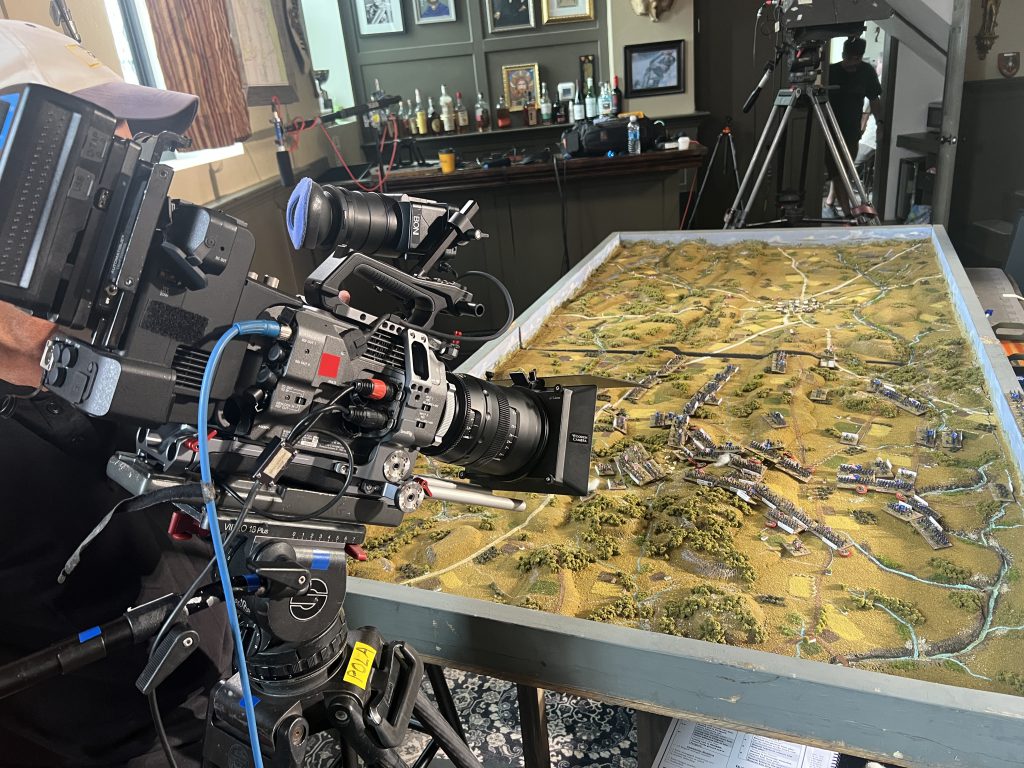 Credit: Greg Wagman, LittlewarsTV
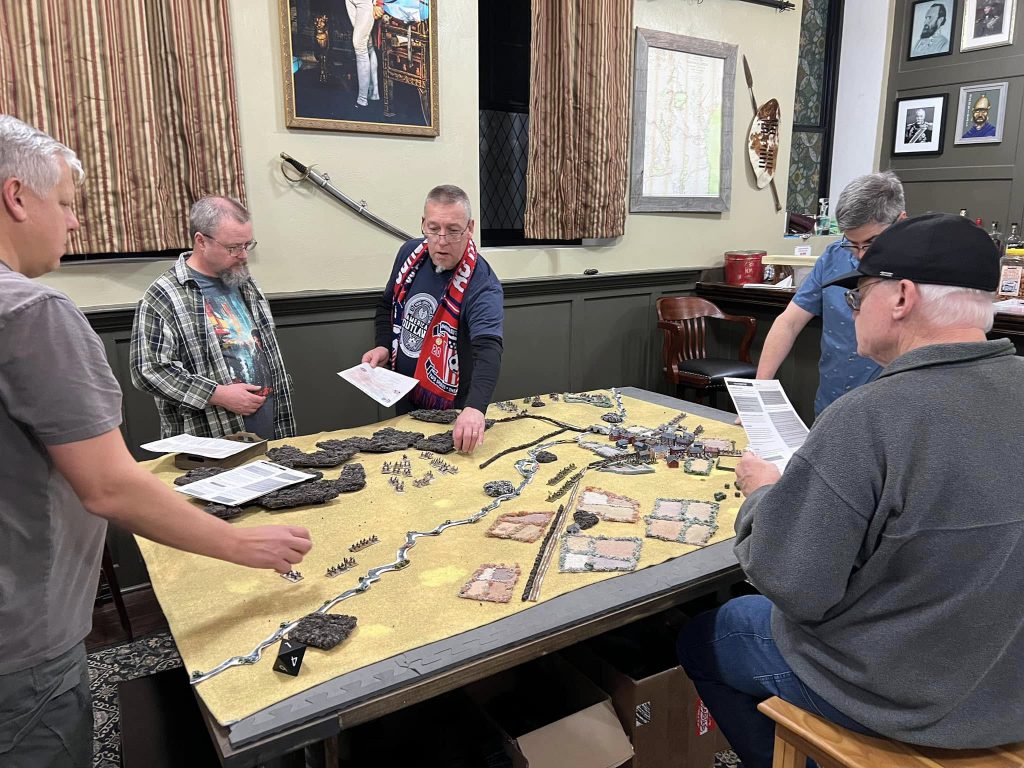 Playtest of Live Free or Die scenario Credit: Greg Wagman, LittlewarsTV
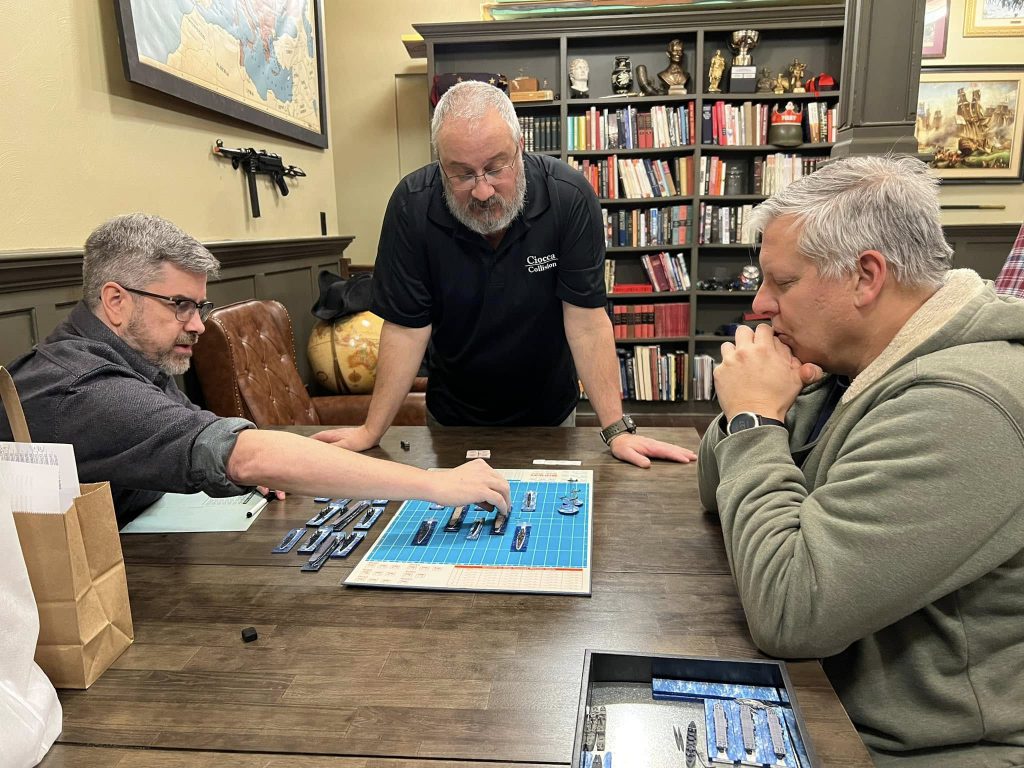 Credit: Greg Wagman, LittlewarsTV
 Credit: Greg Wagman, LittlewarsTV

 Goonhammer Hobby Round-Up: March 2026
 Goonhammer Reviews: Tribal Conquest
 Conquest: Weaver Courts Gemred Knights and Scaile Dancers Model Review