If you want to play the American Civil War, you’re spoilt for choice with rulesets. As far as historical periods go, it certainly seems to be one of the most popular time periods. It is a bit odd at that; no flashy costumes like the Napoleonic wars, or no million and one media like you can watch and play for World War 2. What it does have, is strong personalities, generals who were myths even in their day, and an astounding number of casualties. Greg Wagman, author and also contributor to the LittlewarsTV site and Youtube channel, zooms out and lets you command an entire army, and play a complete historical battle in a couple of hours.
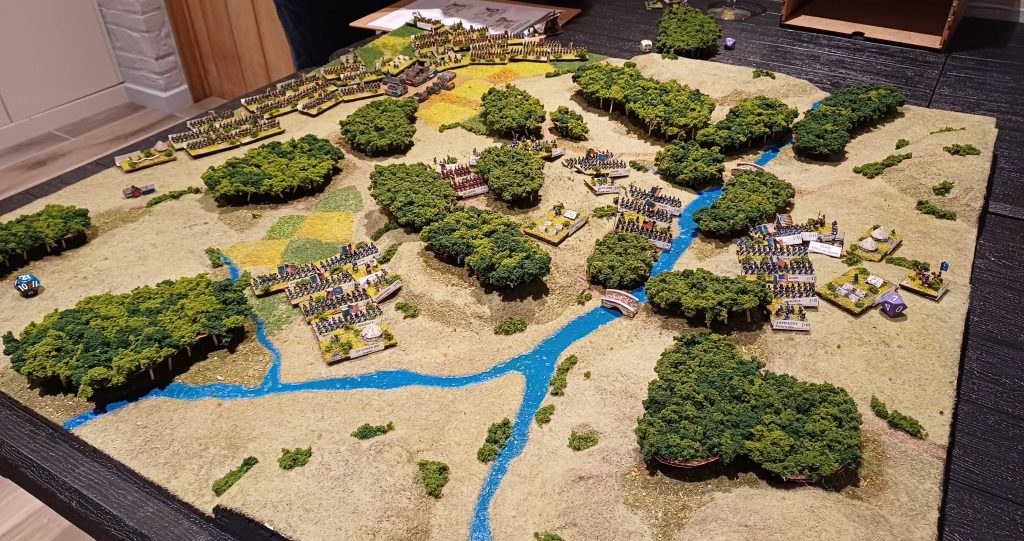 Battle of Jonesboro Credit; Jackie Daytona
An Issue of Scale
We have to get the basics out of the way first; in this article I will have to convince you to actually paint and collect 6mm ACW, because folks, this is one of the best rulesets out there to capture the feel of an entire battle for the period.
To get a feel for the scale, the Battle of Jonesboro in the picture above is played on a 3x3 board, one of the smaller scenarios in size, but medium in terms of troops (about 20,000 Confederates, around 15-19,000 Union troops). The first thing you need to know about Altar of Freedom (AoF abbreviated for the rest of the article) is that it is very much a scenario based ruleset. There are two campaign books which give you the order of battle, board lay-out and timing of reinforcements, if any. The author carefully explains why he chose this in a game design philosophy chapter, which is something I’d love to see more in rulesets, but does reluctantly give you points values if you want to try a make-believe battle. However, AoF really shines in the asymmetric historical recreation of the battles.
In that respect, board and army size is completely dependent on which scenario you choose. Board size can be anything from 3x3 to a whopping 8x6. You’ll need about 25 to 30 bases of infantry for most battles, with assorted artillery, and a handful of general, cavalry and HQ bases. You control different corps in your army, made up of divisions, of which the smallest unit is a brigade.
Every base on the table is, depending on the time period and army, roughly 500-1200 men. Base size is 60x30mm for an infantry or cavalry base (the Baccus standard, if you will), and 30x30mm for generals and artillery stands. This is the recommendation, as long as bases are the same size for both sides, it will work out. Every campaign book has a handy overview for each battle which shows how many stands you need, how big the board is, and how many players can participate. This actually gives you something to work towards if you want to start out, and is very convenient for planning out your armies (yes it’s plural, let’s be real here).
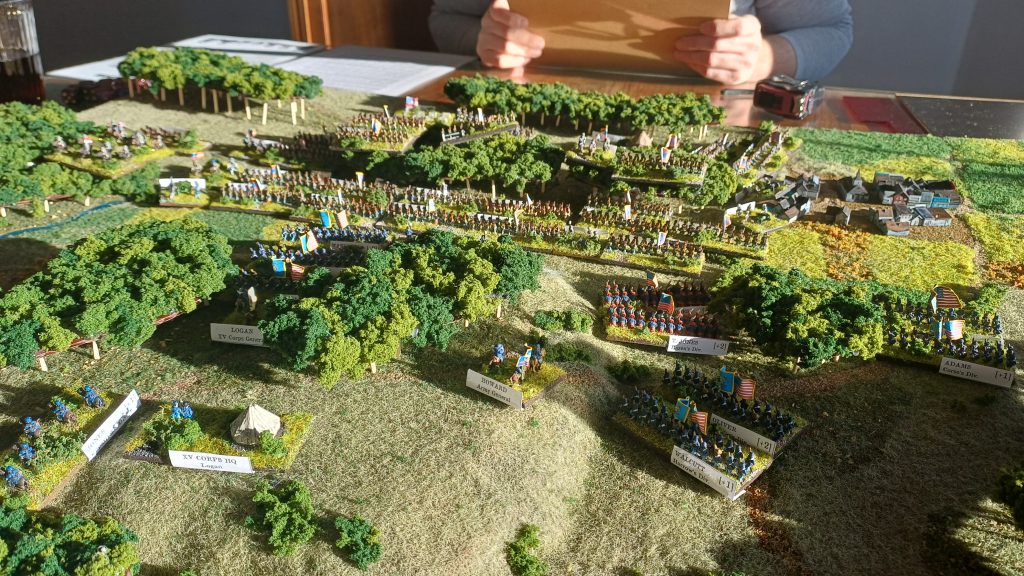 Another view of the battle with different deployment Credit; Jackie Daytona
Since making a bespoke board is not in everyone’s wheelhouse, making a 6mm battlefield can be very cheap. Felt or cardboard roads can be cut out, and there is an
entire section on the website dedicated to making scenery, and on a budget as well. For those who do want to jump in feet first, making a board itself can be cheap too (an article is in the works), and the scenarios have great replayability. You may object that having a fixed order of battle and table lay-out will become repetitive, but that’s not the case here. This is because the engine that drives the rules is based on elegant and simple mechanics that work together fantastically
Elegance in Design
The word “elegant” with regards to wargame rules has lost some of its meaning, but let’s break down what I want to convey by it in this context. An elegant ruleset - at its core - lets you play the battle in front of you without any homework. Mechanics are clear, there’s not too much fuss with special rules, and you have to make choices under pressure, not always optimal ones. The friction does not come from dice rolls, but the strategy and tactics are yours to use. An elegant ruleset can be played with a quick reference sheet and without rifling through a rulebook every five minutes because of an interaction dictated by rules, not common sense.
"I will not move my army without onions!" - Ulysses S. Grant, 1864
AoF achieves this through a couple of different means. The first is the bidding system, where every army is divided up under the respective generals in corps and divisions, which can only be activated through assigning points. You can’t activate everything. Sometimes you won’t activate the lower bids on your board, because the next mechanic, the turn clock, dictates the pace. This is something that takes very long to explain and it works best to just do it in-game. You basically call out the bids, players activate divisions (so a couple of brigades) and after a bid is finished, both players roll a D6. The player with priority (who also activates first) chooses which die is used to deduct from the turn clock. So let’s use an example with an Order of Battle page. It’s recommended to laminate these, so you can use an erasable pen.
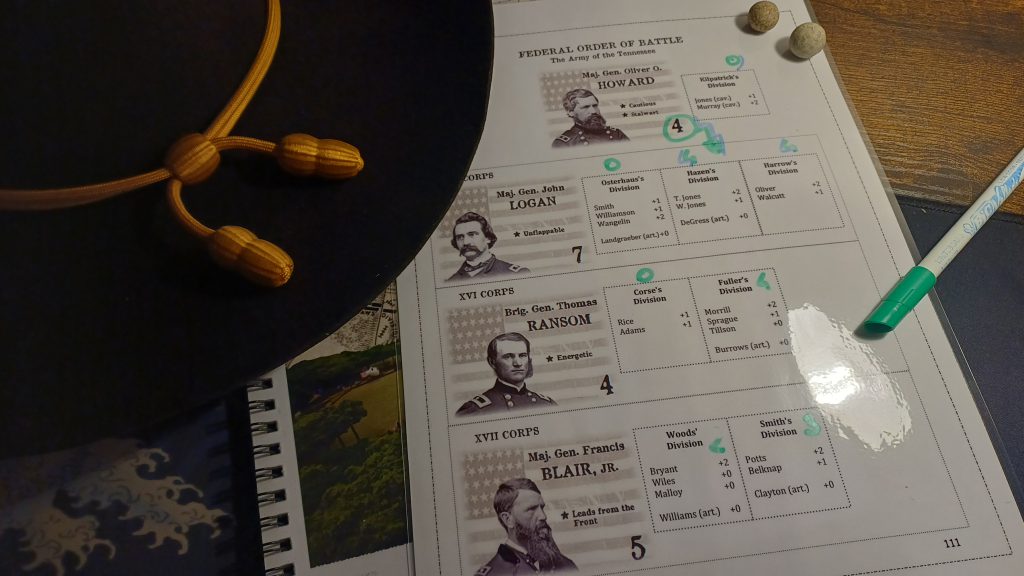 Game sheets. Credit: Jackie Daytona
In the above shot, we have the Army of the Tennessee. General Howard has four points he can distribute across all other corps, while Logan, Ransom and Blair can only assign points to their own division. The division with four points will all act in the same bid, one after the other. So if these and any of your opponent’s divisions have activated, the bid ends and you both roll the d6.
The turn clock is dependent on the scenario and is represented by a number or die. Smaller battles have a D10 turn clock, larger ones a D20. if it reaches zero, the turn is done, even if you still have points on a division you wanted to activate. So you can bid high, bid some points to add to your priority roll, and hope to outmaneuver your opponent and run out the clock. You can also “save” points to maneuver 1 base per point at the end of the turn, if you really need to plug a gap in the line. But spending a point on moving one brigade is not the most cost-effective way of maneuvering!
As you’ve no doubt noticed, every general has some traits. These can affect the number of points you can bid or give you an edge on the tabletop itself. Why this works so well with scenarios is that this changes battle by battle. Grant can be brilliant in one battle, or distracted or tardy in another. Every general has these traits based on how they acted on the day of battle.
This is absolutely brilliant, and has a tremendous effect on your battles. You may be very much outnumbered as a Confederate, but your Union opponent has indecisive generals who will be hampered to activate troops. You can’t always activate everyone, so will have to put pressure where you can. Battles are usually fought until a certain break point is reached. You do not know the strength and disposition of the enemy brigades in front of you, this will only be revealed once you meet them in combat, which neatly brings us to the next bit; tabletop tactics.
Game sheets. Credit: Jackie Daytona
In the above shot, we have the Army of the Tennessee. General Howard has four points he can distribute across all other corps, while Logan, Ransom and Blair can only assign points to their own division. The division with four points will all act in the same bid, one after the other. So if these and any of your opponent’s divisions have activated, the bid ends and you both roll the d6.
The turn clock is dependent on the scenario and is represented by a number or die. Smaller battles have a D10 turn clock, larger ones a D20. if it reaches zero, the turn is done, even if you still have points on a division you wanted to activate. So you can bid high, bid some points to add to your priority roll, and hope to outmaneuver your opponent and run out the clock. You can also “save” points to maneuver 1 base per point at the end of the turn, if you really need to plug a gap in the line. But spending a point on moving one brigade is not the most cost-effective way of maneuvering!
As you’ve no doubt noticed, every general has some traits. These can affect the number of points you can bid or give you an edge on the tabletop itself. Why this works so well with scenarios is that this changes battle by battle. Grant can be brilliant in one battle, or distracted or tardy in another. Every general has these traits based on how they acted on the day of battle.
This is absolutely brilliant, and has a tremendous effect on your battles. You may be very much outnumbered as a Confederate, but your Union opponent has indecisive generals who will be hampered to activate troops. You can’t always activate everyone, so will have to put pressure where you can. Battles are usually fought until a certain break point is reached. You do not know the strength and disposition of the enemy brigades in front of you, this will only be revealed once you meet them in combat, which neatly brings us to the next bit; tabletop tactics.
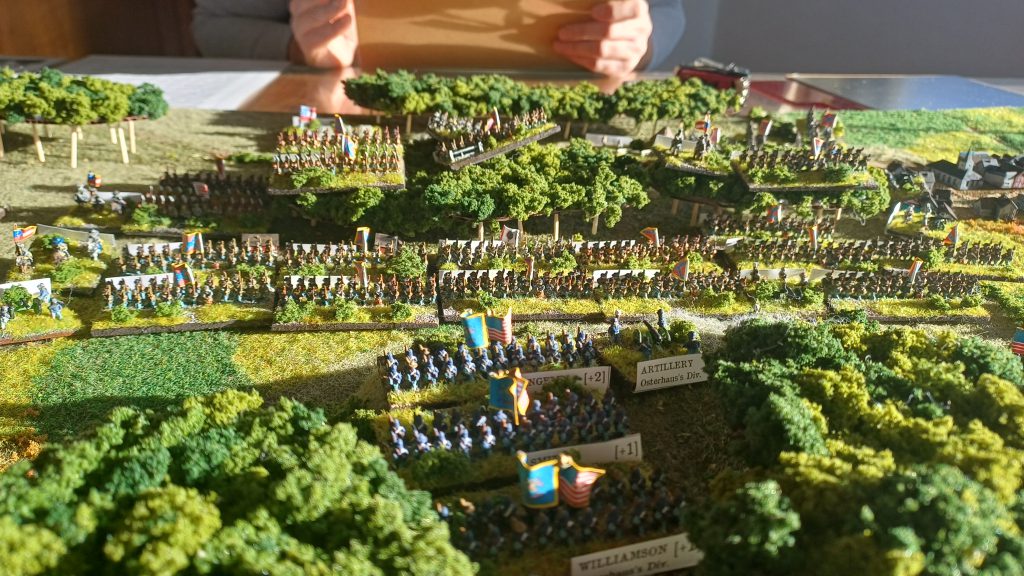 Always label before your battle! Credit; Jackie Daytona
Playing the Game
Every brigade, made up of numerous regiments, won’t have to be micro managed. They all have a value next to them, and on paper base labels you use to keep them apart for activation and combat. Like the generals, these values are based on the number of soldiers and effectiveness on the day of the battle. If you have a corps that had to march through the night and was defeated in the previous battle, the demoralisation is translated in this number. A +3 is insanely good, at full strength and very motivated, a -3 a brigade is in a pitiful state, with depleted regiments and low morale. You are not concerned if they are deployed in line or column, that's not your job. You simply direct them, and hope they don't overextend.
Combat is either shooting or “close combat”. How this works is inherently connected to the scale used. You’re commanding thousands of troops over a battlefield that is miles long. If you move into base combat you’re probably not seeing a blank bayonet charge but a concentrated volley fire at short range, 100 yards or less. The actual shooting at two inches is skirmish fire and probing long range fire. Results of the die roll and any modifiers (cover, being uphill, in woods etc..) are compared and the difference will be a simple pushback, accumulation of fatigue (which is also a negative modifier to the roll) or a complete rout.
A complete rout is rare, but not unheard of. Brigades placed next to each other support and amend the result, so maneuvering and positioning is very important. No micro managing does not mean that you won’t get outflanked! This translates into a push/pull across the battlefield. Brigades can break through, but a lone brigade is easily outflanked and will accumulate fatigue very quickly. If you win a combat, you will have to follow up, which can break the enemy lines, but leave in gap in yours as well. At five fatigue points, it will break as well. Every base lost is placed next to their respective HQ, and has a (small) chance of rallying. If it doesn’t, it is definitively gone and will count against your breakpoint. Keeping your HQ safe from raiding cavalry regiments is therefore an important thing.
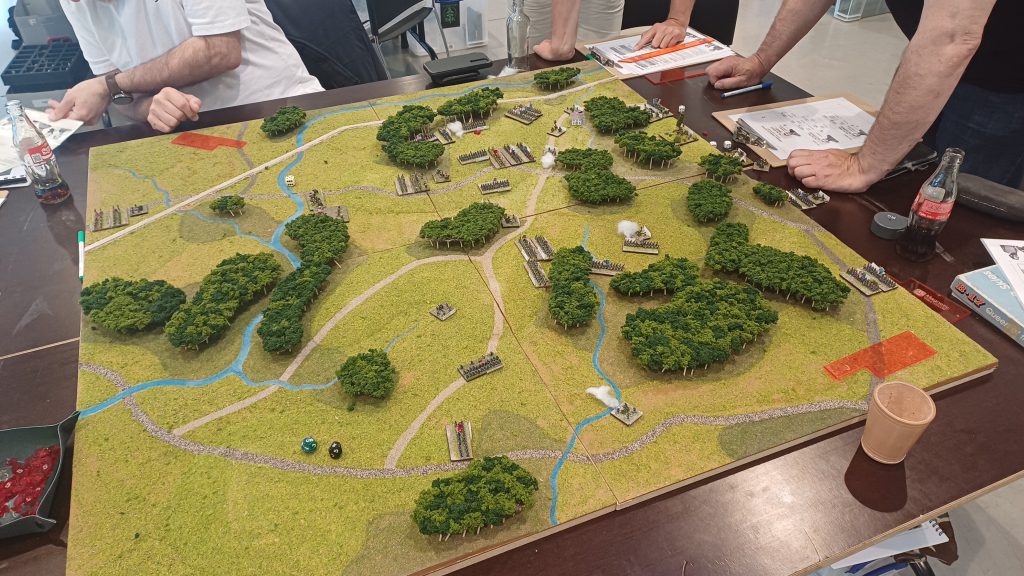 Battle of Champion Hill credit; Jackie Daytona
So how does this feel after playing a game? Well, like the best grand tactical scale games this definitely feels like a battle. I have played this game with wargamers who have had little to no experience with historicals, and certainly not in the smaller scales, and they picked it up after a turn. This means that after a turn, they were playing the battle, not the rules. There is a momentum to the movement of your divisions. Hills are contested, bridges and roads threatened. A story unfolds. There is a set order of battle, but not deployment. The battlefield is divvied up into zones and you can deploy however you like.
Battle of Champion Hill credit; Jackie Daytona
So how does this feel after playing a game? Well, like the best grand tactical scale games this definitely feels like a battle. I have played this game with wargamers who have had little to no experience with historicals, and certainly not in the smaller scales, and they picked it up after a turn. This means that after a turn, they were playing the battle, not the rules. There is a momentum to the movement of your divisions. Hills are contested, bridges and roads threatened. A story unfolds. There is a set order of battle, but not deployment. The battlefield is divvied up into zones and you can deploy however you like. You can follow the original historical deployment, of course.
Since I’ve made the little Jonesboro board I’ve played the scenario three times, have assisted in another replay, and every time it feels different. After three times playing the Union side I am itching to try a strategy with the Confederates. Even with a vague knowledge of the disposition of the Confederate side in this scenario (very bad, low morale, but a numerical superiority) there hasn’t been a decisive win. Even though technically all the Union has to do is hold out, this is still a draw. Winning can be hard, even if you have better troops and a better deployment.
The ruleset author has made scenarios for the most iconic battles of the war.
Atlanta Is Ours is the western theater scenario book, while
All Quiet Along the Potomac lets you fight the eastern theater. Both books each contain 18 scenarios, and if you somehow manage to play through all of these and want even more, there’s a campaign book,
A Formidable Invasion, where you can game the Gettysburg campaign. This game is set for content.
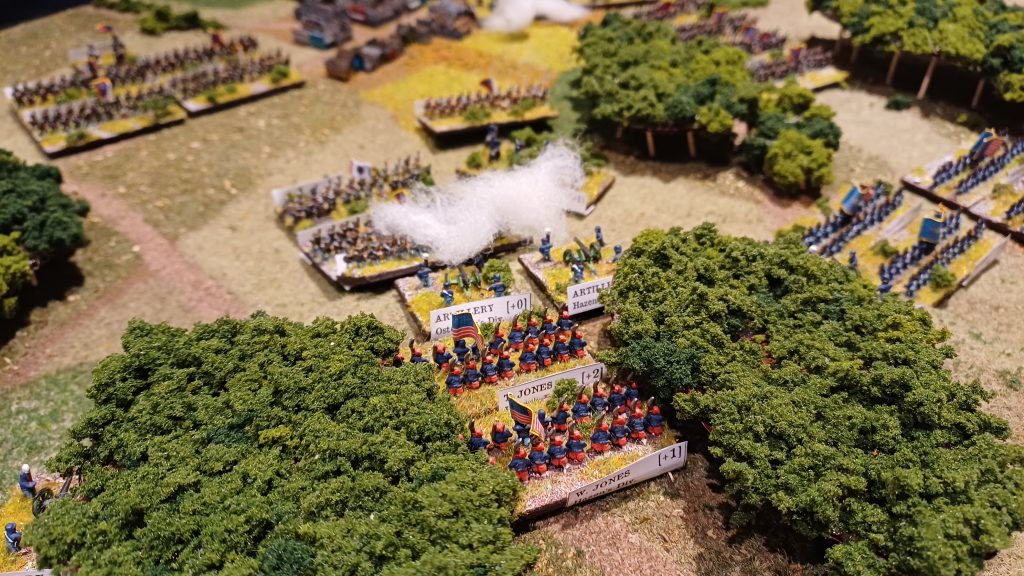 Defending the hill credit; jackie Daytona
So what’s the catch? The drawback of the scale is of course, you lose granularity. The author does acknowledge this in the design philosophy chapter, and that is a choice you have to make of course. You can line up cannons and shoot, but this doesn’t feel like a bombardment if that makes sense. You won’t have to houserule much, but you can game the system easily if you want to. You’re replaying a historical scenario, not a tight tournament set of rules like SAGA. Most people who will play this can understand, I think. Most edge cases can be solved with “what is historically accurate”. In the end, you are the overall general, not the colonel who has to dress the lines of his regiment.
There will be compromises, of course. Few games can deliver what Altar of Freedom succeeds at, having a fast play grand tactical full battle experience. At our club we have roughly three hours of play time, which is generally plenty of time to play a medium scenario. If I announce a multi-player game, seats are very quickly taken. At one of our full club days I organized a Gettysburg game and it moved along at a great pace. If you organize a big game, the worst that can happen is your players not having a good time. This is indicated by time spent on screens, people wandering off and empty beer or wine glasses piling up.
Defending the hill credit; jackie Daytona
So what’s the catch? The drawback of the scale is of course, you lose granularity. The author does acknowledge this in the design philosophy chapter, and that is a choice you have to make of course. You can line up cannons and shoot, but this doesn’t feel like a bombardment if that makes sense. You won’t have to houserule much, but you can game the system easily if you want to. You’re replaying a historical scenario, not a tight tournament set of rules like SAGA. Most people who will play this can understand, I think. Most edge cases can be solved with “what is historically accurate”. In the end, you are the overall general, not the colonel who has to dress the lines of his regiment.
There will be compromises, of course. Few games can deliver what Altar of Freedom succeeds at, having a fast play grand tactical full battle experience. At our club we have roughly three hours of play time, which is generally plenty of time to play a medium scenario. If I announce a multi-player game, seats are very quickly taken. At one of our full club days I organized a Gettysburg game and it moved along at a great pace. If you organize a big game, the worst that can happen is your players not having a good time. This is indicated by time spent on screens, people wandering off and empty beer or wine glasses piling up.
Final Thoughts
The total actual play time was about 5 hours, starting out in the late morning and continuing after a relaxed lunch break. Since every player gets to command a general (or two if playing the Union side), working together is key. Every turn featured whispered huddles and tactical debates. The bidding system kept play brisk and decisions meaningful. Few games can survive the dreaded “let’s all play Fontenoy it’ll be fun” idea, which you know will end in a terrible slog where you might as well be sat in a hospital waiting room while others are doing their thing. AoF is pretty much the perfect multi player game, even with the smaller scenarios. The reason I played this game the most last year is because it’s pretty much perfect for my small scale dream: an accessible game that can be concluded in an afternoon or evening which delivers the experience of a historic battle.
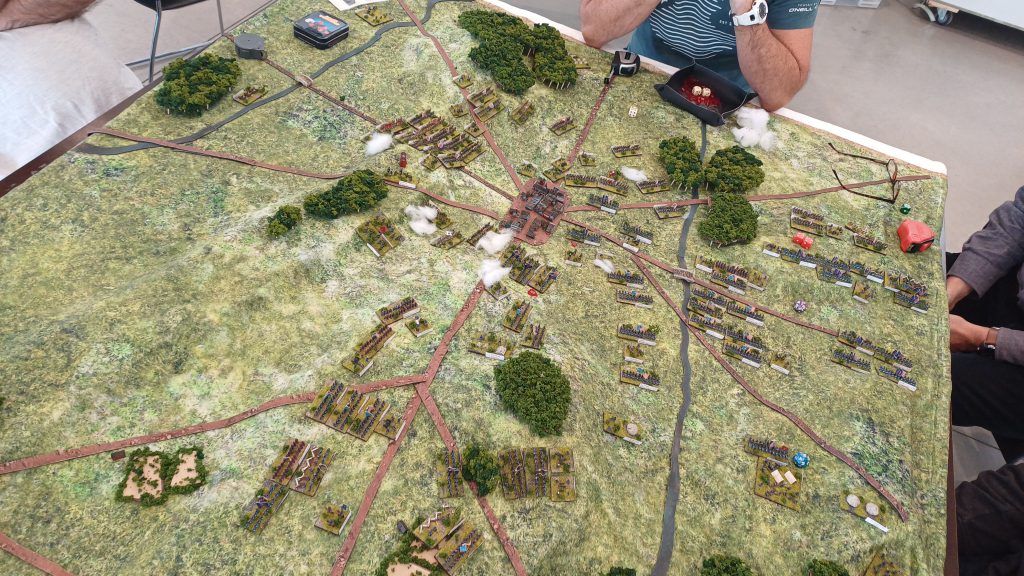 Gettysburg at the club credit; jackie Daytona
If you balk at the idea of 6mm being accessible, we can help you out. Painting up a Baccus army pack for either theater can be done in a weekend (I’ve witnessed this). With a Baccus army pack for each side (with maybe a couple of extra cannon or generals) you can play 20 of the 36 scenarios, for the cost of one Games Workshop combat patrol box.
The dream is real, good people; you can do an affordable and fun miniature gaming project in under a couple of weeks that will let you game an entire war.
Gettysburg at the club credit; jackie Daytona
If you balk at the idea of 6mm being accessible, we can help you out. Painting up a Baccus army pack for either theater can be done in a weekend (I’ve witnessed this). With a Baccus army pack for each side (with maybe a couple of extra cannon or generals) you can play 20 of the 36 scenarios, for the cost of one Games Workshop combat patrol box.
The dream is real, good people; you can do an affordable and fun miniature gaming project in under a couple of weeks that will let you game an entire war.
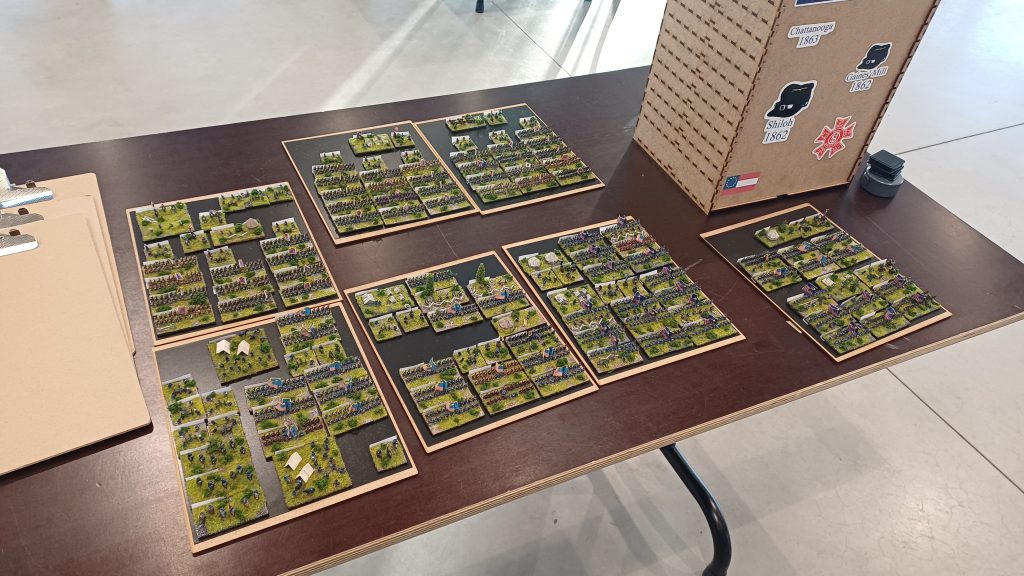 Gettysburg Union order of battle credit; jackie Daytona
You can find all terrain tips here: www.6mmacw.com, as well as the ruleset, theater books and downloads.
Have any questions or feedback? Drop us a note in the comments below or email us at contact@goonhammer.com. Want articles like this linked in your inbox every Monday morning? Sign up for our newsletter. And don’t forget that you can support us on Patreon for backer rewards like early video content, Administratum access, an ad-free experience on our website and more.
Gettysburg Union order of battle credit; jackie Daytona
You can find all terrain tips here: www.6mmacw.com, as well as the ruleset, theater books and downloads.
Have any questions or feedback? Drop us a note in the comments below or email us at contact@goonhammer.com. Want articles like this linked in your inbox every Monday morning? Sign up for our newsletter. And don’t forget that you can support us on Patreon for backer rewards like early video content, Administratum access, an ad-free experience on our website and more.
Thank you for being a friend.
 This website uses cookies. Learn more.

 Goonhammer Hobby Round-Up: March 2026
 Goonhammer Reviews: Tribal Conquest
 Conquest: Weaver Courts Gemred Knights and Scaile Dancers Model Review