Welcome to yet another review of a WWI ruleset! My quest continues to find the holy grail of World War I wargaming. Today we’re reviewing a newcomer to the scene, 1918 by Warfulcrum Games. 1918, as you might suspect, focuses on the last year of the war on the western front. The rules come in a hardback rulebook or PDF after a successful Kickstarter last summer along with an array of excellent STL files for the period.
I’ve been following this project for a while now, including an interview I conducted with the author back in 2024. I now have the rulebook in hand and am excited to give you my impressions.
I’ll be conducting this review using the Little Wars TV template for reviewing game rules (breaking it down into five categories: Presentation, mechanics, playability, historical flavor, and support) sans scoring each category - I’ll simply give my impressions of each.
1918 gaming. Credit: Alexander Smith
Presentation
In this category we're going to talk a bit about how the book looks and reads. 1918 comes in either a PDF digital version (£20), or a 222-page hardback rulebook (£35). In my opinion, it is definitely worth springing for the hardback rulebook. It’s wonderfully put together with an evocative front cover, nice heavy paper-stock pages that are easy on the eyes, and liberally sprinkled with dioramas of models, illustrations, and propaganda posters. It even comes with an attached cloth bookmark for saving your place.
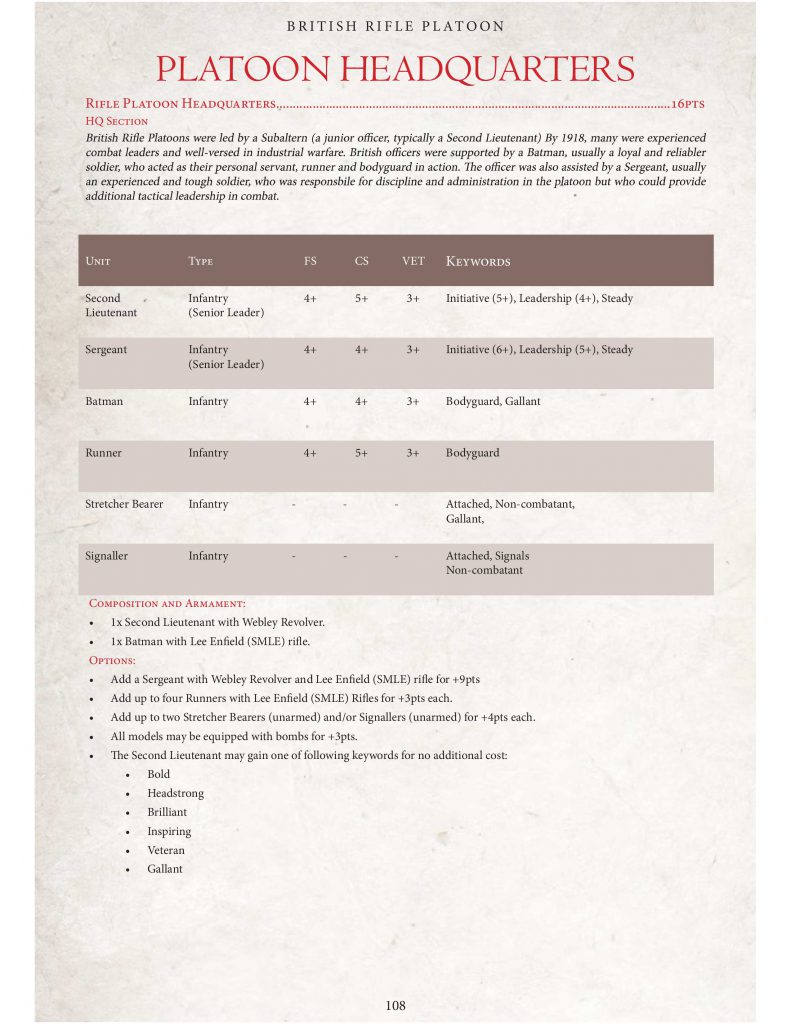
In the Force List section I was delighted to find the kind of historical information treasured by old grognards - divisional markings, rank insignias, and tables of organization for various platoons and companies. For someone like me, who is compelled to field historically accurate battle formations, this information is especially valuable considering how tough it can be to find reliable information on WWI unit make-up.
British Rifle Platoon org. Credit: Warfulcrum Games
History in the rulebook. Credit: Warfulcrum Games
The rules themselves are written in a precise instruction-manual style with designer notes and historical blurbs generally separated into pop-out boxes. There are about a dozen pages of background and history, 50 pages of core rules, another 30 pages of advanced rules, and nearly 100 pages dedicated to force selection and unit info which cover the British, French, US, and German armies.
Mechanics
This section relates to what actually playing the game feels like, what mechanics it utilizes, and if there is anything unique about this rule set. 1918 uses a combination of tried-and-true mechanics with some unique twists. Shooting and close combat are pretty straightforward, with players generally rolling to hit, then rolling to save with a few modifiers to each such as distance and cover. The game uses the keyword mechanic heavily. Units, weapons, and terrain all have keywords that affect how they perform. More on this in the playability section.
A turn in 1918 is broken into three sections, the Command phase where units are secretly given one of six orders, the Tactical phase where units carry out their orders, and an End phase where units rally and there is some clean-up for the next turn. The game uses an Initiative roll-off to determine the first player in the turn, followed by players alternating activations of their units. The fact that players assign their orders first, in secret, then carry them out in a different phase is an interesting mechanic that I think I’ll have to play with more to really master the strategy behind.
Trench warfare. Credit: Alexander Smith
My gaming group primarily plays Bolt Action, and coming from that game there are some components of 1918 that are instantly familiar. In 1918, units can be given one of six commands each turn, which are largely analogous with the orders in Bolt Action. Units can run, advance, fire, go on overwatch, rally, or take cover. Likewise, when units are shot at, even if they don’t suffer casualties, they receive pins which degrade performance and can interfere with their ability to perform their assigned orders.
The German Empire board. Credit: Warfulcrum Games
On the other hand, fans of SAGA will instantly recognize the signature mechanic of that game here in 1918 - battle boards! Each nation has a unique battle board with various special abilities on them. At the beginning of each turn, players roll a number of D6 Command Dice which they can use to activate abilities during the turn. Each ability requires a certain dice result in order to activate. For example, the German Shock Assault ability needs a dice showing a 3 or 4 result to use.
The boards are considered part of the advanced rules, but I do love me some battle boards, so I immediately added them to my test games. It definitely adds another layer of things to keep track of, which can be hard while still learning the ruleset. On the other hand, they’re a big part of what makes 1918 unique and give players so many more interesting tools that I’d be loath to exclude them.
For example, in one game, my German advance was being completely bogged down by French machine gun fire from the next trenchline. I still had units in reserve, but launching them into the frontal assault wasn’t likely to achieve much. Then, I noticed an ability on my German board that offered a solution to my problem - once per game the Germans can infiltrate a unit from any table edge. To the French player’s chagrin a unit of my stormtroopers cheerfully emerged from no man’s land to roll up his flank.
Duckboards and gasmasks. Credit: Alexander Smith
Since this is a WW1 ruleset, let’s talk about artillery. When it comes to indirect weapons I like 1918’s twist on the classic scatter system. Many indirect fire weapons, like mortars, use a rule called “Bracketing” where rather than scatter wily-nilly in any direction, misses will either fall short or long along a line from the firer to the target. Aside from logically making sense, this also gives the firing player a better idea of what possible outcomes they might get, even if they miss. I also appreciate that inaccurate shells don’t simply disappear into the ether, ala Bolt Action, but may scatter and hit something else. Furthermore, terrain itself, such as barbed wire and trenches, can be destroyed by artillery. At one point a timely French artillery barrage collapsed the communication trench my Germans were advancing down, sending the survivors scrambling out of the obliterated trench back towards safety.
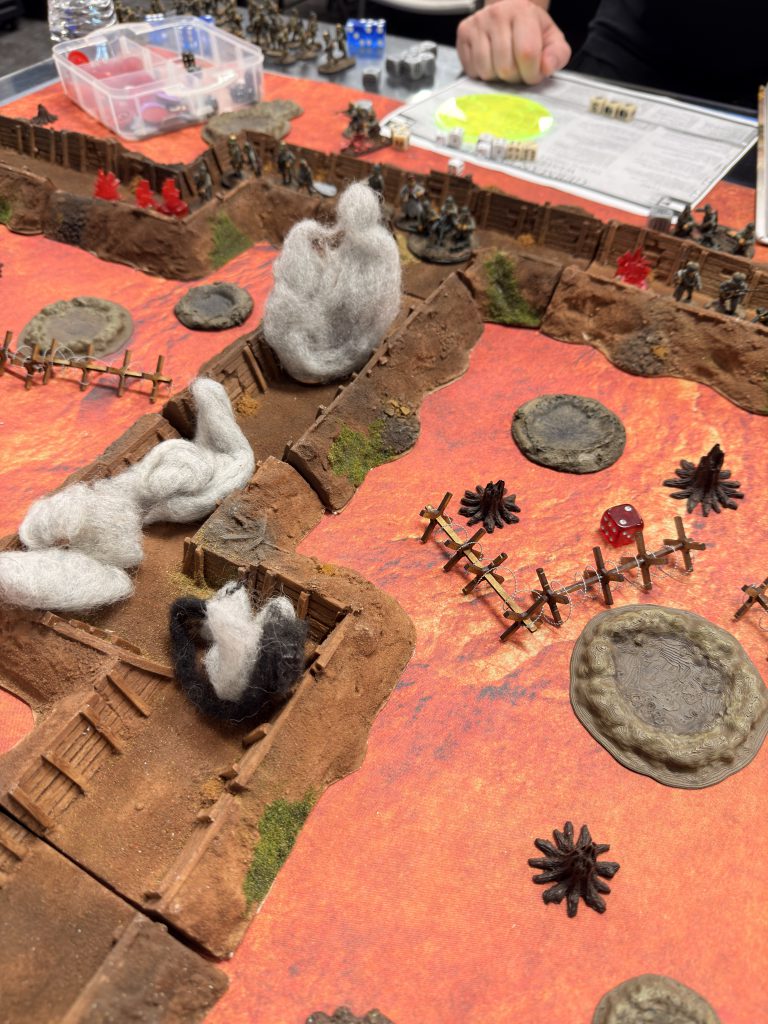
A whole lotta smoke. Credit: Alexander Smith
Off-map artillery barrages are an important component of the ruleset, with tons of options for types of barrages. Players can select timed barrages (assigned to kick off on a certain turn), creeping barrages, or ad hoc emergency barrages. Furthermore, players can pre-register targets or use special ammo like gas, smoke, illumination, or shrapnel.
Playability
How easy is it to get a game of 1918 on the tabletop? Once you do, how easy is it to play? I wouldn’t, by any means, call 1918 a “beer and pretzel” game. At over 200 pages, there is a lot packed in here and a decent amount of accoutrements are required, such as tokens and reference sheets. As I mentioned before, Bolt Action and SAGA veterans will find enough familiar ground to jump right in, and most of the core rules are relatively straightforward.
The rules aren’t hard to understand - they’re laid out logically and well written, but the game does play fairly slowly because of the amount of rules. By far the biggest impediment to speedy play are the number of keywords the game utilizes. Each unit, weapon, and type of terrain has a number of keywords that affect most aspects of how they interact with the rest of the game. At nearly 100 keywords total players usually will need to frequently reference the collected keyword master reference sheet near the back of the book.
Platoon HQ stats. Credit: Warfulcrum Games
From a historical perspective, it’s cool that 1918 represents the differences between the equipment of the various powers, but the result is that rather than one master list of weapons, each force has their own unique weapon list they will need to reference.
As an example of how this can slow down gameplay, say one infantry unit is firing on another. This might involve up to four references to the keyword section: first to check keywords of the firing unit, then to check the keywords of their weapons, checking the keywords of any relevant terrain, and finally any keywords possessed by the target unit. Combined with 100 pages of unit profiles, play involves a lot of flipping back and forth between unit pages and the keyword reference sheet.
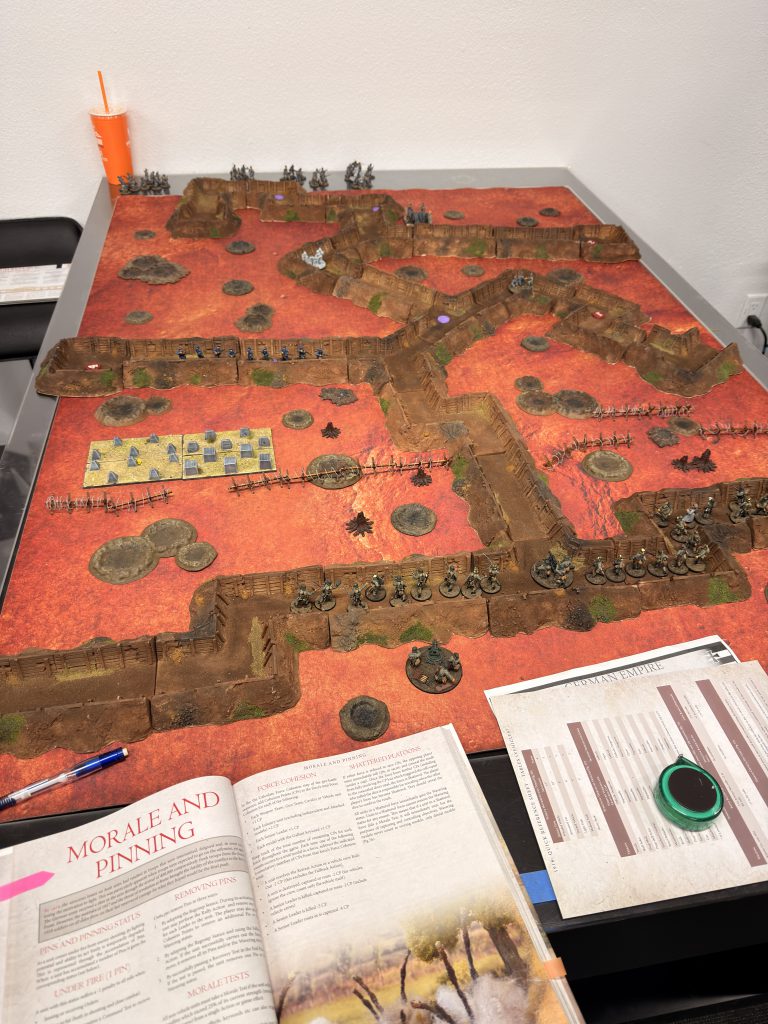
The entire trench board. Credit: Alexander Smith
1918 does include two double-sided quick reference sheets, which are handy for navigating the normal course of a turn, but since resolving almost any unit activation requires checking keywords, it is not enough. What the game could really use, in my opinion, are unit cards. A card with the unit profile (including weapon options) on one side, and relevant keyword definitions on the back would go a long way towards improving the speed of play.
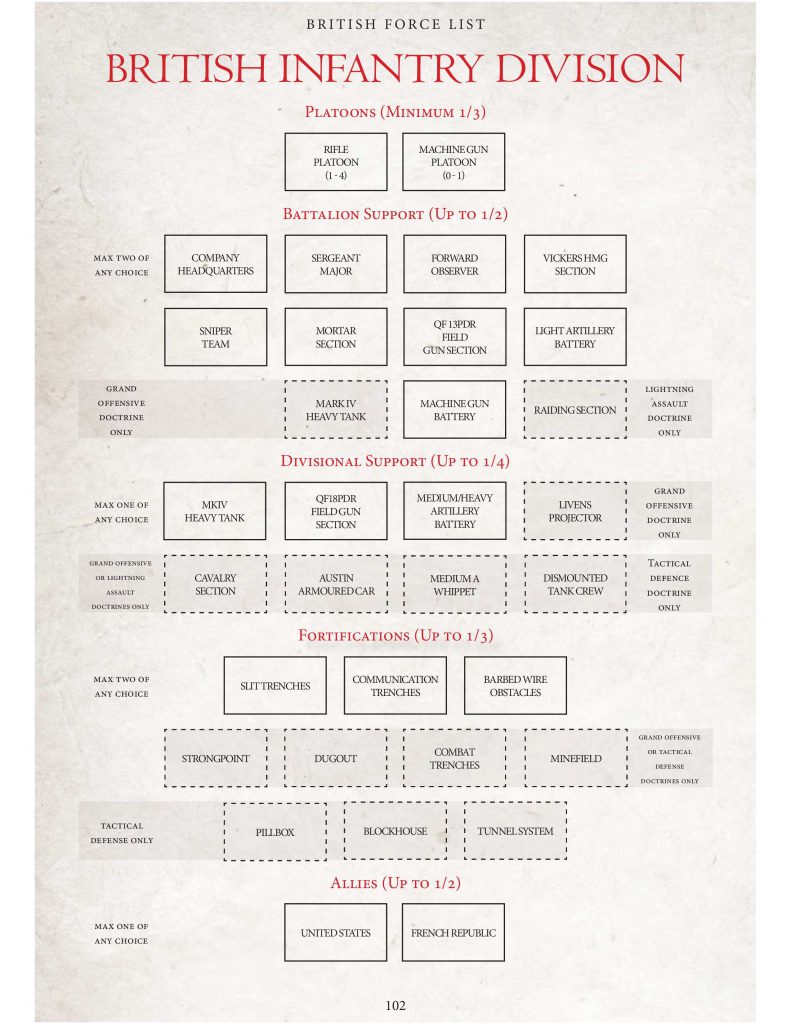
Speaking of units, for those that like list-building, 1918’s system is very in-depth. After picking their nation, players select one of three doctrines, which influence which units are available to them and their force organization. This means that a German list with the Lightning Assault doctrine, focusing on infiltration and stormtrooper tactics, could play very differently than a German list with the Tactical Defense doctrine that loads up on fortifications and responding to the enemy.
From there, players start with an infantry platoon, onto which they can add a variety of support options such as machine guns, artillery batteries, tanks, and fortifications. I personally enjoy list-building so I was excited about the amount of depth here. Trying to devise the most devious defensive position possible is just as fun as working out how to build a list capable of breaking through your opponent’s kill zone. For those that want to skip list-building the game does include a set of pre-made exemplar forces.
Infantry division org chart. Credit: Warfulcrum Games
The rulebook comes with eight scenarios, all of which seem unique and interesting. Rather than the normal run-of-the-mill stock scenarios (like kill points, yawn) each scenario tells a different story: repairing damaged defenses in the face of an enemy raid, retaking a trenchline overrun by the enemy, or halting an enemy breakthrough. When trying to pick a scenario to play, I found myself having trouble deciding, because they all seemed extremely cool.
Historical Flavor
When it comes to historical flavor, it's hard to imagine what more you could possibly want out of a WWI ruleset. It literally has everything: creeping barrages, underground tunnels, barbed wire, poison gas, historical platoon organizations, trench mortars, you name it.
Despite being named 1918, I don’t really see any reason this ruleset couldn’t be used for any part of the war, or even interwar conflicts in the 1920/30’s. I’m hopeful that Warfulcrum Games are working on additional supplements to expand the game (Gallipoli/Middle East front please!).
As I mentioned earlier, the scenarios all are extremely thematic to the period and show a deep understanding of what WWI warfare was like and what kinds of situations troops might face. Meanwhile, for list-building it gives you everything you need to build a historically accurate force, but enough flexibility to to bring other cool toys as well.
Mission diagram. Credit: Warfulcrum Games
Support
Finally, the section will talk about what kind of support this rule set is getting from the author and publisher. Warfulcrum Games is a newcomer on the scene, with 1918 being their first published ruleset after a successful Kickstarter. Their website is nicely designed and includes a shop to buy the rules as well as STL/physical miniatures for the British, Germans, terrain, and game tokens. Meanwhile, the download section contains files for printable tokens, play aids, and the battle boards. Essentially, everything you need to play can be found directly from their website.
1918 also has an active Facebook group. The only thing I’d like to see are maybe some tutorial videos showing how various parts of the game play.
Tactical phase. Credit: Warfulcrum Games
Final Thoughts
Who would I recommend 1918 to? Any wargamer who is passionate about the first World War who is willing to invest some time into learning a ruleset with a lot of depth to it. This definitely isn’t a grab-and-go type of ruleset. Appropriately enough for WWI, I think 1918 works best with a methodical approach - a careful reading of the rulebook, thoughtful list construction, and preparing ahead of time with reference materials.
Divisional markings. Credit: Warfulcrum Games
All in all, I really like 1918. It has everything I’m looking for in a World War I ruleset. I’m already mentally preparing my next trench line and a plan for the next time I go over the top.
Have any questions or feedback? Drop us a note in the comments below or email us at contact@goonhammer.com. Want articles like this linked in your inbox every Monday morning? Sign up for our newsletter. And don’t forget that you can support us on Patreon for backer rewards like early video content, Administratum access, an ad-free experience on our website, and subscriber-only content covering competitive Warhammer 40K!
 This website uses cookies. Learn more.

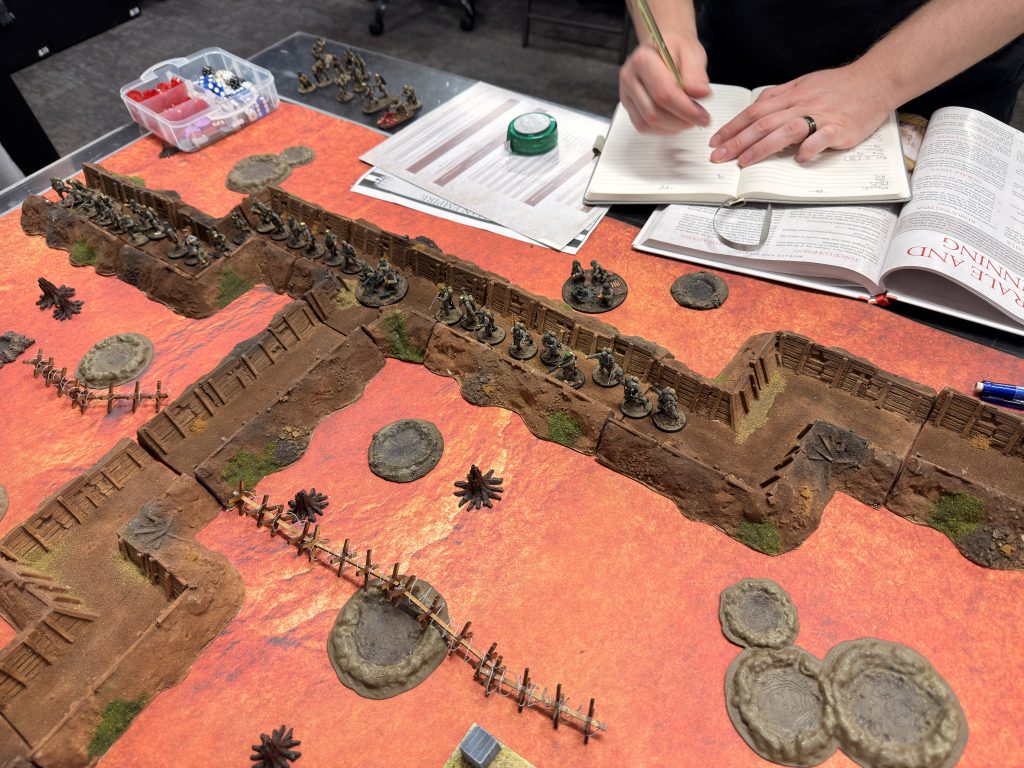 1918 gaming. Credit: Alexander Smith
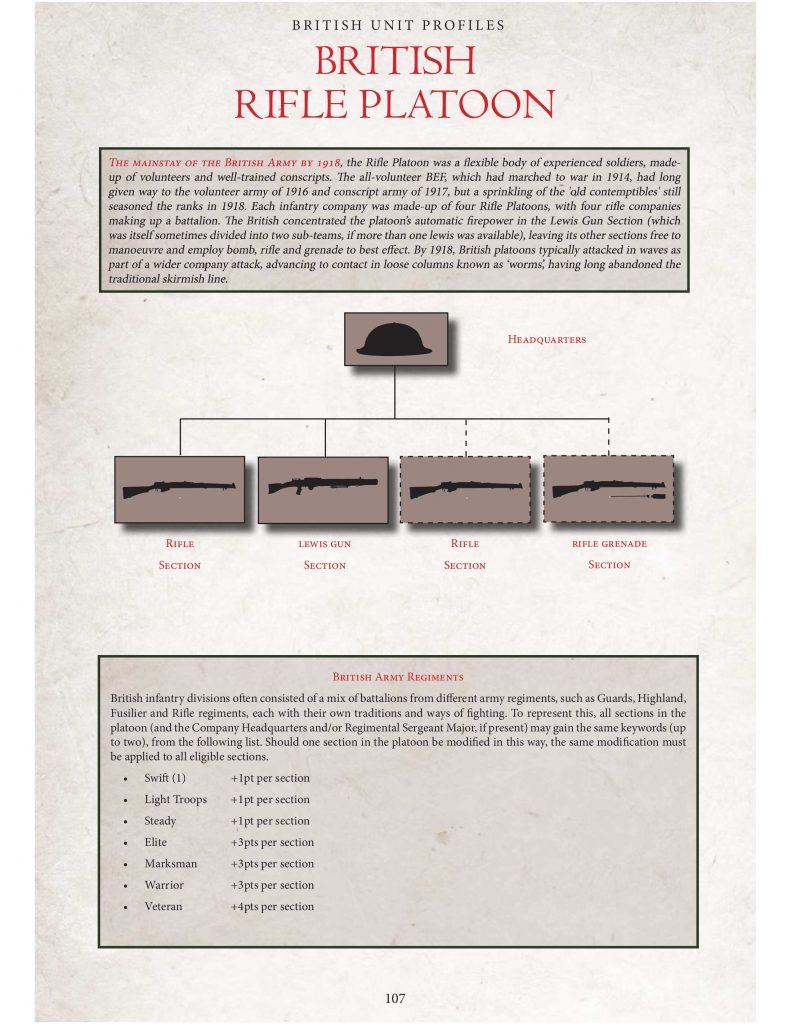 British Rifle Platoon org. Credit: Warfulcrum Games
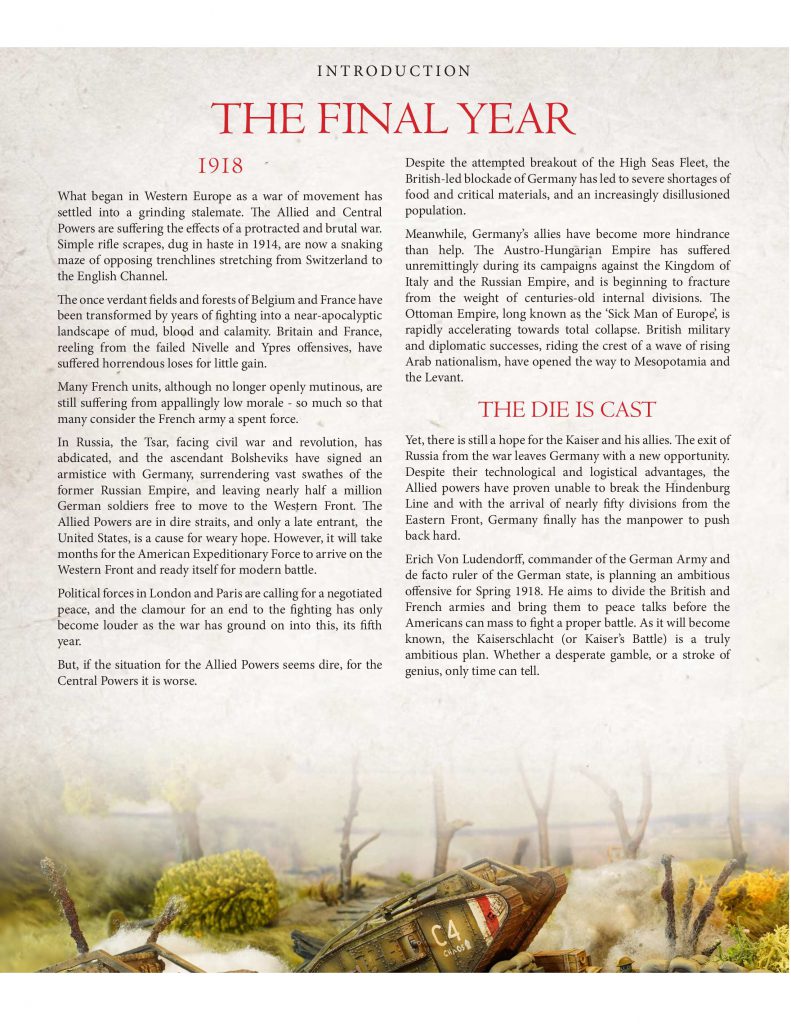 History in the rulebook. Credit: Warfulcrum Games
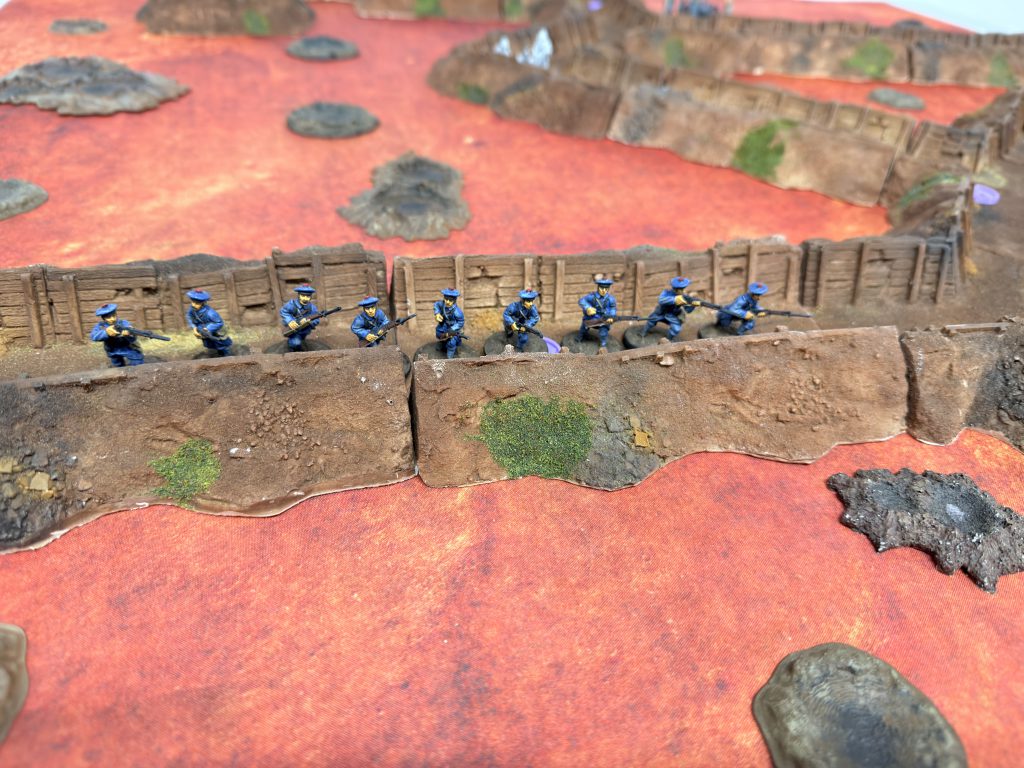 Trench warfare. Credit: Alexander Smith
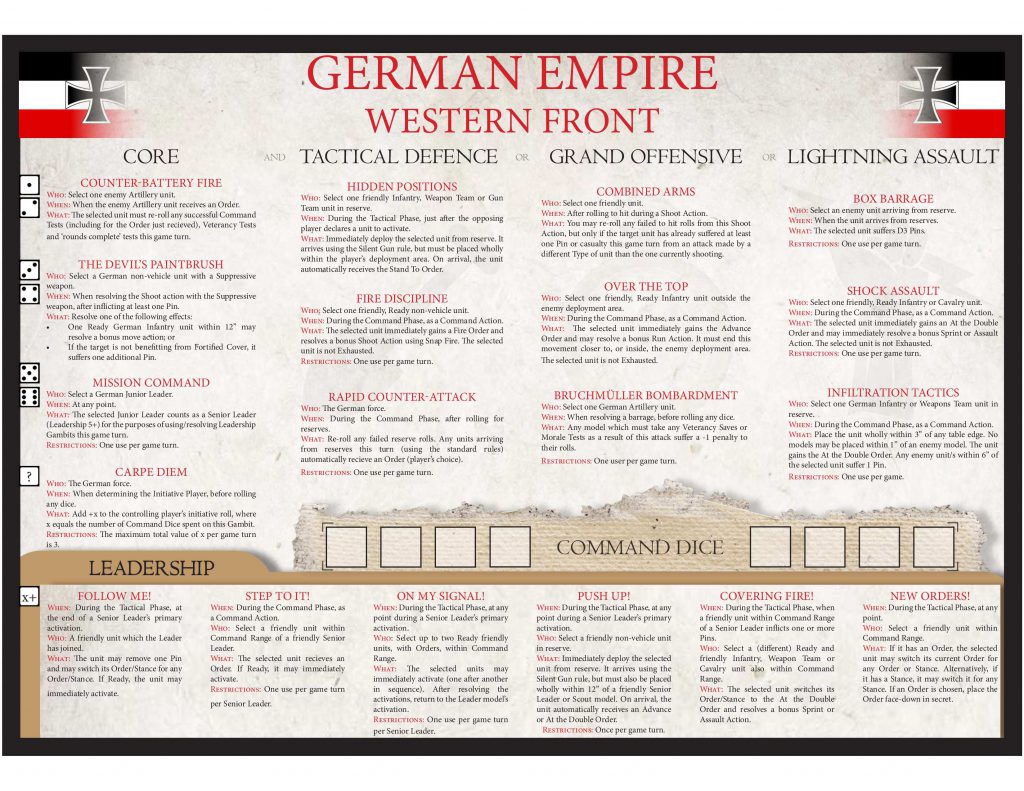 The German Empire board. Credit: Warfulcrum Games
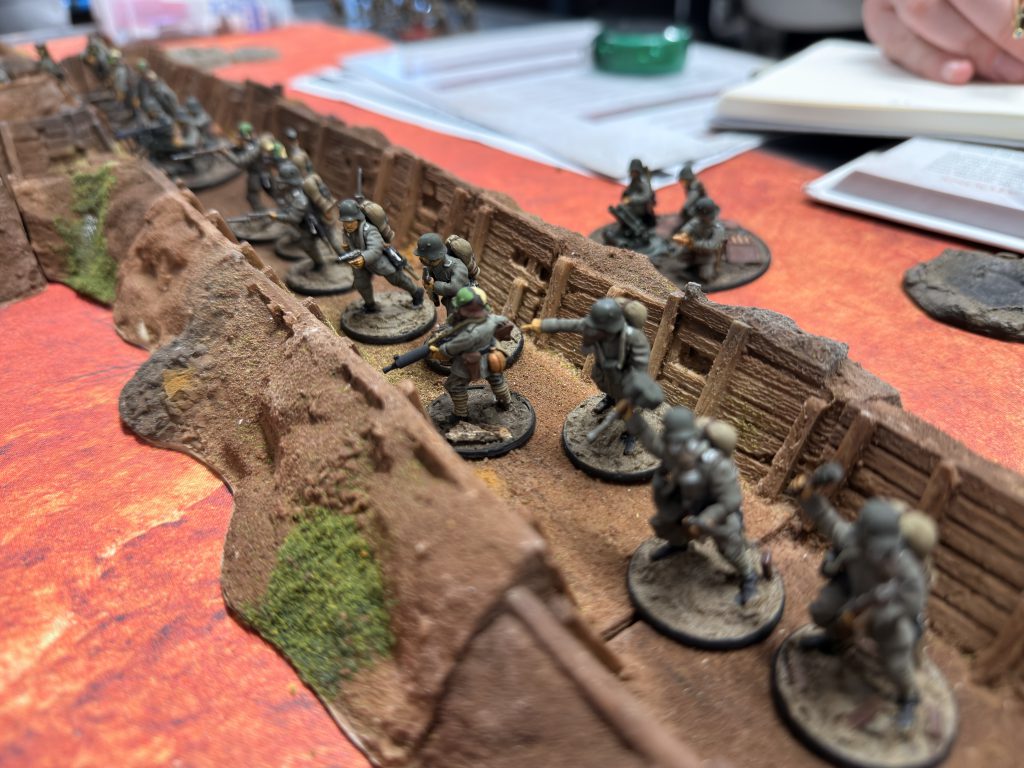 Duckboards and gasmasks. Credit: Alexander Smith
 A whole lotta smoke. Credit: Alexander Smith
 Platoon HQ stats. Credit: Warfulcrum Games
 The entire trench board. Credit: Alexander Smith
 Infantry division org chart. Credit: Warfulcrum Games
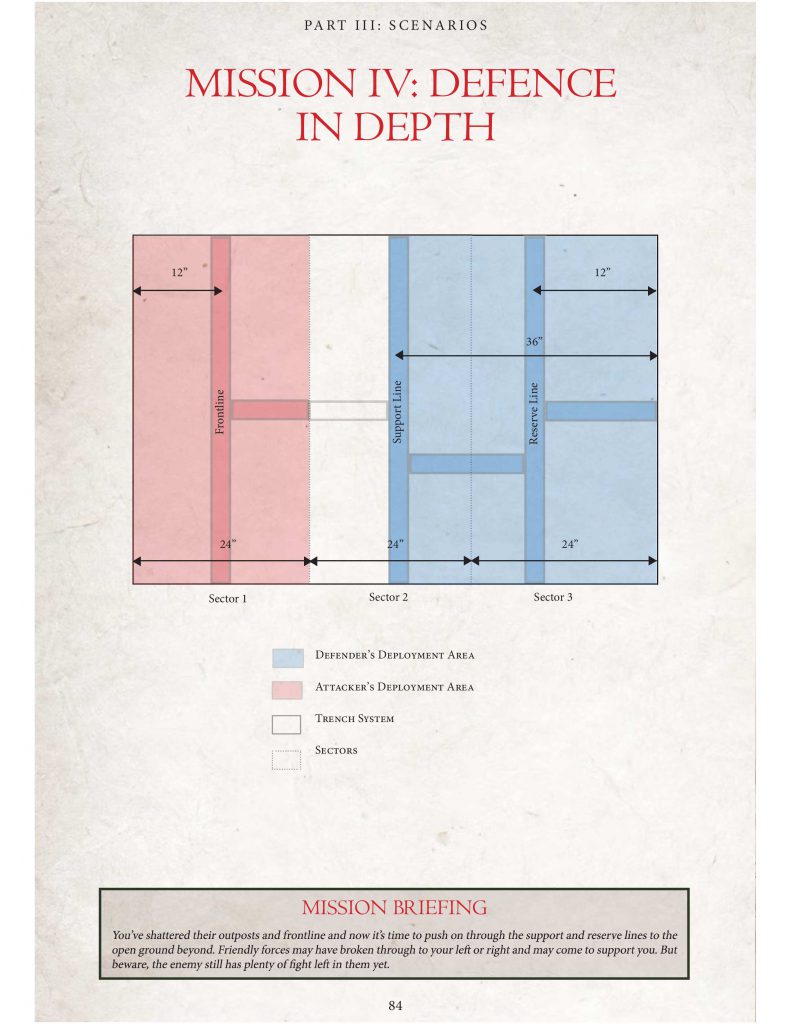 Mission diagram. Credit: Warfulcrum Games
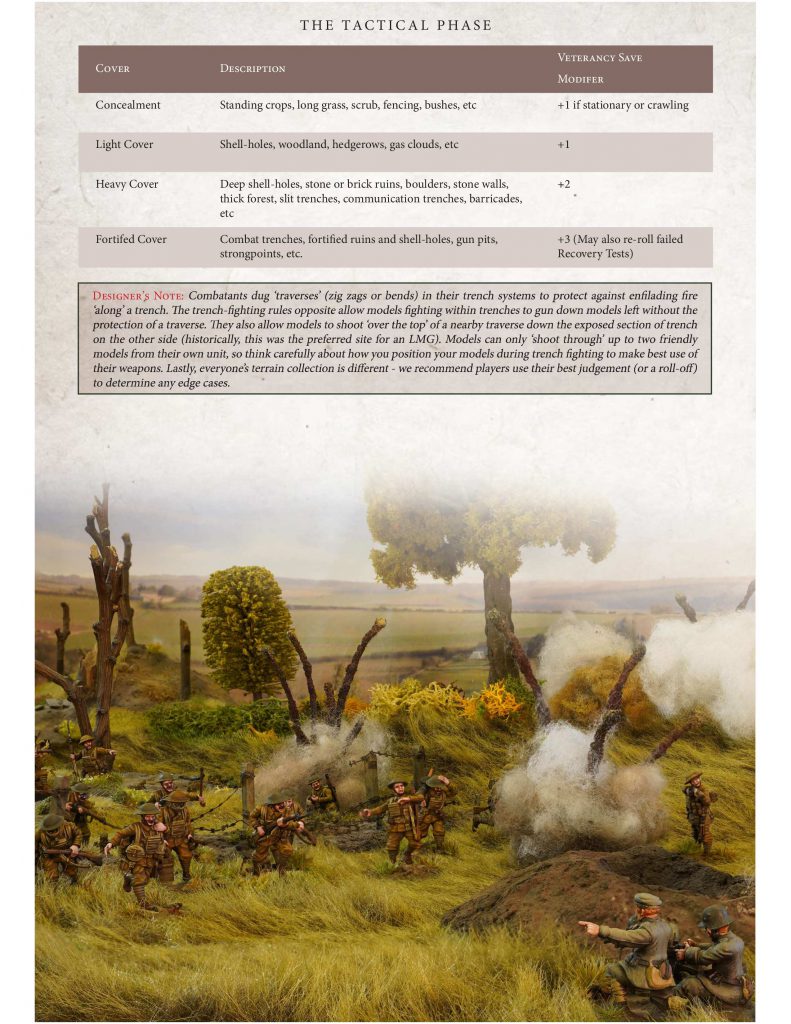 Tactical phase. Credit: Warfulcrum Games
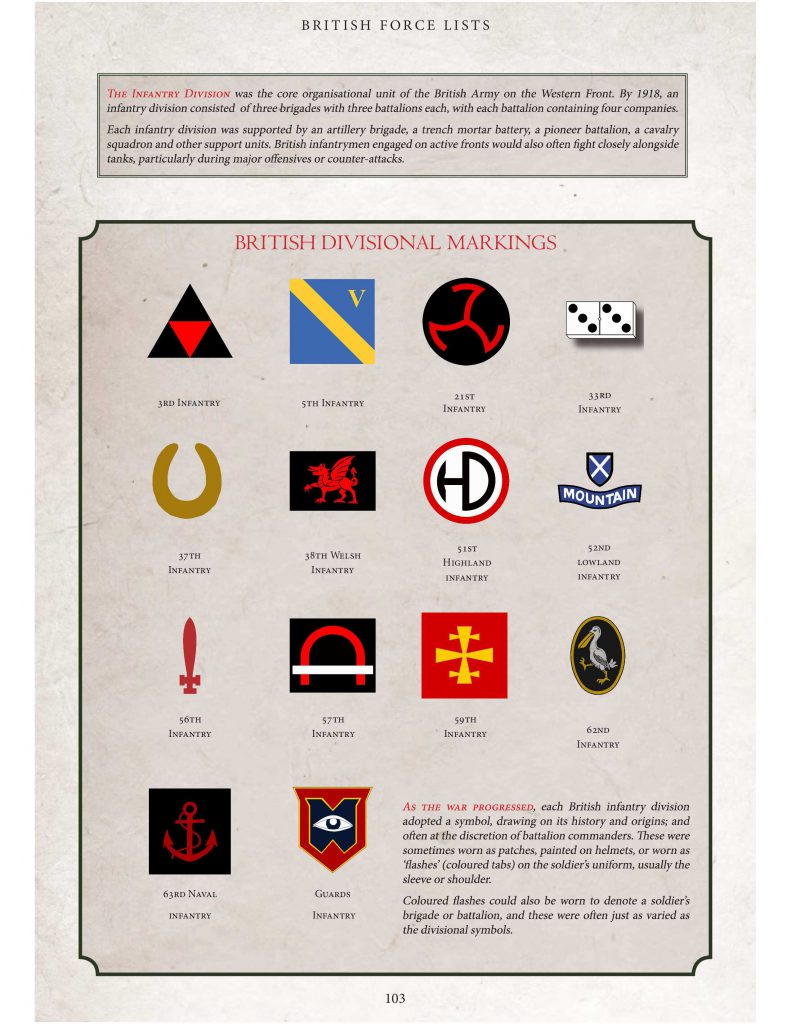 Divisional markings. Credit: Warfulcrum Games

 Goonhammer Hobby Round-Up: March 2026
 Goonhammer Reviews: Tribal Conquest
 Conquest: Weaver Courts Gemred Knights and Scaile Dancers Model Review