 This website uses cookies. Learn more.
This website uses cookies. Learn more.
This website uses cookies. Learn more.

The scene is Dragon Con, 1996. Olympic year here in Atlanta. My friend and I are hanging out in the open gaming area checking out all kinds of “German games” at a time when Catan was called Settlers of Catan (or Die Siedler von Catan if you were really hip) and you had to play games like El Grande with printed-out paste-up translations. We play a couple of really weird games with this guy Frank, who it turns out is something of a local gaming celebrity/cryptid. Now, my friend and I are completely gothed out. He’s got on this spiked leather harness and I’m in a Christian Death shirt with eyeliner and a skirt. Frank says “I’ve got a game I think y'all will like.” He produces this stark black box with a severe white title forming a dagger dipped in blood – The Gothic Game. We didn’t say “hell to the yeah” back then, but that’s exactly what I was feeling looking over this game that appeared to be equal parts Edward Gorey, Gormenghast, and Hammer Horror.
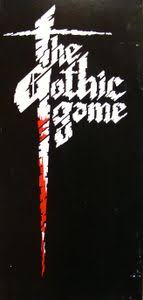
What followed was a raucous, absurd, and hilarious session of a game that flew in the face of contemporary game conventions at the time, let alone today. The Gothic Game is a roll-and-move, player versus player game with elimination and the possibility of random death at virtually every turn. With the “hapless victims decide to see what’s up with that old castle” trope from Gothic horror as a trope, the idea is that players are trying to survive the night. Which means rummaging through its rooms for weapons to kill the other players, avoiding traps, and possibly hiding from a player that turns into a vampire. It’s a last person standing situation. There are no rubberbanding, catch-up, rerolls or other balancing mechanisms. It was first published in 1992, but if you told me it was a Waddingtons game from 1974 I would have believed it.
Some have compared it to Talisman, but I think it’s even more old fashioned, irresponsible and unruly. Each of the game’s rooms have a fixed set of cards so you can kind of get to know the castle and what to expect- for example, if you go in the dining room, the chandelier could fall and kill you outright. And if you find the blowgun, head to the tower to snipe someone. Each of the game’s weapons also has a counter card, so the possibility for dramatic reversals is ever-present. There are also fun features such as potentially never-ending staircase that I’ve seen a player make the rolls to get out of exactly one time (legendary) and an oubliette that you can shove another player into to end their aspirations of survival.
One of the key things that makes this game so deliciously nasty is an extremely simple rule- the power of adjacency. If another player is next to you when your turn starts, they roll and move for you. This is how you wind up in the staircase or in the oubliette. Or pushed into the dining room. Or even toward the vampire coming down the hall. This is obviously not a great game for players who insist on absolute player agency and control. But it is for players who insist on fun, drama, and high-spirited competition.
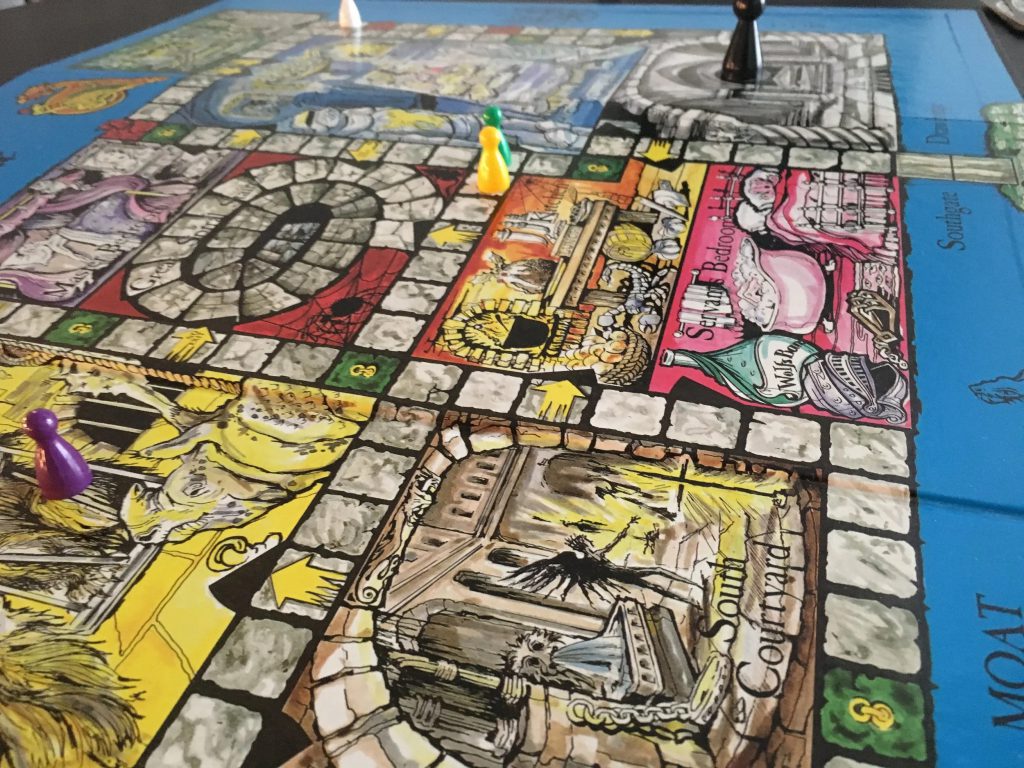
I’ve had phenomenal games of The Gothic Game with up to eight players that “get” it. We came up with special rules like how you have to roll the die using the little cup the game comes with or you die instantly – leading to chicanery where you try to get people to roll without the cup. We added a pewter Grim Reaper figure that sat on the board and if you touch it at all with your hand or the die then you are dead. There are stories and sequences of events that remain mythic in my friend group, still eliciting laughter decades on. And I’ve also played the game with die-hard Eurogame players who shifted in their seats nervously at the thought of eliminating other players and possibly hurting someone’s feelings. Some have decried it as “more of an activity than a game,” the most vicious of epithets a hardcore boardgamer could utter.
But I loved and still love this admittedly stupid game- but it’s stupid like Ramones in that it’s actually genius. Over the years I became obsessed with this game- there were exactly two copies in Atlanta and I was fortunate enough to be friends with both owners (one of whom was Frank). It was an exceptionally rare game in the 90s and early 2000s, with something like only 500 or so copies available from a teeny tiny UK publisher, Tolmayax Games. As far as I can tell, it’s the only product this firm ever produced. Prices were in the $200 and up range, and there were apocryphal stories that you could email the designer, ask nicely and he would mail you a copy wrapped up in nothing but kraft paper for about $100.

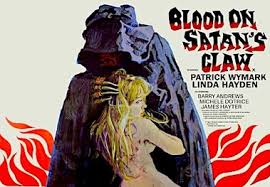
The designer was one Robert Wynne-Simmons, a British writer, director, and composer best known for the screenplay for Blood On Satan’s Claw, a folk horror film I recall watching when I was a kid when one of the local TV stations would run a lot of English horror films on Saturday afternoons. In the early 2000s, a wealthy friend of mine got the idea to buy the rights to The Gothic Game from Mr. Wynne-Simmons and so he managed to get in touch with the man and we started thinking about respectfully updating the game and publishing a new edition. Talks fell apart and my rich friend lost interest. Somewhere I have a notebook of ideas I was going to give to Mr. Wynne-Simmons to get his blessing on, but I was very cautious about changing too much.
Flash forward to 2021. It’s well known in the board gaming community that I’m a big supporter of The Gothic Game. I get an email from this guy from Blackletter games saying that he’s doing a new edition called Damnation: The Gothic Game. He invites me to consult on it and look at an early prototype. His redesign work is quite good, and although I find myself missing the crude artwork of the original (replaced by some rather Mignola-esque illustrations) and feeling like maybe there’s a few too many concessions to modern design, it turns out to be an impressive and very viable go at bringing The Gothic Game back from the dead. Then the Kickstarter failed. A second was successful, and now you can buy the updated edition today along with an expansion that adds a little more to the vampire situation. It’s good, and you can play with the old rules if you see fit.
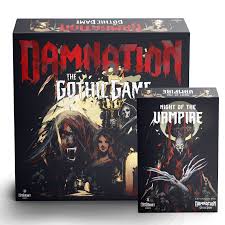
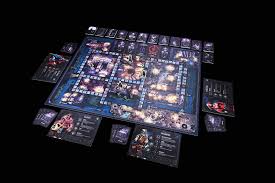
The Gothic Game is hardly an “important” design, I couldn’t point to anything else that drew inspiration from it, largely because it was obscure and hard to get a hold of for so long. Many would consider it a “bad” game with antiquated mechanics and production, at least in its original incarnation. I’d play 100 games of The Gothic Game over a soulless Kickstarter miniature explosion cruft-a-thon or a rigid, frowny management game where players cannot possibly interact with each other. Despite its willful atavism I think this game, possibly more than any other, captures what I love most about tabletop gaming- it’s the creation of stories and sequences of events generated by the players in a setting that is both competitive and capricious. It’s lighthearted but also ruthless. It’s silly and morbid and could not possibly be more up my alley, and I still regard it as one of the most important games of my life. Frank absolutely had me figured out that very first time I met him.
Have any questions or feedback? Drop us a note in the comments below or email us at contact@goonhammer.com. Want articles like this linked in your inbox every Monday morning? Sign up for our newsletter. And don't forget that you can support us on Patreon for backer rewards like early video content, Administratum access, an ad-free experience on our website and more.Tags: history | board games | tabletop game | Gothic | games from the crypt

Thank you for being a friend.
 Goonhammer Hobby Round-Up: March 2026
 Goonhammer Reviews: Tribal Conquest
 Conquest: Weaver Courts Gemred Knights and Scaile Dancers Model Review
Support us on Patreon to get access to our Discord and exclusive App features.
Thank you for being a friend.
Already a Patron? Login with Patreon.
Visit our incredibly official store on RedBubble.

Support us on Patreon to get access to our Discord and exclusive App features.
Thank you for being a friend.