 This website uses cookies. Learn more.
This website uses cookies. Learn more.
This website uses cookies. Learn more.

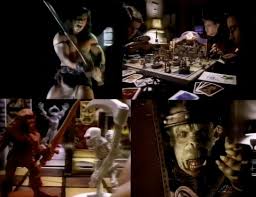
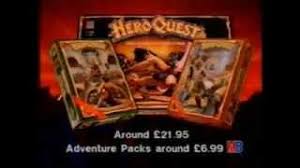
In 1991, a commercial hit the airwaves promising a board game full of magic, barbarians, wizards, traps, and of course, broadswords. The dramatic narrator suggested that once we got into this game, we’d never be the same and to demonstrate this fact, one of the players turned into an Orc. It was all a gloriously early 90s toy commercial vibe with live actors and cornball effects and those of us who saw it didn’t soon forget it. This commercial heralded the US arrival of HeroQuest, a game released jointly by Milton Bradley and Games Workshop with several expansions and even some novels and computer games hitting the markets to support it. Despite its relative success, by the late 1990s it was out of print and abandoned. But frankly, this game turned out to be much more impactful and influential than it seemed it could ever be at the time – especially through the wilderness years when it was something of a common yard sale or thrift store find.
Designed in 1989 by the great Stephen Baker, the former Games Workshop creator who also brought the world the glorious and German-only Der Schlacht der Dinosaurier, HeroQuest was greenlighted at Milton Bradley under the proviso that Baker keep the game simple and the result was, at the time, the most successful attempt at what we know commonly refer to as “dungeoncrawl” board games. In the post Kickstarter-era we have been flooded with quite literally hundreds of games in this genre, and to be completely blunt about it there have been very, very few that have been better than HeroQuest and in fact I can’t count the number of games of this ilk that I’ve played where I felt like the designers were trying in some way to emulate playing HeroQuest.
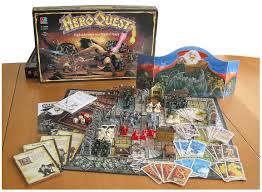

But where most of the descendants get it wrong is that they miss all the things that Baker did right in the first place. They add more details, more complex rules, more strategic gameplay, more cards, more miniatures, more extensive lore, more intricate scenarios – more, more, more. But the value of HeroQuest is that is disarmingly direct, accessible, and easy to play while also offering what is a quite comprehensive vision of what “fantasy gaming” circa 1989 looked like. What’s more, it is also an extremely malleable system that allows for players to really make the game their own with house rules, homebrew scenarios, and other customizations – I bet most gamers of my age (50!) had at least one friend that was an absolute HeroQuest madman with a notebook full of advanced monsters, traps, spells, and characters. Mine was a guy called Anthony that had like four copies of the main set. When I got back into the game this year, I had become that madman myself.
There are some genius touches in this game that I wish more contemporary designers would like toward. One of the best features is how it handle dungeon variability. Rather than saddle players with the chore of finding and connecting a bunch of puzzle piece dungeon tiles (please for the love god, do not do this anymore designers), a standard dungeon layout is used that is made unique in each quest by the placement of doors, furniture, and monsters with hidden traps, features, and narrative beats written into the Quest Book so that the Zargon/Morcar player effectively runs the game like a DM- and they are absolutely free to embellish what is written there, and that especially becomes necessary when those darn heroes start to get too powerful.
I also especially like how the game lets the players craft the narrative around what is really kind of a threadbare storyline. There’s a little text in the Quest Book to set up each outing, but really it comes down to the gameplay. This is another thing I believe a lot of dungeoncrawl designers ignore, unfortunately- that playing the game tells the story, not flavor text and a two page read aloud intro.
Mechanically, the game couldn’t be simpler, and among its innovations is the classic “skulls and shields” dice resolution system. Sure, they cold have been numbers- but changing the dice results to icons makes it more immediate and somehow more exciting. I believe this was the first game to use this type of custom dice for combat resolution purposes. It’s just a smooth-playing mechanic, and likewise the rules are refreshingly free of complexity that might get in the way of simply having fun and enjoying the game.
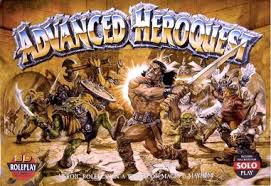
Back in the day there were more advanced options available for players who wanted a little more, such as 1990’s Advanced HeroQuest, which was a Games Workshop hobby market product not released in the US and a string of expansions that were available everywhere- most of which were fiendishly difficult. There was also a design kit, which encouraged players to cook up their own quests but also was unreleased in the US but that never stopped my pal Anthony from doing all of that on his own accord.
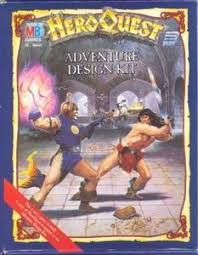
Over the past summer, my son and I got really into playing vanilla, play-as-written HeroQuest and it was an absolute delight to run through the first quest book again, just like I did over 35 years ago with high school friends and then a few years after that with drinks and college gaming buddies. Although many modern gamers might find it too simple, I found the ease of play refreshing, and in an age where co-op games are de rigeur to avoid the hurt feelings and negative feedback of losing, it was nice to dig into the role of Zargon (Morcar in the original UK editions) and just absolutely go for the throat against his band of heroes. But it is the modern age, so a companion app will take on the Zargon role if you want to go full co-op.
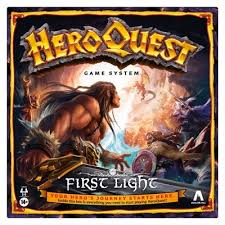
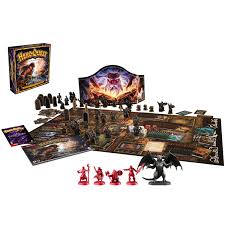
HeroQuest is in print today thanks to, of all companies, Avalon Hill via Hasbro – which marks the game as having been published by four of the top companies in the history of the gaming hobby. There was a very successful Hasbro Pulse crowdfunding campaign back in 2020 that resurrected it. The newest edition is lovely and offers new expansions as well as the classic add-ons, and it is a great way to get into the game. I do have to say, however, that a lot of the charm of the original MB edition, with Games Workshop-designed miniatures and artwork by the incomparable Gary Chalk among others, has been dulled somewhat by a more modern aesthetic. There’s no more Chaos Warrior, which is an absolute shame. But hey, you don’t have to scour Goodwills or pay a collector price for an eBay copy anymore- there’s even a special "intro" edition (First Light) that trades most of the miniatures for time- and cost- saving cardboard standees, offers a whole new Quest Book, and has a new double-sided board.
It's important to note that it was not the first game of this type- there were others, some of which we’ll take a look at in future Games from The Crypt installments. Even though Hamblen’s majestic and terrifying Magic Realm, the sprawling Sorceror’s Cave, and Gygax’s own Dungeon! pioneered the design brief “what if D&D but board game”, HeroQuest did it in a way that was concise yet robust, and playable by virtually anyone from 8 year old kids to semi-drunk college kids on through to adult RPG enthusiasts.
Reflecting on HeroQuest through the lens of tabletop gaming history and the development of the hobby games medium over the years, as is the goal of Games From the Crypt, it’s not hard to see its traces in every edition Warhammer Quest (including Blackstone Fortress and the upcoming Darkwater boxed game), Fantasy Flight’s classic Descent: Journeys in the Dark series, and Isaac Childres’ phenomenally successful Gloomhaven games. But there again, I find that when I want to play a dungeon crawler, what I really want to play is HeroQuest, because I think Stephen Baker just got a lot of it right on the first go.
Have any questions or feedback? Drop us a note in the comments below or email us at contact@goonhammer.com. Want articles like this linked in your inbox every Monday morning? Sign up for our newsletter. And don't forget that you can support us on Patreon for backer rewards like early video content, Administratum access, an ad-free experience on our website and more.Tags: history | Board Game | HeroQuest | games from the crypt

Thank you for being a friend.
 Goonhammer Hobby Round-Up: March 2026
 Goonhammer Reviews: Tribal Conquest
 Conquest: Weaver Courts Gemred Knights and Scaile Dancers Model Review
Support us on Patreon to get access to our Discord and exclusive App features.
Thank you for being a friend.
Already a Patron? Login with Patreon.
Visit our incredibly official store on RedBubble.
Support us on Patreon to get access to our Discord and exclusive App features.
Thank you for being a friend.