Commander has become by leaps and bounds the most popular way to play Magic, and therefore, more players are learning the game through the format. This creates...issues. Commander began as a way for Judges to unwind with massive piles of unplayable bombs during tournament afterhours, and in the years following, has ballooned to being outrageously complex and difficult to manage, in terms of the board state and deckbuilding. I aim to make this Commander Focus target-locked at dealing with both of those complaints, and showcase a $200 deck that you can hand to anyone slightly familiar with the game to teach threat assessment, endgames, and even sequencing. In spite of its budget, this remains a classic Saffgor special in that it focuses on a suite of cards that rarely see the light of day: Triggers for when an opponent
loses. If you want to bring someone into the fold with a Commander deck that still feels plenty unique, venture onward with me as we tackle Gilanra & Sengir!
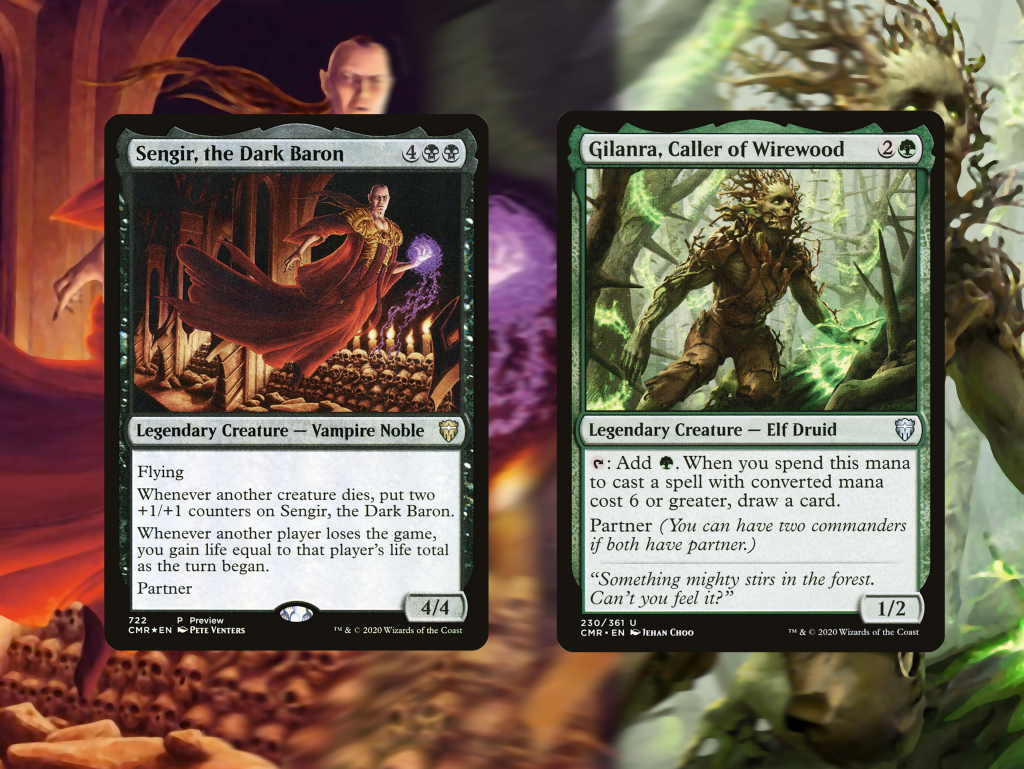 Credit: Wizards of the Coast.
"Whenever Another Player Loses the Game"
As mentioned, the conceit of this deck hinges on your opponents losing the game, something that rarely happens early on in a Commander game. This is down to the social mores of 'spreading damage' and not wanting to kick players out, only to wait 40+ minutes for the next game. These cards have remained unpopular for that reason, though if we can present a compelling case that the game will end soon after that one player dies, it feels significantly less bad. Therefore, we aim not to play for a combo (something I feel often gets mismanaged as a teachable part of deckbuilding), but instead to turn one player's untimely demise into a full-fledged victory.
Sengir, the Dark Baron was my obvious pick for a Commander here, being a classic big evasive guy that only grows larger, with a splashy effect to boot. If we can achieve his second trigger even once, it should put us far enough ahead against fair decks to spin that into a win. The choice of partner was a bit of a tough one, but given Sengir is a whopping 6 mana, having consistent access to mana in the Command Zone was a clear preference, and
Gilanra, Caller of Wirewood even draws us a card when Sengir gets cast with her mana. We're locked into Golgari, a great place to be, but what other cards help us turn one player kill into three?
 Magdalena Bay is a trio now, I guess.
Let's start with
Curse of Vengeance, a fantastic card that depicts precisely how the enchanted player ought to feel—Damocletian. The earlier this comes down, the more it's telegraphed to go poorly for everyone else once the chosen player's out of the game, but likewise that sword which hangs above is a juicy target for you to focus down. These cards all, in their own way, guide the player to choose someone to kill and clamp down like a junkyard dog; threat assessment matters less when your cards direct you to point each bit of ire afforded to you at one target. Next is
Elbrus, the Binding Blade//
Withengar Unbound, a card folks have asked to be a Commander for nearly a decade. While this Legendary Equipment can't lead a deck, it nearly does so here—we can easily flip the blade, it's mana value 6+, and Withengar kills basically anyone once you push over the first domino. If it ever had a home, it's here.
Zenos Yae Galvus//
Shinryu, Transcendent Rival is a larger in scope, winning you the game if the chosen player dies, but it comes attached to a small wipe that Sengir appreciates for his +1/+1 counter trigger. There's one more card like this, set to release in
Teenage Mutant Ninja Turtles next year:
Super Shredder. There's a rules quirk with Shredder where, for each permanent a losing player has before exiting the game, Shredder will see and get a +1/+1 counter. Between tokens, Lands, and more, that can make Shredder obscenely large, catapulting us towards another lethal threat. Note, however, that those cards don't 'die', for Sengir purposes, so it's wise to kill those first if you've the chance.
A Token of My Gratitude
One aspect of the deck which might be a surprise is its token-centricity, a great deal of our cards giving everyone at the table their very own temporary cardboard. I say temporary because we're aiming to leverage these bodies both for politics, and as fodder for Sengir; the Baron doesn't care whose Creatures die, meaning we're incentivized for everyone to partake in that macabre party.
Sylvan Offering is an awesome representation of what we aim to do, spreading tokens across the board and, with X=5, even triggering Gilanra's draw.
Tribute to Horobi//Echo of Death's Wail returns from
a previous Command Focus, distributing Rats among your opponents, and reclaiming those that survive the ordeal.
Dowsing Dagger//Lost Vale is even better in multiplayer, as you can give the Plant tokens to the player you aren't attacking, and similarly,
Forbidden Orchard can be wielded politically with every untap. None of these tokens block Flying Creatures, but do excellent jobs at hosing ground-bound attackers, incidentally helping Sengir take players down from higher initial life totals via Commander Damage, rather than your opponents being picked apart bit-by-bit. The Baron prefers his meals whole.
Then, there's mass token generators like
Rampage of the Clans,
Curious Herd, &
Fresh Meat, which eachs allows us to react to different board states. Curious Herd will at minimum make ~3 Beast tokens, purely due to mana rocks, but as Commander has progressed more and more decks rely on things like Clues or Treasures, this chaff being all the better for you to exploit.
Fresh Meat is an ideal pick following a board wipe, and can give you enough attackers to positively ruin opponents now left open from the table being cleared. Finally,
Rampage of the Clans deals with so much, so well, flooding the board with a card type you can actually handle: Creatures. All of this is going on while you've played things like
Grismold, the Dreadsower &
Slaughter Specialist, growing larger with every death. If either of these get big enough, or Sengir's grown heavy with counters,
Windswift Slice is perfect removal, cascading into even more bodies. In short, we're aiming to give everyone tokens, and eventually deal with them. Let's talk about part two of that plan.
 As long as you've got enough triggers.
Brahmagupta's Invention
Making a ton of tokens is great for a number of reasons, and donating them to opponents we're not set on killing can lead to some great politics...but we need to get rid of them sometime. Full on board wipes are a bit of a nonbo with Sengir, who needs to be alive to see Creatures die, and largely the toughness-killing ones can be inefficient, so what's our next best option? The answer, weirdly enough, is a slew of mana-value-matters wipes. It's become a running theme for me to care about mana value in my lists, and here it's no different, though the number we've skewed towards is a new one: 0. If we look to these spells to wipe exclusively tokens, more or less, they become extremely efficient means of pumping Sengir to lethal heights and clearing annoyingly dense boards. Most of these are at Sorcery-speed, such as
Gaze of Granite or
Day of Black Sun, being cheap to cast at X=0, but alternately can wipe entire boards at higher costs. The flexibility, coupled with an opportunity to even draw cards with Gilanra's mana should we hit 6 total mana spent, means they can both let us kill opponents with a boosted Sengir, or simplify a board state if it's too much to handle. For new players, that second mode is a great way to reset, and get back to a more understandable game state.
Then, there's
Pernicious Deed, the all-time great card for this effect that's available at Instant-speed. It does sit on the board, but the flexibility of using it reactively is unmatched. Two funnier options are the pair of
Ratchet Bomb &
The Filigree Sylex, each having seen Modern play. We're content to crack these 2 mana Artifacts for 0, to clear tokens, but we can also snipe specific problem permanents by ticking them up, all at Instant-speed. While these cards do scale poorly, if someone's got a problematic 5 mana Creature on the table, we not only play a ton of ramp to get to the necessary X values, but also a number of targeted sacrifice effects in concert.
Szat's Will,
Flare of Malice, &
Soul Shatter are all among my top picks for budget Black removal, and here help us deal with the Creatures that aren't readily hit by our X-cost wipes. Together, they give us an unmatched capacity to control the board, and get Sengir as big as possible, as quickly as possible. One last mention for the X=0 cards is one that inverts our normal use case,
For the Common Good: It gains life and actually protects our board, in cases where having bodies to attack or block with is more valuable than turning them into Sengir power. Usually, we just play this for {G}, though if there's spare mana to go around it can make extra Beasts, Centaurs, etc. The gameplan can be boiled down to ramp, spread tokens, play a cheap token-specific wipe, and kill someone with Commander damage, reaping the rewards. Simple enough, but what do we have when things aren't going perfectly? What about our second Commander?
Six: The Musical
Gilanra plays second fiddle to Sengir in the deck, but that's not entirely a bad thing. Having a source of mana in the Command Zone
always feels excellent, and allows us to build a ramp package that skips 3, knowing we can just cast our Commander. Therefore, we're loaded up on mana value 1 dorks, which coincidentally die very readily to our X-cost wipes to boost Sengir after he arrives. That being said, we do aim for Gilanra to draw us 1 card per turn, most turns. There's a number of fun, splashy 6-cost cards in the list that fit the trend set by Sengir, giving us something to do with Gilanra's ability once both of our Commanders are on the table. These can fluctuate based on your budget, as Commander is a format full of splashy high-mana Creatures, but in this list I've suggested a few which work well. First is
Anticausal Vestige, a card which seems to me a better
Solemn Simulacrum every time I play it; here it's a 6 mana card that can be played for 4, reaping the reward from Gilanra far more readily, and which often draws and ramps you when it leaves the board.
Summon: Primal Odin is a way to 'cheat' the game loss condition, which can lead to some very fast games versus opponents without great blockers, but it's also a reasonable body that does enough on its own.
Vein Ripper is some sustain, and
Feaster of Fools translates tokens into triggers and counters, but these feel like the flex slots for 6 mana guys.
 But now we're X-cost.
What is less of a flex slot is
Massacre Wurm, which paired with our means of donating tokens can take multiple players out from a single cast. Vein Ripper can do its job in a similar manner, but because it targets one player, you can send everything at the person you've been targeting all game to reach for a Sengir trigger. Speaking of accelerating games,
Sorin Markov is conveniently 6 mana, and gives you the chance to only need 10 damage for a loss, with Sengir caring about the life they had at the turn's start. Sorin can give you a chance to pivot between who you kill, surprising a foe by taking them from the 30s to 0 in one fell swoop. Finally of note are
Feaster of Fools &
Ghalta, Primal Hunger, both big guys that get self-discounted, with each giving us an easier time drawing from Gilanra. On the whole, the Timmy side of this strategy is less important than combining tokens and wipes, but I find it vital we have the opportunity to treat Gilanra like a
Phyrexian Arena in the Command Zone, on top of being a
Llanowar Elves.
Enemy Mine
As has been expounded upon throughout this article, the main way we're looking to win is by way of Sengir, though that's not telling the entire story. In the best of worlds, Sengir is letting us gain anywhere from 15-20+ life once a player is taken out, and that degree of life gain can be spun into more than just sustainability on the board. Case in point, it gives us the ability to
Assemble the Entmoot and make three
massive Treefolk tokens, giving us game against both remaining opponents. As a brief aside, sacrificing Entmoot for X=0 is hilarious as a means of getting 3 death triggers. Then, there's
Gollum, Obsessed Stalker, who can mark opponents other than our chosen target, causing each to lose life equal to the deceased player's remaining life at time of death. The ability on
Shaman of Forgotten Ways is similar to Sorin Markov's, but for each opponent, mimicking the banned
Biorhythm. It's expensive, but with the ramp package here it's not out of our reach if the game goes long. Along similar lines is
Torgaar, Famine Incarnate, which at most reduces the necessary damage from 40 to 20, and in a pinch can even reset our life total to 20 if things have gone
very badly.
Pointedly, however, this deck has no combos. It has every card type, a clear gameplan, ultimately plays 'fair' Magic with its path to victory, even if the means are a bit odd with the tokens and X=0 wipes. In fact, the entire point of the strategy is to help guide a player towards victory every step of the way, giving them ideal opportunities to politic with token creation, and answer anything under the sun with its suite of mana value wipes. Critically, though, it teaches players that it's okay to kill a player, and in fact, that focusing someone down is often essential to stopping their gameplan. 'Player removal is the best removal' is an adage oft repeated in some form, and here it's doubly true with Sengir's trigger hanging over the table. Identify a threat, pursue them until death, then continue the arc of that blade until it cleaves through your other opponents. Elegant, like an axe wildly swung.
Example Decklist: Is This Loss?
With the fundamentals fully covered, I want to highlight a few miscellaneous cards in the list here, starting with
The Aesir Escape Valhalla. Coming from the unpopular
Assassin's Creed, it makes sense that the card has no buzz, but I found myself shocked at how great it feels in the right context. It's a slow, repeatable means of recursion, but if you're getting something big back (such as a Landcycler like
Troll of Khazad-dûm) it makes a Creature massive for essentially no cost.
Tyvar, Jubilant Brawler &
Culling Ritual are two cards that find their way into every deck I build with Black & Green for the most part, but here perform some added duties. Tyvar does an excellent job of letting Gilanra tap for 2 mana each turn, and if both are spent on a spell with mana value 6+, you draw 2 cards. Culling Ritual meanwhile is an excellent board wipe along the lines of our X=0 fare, but adds a breathtaking amount of mana on top of it, letting us have pop-off turns that often end with at least one opponent dying.
I've been an advocate for MDFCs—Modal Double-Faced Cards—since their debut, and here we're playing a whopping 8, more than I normally stock in my lists. Why is that? Well, simply put, the best way to reduce the number of non-games you have is to increase your count of MDFCs; they're Lands when you need Lands, and gas when you need gas. Rare is it for these cards to be
terrible to draw, and even for those which are taplands, compared to a tapland that creates either Green or Black mana, I'd prefer the MDFC. I debated playing 10 here, even something like the 6-mana
Zof Consumption, but there's a cutoff even for me with these stellar inclusions.
Decklists are kept updated, and may change with set releases.
At time of writing this, the decklist comes in at a cool $197.92 on Manapool (not sponsored, yet anyway), and you could pare it down even further if playing for pennies. There's cards like
Delighted Halfling,
Agadeem's Awakening, &
Heroic Intervention that if swapped shave ~$50 off the total, but trimming beyond that gets a bit tougher. You could probably get this to $100 with a few noteworthy concessions, but a few proxies never hurt anybody. That being said, as far as bracket goes, this is a pure 2, and I wouldn't try to push it into 3; the core gameplan requires things to go long and err away from combo, and Sengir is too much of a fair beatstick to be worth 6 mana once the game pace accelerates. Keep this to playing against upgraded precons and you'll do wonderfully, though. That was largely my pool for testing, as well as some odd brews, and the deck performed admirably.
You're a Loser, Baby
 Choo pushes the weirdness of Wirewood to modern art, while Venters harkens back to classic Magic art.
The vast majority of budget decks you see online are one of two things: Typal lacking their best options, or midrange without the necessary value pieces to keep up. This list, while implicitly sticking to a budget, does not
feel like a budget deck in its gameplay, and I chalk that up to the deference given to weird cards here. X=0 wipes, as I've affectionately called them, aren't in high demand, and the token-spreading capabilities of the bulk of our Instants & Sorceries are far less sought after than tutors and filtering. If you build a weird, niche deck, your core cards will be in lower demand and therefore cheaper, outside of the odd never-reprinted-Portal card. The other problem with the above-listed archetypes, as well, is their complexity (and relative inability to answer complex board states). The more whirring little gears on your board that make up a value engine, the more difficult it is to navigate a turn—because these boards likewise need all their funny pieces to function, you also tend to run few wipes, meaning each opponents spinning their own plates will continue to do so until toppled, or victorious. This list answers such a problem with a number of synergistic wipes as part of its core gameplan.
By no means am I saying midrange is the wrong way to learn Magic, or Commander, as it is certainly the most popular archetype in the game at large. What I am arguing for is the necessity of those enfranchised players to recognize its faults, and the faults of Commander as a player's first format. Even some modern precons make for poor choices to onboard a player (Good lord, Tricky Terrain wasn't for anyone new), and outside of handing someone a Krenko list and saying 'go, do a violence' there's little respect paid to the issues faced by new players. We should aim for these starting decks to have a lot of similar effects across cards, a fairly straightforward gameplan, and enough beef to keep them in the game if things go awry; I'm not saying I hit the nail on the head with my list here, but it's close. I would love to hear about your experiences either getting into Commander yourself, or helping someone new, and whether a deck like this would have been a boon. For as much as I might toot my own horn, I know the concept of casting
Forced March for X=0 is a weird one no matter how long you've been playing.
Until next time, let their loss be your gain.
Have any questions or feedback? Drop us a note in the comments below or email us at contact@goonhammer.com. Want articles like this linked in your inbox every Monday morning? Sign up for our newsletter. And don't forget that you can support us on Patreon for backer rewards like early video content, Administratum access, an ad-free experience on our website and more.Thank you for being a friend.
 This website uses cookies. Learn more.

 Goonhammer Hobby Round-Up: March 2026
 Goonhammer Reviews: Tribal Conquest
 Conquest: Weaver Courts Gemred Knights and Scaile Dancers Model Review