Black Library Bibliophiles is Goonhammer's occasional series on the collection and display of Black Library books. From diving between the covers of deluxe editions to chasing rare editions and notable misprints... from collectors' well-stocked personal libraries to the curated display of trinkets, curios, and other Warhammer memorabilia... we go beyond the pages to celebrate the love of the books themselves. You may find previous installments here.
Today's article is something a little different, an open invitation to those newer to this incredible hobby on how to get the most from it.
 Image credit: Games Workshop
Earlier this year the Black Library released the Illustrated and Annotated Edition of
Chris Wraight's The Lords of Silence. While this hewed to the same successful formula as
Dan Abnett's special releases (
Xenos,
Malleus, and
Hereticus), there were a few interesting differences that had nothing to do with what was actually on between the pages.
Abnett's Eisenhorn trilogy has long been readily available (in omnibus format)
1, but that hasn't at all been the case for Wraight's. As I noted in my
review, prior to the reissue paperback copies of
The Lords of Silence had been trading hands for around $150, going even higher for hardcover or Limited Edition.
Games Workshop may not have been directly responding to reprint demand, but the Illustrated and Annotated Edition was a perfect point of entry for the aspiring Black Library collector. A sought-after story given a beautiful treatment with loads of author insights throughout
2, the mass release of the book (as opposed to being a Special or Limited Edition) meant that it was a lot more accessible to Black Library readers- while still having a 'deluxe' feel
3.
I'd love to see more products like this, ones that offer a bit of shine and polish to a library and encourage readers to begin building a collection. Indeed, how to start collecting is one of the most common questions I see in the community spaces for readers on the net, so today I'm kicking off a three-part series about our hobby.
This first installment is all about the art and science of collecting, including strategies for getting the most out of your time and treasure in order to build a library you can enjoy and be proud of.
Let's begin with this simple question:
what kind of library are you looking to build?
I. Plan Your Library in Advance
This is often the last step that collectors end up doing in their quest to build their dream Black Library, but it's so important that I'm putting it first. That step is having a vision of your library, and while it's likely to change along the way if you give it some real consideration, you're far likelier to have a much more enjoyable library a year from now.
Let me explain what I mean.
A year ago, I had no real vision of what I wanted from my Library. I loved reading Warhammer fiction, and the books I'd acquired sat in one of my bookshelves alongside all of my other books. The pleasure I derived from the Black Library was mainly in its consumption, not its display.
At some point as my collection began to crowd other books off the shelves, my interest in displaying them grew. The bookshelf wasn't just a place for containing the books I'd read and yet wanted to read. It was an aesthetic in its own sense, on par with my shelves of Advanced Dungeons & Dragons 2nd Edition, say, or my expansive collection of history nonfiction.
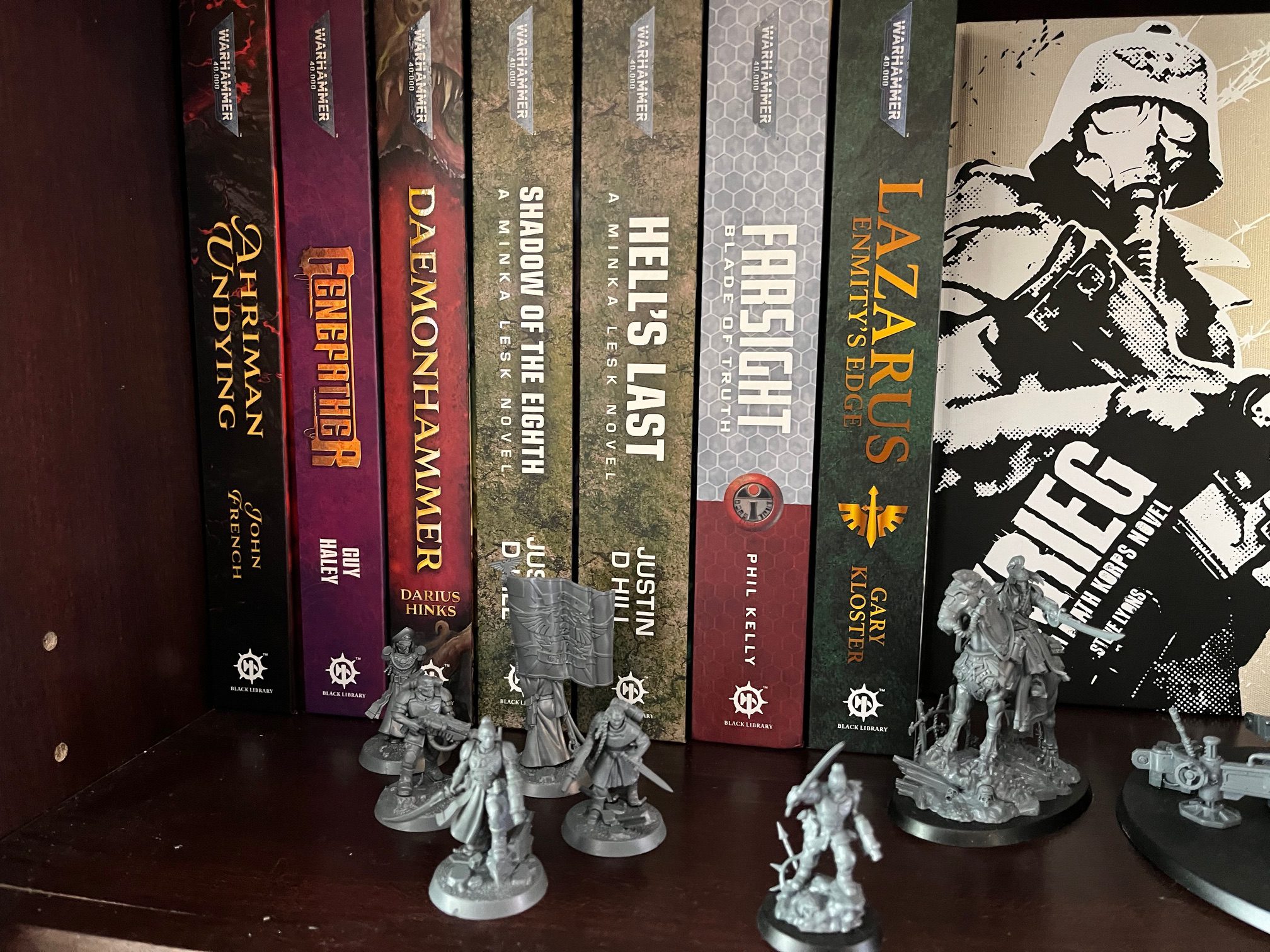 Adding minis. Image credit: Jay Kirkman
It was at this stage that I introduced the miniatures. Embracing Warhammer as a modeling hobby has only been a product of the last year of my life
4, and while I haven't been much into the tabletop gaming experience I've had tremendous satisfaction from staging my minis alongside their books. Sure a hardcover or Limited Edition looks great on a shelf, but paired with some corresponding minis they look so much better!
As my collection evolved, so did my vision. I moved from library to museum, adding coins, curios, Mega Edition trinkets and other officially-licensed merchandise to go along with the display of books. I invested in illuminated display cabinets, giving shelves a theme (below there's the Loyalist Astartes and Ahriman shelves).
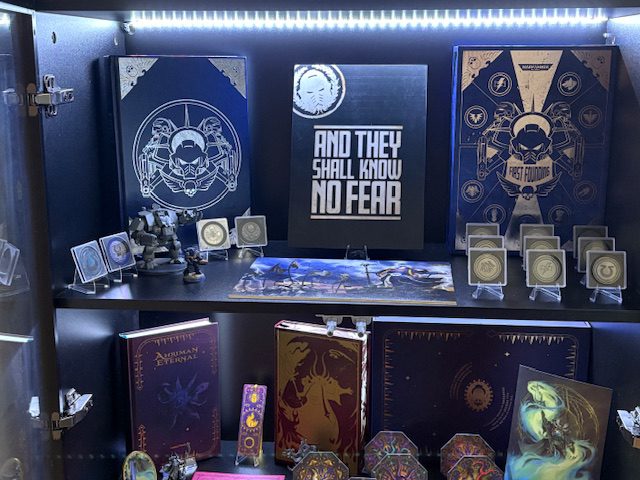 Image credit: Jay Kirkman
I've enjoyed assembling my Museum so much that I make sure to spotlight a piece of it with every installment of the
Black Library Bibliophiles series, and it's likely to be the 'final form' my Black Library collection will take. From here, it just keeps expanding!
The point of all this is to say that I sort of stumbled into what I wanted my library to be. A lot of my disposable hobby income went in lurching from one piece of FOMO to the next, snapping up collection-building lots and prestige pieces on the secondary market. I bought loads of miniatures for things I thought might be fun to build rather than narrow in on things that might advance the vision I eventually arrived at in my head
5.
In other words, the sooner you get an idea of what your endgame looks like, the faster you'll get there. Give it some thought- you'll be happy you did.
II. Know Your Budget
One of the collection targets I set for myself in 2025 was to acquire every Limited and Special Edition release for the year. If you'd told me in January that this ambition would set me back around $3000
6, though, would this be how I'd choose to spend it?
Maybe so. I mean, some of this year's highlights look absolutely stunning on display. The deluxe editions of
Jude Reid's luscious
Fulgrim- The Perfect Son (
review) and
Lucius, The Faultless Blade by
Ian St. Martin anchor the Emperor's Children wing of the Museum, while
Guy Haley's Belisarius Cawl: The Great Work is patiently awaiting for me to add
Archmagos to the Adeptus Mechanicus corner
7.
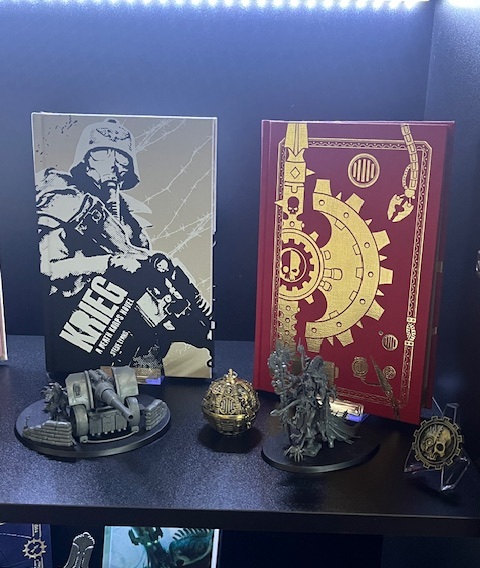 Image credit: Jay Kirkman
But maybe not. Because my Museum is ever starving for more trinkets, relics, and doo-dads to accompany the books, I much prefer the Mega Edition sets to the Box Sets. We only had our first one of the year announced (
William King's Trollslayer), but we've had
four of the latter (the two Space Wolves sets,
Saints of the Imperium, and the Yarrick one).
For a comparable amount of money, though, what would I have preferred: those four boxed sets or the
Gaunt's Ghosts: The Warmaster limited edition box? That's a very interesting question.
Knowing your budget- and the potential expense of your collecting ambition- will also help you keep the FOMO daemons at bay and build the best collection your budget will allow.
III. Know What Things Cost
Pop quiz! Someone's offering a copy of a book on your wish list,
Guy Haley's Konrad Curze: The Night Haunter, for $100 shipped, is that a good deal?
If you have to stop and think about it, you might have missed out. Bargains come and go, but the one thing they all have in common is that they don't last long. If your first instinct here is to head to
eBay and get an idea of what the market price for that book is, someone else who already recognized it as a great deal has snapped it up.
I file this under, "if I had to do it all over again, what would I do differently." A good chunk of my collection is books that I found at a good price but weren't necessarily things I really wanted. That's another advantage to having a roadmap to building your collection- once you know what books you
really want to own, you can do your due diligence for them and get an idea of what price you're willing to pay for each.
The next time that copy of
Helsreach by
Aaron Dembski-Bowden pops up for $35, you won't even have to think about it, and you'll be the one snapping it up while others go off to confirm whether or not it's a good price. A little work up front can save you a
lot of money in the long run.
To ballpark market prices, the simplest method is to review the past 90 days of
sold listings on eBay. Don't look at what people are listing things for- you can put whatever price you want on a ball of lint, it doesn't mean the market will agree. What you need to know is what copies are actually trading hands for. For particularly scarce items that don't get exchanged frequently, you might have to go further back (or simply settle for a smaller data pool).
IV. Know How Books Are Released
Finally, it's essential to have a good understanding of the product life cycle for the Black Library. Being a collector doesn't not automatically mean you go straight for the deluxe editions; there are plenty of folks quite happy building up a library of standard hardcover or softcover books, and it's good to know when titles may come into print.
Stage One: The Limited Edition
The first stage is the deluxe release, and there are a few different versions of this. Many (but by no means all) novels will be released as a "Limited" edition first. These typically cost $65 to $75 apiece, are limited in quantity (typically to 2,500 copies), come signed by the author, usually have some bonus content (an author introduction/afterword, or a bonus short story), and have a deluxe treatment (artistic cover, edge spraying, a ribbon bookmark, etc.)
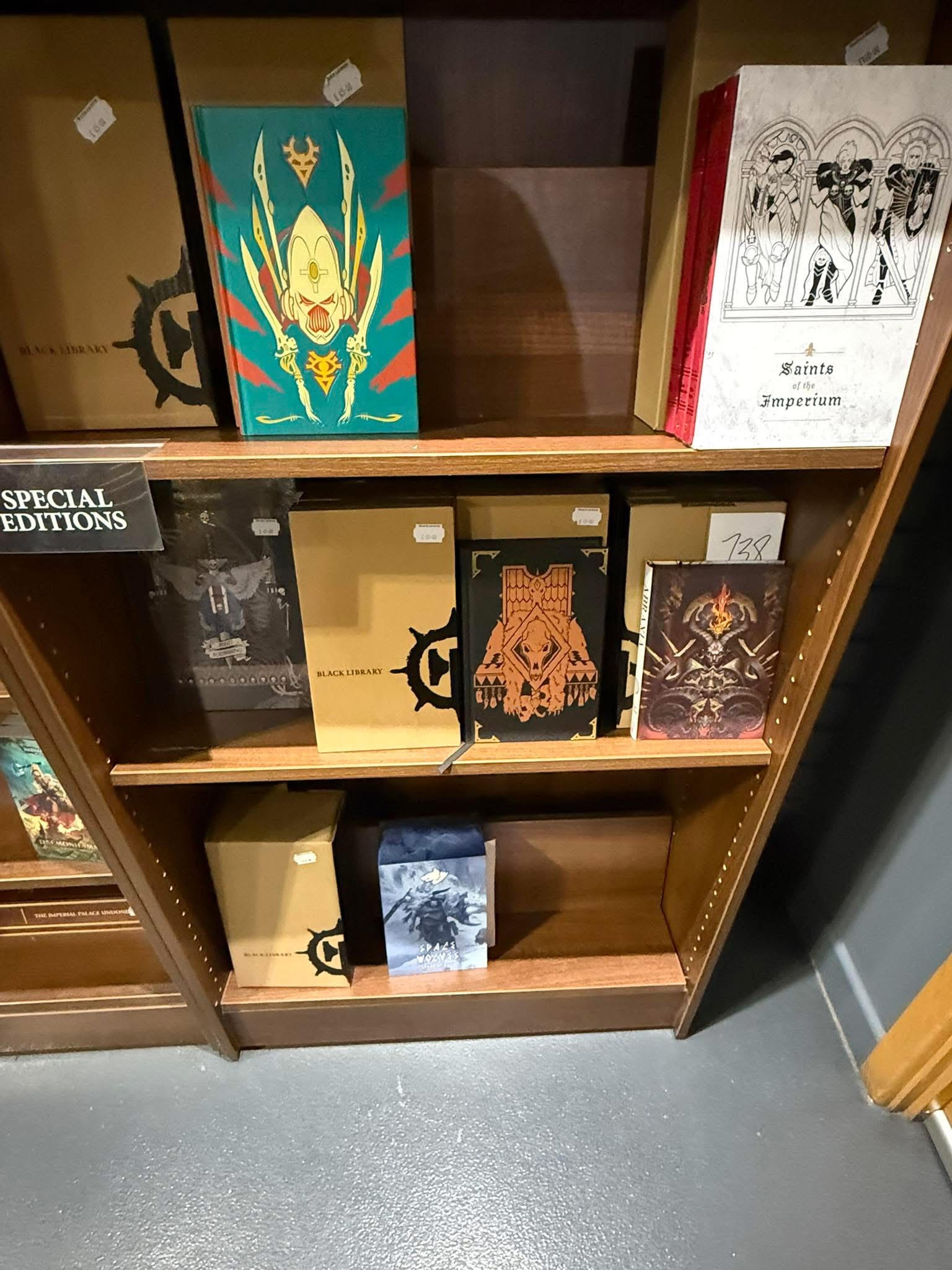 A day in the life at Warhammer World. Image credit: Aidan Gerard
There are only two primary sources for these books. One is the Warhammer.com website, which will be the option for most of us. The other is a Warhammer retail outlet, but outside of the main "headquarters" retail stores (
Warhammer World in Nottingham,
Warhammer Store & Cafe in Grapevine, Texas, etc.) the odds are long. My local Warhammer store never has deluxe editions as a matter of course, but they did recently have a copy of the
Saints of the Imperium Box Set after a customer order cancellation. Every now and again you can get lucky, but you can't rely on that.
Limited Editions are typically offered
in advance of the standard hardcover edition. Earlier this year,
Grotsnik: Da Mad Dok by
Denny Flowers (
review) was released in Limited Edition on 18 May, while those wanting a standard hardcover edition found their joy on 28 June- about a six-week lag time.
Stage Two: The Hardcover Release
In other cases, some books will get a deluxe edition (in this case, usually called a "Special" Edition)
at the same time as the standard hardcover release. For example, both the Special Edition and standard hardcover edition of
Eidolon, the Auric Hammer by
Marc Collins released on 22 October, 2024.
If there's a logic behind versioning decisions, it's a secret of the warp. Both
Eidolon and
Grotsnik are part of the Warhammer "Characters" series and received the same treatment (cover design, edging, bookmark), yet one had a Limited release and the other a Special one.
It's also worth noting that some books actually skip this step entirely. Series books like the recently-completed Dawn of Fire received a premium edition and softcover release at the same time, never receiving a standard hardcover edition.
With Chris Wraight's
Ashes of the Imperium, we may have seen the advent of a new release type, as its deluxe edition (sans autograph and numbering) was billed as a "Premium" Edition.
Stage Three: The Softcover Release
Now we start getting into the Wild West of Black Library releases, as all sorts of goofiness happens here.
For one, many books actually
start their life cycle here. Short-story anthologies often do (for instance, the recent
Death and Duty and
Darkness Eternal collections)- but not always!
On the Shoulders of Giants and Other Stories, an Age of Sigmar anthology anchored by a cracking novella by
Adrian Tchaikovsky (
review), released on 26 October, 2024 in hardcover, with the softcover following a year later.
As noted above, series books like the Dawn of Fire or Dark Imperium titles have only had softcover releases for their non-deluxe editions. There's also the Astra Militarum series which began in 2021 with
Andy Clark's Steel Tread (and which is now getting a Special Edition, showing that this "life cycle" isn't always strictly linear when it comes to premium releases), each of which has only been printed in softcover
8.
Second, there's no real set time lag between hardcover and softcover editions.
Noah Van Ngyuen's extraordinary
Elemental Council debuted in standard hardcover on 7 December, 2024 (
review). The softcover arrived this past October.
If nearly a year seems like a long time, spare a thought for those awaiting a copy of
Gav Thorpe's Luther, First of the Fallen in paperback (
review). Released in hardcover in April of 2021, it received a softcover printing only just this past June.
Stage Four: The Compilation Release
This isn't a "stage" in quite the same way as the other three, but this is the category where I'm putting the humble-yet-mighty Black Library omnibus. The
Night Lords Omnibus by Aaron Dembski-Bowden is almost required reading for Warhammer fans, and in the past year we've seen two terrific collections of
Peter Fehervari's Dark Coil work (the first of these reviewed
here).
These massive paperback tomes will win few beauty awards, but in terms of comprehensiveness and value for dollar they're unmatched. Many of us English-speakers look on with undisguised "omnibus envy" for our friends in French- and German-speaking lands who get to enjoy the entire run of the Horus Heresy being
released in omnibus form.
Now that we've covered how books get released, let's look at the different places to get them. Here's where things get
really exciting- and by exciting I really mean 'stressful.'
Here's where the rubber hits the road, the acquisition of the amazing books that are soon to be filling your shelves. Perhaps you'll be chasing new releases, which staying on the bleeding edge of collecting new deluxe editions or series. Or maybe you'll want to go the vintage route, building the history of Warhammer in paper.
What you're after determines where you need to be looking, and what purchasing methods for each are quite different. In this next section, we take a look at all of them!
At risk of turning this into one of my MBA textbooks, let's begin with a simple chart.
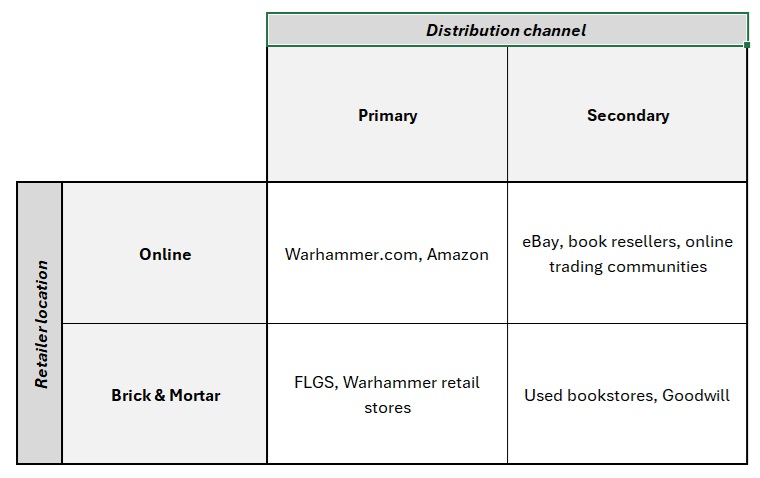 Image credit: Jay Kirkman
I. Buying on the Primary Market
There are two ways to acquire books for your library: the primary market (online and brick-and-mortar retailers, including Warhammer.com) and the secondary market (buying from other people). Both have their advantages and disadvantages, which we'll be looking at next.
In talking about the primary market, we need to make a distinction between buying limited and unlimited product. Technically no product is truly
unlimited (unless it's a print-on-demand service, which only rarely applies to the Black Library), but the buying process for deluxe (Special/Limited Editions, etc.) is very different than from the regular catalogue.
Primary Brick and Mortar
It's a dangerous misconception to think that the only deluxe edition releases are difficult to obtain. Recent standard hardcover releases like
Mike Vincent's The Remnant Blade (
review) or the Adepta Sororitas anthology
Paragon of Faith and Other Stories (
review) were sold out on Warhammer.com within minutes of prerelease.
And it's not just the hardcovers.
No Peace Among Stars, one of October's short-story anthologies, was out of stock online just as quickly as most limited editions.
Unlike deluxe editions, these standard releases
do show up at retail locations- but usually not in large quantities. My local Warhammer store, for instance, stocked only two copies of
The Remnant Blade- and both sold within minutes of opening.
Typically what you'll find in a brick and mortar retail store are an assortment of
the in-print, currently available paperbacks. On occasion if you're lucky you'll find a retailer that takes pride in having an especially well-stocked collection. Cincinnati's
YottaQuest is one such destination; I stopped in there about a year ago for the first time and dropped about $400 on filling holes in my collection- it felt like an early Christmas. They say you can tell a lot about a salesman by their shoes, and similarly you can tell a lot about a Black Library retailer by their stock of hardcover books. YottaQuest had plenty of them.
But for the Black Library collector the real power in your friendly, local game store (FLGS) isn't what they have in stock, it's what they can
get.
Derby Comics and Games in Shelbyville, Kentucky has been the secret weapon in my Black Library collecting. Every week when
the Sunday Preview drops on Warhammer Community, I take note of all the upcoming Black Library titles for the week. Anything that isn't a Limited or Special Edition can typically be ordered through Derby as long as I let them know what I want by order cutoff on the following Tuesday (deluxe editions are usually Warhammer.com exclusives
9).
All those paperback and hardcover books that sell out every bit as fast as the deluxe editions online on preorder Saturday? My order was already in four days earlier. Not only does this virtually guarantee I'll get the books I want, but it also frees me up on Saturday to limit my purchase to the online-only deluxe editions. Every week you hear about people who missed out on ordering that Limited or Special Edition they wanted by mere moments. "I got it in my cart," goes the long-familiar tragedy, "but by the time I clicked to pay it was already out of stock."
And perhaps the best part? I'm routing my custom through a local, independent game store. If you want to have local, independent retail stores in your community, there is no substitute materially supporting them through your buying habits. (There are additional knock-on benefits to keeping money local, but this isn't the place to launch into a lecture on the velocity of money. Let's just say it's really good to keep your money moving in your own community).
What about using a
Warhammer Store? It might seem counterintuitive, but this actually puts you at a disadvantage compared to your FLGS. In many ways Warhammer Stores are less like an FLGS and more like a physical outpost of the company's online webstore
10. Preorders are done in-store through a computer kiosk (typically just one) and adhere to the standard preordering hours.
To understand this in practical terms, let's flash back to Saturday, 30 August of this year. I stopped by my local Warhammer Store at around 12:30 to pick up my order of
Chris Thursten's Abraxia, Spear of the Everchosen Limited Edition (
review) that had come in. The store was abuzz with excitement over the new Kill Team: Tomb World release, and indeed there were already three people queued up at the kiosk eagerly waiting for the preorder window to open.
My focus, though, was on something else in that preorder window: the Special Edition of
Assassinorum: Kingmaker by
Robert Rath. If I'd waited in line to use the preorder kiosk at the store, by the time it was my turn I would have missed out. Instead, I simply pulled out my phone and ordered it online.
There's a common belief that ordering through a Warhammer store kiosk gets you advantageous order processing, but because you have to log in to your own Warhammer.com account (just like you would at home) I'm somewhat skeptical.
It's good to support your local Warhammer Store. Just don't count on them for high-demand, time-sensitive orders like deluxe Black Library books.
For those, it's vital to go straight to the source.
Primary Online: Preordering
Now we get to one of the most anxiety-inducing, peril-fraught aspects of collecting Black Library books: the online preorder stampede. If you're serious about collecting Black Library deluxe editions, you're going to have to learn how to navigate this process effectively as the only alternative is to source them on the secondary market (usually at a premium).
From the comments we see every week in the Black Library online communities this is one of the areas of greatest uncertainty for the neophyte collector. Let's walk through it one step at a time.
Step One: Know Your Targets
Every Sunday afternoon
11 Warhammer-Community.com
runs its Sunday Preview article, giving you a six-day head's up of what products will be available for preorder the following Saturday. If you've subscribed to the Warhammer.com newsletter, you'll also get this in email form.
Then every Monday, Goonhammer runs
my regular column Black Library Weekly, where I also review what's coming up for preorder in greater depth.
At the very least, make sure you're tuned in to one of these two channels (and preferably both!) so you know what books are coming up that you'd like to order.
Step Two: Know Your Window
Do you know what time your preorder window opens? This is essential information if you want to be sure you don't miss a deluxe edition. I'm in the Eastern Standard Time zone in the US, so my 'official' window opens at 1:00 PM.
Folks, this is a lie. If you're just logging in at 1:00 PM to preorder your books, there's a very good chance they're already gone.
Products will go live around five minutes ahead of the official window open- emphasis on
around. If there's a deluxe edition I'm after, you'd better believe I'm logged in and ready to go by 12:54 PM.
Step Three: Know How to Find Your Product
Once you're logged in, it's essential to know how to find what you're looking for. You might be tempted to simply camp out at
the Preorder page, but collectors have increasingly shared that new books seem to appear on their own faster than they are added to the Preorder page.
That means your best bet will be to use the search bar in the upper-right-hand corner:

At 12:54pm, I'll start entering in the name of the book I'm after to see if it's populated on the website. Remember, I've already ordered all of the non-limited books I'm after from my FLGS, so the
only things I'm hunting for here is whatever deluxe edition I happen to be chasing. Most weeks, that's a single book
12.
If it's not there, I'll wait twenty seconds or so, hit refresh, and look again. Repeat until the book appears. Note that recently Games Workshop has upgraded its anti-bot measures, so repeated refreshes may trigger a quick Captcha just to verify that you're human.
Once the book has appeared and you've added it to your basket, don't stick around to browse. Head
straight to the checkout!
 Step Four: Know How to Pay
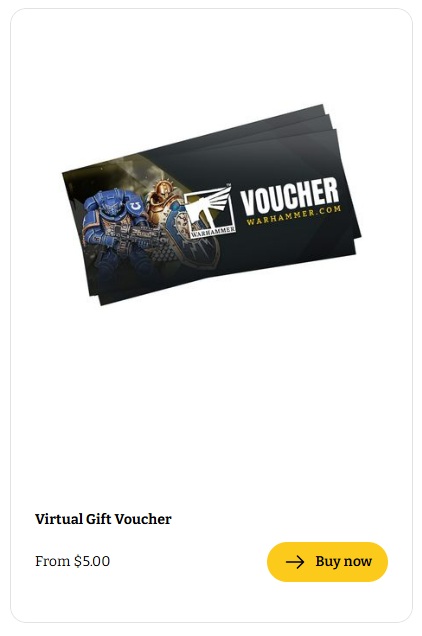
Like any online retailer, the website offers you several ways to pay including with a credit/debit card or with PayPal. But if you're one of those people who likes to min/max every advantage to make sure you get the book you're after instead of the dreaded 'out of stock' message, there's one clear winner: the voucher system.
The word 'voucher' has a bit of a different connotation here in the States, where it tends to imply a coupon that's redeemable for an item. "Here's a voucher for a burger" means you hand over the coupon and get a free burger. In the UK, the home of Games Workshop, it's more synonymous with "gift card," and pre-loading your account with store credit means that when you go to check out, the Warhammer site won't have to spend time linking to your bank or PayPal account.
To do so, just go to the Warhammer store and enter the term "voucher" in the search bar, which will take you right to it. Then just load it up for the
full amount you expect to need (make sure to account for taxes and any anticipated shipping
13- better to overshoot than undershoot as the remainder will just stay on your account for next time). You will also need to select what date you'd like it delivered, but should in most cases just select delivery for the same day.
Once you've purchased a voucher, it does
not load automatically to your account! Instead, it will send a code to your email
14 (typically within 20 minutes, so this is best done well in advance of your preorder window) which you will then need to input back into the website. To do so, log into the website, click on the profile icon (that circle with the head and shoulders on the right of the screenshot) and click on the Vouchers option.
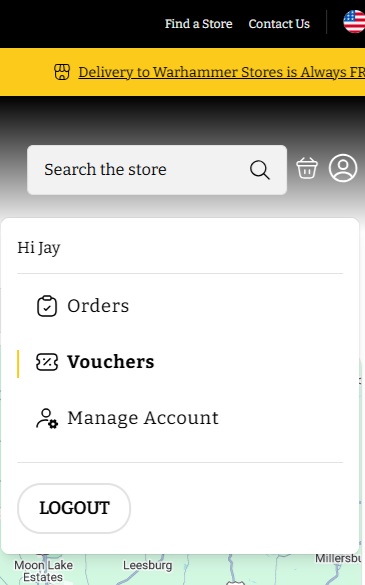
You'll see an option there to add a voucher onto your account, so just copy/paste the code from the email you were sent
Once you've got the code loaded, you're good to go. When it comes time to preorder your book, there will be a box on the checkout screen confirming that you'd like to use your voucher balance for this purchase. Make sure to check it, and you're off to the races!
Once you've successfully ordered the book, you'll get an email confirming your order. Most of the time, you can rest easy. Job done, you'll get your book two weeks later. Once in awhile, though, despite your order appearing to be locked in you'll later learn that your order's been canceled, and that's an issue I'll be looking at in the third article of this three-part series. For now, we're just going to stick with the happy vibes that come from securing the bag of your preorder.
In some cases, you can preorder books through other online retailers, like
Amazon. This never includes deluxe editions, which are offered exclusively through Warhammer's own site. Bear in mind that Amazon's indicated release dates represent an estimate and not a guaranteed delivery date- Amazon can (and will) update these dates as they get closer to the actual release. Sometimes more than once- Chris Wraight's
Ashes of the Imperium has had (at least) three different release dates attached to it. The only ones who know all the future release dates for certain is Games Workshop- and they ain't tellin'.
II. Buying on the Secondary Market
If the primary market is anything connected to the official distribution channel, the secondary market represents everything else from the Goodwill store down the street to the collector in Topeka, Kansas who is selling some of her books to pay for a new army.
Here again, having a vision of what you want and a good idea of what things cost is a great way to maximize your value for dollar when collecting.
Secondary Brick & Mortar
Like any other treasures at secondhand stores, this is all about luck and opportunity. We've all seen the killer hauls collectors have dredged up from their local charity store. Charity shop workers tend to be fairly oblivious to aftermarket valuation of highly-sought-after books. To them, a paperback is a paperback is a paperback, whether it's a $3 copy of
Peter Benchley's Jaws or a $3 copy of
A Thousand Sons by
Graham McNeill.
Many secondhand bookstores, like
Half Price Books, tend to be wise to the aftermarket value of the Black Library. You might find the occasional
value (I often am quite happy to grab used Codexes and Battletomes for $10-15, for instance), but you're unlikely to get a
steal.
Secondary Online
If you're after older books, this channel will be unavoidable. Still, you have a number of different options available to you in your questing, and it's helpful to be familiar with all of them. It's worth pointing out here that these categories I've laid out have some overlap. For instance, some physical game store operations (primary brick & mortar) will also sell through eBay (secondary online). This is also the channel where you'll most frequently encounter the parasitical entities that prey upon our hobby, the scalpers (about which we'll go into much greater depth in the second part of this article series).
Broadly speaking, you can divide this into two categories: the
formal and the
informal. To have the best success at building your library, you'll need to utilize both.
The Formal: eBay, Vinted, Shop, Amazon, etc.
By "formal," I mean platforms that act as brokers for buyers and sellers. eBay is probably the best-known of these, but there are others you can try as well. I've read of some folks having success on
Vinted, and after someone suggested I try the
Shop app I managed to finally find a copy of Guy Haley's
Throne of Light15.
With these options, what you see is what you get. It's a virtual storefront. The odd one out here is probably Amazon, I've never found an aftermarket value there worth acquiring. Usually, it just seems to be sales-bots adding an extra zero or two to their valuation.
For eBay, there are apps like
eFerret which allow you to receive notifications based on criteria you select. Want to be alerted when a there's a Limited Edition of
Steven B. Fischer's Broken Crusade (
review) available for $120 or less? Here you go. There's almost nothing you'll be hunting in the Black Library that someone else isn't hunting, so use every advantage you can to get there first.
The Informal: Black Library Sales, Black Library Nutters: Warhammer Buy, Sell, & Trade
I've no doubt that in different corners of the internet there are swap communities for just about every collectible under the sun. I'll speak to what I'm familiar with, which is a couple of Facebook Groups:
Black Library Sales, and
Black Library Nutters: Warhammer Buy, Sell, & Trade.
The difference between the two is where their focus is.
Black Library Nutters: Warhammer Buy, Sell, & Trade is more buyer-focused. There are a number of protections in place, including:
- Payment must only be through PayPal Goods & Services (G&S). Unlike the "friends & family" method, G&S gives some protections to buyers to dispute payments if their purchase isn't what they expected (for example, a book you ordered arrives in worse condition than you'd expected based on the pictures).
- The Nutters also have price protection designed to deter scalpers. You cannot sell deluxe edition books for more than retail pricing for twelve months after release; print-on-demand (POD) books have nine months of protection, and hardcover three months.
Obviously, for sellers looking to extract maximal value from their wares, the Black Library Sales group is the preferred destination. There are no limitations on sellers here, whether it be methods of payment or pricing on books. This is much more the 'Wild West' of collecting. As a result, it attracts a bit of a different crowd- a crowd that unfortunately also includes more scammers.
If you're serious about Black Library collecting, you'll need to be comfortable navigating terrain that includes scammers. These two guidelines should shield you from 99% of your encounters.
One: If a deal looks too good to be true, it probably is.
We all dream of finding a set of Primarch Limited Editions for $100 apiece (don't we?), but scammers depend on avarice overcoming our common sense. You are more likely to be ripped off than you are to find the deal of a lifetime online. Remembering that building a Black Library collection is a marathon and not a sprint can help you avoid falling for shortcuts.
By the same token, here again knowing what the going prices are for books you're chasing is essential. Particularly in the Nutters group, where there's a stronger sense of community, people will often list books at a markdown and they can get snapped up fast.
Two: PayPal Goods & Services is the way.
The Nutters group has the right of this one- there's no substitute for PayPal G&S. If a seller (or buyer, if you're selling) asks to use Venmo, CashApp, or anything else, then you're assuming additional (and unnecessary) risk. A seller's refusal to use this should be considered a red flag.
So now we've talked about the mental game (learning what you need to know) and the ground game (how to best obtain the books you're after). Finally, a few quick notes on the
possession game.
In our last section, I want to address the last class of questions I often see in the Black Library community, which is how to handle- and take care of- their deluxe edition books.
Tastes Great vs. Less Filling
Back in 1973, Miller Lite kicked off one of the greatest ad campaigns ever made, featuring people arguing about which aspect of the beer they thought was best. Some preferred its 'great taste,' others that it was 'less filling' compared to Miller, and the commercials invariably had people on each side- all drinking the same beer, mind- descent into argument and bickering.
I'm reminded of this ad sometimes when I see some of the disagreements in the Black Library reader community about the purpose of deluxe edition books. One side collects them for display (derisively referred to as "shelf collectors") or "investment," the other declares that "books are meant to be read."
My opinion?
 Of course
 they're books, and I love the feeling of reading a deluxe edition book (with a few considerations I'll get to with the aim of preserving its condition). The ribbon bookmark. The beautiful cover art. And perhaps my favorite feature, the author's introduction or afterword giving some additional insight into the writing of the book.
On the other hand, we display things that are aesthetically pleasing to us, like art and collectibles. If Games Workshop didn't intend to cater to that market- a market that has traditionally shown a willingness to pay a premium to match its tastes- they wouldn't be devoting additional resources into making deluxe versions of these books. Everything would just be a standard hardback or softcover, end of.
So I like to say that these books are meant to be
enjoyed- and how you enjoy them is entirely up to you
16!
Finally, a note on that popular four-letter word, "investing." The problem with that term is that it's a fellow traveler with scalping, which is essentially treating the books like a financial instrument that promises some future return. The soullessness of this approach is anathema to those who love the written word, the lore, and the universe within. Books, after all, have a
soul17.
That said, I have thousands of dollars invested in my Library and Museum. God willing the day never comes, but should such calamity befall me that I am compelled to part with it, you'd better believe I'll be looking to extract maximal financial value for no reason other than simple, mercenary desperation. So in that light, there's nothing wrong with treating the books you love like "investments" not because you intend to flip them, but because someday you may need to. From Magic: the Gathering cards to classic cars, I've encountered no hobby that so seems to frown on this concept than this thing of ours, but it needs to be said.
So on that note, here are some tips about keeping your books in their best shape.
Read with Caution
How is chiropractic care like book reading? When it comes to caring for the spine, gentler is better.
Spines, like any other part of the book, are susceptible to damage when mishandled. Now chances are if you're only ever going to read a book once you might not see a great deal of benefit from conditioning the spine, but all the same I like to condition my hardcover books before reading them so as to avoid any unsightly spinal breaking.
I've seen two methods of doing so, one which is casual and the other I'll call obsessive.
The obsessive method involves turning every page or two individually, which is more time than I'm willing to devote to the task. You can find these methods
here.
The "casual" method occupies the intersection of care and expediency, and is what I use.
- Place your book on a flat surface.
- Supporting the book with your hands, place it on its spine.
- Open it about halfway, from the middle. Close it.
- Open it about halfway, from about 25% in. Close it.
- Open it about halfway, from about 75% in. Close it.
- Repeat steps 3-5 three more times, opening it a little more each time until it's fully open.
Next, when reading my books I keep them on a flat surface, and handle them as little as I can. I'm not going all-in here and donning a pair of white gloves, but I've
covered in my weekly column the hazard of sweat degradation on some of the components the Black Library has used in its deluxe edition treatments. Why risk it?
A Box of Tissues
Another common question involves the special tissue paper and shipping box that accompanies every Black Library deluxe edition. To save... or not to save? Is it worth it to go through the trouble?
Unless you are absolutely certain that you will never, ever under any circumstances have to sell them- an enviable position!- my guidance here is to preserve them.
Books will actually slide out of the tissue paper
18, so there's no need even to pop the sticker. Boxes can be disassembled, laying flat for easy and convenient storage stacking.
The payoff for this doesn't seem to come in the aftermarket price- books typically will sell for about the same with or without the additional special packaging, and the majority of sales posts make no mention of whether or not they're included in the sale. But where you've done yourself a favor is in increasing your market reach. A nonzero number of collectors, which I'd put no higher than ten percent (and within which I'd include myself)- are less inclined to buy deluxe edition books that lack the added packaging.
Environmentalism
Finally, every environmental injunction that applies to paper collectibles like comics applies here. Try not to display them in direct sunlight (I'm not going to go so far as to recommend keeping them behind museum glass, but I'm not
not going to recommend it either).
UPDATE 12/13/25: u/NewSpeak2050 in the Black Library subreddit also recommends being aware of ambient humidity. "For care of books a dehumidifier may be a great boon. Too high or low or wildly varying humidity is also the enemy of books. I've got a good HVAC system at home so it's easy to regulate temp, but I did buy some ultra cheap hygrometers on Amazon and I have them on my shelves for peace of mind, so I know what the actual humidity is in the area at any given time.
Love cooking with garlic for every meal? Maybe don't keep your books stores on a kitchen shelf. Try to scoop the catboxes at least once a day so your atmosphere doesn't have the hint of a kennel. And smoking around your books in the year of our Lord 2025 is as welcome as a turd in the proverbial punchbowl.
Paper over time acquires the odor of its environment. I prefer mine to be as neutral as possible. Your mileage may vary.
Numerology
Finally, a note here about limited edition
19 numbering. From
a recent Black Library Weekly column:
Those of us who collect the Special and Limited Editions of Black Library releases know the ritual all too well, flipping over the book package in the packing box to see what number is written on the accompanying post-it note.
The market for specific book numbers is an interesting one, albeit fairly modest. Outside of the obvious '0001,' I’m not aware of any concerted efforts to track down and obtain, say, number 0013's (for the superstitious), 0069’s (no explanation needed), or even 0099's (for all you Gretzky fans still out there). Sorry, Battle of Hastings aficionados, but sometimes a 1066 is just a 1066.
Book numbers are one of those things that are completely irrelevant- until they're not. The number of collectors willing to pay a premium for certain 0001's is another one of those small-but-nonzero numbers, but largely there hasn't been a lot of demand for specific numbers of books.
Back to the Future
Ours truly is an amazing hobby with an extraordinary- and extraordinarily passionate- fanbase. I hope you've found some useful information in today's mega-column, and will share this piece with others who may be just beginning their collecting journey.
At time of writing- December 2025- the future as we look through the warp is uncertain. Games Workshop's apparent delimiting of the
Ashes of the Imperium "Premium Edition" raised questions that the recent print-on-demand issuance of
Era of Ruin have only underlined. We may well see some changes to the long-familiar formats in the year ahead as Games Workshop adapts to current prevailing market conditions.
Finally, posts like these are made possible by the support of the Black Library reader community! If you're one of our patrons,
thank you. If you're not yet one,
please give it some thought? Just in 2025 alone we've added:
- Black Library Weekly, which brings you all the news and happenings every Monday
- New book reviews almost every week!
- Black Library Bibliophiles, an occasional feature devoted to the collection and display of all things Black Library
- The 40K History of the Black Library, a year-by-year deep dive in the origins and history of our favorite publishing house and its stories
- Lore & More, an occasional series translating Black Library stories for use in Warhammer role-playing-games
And if you think all that is exciting, wait til you see what we've got planned for 2026!
Footnotes
- At time of writing it is available on the US Warhammer site for $21.
- Wraight really understood the assignment here, too, giving terrific commentary all the way through.
- I think it's such a great collector's piece that I included a segment on it in the most recent Black Library Bibliophiles.
- As a ten-year-old boy in 1984, I was overjoyed to unwrap a COBRA Rattler under the Christmas tree that year. It was the top toy on my list, and boy did Santa deliver! When I retreated to my room that afternoon to play with my toys, in the course of assembling the Rattler I snapped the wheel off. I was devastated. Every story I played out in my head as I battled by Joes and COBRAs had to involve battle damage to the Rattler's wheel, and it became a sort of permanent reminder that I just didn't possess the patience to find modeling of any kind an enjoyable hobby. This was the threshold I learned to cross a year ago when we moved house and found a Warhammer store just a few miles up the road.
- Want an example? I paid $315 at my FLGS for the Horus Heresy: Saturnine box. Another illuminated display case for the library- expanding it a further four display shelves (or around 16 books) costs $180. Which one would make me happier in the long run?
- I did a breakdown of the SE/LE costs per quarter for 2025 in a recent Black Library Weekly column, found here.
- I covered Cawl- and its accompanying display items- in this installment of Black Library Bibliophiles.
- Games Workshop people, if you're reading this, I am once again humbly asking for a Special Edition of my Book of the Year for 2024, Victoria Hayward's Deathworlder.
- This includes Limited Editions, Special Editions, Box Sets- but, interestingly, the Annotated and Illustrated Editions were not website-exclusives. When in doubt, be sure to ask your retailer partner.
- For the avoidance of doubt, there's a lot of things Warhammer stores are amazing for. The one in Louisville is amazing, and Jimmie the store manager is an incredible ambassador for the brand. He's not just friendly, welcoming, and knowledgeable, but my kids adore him. Kids are like cats- they just know who the good ones are.
- I'm Eastern Standard Time. Your mileage will vary in both Sunday Preview delivery as well as Preorder window start time.
- Last week it happened to be two, Guy Haley's Archmagos and Renegades: Harrowmaster by Mike Brooks. I simply searched up the first one, added it to my cart once it appeared, and repeated the process for the second before heading to checkout.
- If you're fortunate enough to live near a Warhammer retail location, you can save on shipping by having your order sent to the store instead of your home.
- Upon reaching my fourteenth footnote I realize I may be overexplaining here, but I'd rather provide too much detail than too little. When you order a voucher on Warhammer you will actually be getting two emails. The first one comes immediately, thanking you for your order. It's the second email you need to be on the lookout for, the one titled "Good news! You've just brightened someone's day." It's you. The person whose day you've brightened is yourself, because that's the email that has your voucher code.
- The Dawn of Fire series has had a bewildering release. Most of the series is readily available either on Warhammer.com or on the secondary market, but there are two titles in particular that are curiously hard to find. Throne of Light is the hardest, followed closely by Gav Thorpe's The Wolftime. Usually when books are scarce it just means they command a premium in the aftermarket, but these books are scarce scarce. As in, they seldom are even available for sale, regardless of price. It's not often I'll cheerfully pay $50 for a $16 book, but this was certainly an exception...
- Unless your idea of enjoying books is instantly flipping them for three times the listed price on eBay, to which I say get bent. We'll be covering scalpers in the next article in this series.
- Not all of them, when burned, however, will ascend to the foot of the Golden Throne.
- Not always easily. But I haven't met one yet that doesn't eventually yield to persuasion.
- Not to be confused with Limited Edition numbering. I mean any book whose edition is print-number-limited.
Have any questions or feedback? Drop us a note in the comments below or email us at contact@goonhammer.com. Want articles like this linked in your inbox every Monday morning? Sign up for our newsletter. And don't forget that you can support us on Patreon for backer rewards like early video content, Administratum access, an ad-free experience on our website and more.
Thank you for being a friend.
 This website uses cookies. Learn more.


 Goonhammer Hobby Round-Up: March 2026
 Goonhammer Reviews: Tribal Conquest
 Conquest: Weaver Courts Gemred Knights and Scaile Dancers Model Review