Anyone who’s read the Black Library for any length of time will naturally have found a few writers whose work resonates with them. Have you ever wondered what they’re up to outside of the Warhammer universe? I certainly have, and in
Beyond the Black Library we turn a grimy, grimdark eye towards the fruits of the imagination that our authors have been hunched over their desks creating when they’re not weaving tales of the Imperium or the Mortal Realms.
Last time we looked at
Sarah Cawkwell's (
Silver Skulls: Portents, Valkia the Bloody) new title from
Aconyte Books, set in the
Twilight Imperium world.
Before that was a
Legend of the Five Rings tale from
Josh Reynolds (
Neferata, Skaven Pestilens). Both were IP tie-in fiction
1, both terrific reads in their own ways.
And now, for something completely different
2 we've got a completely original story from the dynamic duo of
Andi Ewington and
Erica Marks.
We Meet Again
Ewington entered the pantheon of Black Library writers only recently when he was tabbed to pen 2025's novella,
Da Red Gobbo's Last Stand.
In my review, I noted that...
"Ewington manages to largely sidestep this by writing an Ork story that doesn’t seem to actually try too hard to be an Ork story. It would have been almost forgivable for a Black Library debutante to lean in a little too much into the tropes and jokes, which would have made for generally unpleasant and occasionally excruciating reading.
"Instead, he tacked closer to a traditional Warhammer action story with elements of humor sprinkled in rather than swinging for the laughs, and the story as a result is much more enjoyable. Put another way, I wasn’t laughing my way through the book, but I chuckled far more often than I rolled my eyes. And the bits that worked worked, such as when the Ork runtherd solves the problem of two grots fighting over which one gets to wear a voidsuit by stuffing them both into it and zipping it up."
This time, Ewington's playing in his (and Marks') own sandbox, with no rules to break but their own.
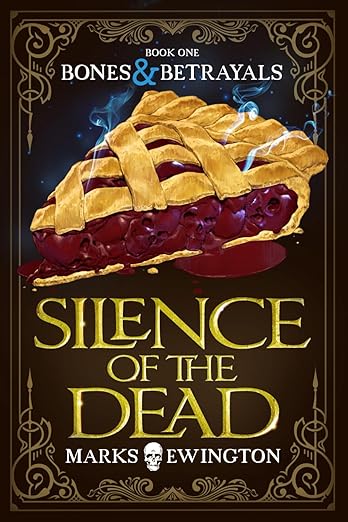
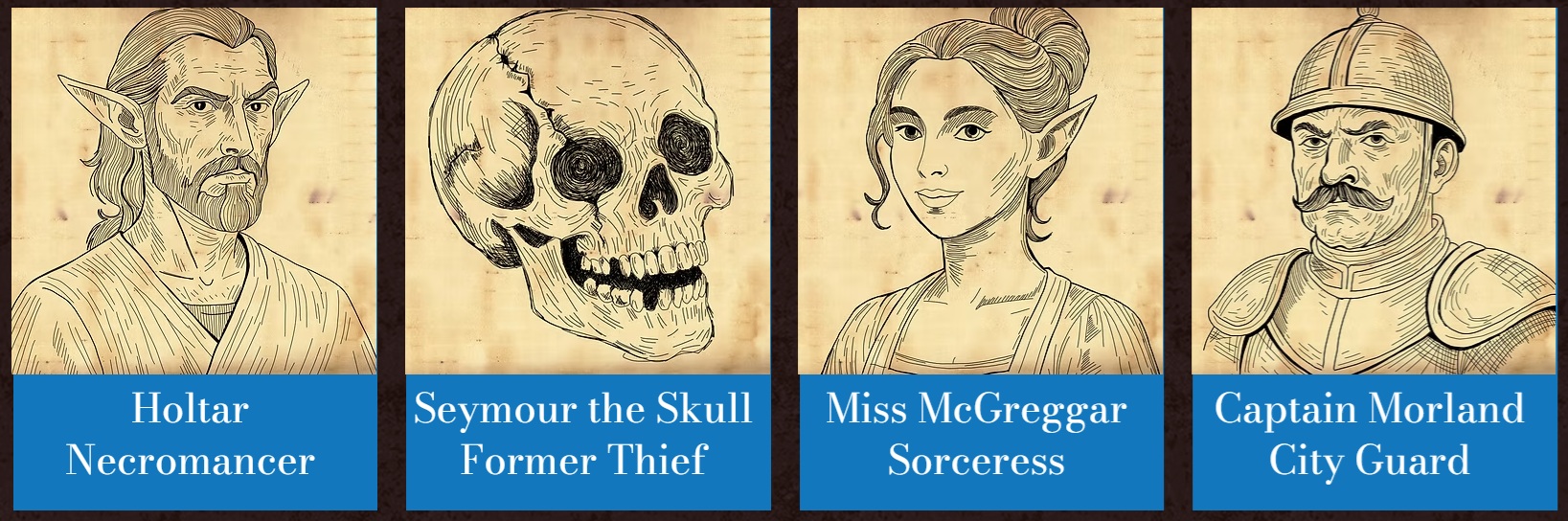
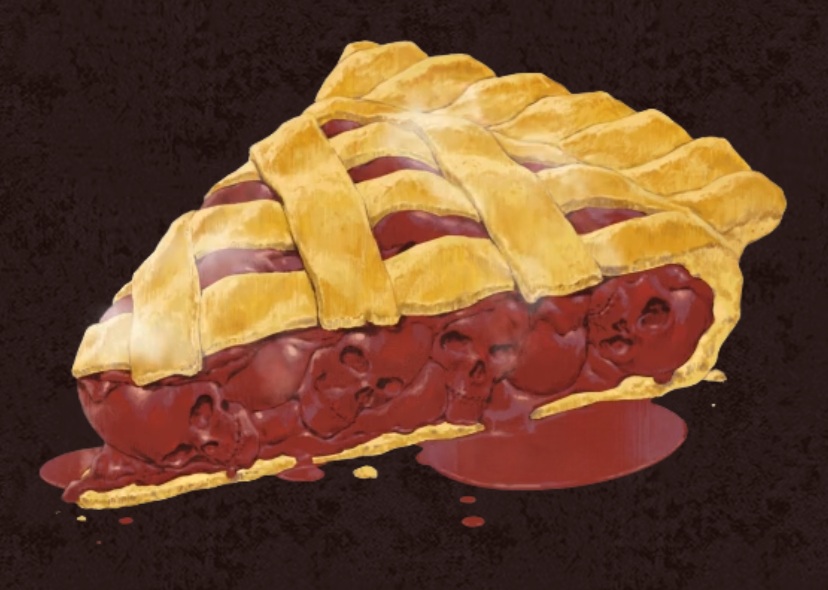
Set in a relatively generic medieval fantasy city setting (Tronte) that could just as easily be the Free City of Greyhawk or Waterdeep, the story involves a Necromancer and his talking-skull sidekick tasked by the city guard to solve a string of baffling murders that all have certain elements in common. The victims appear to be linked in some way to an illicit smuggling trade. Their souls have been removed, making posthumous interrogation impossible. And- perhaps most damning of all- at the scene of each was a pie from the best piesmith in town, Miss McGreggar's Pie Shoppe. Each was missing a bite, and secreted within the pies were a note with a single scrawled word.
With the city guard breathing ever heavily down their neck, Holtar and Seymour must crack the case and unravel the mystery of the poisonous pies.
A Second Chance at a First Impression?
We've all known that person (heck, maybe some of us
are that person). A little socially awkward or uncomfortable, they come into a party and try just a little too hard to make a good impression. In
Silence of the Dead's case, after a pitch-perfect opening chapter (setting up the book's first murder, like any good mystery) it very quickly wore out its welcome with an overload of gags and silliness.
An early example:
Just before dawn, a Barker- one of the most unreliable messengers in existence, known for shouting messages across great distances until the misheard words finally reached their destination- had knocked on his door. The weary man had recited a jumbled summons from Captain Moorland to "come with wands."
Taking the request at face value, Holtar had turned up at the captain's office with enugh magical rods to start a bonfire- only for Moorland to answer the door with confusion etched across his face as he stared at the large bundle of wands under the necromancer's arm. The Barker, it turned out, had meant at once.
Now, not every joke or gag is going to connect with every reader, but it felt the sheer volume of them jammed into these early pages distracted from the narrative Marks and Ewington were crafting. I've read many books that seemed to take themselves too seriously, but it's less often I've found ones I didn't think took themselves quite seriously
enough. Now longtime readers know I don't generally engage in reviewer snark, but amongst my early notes was scrawled "
Temu Discworld...?3"
But then something wonderful started to happen as I continued to read. Going back to the earlier analogy, it was like your slightly-awkward friend had a drink or two, settled into their own skin- and ended up being the life of the party. The gags settled in, better balancing with the narrative arc of the story; the characters themselves had some more time to breathe, and it became a delightfully enjoyable detective story.
Mystery Machine
While I wouldn't consider myself a fan of mysteries- my wife devours Agatha Christie the way I do the Black Library- I imagine there's a linear spectrum of mystery stories where, on the left, you've got "on rails" and on the right "true whodunnits."
"On-rails" are things like the Scooby Doo mysteries, linear arcs where the main characters go (or stumble) from event/clue to event/clue to event/clue until inevitably they solve the mystery. "True whodunnits," on the other hand, are labyrinthine weaves of characters and motives that might require a flowchart to decipher. Which you prefer is a matter of personal taste, but I was happy to see that
Silence of Dead hewed towards the left of the spectrum. It moved along at a solid pace, adding in more characters and suspects and motives as it went, but never so much that you were at a loss as to what was going to happen next.
And that, I suppose, is the true test of a mystery: does it play fair with the reader, and work within the rules the book establishes? A fair mystery is one where the author gives enough to the reader to make sense of the narrative once the 'big reveal' happens. Things, in hindsight, "make sense." (For an unfair one, imagine a murder mystery where, after following an investigation for the entire book, the DNA test comes back and- whoops!- turns out it was some guy already in jail that had never been named or referenced once in the story.)
Final Thoughts
On all counts,
Silence of the Dead is a delightful read. The story's detective duo of Holtar the Necromancer and his talking-skull friend Seymour have terrific comedic chemistry, with the former taking on more of the straight-man role and the skull providing the running gags. Once it hit its stride it became a genuine page-turner, one that provided a breezy and entertaining mystery without getting in its own way. If you found the humor in
Dungeons & Dragons: Honor Among Thieves hilarious (as I did), this one will be right up your alley. And the payoff of the book's central mystery works and plays fair with the reader.
It's also worth noting that it's a great book for younger readers while never making me feel like I was having a "hello, fellow kids" experience reading it. With just a couple of minor editorial tweaks (smoking references, mainly) you could just as easily imagine this on a table at the school Scholastic book fair.
Finally, I couldn't help but think back to
Da Red Gobbo's Last Stand. As I noted in the excerpt from my review earlier I enjoyed the book's restrained humor, but reading
Silence of the Dead made me wonder what a grot story would look like if Ewington took the comedic gloves off. The silliness and gags of
Silence of the Dead was a little overwhelming in the beginning, but the formula worked a charm once it settled in. Hopefully we'll get the chance.
Bones & Betrayals is clearly intended to be a series, and
Silence of the Dead clearly leaves open the possibility of more adventures with Holtar and Seymour.
I hope we get those, too
4.
Footnotes
- "IP tie-in fiction" is the awkward term used to describe stories set in an existing property. The Black Library is IP tie-in fiction, for example.
- Made you look, Ewington.
- In the interests of fairness, allow me here to posit the opposing "Temu reviewer" hypothesis: it wasn't that the book was 'trying to hard' in the beginning, it was that I have marinaded in the grimdark as the overwhelming majority of my fiction reading for so long that it took me a few dozen pages to grow accustomed to the tonal shift. This may well have merit, but you only ever get to read something for the first time once. All the same, the Beyond the Black Library series presupposes the reader is coming from a center of Warhammer and reaching out beyond it, so perhaps it ultimately immaterial.
- In the meantime, there's a free Holtar & Seymour short story available for signing up for the newsletter, as well as Ewington's earlier book in the same world, The Hero Interviews.
Have any questions or feedback? Drop us a note in the comments below or email us at contact@goonhammer.com. Want articles like this linked in your inbox every Monday morning? Sign up for our newsletter. And don't forget that you can support us on Patreon for backer rewards like early video content, Administratum access, an ad-free experience on our website and more.Thank you for being a friend.
 This website uses cookies. Learn more.


 Goonhammer Hobby Round-Up: March 2026
 Goonhammer Reviews: Tribal Conquest
 Conquest: Weaver Courts Gemred Knights and Scaile Dancers Model Review