Anyone who's read the Black Library for any length of time will naturally have found a few writers whose work resonates with them. Have you ever wondered what they're up to outside of the Warhammer universe? I certainly have, and in
Beyond the Black Library we turn a grimy, grimdark eye towards the fruits of the imagination that our authors have been hunched over their desks creating when they're not weaving tales of the Imperium or the Mortal Realms.
In our last feature we looked at
Poison River, a
Legends of the Five Rings mystery story from Black Library stalwart Josh Reynolds (
Lukas the Trickster, Shadespire: The Mirrored City). Today we'll be switching gears into science-fiction and
Sarah Cawkwell's new
Twilight Imperium novel,
Thunder's Edge: Echoes of Memory.
Access Denied
I've written before about the topic of accessibility in IP writing, and it's probably fair to say that the smaller the IP, the more prominent a role accessibility plays. For the Black Library, not only is the lore massive and sprawling, but the consumer market is substantial. As a result, writers to the franchise can usually expect a certain baseline of cultural literacy from its readers.
For instance, how many words are needed in each novel to explain what Space Marines are, or the Emperor of Mankind? Sure some books may perhaps be best appreciated by setting veterans, such as with
Chris Thursten's Abraxia, Spear of the Everchosen (reviewed
here), but in general Warhammer has multiple points of accessibility (tabletop, fiction, comics, video games, role-playing games, television series and appearances, etc.).
Now consider that calculus for
Twilight Imperium. Currently in its fourth edition, the game debuted in 1997 and is published by
Fantasy Flight1. Notorious both for its complexity as well as its lengthy gameplay (six-hour games are
de rigueur), this is a property with a much smaller footprint.
Aconyte Books has to-date published nine novels in the setting, starting with 2020's
The Fractured Void by
Tim Pratt2.
When they forecast their anticipated book sales, how much of that do they assume is from currently-franchised consumers and how much of that is penetration into new readership?
I felt that question acutely as I dove in to Sarah Cawkwell's
Thunder's Edge: Echoes of Memory. This isn't just another
Twilight Imperium book, but rather one that's tied directly to the
Thunder's Edge expansion which released only last month. I came into the property cold, never having played a game of it and largely unfamiliar with anything about the game aside from its highly esteemed reputation with the tabletop community (it's an unsurprising 8.6 on
Boardgamegeek). Would the book have plenty of onramps, or would it be geared at a more experienced audience?
Turns out, it was the latter.
Thunder's Edge: Echoes of Memory presumes a certain amount of lore foreknowledge, with even the universe's different races getting little in the way of backgrounding. If you're going in cold, as I was, you may need to hit up Google a time or three to fully get your bearings and round out your understanding
3. But the good news is, it's not that deep-
Twilight Imperium's lore is fairly accessible on the whole.
The game's universe takes the core fantasy trope of making its races humanoid Earth-inhabitants, such as the mercantile lion-people (Hacan), fungus people (Arborec), lizard people (Ral Nel Consortium), robot people (Titans of Ul)- and of course baseline humans (Federation of Sol). In this I was actually reminded of an older board game I used to play as a kid, 1983's
Shadowlord, which was a space-opera game with along with the humans had all sorts of alien races based on pigs, mice, and weasels- so there's certainly no shortage of precedent.
But it doesn't need to be deep- it just needs to be deep
enough. And none of this is on Cawkwell, who can only work with what she's been given. So how does she do with it?
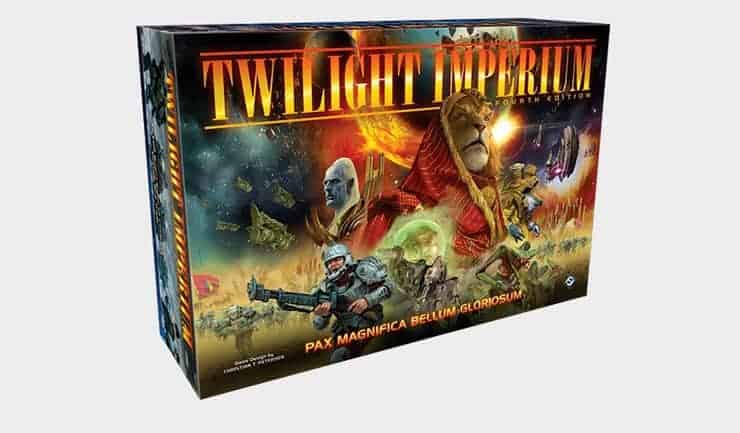 Image credit: Fantasy Flight Games
The Story
It's funny, but while I never could get into
J. R. R. Tolkien as a kid (too dense, too dry
4), so many of the books and saga I greedily devoured followed that same formula: a mismatched (often ragtag) group of heroes of diverse backgrounds coming together to undertake a perilous quest with enormous stakes. I mean, c'mon, tell me that's not half of TSR's catalogue- including the legendary (and much-beloved)
Dragonlance, or (the other property that come to mind while reading this), 1980's
Battle Beyond the Stars.
Cawkwell runs this same playbook in her story of a former Hacan general, Harrugh Gefhara, who must compile a mismatched group of heroes after getting a vision of the end of the world, finding himself in possession of two mysterious artifacts that could unlock the fate of the universe. Along the way he is helped by quirky, unique heroes from all different other factions, but the ultimate decision that must be made is his alone.
Sarah Cawkwell is a veteran of the Black Library with her first novel,
The Gildar Rift, published in 2011 and her final contribution, the short story
Awakened, released in 2020. She is perhaps best known for her well-regarded stories about the Silver Skulls successor chapter (and I was delighted to see a Silver Skulls cameo in
Jonathan Beer's recent novel
Tomb World, reviewed
here), though I also particularly enjoyed 2012's Warhammer Fantasy character story,
Valkia the Bloody.
Ultimately, I found this effort to be a book of two halves.
The first half focuses on the efforts of Gefhara to unlock the mystery of the vision and artifacts placed in his care, acquiring sidekicks like level-ups along the way. Because of the lack of lore onboarding, as an outsider the story struggled to gain emotional traction. Cawkwell writes well enough that I wasn't tempted to put the book down and start another, but at times I had to compel myself to soldier on.
Similarly, there was a bit of a thematic mismatch for a reader steeped in the Black Library. I think sometimes I forget how steeped in Warhammer I've become, to where reading something that's somewhat adjacent (sci-fi gaming fiction) but notably
isn't grimdark is a bit jarring. There's a certain youthful, almost adolescent lightness of spirit that infuses the book, a feeling that was at once both distinct from what the bulk of my modern reading looks like yet echoed the feeling of reading books like the Dragonlance Saga when I was younger.
Characters tease and are silly with each other, and the crushing weights of truly high-stakes emotional adulthood and survival find only surface-level purchase in their depictions. In Gefhara, once the 'Golden General' and leader of the entire Hacan people, you won't find dark musings on how leadership in war means making hard decisions and sending good soldiers to their deaths, nor the kind of soul-deep wear you might expect from someone who's had to routinely make those sorts of decisions. Rather, he's the paladin, an almost-cartoon exemplar of nobility and self-sacrifice.
The degree to which you'll enjoy the book will depend on your ability to enjoy that approach. But when it gets to the second half- Gefhara and his gaggle of allies arriving on the mystery planet where the book's mysteries begin to resolve- everything starts to click and it's an absolute blast.
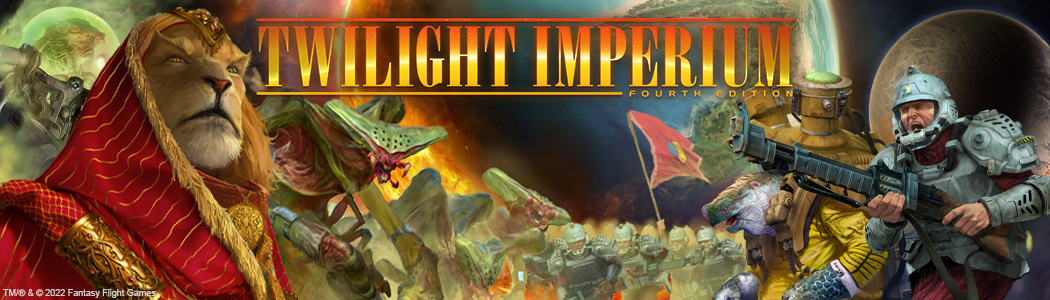 Image credit: Fantasy Flight Games
The Back Nine
If all that sounded a bit negative, note that the
Beyond the Black Library series is aimed at folks who, like me, are regular Warhammer readers who might be considering dipping into other IP's because the writers we've enjoyed are doing the same. The chances of me reading a
Twilight Imperium book are fairly modest unless I'm wanting to see how a Black Library writer tackles the setting
5.
There's not a thing wrong with the lighter tone of non-grimdark fiction. Indeed, I imagine for many
Twilight Imperium fans the first half of the book would have been significantly more enjoyable than I found it, filled with lore and references they understand without needing to pull up their phones and head to Google.
But regardless of your level of lore foreknowledge, once you arrive at the book's second half you've got more than enough to appreciate the story as the action picks up and the mystery unfolds. Beyond that- the part that made it fun- was Cawkwell's ability to write sympathetic and enjoyable characters. I may not have started the book with much of an understanding of them, but she still manages to breathe a great deal of personality into her characters which makes for delightful reading.
From the almost-innocent robotic titan 'Junior' to the techno-mercantilist Izt, the irrepressible Suffi An to the more stoic Connor, and the crew of the
FSS Orlando, Cawkwell's story was enjoyable but it was the players who stole the show. There's a lot of heart in this book- Cawkwell's affection for her characters is apparent- and once it comes together it keeps you well-invested until the end.
To the editors at Aconyte, I'd encourage you to take a page out of the Black Library playbook and incorporate a sort of boilerplate introduction and dramatis personae in your stories. A simple, two-page reference section noting the different races that populate the world of
Twilight Imperium would have made a huge difference.
Here, for instance, is the in-game bio for Harrugh Gefhara:
The former Quieron created a galactic financial network, enriching all who participated in it. Especially the Hacan, who quietly retained control of their creation.
Short, simple, but illuminative. For a smaller property with fewer avenues of accessibility, the better bet is to assume that not every reader coming to your world is intimately familiar with it.
Overall, this book is best situated for readers who are already fans of
Twilight Imperium, but there's enough here to make a few new fans along the way. If Aconyte commissioned a follow-up book with Gefhara, Izt, Junior and the gang (which they should), I'd find it a snap-buy.
Footnotes
- Fantasy Flight's founder, Christian Peterson, was the sole designer of Twilight Imperium's first edition.
- Two of them, Empire Falling and Empire Burning, were notably written by Black Library veteran Robbie MacNiven (Oaths of Damnation, Void Exile).
- To be clear, I consider this an editorial choice, not a writer's one. If Aconyte wanted a book that took the time to fully onboard the new reader, that's entirely their prerogative and Cawkwell would have delivered. Ultimately, what goes to print isn't up to the author, but rather the editor.
- Hey, I was a kid. My appreciation would come later.
- That's not a knock on Twilight Imperium at all, nor quite so stark a line for some of Aconyte's other properties. Having writers like Josh Reynolds and Evan Dicken writing Legend of the Five Rings is like chocolate and peanut butter, and I haven't even gotten started on the crazy bench depth they've assembled for Arkham Horror. David Annandale's The House of Night and Chain was not only an extraordinary audiobook, but it set a very high bar for what he's capable of in that space. It's mainly that as a principal book reviewer for Goonhammer my dance card stays pretty full.
Have any questions or feedback? Drop us a note in the comments below or email us at contact@goonhammer.com. Want articles like this linked in your inbox every Monday morning? Sign up for our newsletter. And don’t forget that you can support us on Patreon for backer rewards like early video content, Administratum access, an ad-free experience on our website and more.Thank you for being a friend.
 This website uses cookies. Learn more.


 Infinity N5 First Principles: Understanding the Outcomes of Face to Face Rolls
 Tactical Feedback: Timing the Go-Turn
 SRM's Roundabout to Adepticon 2026: Curd Is the Word