Christmas came early in Georgia this year, with the second annual Toys for Tots charity BattleTech tournament at Level Up Games in Duluth, GA (which was properly air-conditioned this time around!). Circumstances pushed this Yuletide celebration up to Saturday, October 4th, and your Atlanta-based BattleTech tournament correspondent was there in the thick of it. I'm happy to bring you another report on the action!
While this was a charity tournament, it was not fully silly season. Unlike charity tournaments for other systems I’ve seen discussed here, there was no opportunity to give more to the charity in exchange for rerolls or abnormal power ups or anything; it was a competitive tournament with fairly generous prize support. That said, the spirit of the season was certainly present, as you will see.
Toys for Tots 2025 was a one-day, three-round, 23-player (with one of the Co-TOs playing to fill out twelve tables) Classic BattleTech tournament compliant with the guidelines of MRC (MechCommander Review Circuit) Season 5. Civil War era, 8k BV, 2-6 units, piloting and gunnery within two of each other. Maximum of two of the same chassis for mechs (must be different variants). Vehicles were capped at two total, ditto for Battle Armor, but CVs and BA could be the same variant if desired. No aerospace, conventional infantry, on-board artillery, mines, or mortars. VTOLs were allowed, but had to land to contest objectives. Mech equipment was limited to what’s in the BattleMech Manual, vehicle and battle armor equipment was limited to what’s in Total Warfare.
The optional rules in play got shuffled up again: One-Armed Prone Fire, Floating Crits, Expanded Damage Modifiers (PSRs scaling with damage 40+), Careful Stand, Enhanced Flamers, Front-Loaded Initiative, and the biggest change… Engine Explosions. Yes, Stackpoling was enabled for this tournament (and, I learned, is actually recommended by the MRC this season, for some ungodly reason).
As mentioned in
my Summer Fever II report, BSP Strikes remained in play for this event (flavored as “Robot Santa Strikes”), with 30 BSP available and no support option being able to be taken more than once.
Missions were again revealed at the event, and scoring included a significant extra wrinkle this time. In addition to each mission having its own unique primary objective(s) and a “combat score” based on enemy units crippled and destroyed being tracked (a requirement of the MRC), an additional secondary objective set of “feats of strength” was added, inspired by video-game-style achievements. Primary score capped at 100, with Feats of Strength and Combat Score able to contribute up to 50 points each, for a maximum of 200 points scored in any given round.
I’ll hold my full commentary on the secondary point scoring system until later, but it should be noted that it strongly favored increased Piloting by rewarding physical combat, and this wasn’t revealed until after lists were due, which proved a thorn in the side of some lists (mine included).
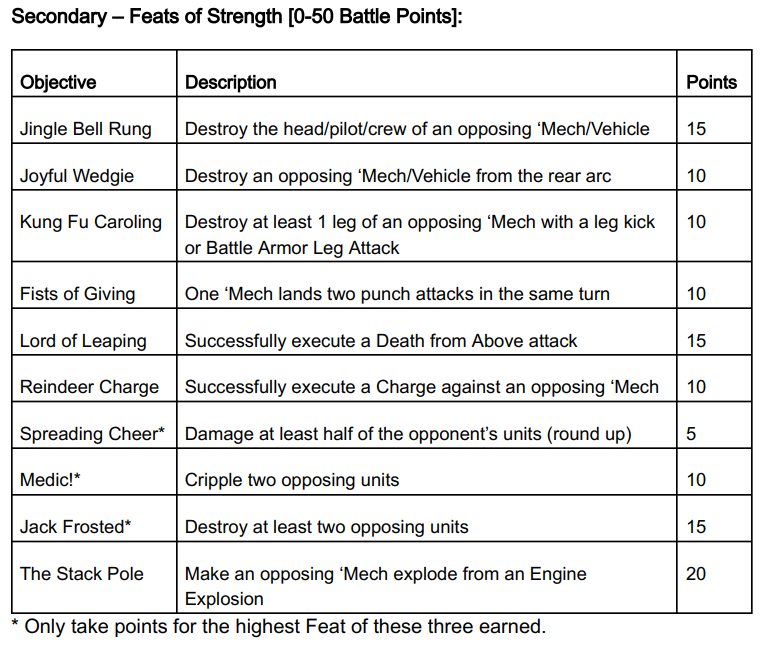 It is technically possible to max out secondary points without any of the physical attack achievements, but it’s not likely. Table Credit: Scott "Clamps" Grill
The List
I actually prepared for this tournament! While my prep work still isn’t on the level of Liberty and Peri, I got a decent number of practice games in, and did some theory-crafting with Goonhammer Discord friends. I want to give a particular shout-out to Tentacle, who I persuaded to come all the way down from Virginia for this tournament; he was a great help in practicing and refining my list concept.
I was committed to the Free Worlds League for this tournament (after having gone Nova Cat during the last Civil War Era tourney), my list concepts revolved around a fairly small number of potential chassis, and I attempted to preference mechs whose miniatures I already own, but even within those constraints I considered a wide range of options. Eventually, though, I landed on a list which contained a mix of mechs I liked, satisfyingly filled 8k BV exactly, and (sort of) survived Tentacle throwing a list with an Iron Cheetah B at it in testing. After just a bit more hemming and hawing, I locked it in. That list was…
Kingfisher Prime (2401 BV at 4/5): The brave lasses and lads of the First Free Worlds Guard didn’t die in Perium Swamp for nothing when they fought the Great Refusal, and I decided early on to anchor my force with a Clan Assault Mech. It’s hard to say no to a big tough pile of efficient guns, and with forced withdrawal not in effect during this tournament, I knew that a Kingfisher, even one with a torso ammo bomb, would take an obscene amount of killing to put down.
Hercules HRC-LS-9001 (1566 BV at 4/5): The oddball pick of my force, I viewed the Hercules as a sidegrade on my beloved Gargoyle Prime (which is 1537 BV at base). The Hercules sacrifices ten tons of physical combat ability, doesn’t have the option to take Inferno SRMs, and gives up a non-negligible amount of durability with slightly thinner armor and an Inner Sphere XL engine, but it moves the same speed and bumps up its offense to a significant degree with an LB/10, an ERPPC, two Streak SRM-2s, and an MPL (plus, uh, two rear-mounted SPLs to mildly inconvenience short-range backstabbers). It will abruptly cease to exist if any of its three tons of ammunition explode, but it can put in good work.
Orion ON1-MA (1501 BV at 4/5): A mainstay of my forces, the ON1-MA is a solid chunk of machinery, if a bit unexciting. It does Orion things well, as long as it doesn’t evaporate in an ammo explosion. (Sidebar, but the much-maligned Inner Sphere XL engine actually makes side torso ammo safer than un-padded, un-CASEd ammo like the ON1-VA’s left torso bomb, simply by virtue of shoving more non-explosive crits into the torso.)
Wraith TR1 (1287 BV at 4/5): My early builds pinballed back and forth on what to use as the fast objective-grabbing element of the force, with the Venom 9KC, Spider 8M, and Tarantula 3A all strongly in consideration, but I ultimately decided to go quality over quantity and tapped the dependable TR1 as a BSP-proof objective runner.
Ostsol OTL-5M (1245 BV at 4/5): This mech is an absolute steal at its BV, and offered a great way to fill out my force. It’s not the fastest, toughest, or toothiest mech around, but it’s got a great balance of attributes, and even its short range isn’t as big a drawback as it initially seems to be, since its Large Pulse Lasers are as accurate at 10 hexes as a non-pulse weapon would be at Medium range.
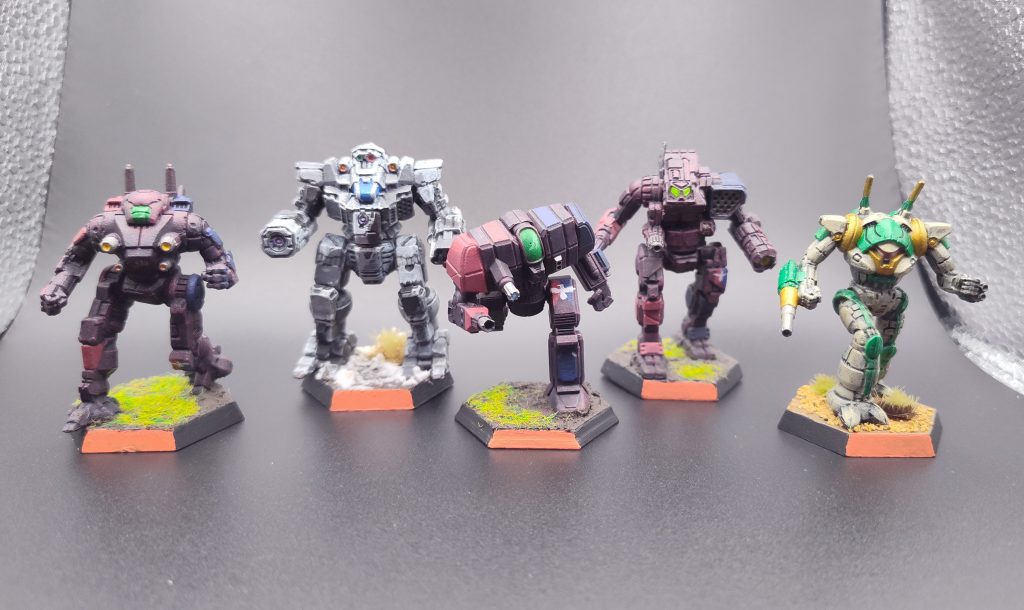 Yes, I did paint them myself this time! Photo Credit: Lynn C.
The idea was to present a force in which every unit could hold its own, without an obvious weakest link to pick on, and with killing power sufficiently distributed for my game-plan to survive an early headshot. Piloting 5 is
unfortunate when playing with expanded damage modifiers to PSRs, but I’ve kind of gotten used to playing around the knowledge that my mechs are going to fall down at inopportune times, and I’ve also found that Piloting 4 isn’t really sufficient to make them reliably keep their feet, either. That said, had I seen the secondary objective list in advance, I definitely would’ve invested in Piloting.
My goal for BSP in this tournament was to actually use all my support in every game, and to that end I decided to just commit fully to offense: One Light Bombing and one Heavy Strike, simple as that.
I originally planned to take a ton of Infernos on the Orion; one SRM-6 doesn’t do too terribly much heat with Infernos, but the ON1-MA handles its own heat well, and I figured they might come in handy in a pinch; unfortunately for me, no mech could carry more than one type of specialty ammo, and the TO counted Artemis IV as a specialty ammo, so I had to commit to all Art-IV so that my regular damaging missiles could function properly. I was, at least, able to bring both solid and cluster rounds for both of my LB-10X ACs, and I got a good amount of use out of the solid shot this time around.
The Event
I realized the night before the tournament that I’d forgotten to get a gift for the Toys for Tots donation, and I didn’t really want to just gift money, so my first order of business in the morning was to swing by a Walmart on my way to the game store to grab a Monster High doll. As it turned out, most of the players this time around just donated cash, so the toy donation crate ended up looking a bit lonely, but it was still a significant charity haul on the whole. (Over $250 raised!)
Per tradition, there were goodie bags for all players, and this time around the nicest of the freebies had an important function: Everyone got a 3D-printed, magnetized 000-999 counter which would be used to track damage counts for the primary objectives in both Round One and Round Two. This time around there was also a full set of 3D-printed objective tokens to take home for each player for each mission, rather than each player getting a half set of objective markers like at Summer Fever II, which was a generous touch.
Round One: Operation Naughty or Nice
This round and round two both used the six-hexes-in-from-the-short-edge deployment zone that was used at Summer Fever II to get players into the action more quickly. The premise for this round was that we needed to impress Robot Santa by demonstrating our capacity for violence through the medium of
attacking his sleigh. Robot Santa’s sleigh counted as a VTOL with 7 MP flying at elevation 6. At the start of each turn, the loser of the initiative roll would roll on the Facing After Fall chart to determine Santa’s initial direction of travel. He would start moving in that direction without needing to pay MP for turning, but would need to expend MP to change facing twice to head back towards the middle of the board if he bounced off of one of the long edges of the map or off the players’ deployment zones. Many of us missed the detail that he would bounce off the deployment zone rather than continuing all the way to the short edge of the map; this was meant to be the factor keeping Santa from going too deep into one player’s territory, but it wasn’t communicated especially clearly. This apparently did cause issues in some players’ games this round, though it didn’t become relevant in mine.
The player who dealt the most damage to Santa in any given round would win the primary objective for that round and receive 15 points. This was the
only way to win primary points on this mission, so maxing out on primary points would mean playing at least seven rounds of BattleTech. No damage to Santa carried over between rounds.
Winning the primary objective not only got you points, it also gave you a randomly-rolled “gift” off a 1d6 table, with “nice” bonuses for one of your units or “naughty” penalties to your opponent’s units. These effects ranged from penalizing the targeting of one of your opponent’s units for a turn to gaining additional heat-sinking capability on one of your own mechs, and more besides, but as luck would have it, in every single turn we played in this game the result was a 4: “Jingle Jets” granting +2 Jump MP to a mech or BA.
I was paired into one of our community’s youngest players, the son of WarZone ‘25’s winner, for this round. He’d brought a ComStar list tooled for objective play, able to boast an enormous amount of speed. He was running, as best I can recall, a Mercury 99, a Hermes 4S, an Omni Firestarter in the pulse-heavy B configuration, and the Shadow Hawk Ht, plus a Royal Black Knight and Highlander 732, all at 4/5.
We were on the lunar battlemat for this round, and I’m EXTREMELY pleased to report that my complaint from Summer Fever was noted and the added 3D elements all had their hexes delineated this time around.
I did a poor job of taking photos during this round, with multiple pics taken at the start of movement rather than at its end, and one movement status quo entirely skipped, so I’ve had to do a bit of reconstruction of this narrative, however, I think I’ve got events in the right order.
Santa’s initial move saw him heading straight to the “south” of the map from my perspective. While I’d spread out my deployment to a degree, I’d biased in the opposite direction, so my Wraith was the only thing particularly close to Santa. I started racing in that direction, but didn’t have great shots onto the objective, while he was practically able to teleport his lights onto the objective. I decided to focus on his Firestarter with my Kingfisher and Wraith, hoping to take it out early; it took significant armor damage, but nothing critical. My opponent didn’t land too terribly much into Santa through his +4 TMM, but the only thing I had firing at him was my running Hercules at Medium Range, and even with the power of Flak on my side, he won the trade, scoring him the primary objective for the round and starting me off on the back foot.
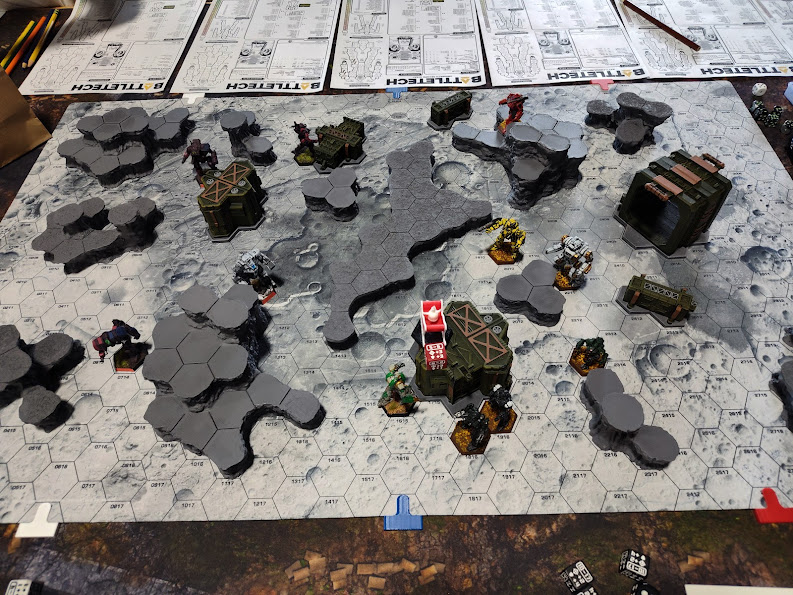 These are the positions of our mechs from the end of the first turn, but Santa is in his vulnerable second-turn position. Photo Credit: Lynn C.
In Turn 2, Santa “bounced” off the southern side of the map, leaving him on a +3 TMM, and I got myself into position to properly unload on the objective, while my opponent repositioned his lights to backstab my Hercules (with the Jingle Jets he won off Santa allowing him to land the Firestarter directly behind the Herc with a mighty eight-hex jump). The Herc lost its ERPPC, but I won the primary race by an enormous margin, scoring 108 damage against Santa while my opponent only landed eight.
In Turn 3, Santa broke straight north, carrying him close to my Ostsol and Orion, who were still hanging out in that part of the board. My opponent’s Shadow Hawk was also in the vicinity, but his Black Knight and Highlander had chased hard to the south and were suddenly well out of position, and my own Hercules wasn’t in the best spot, either.
I made the decision to focus my Hercules, Orion, and I believe Ostsol into Santa while hunting his Black Knight with my Wraith and Kingfisher. My opponent’s Firestarter kept hunting the Hercules, angling for a head kick, while the other lights ran after Santa. In what I believe to be a critical mistake, he jumped the Shadow Hawk adjacent to Santa when he could’ve gotten there at a run or maybe even a walk; this, plus Santa’s range from the Highlander and Black Knight, significantly reduced his DPS into the objective, and I won primary again, if only by a hair (21 damage dealt vs 17 from my opponent) to edge into the lead.
I had a boneheaded lapse in my recollection of the rules in this round and I wish to apologize to my opponent, though I don’t believe it directly influenced the results of the game. His Black Knight failed its PSR and fell as a result of the damage it took in this round, and I had a total brain fart and quoted kick damage (tonnage/5) as the total fall damage instead of punch damage (tonnage/10). His Black Knight would fall again in the next round on its first attempt to get up and would again be assigned too much damage; in total it took 14 points of damage that it should not have taken, and I know the falls were a source of significant frustration to my opponent to begin with. As I recall, the only critical damage taken by the Black Knight was to its ERPPC, which it never fired in the course of the fight anyway (my opponent very naturally favoring the Large Pulse Lasers), and it did not count as crippled at the end of the game, so I didn’t get any points out of the damage it took, but it’s still shitty that the adult he was playing, who styles herself as well-versed enough in this game to write articles about it, confidently misquoted a very basic rule in a way that disadvantaged him.
None of us are perfect, we all make mistakes, but that was a lousy one to make. I am truly sorry, and I’ll work to be sharper next time.
In Turn 4, Santa steered towards my deployment zone, taking him even further away from my opponent’s biggest damage dealers, and he struggled with defeatist thinking. He pinned his hopes to the Feats of Strength, banking on landing a DFA on my Orion with the Firestarter for secondary points, and I angled my Ostsol to try to punch his Highlander in a Hail Mary to keep his secondary points from outpacing me
too much. Unfortunately, his struggle against pessimism, especially in the face of the Black Knight’s second fall, slowed our play in this turn and resolution of the shooting phase spilled over the official end of the round; the TO asked us not to proceed to the physical phase.
In spite of my opponent’s plan for a Secondary-based comeback not seeming to be in the cards, he very, very, very nearly won anyway. Santa’s position was actually even worse for my slower force than it was for my opponent, particularly since I didn’t send my Ostsol chasing after Santa; I had only my Orion and Hercules shooting at the objective, while my opponent was able to get his Mercury, Hermes, and Shadow Hawk all into position. My dice luck proceeded to be atrocious and I missed almost everything, including both of my LB 10-X flak attacks. I landed only ONE Hercules Streak SRM onto Santa, for a grand total of four damage dealt.
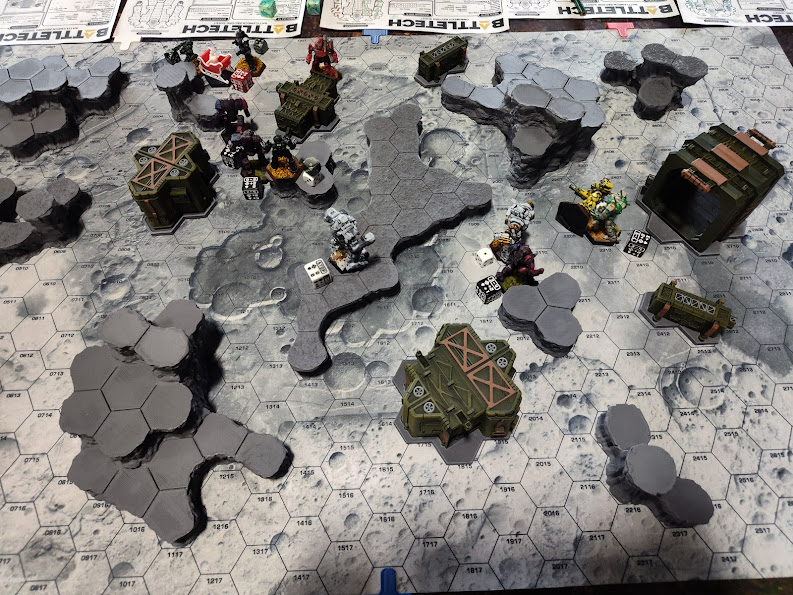 This is where we ended up after our last turn’s worth of movement. Note my opponent’s position much closer to Santa than my trailing Hercules and Orion. Photo Credit: Lynn C.
All my opponent needed to do was land a single medium laser on Santa to beat me on the primary. I had also failed to cripple his Black Knight despite pouring the Wraith, Ostsol, and Kingfisher into it,
and had only damaged his Firestarter and Black Knight so I didn’t qualify for even the “Spreading Cheer” achievement… while he
had qualified for Spreading Cheer. Thus, if I lost primary, I would lose the entire game.
It all came down to a scarce handful of rolls from running mechs with 4/5 pilots against a +4 TMM target, and… he whiffed. I won the game, by the sparest of margins possible, with a final score of 45 to 20.
First off, kudos to my opponent for showing incredible growth as a player from when I first met him at WarZone. I frankly underestimated him, and I probably would’ve lost this game if he hadn’t been quite as jump-happy with the Shadow Hawk and Highlander and got their firepower on target more often. His focus on fast objective grabbers was perfect for this scenario packet, and he bounced back from his first-round disappointment to win both his other games and place 10th overall. This round was honestly a very good reminder to put prejudices aside and take every opponent seriously.
Incidentally, after my dramatic vow to not forget my BSP during this tournament, in this round… I forgot to use my BSP, and my opponent didn’t use his, either. Whoops. ^_^; It really could’ve made a meaningful impact on the Santa damage race, too.
I wasn’t a big fan of this scenario, though Tentacle had a great deal of fun in his own game. The tension between shooting the objective and shooting your opponent should’ve raised interesting challenges, but in practice it felt like it discouraged interaction between the players. I’m told one table went the entire round without firing a single shot at each other, pouring all their fire into Santa every turn. This was also another randomly mobile objective which could favor one player over the other through sheer luck… these missions seem popular with BattleTech TOs, but I do still prefer something more symmetrical.
The hour between Round One and Round Two was our intended lunch break. My now-traditional peanut butter sandwich left me plenty of time to check in with other players and chat about the previous round. I got more involved in the social side of this tournament than I have in previous outings, and it was really nice. It’s fun to shoot the shit with nerds of a similar flavor, who would’ve guessed?
Round Two: Operation Siege of Christmasworld
This Nightmare-Before-Christmas-inspired scenario saw the players stepping into the role of the warring forces of Christmas and Halloween. The hybrid primary objective saw our forces trying to destroy an objective building defended by our opponent (Santa’s Workshop on the Christmas side and the Mad Doctor’s Laboratory on the Halloween side) and also pick up and hold objectives scattered across the map (Present Piles on the Christmas side and Pumpkin Patches on the Halloween side).
The objective buildings were one-level-tall CF 120 buildings with a special rule meaning that attacks targeting them only received a -2 modifier to their TN instead of the full -4 for an immobile target. Unlike the similar objectives at WarZone, these could be stood upon and explicitly followed usual building rules for collapse and for taking AE damage. Their location was loosely fixed to hex 0909 and hex 2309 of one of the neoprene battlemats, but with a rider shifting them up or down the 09XX / 23XX rows if their default starting location wouldn’t be visible from hex 1609 at the center of the board (this affected the position of Santa’s Workshop in my game). Destroying the objective building defended by your opponent offered 55 points towards your primary score.
The Pumpkin Patches and Present Piles could be picked up by any unit which ended its movement in their hex and wasn’t crippled or knocked down by the end of that turn. There was no restriction against jumping into the objective hexes, and no restriction against shooting for units picking up the objectives. If a unit carrying one or more of these objectives was crippled, it would lose control of the objective if it failed a PSR at a +1 difficulty; if it was destroyed, the objective was automatically lost. Dropped objectives did NOT remain in play for other units to pick up, they were instead lost forever. These objectives were placed on the map by the players who would be trying to collect them (i.e. the Christmas player placed the Pumpkin Patches on their opponent’s side and the Halloween player placed the Present Piles on their opponent’s side). They could be placed anywhere between their defending player’s deployment zone and the center row of the board, in theory, though the restrictions that they had to be at least six hexes distant from each other and separated by at least two empty rows between them meant the actual locations for placement were significantly limited. Each of these objectives was worth 15 points if held at end of game.
As the lowest-scoring victor out of all of the Round One games, I got paired down into a man who lost his first-round match, Bill S. I don’t normally name names in these reports, but I’m doing so this time because I want to highlight what a tremendously fun opponent Bill was. He was gracious throughout, generous about letting me walk back a couple of bone-headed moves (e.g. when I realized that I’d put one of my mechs in head-kicking range of his Nightsky the moment after I set down its movement die), took rules reminders in stride, and offered me a fantastic challenge in a fun, back-and-forth game. I’d be happy to play him any time!
Bill was experimenting with his list, trying to gauge if real-world armored cavalry tactics could be successfully applied to BattleTech. Accordingly, he’d favored the Speed and Guns axes of the famous Speed/Guns/Armor triangle, and skewed elite for his pilots: he was running a Flashman (I believe the 8K), Nightsky 6T (the one with TSM), a Blitzkrieg 3F, and a Stealth (I believe the 2D). I thought I recalled the Blitzkrieg pilot being at 3/3 and everything else being at 3/4, but the Stealth may have been 3/5 to make the BV math work out (or the Stealth was a 1D variant and the Nightsky was 3/3, which would also make sense).
Incidentally, the bare-primer Phoenix Hawk in my photos of this game was the stand-in for Bill’s Stealth… he had an actual Stealth mini ready to go, but sadly his cats decided to make a toy of it the night before.
During deployment, Bill spread his lance pretty evenly across the board, while I weighted towards what was, from my perspective, the “south.” LoS issues had shifted Santa’s Workshop that direction, he’d placed two of the three present piles to bracket the plateau in that section of the map, and I’d placed the closest of the pumpkin patches down there as well. Only my Kingfisher deployed in the “north,” opposite his Stealth and Blitzkrieg.
Turn one largely saw us jockeying for position. In the positive column, I was able to land some early damage on his Blitzkrieg with the Kingfisher, but in a remarkably bone-headed move, I put my Wraith in the wrong hex, guaranteeing that in turn two the pumpkin patch it was angling towards would be
six hexes away rather than the seven-hex jump and sweet TMM +4 I craved.
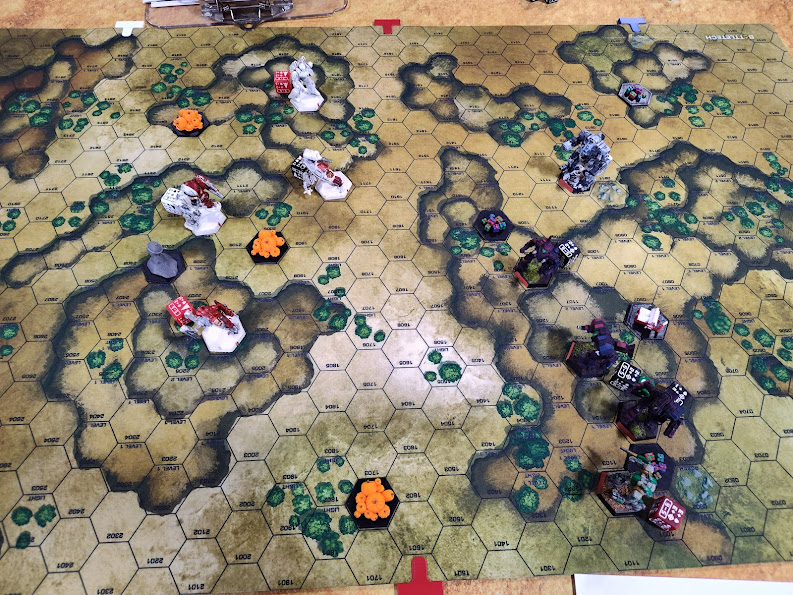 Turn one movement, feat. out-of-position Wraith. Photo Credit: Lynn C.
In turn two I angled my Ostsol, Orion, and Hercules to provide cover fire for the Wraith’s objective run, but I chickened out in the face of the oncoming Nightsky and Flashman and jumped the full seven hexes into woods rather than going for the pumpkins. The Blitzkrieg made a run on my Kingfisher, which had shifted towards the center of the board and taken up a position guarding the middle present pile, while his Stealth made a cautious run up the northern edge of the board, angling towards the topmost present pile. I put more damage into his Blitzkrieg (with it missing its shot against the Kingfisher in return), and we traded shots in the brewing melee in the south, but nothing too consequential happened. The Nightsky did, however, reach TSM heat off its backstab attempt on the Wraith, which made it an existential threat to everything in that part of the board going forward.
Turn three saw my Wraith bugger off to capture pumpkin patches that DIDN’T have overheated axe-wielding maniacs next to them. The Orion clambered into heavy woods to overwatch the Flashman and got a Nightsky in its rear arc for the trouble, and my Ostsol maneuvered to introduce said Nightsky to its pulse lasers. The Hercules and Kingfisher held their defensive positions while the Blitzkrieg angled towards Santa’s Workshop, the Stealth drew ever closer to the northern present pile, and the Flashman advanced on my Orion.
The Orion took a savage beating this turn which either removed or very nearly removed its left arm (during which I learned that the ON1-MA variant’s LRM-20 is actually technically in said arm, not in the left torso!), and it very much fell down, but it didn’t lose anything too critical. My opponent decided to ignore the objective building and double-tapped my Hercules with its U/AC 20, knocking it down as well, but only penetrated its armor on its pulse laser arm and didn’t hit anything critical. Meanwhile I sunk quite a bit of fire into his Flashman and some into the Blitzkrieg and Nightsky, but again didn’t hit anything particularly vital. My Wraith picked up a pumpkin patch and put a little bit of damage onto the Mad Doc’ Laboratory, but I was, frankly, too scared of his mechs’ ability to angle for good shots to divert the heavy firepower of something like the Kingfisher towards the objective building instead of his lance. It would’ve been a different story if the Blitzkrieg or Nightsky died, but with them still active I had angrier fish to fry…
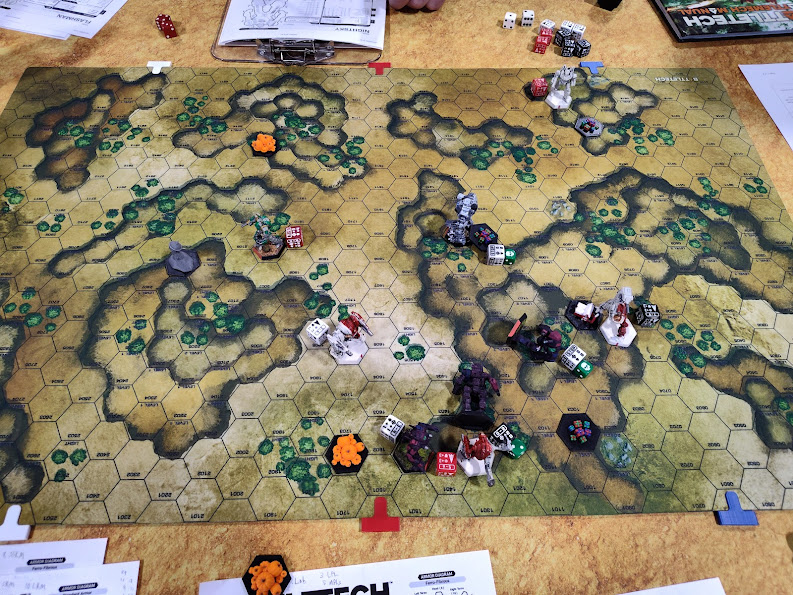 My Hercules and Orion spent plenty of time lying on the ground in this game. I’ll also note my Kingfisher is standing on top of the middle present pile. I couldn’t find anything in the packet saying I couldn’t do that to deny access to my opponent, but I did feel a bit scummy about it. Photo Credit: Lynn C.
In turn four his Stealth finally reached the northern present pile and his damaged Blitzkrieg ran onto the southern present pile while my Wraith jumped to the northernmost pumpkin patch. My Orion and Hercules carefully stood and turned their guns on the Blitzkrieg, while the Kingfisher turned to include the Stealth in its fire arc and the Ostsol angled on the Flashman, again ignoring the dangerously-well-covered southern pumpkin patch in favor of entering woods. His Nightsky entered the Ostsol’s rear arc.
We both unloaded our BSP in this turn, but one of my strikes got countered and the other missed, while he strafed the Herc and Orion and only hit the Orion for negligible damage.
I put my Orion and Hercules into his Blitzkrieg and, after a lot of hemming and hawing over whether to shoot the Flashman with the Kingfisher and try to kill it or try to knock down the Stealth and prevent it from capturing its present pile, I focused on the Flashman with the Kingfisher and Ostsol.
The dice said “no” on me killing the Blitzkrieg, amazingly, though I savaged it and scored a crit on the U/AC. The Hercules ate another 20 points of damage in exchange, but it went non-critcially internal on the LB/X arm and achieved little. The Flashman suffered Death By Inner Sphere XL Engine, while the Orion fell over again and the pilot failed her seatbelt check this time and went unconscious off of the resulting pilot damage. Finally, after opening up the back of the Ostsol with its lasers, the Nightsky put its TSM-enhanced hatchet through its center torso, killing it outright.
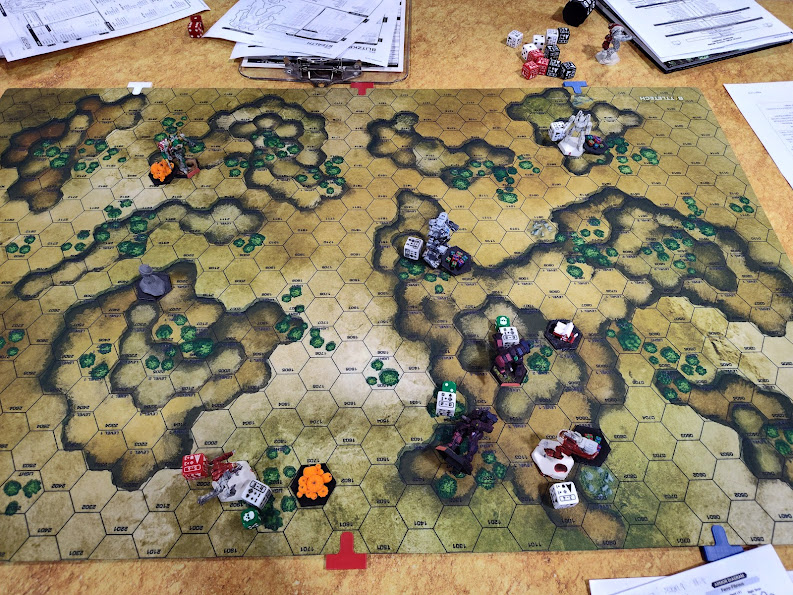 After the killing was done. The Blitzkrieg didn’t even have the decency to fall over after my attempt to kill it that last turn! Photo Credit: Lynn C.
When it came to scoring, we each claimed two present/pumpkin objectives (though in retrospect his crippled Blitzkrieg shouldn’t have been able to pick up its pile!), we each had the Spreading Cheer secondary, and he’d gotten Joyful Wedgie by killing the Ostsol from behind, but my combat score was high enough off my one-kill, one-cripple vs his one-kill, zero-cripples (as both the Orion and the Hercules narrowly avoided the definition of crippling damage used in this tournament) I was able to pip him to the post with a score of 55-50. (55-35 without the erroneous present pile scoring, which might have actually moved Bill down one spot in the final rankings if I understand correctly how the rankings were done, but the difference between 17th and 18th place isn’t all that vital.)
This was, again, a fantastic game. Even though I had a significant advantage in tonnage, armor, and even overall firepower here, all of Bill’s mechs were fully capable of punching up with good positioning, and he absolutely kept me on my toes. Quite possibly the most fun I’ve yet had in a single game of BattleTech!
In retrospect, destroying the objective building would’ve been worth as many points as I scored in this entire game, so I probably should’ve prioritized it more, but I think our semi-formal gentlepersons’ agreement to focus on killing each other was a good part of what made this game as fun as it was.
The “Force Parade” happened between rounds two and three, so a good chunk of my break was taken up with trying to maneuver between the tables to capture decent photos of everyone’s forces while all the other players were trying to get a good look at them, too.
Round Three: Sleigh Team Tryouts
This mission was
difficult to explain, but worked pretty well once the explanation clicked (with a couple caveats I’ll discuss). I’m going to lead with the deployment diagram, as I think it’ll make it a lot easier to understand.
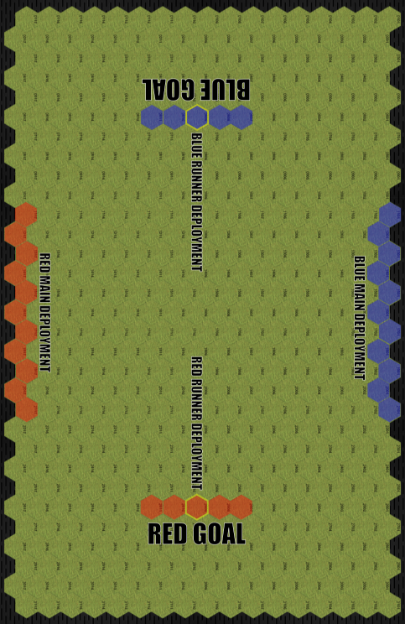 The scenario packet was nicely illustrated, which helped make a lot of aspects more clear; kudos to the organizers on that point. Image Credit: Scott "Clamps" Grill
BattleTech
deployment, long edge vs short edge, is a common source of good-natured argument on the Goonhammer Discord server, with Perigrin in particular championing long edge deployment. This round was, to my knowledge, my own meta’s first flirtation with the long edge, though only most of our forces deployed there, and we were limited to an eleven-hex length of that edge,
guaranteeing violence from the starting gun.
This was in service of playing… American football, sort of. One mech from each team had to be nominated as their “runner,” starting the game in a special deployment zone at the center of this tournament’s usual six-hexes-in-from-short-edge position. The runner started the game holding your team’s present sack. The goal of the mission was for your runner (or another mech, if the initial runner handed off the sack or was destroyed) to reach the opponent’s goal and then, if possible, travel back to their own goal, scoring additional points for making the return trip.
A mech carrying the present sack couldn’t use any jumping movement, though it could otherwise fully engage with the game, shooting, making physical attacks, etc. They wouldn’t be able to score the goal if they were crippled, but also wouldn’t drop the sack upon becoming crippled. By forfeiting their physical attack, they could choose to drop the sack, pick it up from their hex if it was previously dropped, or pass it to an adjacent friendly mech who also didn’t make a physical attack that phase. A destroyed mech would automatically drop the sack in the hex it previously occupied.
After successfully passing through the goal the runner would no longer be burdened by the sack, and could jump on the return trip if they wanted to, but if the mech that scored the initial goal was destroyed, the scoring potential of the return trip was completely lost.
The primary points for this mission broke down as follows: 50 points if you reached the goal before or on the same turn as your opponent, 40 points if you reached the goal after your opponent, 50 points if you completed the return trip before or on the same turn as your opponent, 40 points if you completed the return trip after your opponent.
My opponent was a lapsed veteran returning to the game, playing his first in-person games since the ‘90s (though he’s played some MegaMek more recently). He was fielding a truly bizarre list he credited a friend with helping him build: He had a Summoner/Thor H (2x HLL, 2x ERML, AMS, TarComp), Warhammer 4L (2x ERPPC, 4x MPL, SSRM-6, Stealth Armor), and Spider 7M (a strictly worse choice than the almost-identical-but-for-double-heat-sinks Spider 8M, but the best Spider available on the Capellan MUL, which he must have been using to have the Warhammer 4L), then the rest of his list was filled out with IntroTech: the basic Rifleman 3N, Panther 9R, and Spider 5V. Almost his entire list was at 4/4 skills, save I believe the Panther at 4/5.
I genuinely do not think this player knew that the Warhammer 4L had stealth armor. I missed it when I glanced at the mech’s sheet (though I noted the ECM), and he never mentioned it to me or apparently used it at any point in the game. It’s not a great stealth mech (runs way too hot for it), but still… weird.
My Wraith, naturally, got designated as my runner, and my opponent gave the nod to his Spider 5V. I deployed my Kingfisher in the center row of the board, opposite his Warhammer, and biased the rest of my deployment in the direction of the goal I was defending, while he went more balanced, with the Rifleman and Panther deployed in the direction of my goal and the Thor and the second Spider deployed closer to his own goal.
In first turn movement I positioned my mechs to overwatch the center of the board, hoping his Spider would break cover and cease existing, but he was canny enough to keep it out of line of sight, detouring towards his deployment edge and meeting up with the second Spider for further protection. His Rifleman and Panther climbed a hill opposite the hill my own Orion and Ostsol scaled, his Thor began advancing towards me up the middle, and his Warhammer stood still to start sniping.
I flubbed my Wraith’s run and didn’t actually get into total cover, so his Rifleman and Panther took pot shots at it, but it didn’t take any significant damage. My Kingfisher had climbed a hill in hopes of getting a better view of my opponent’s Spider, but silhouetted itself as a perfect target in the process. This was… actually very good for me, since the Kingfisher was the toughest thing in my list and could actually eat multiple Heavy Large Lasers and ERPPCs without hurting too much. Its punishment began this turn, but it had more than enough armor to soak up the hate it received.
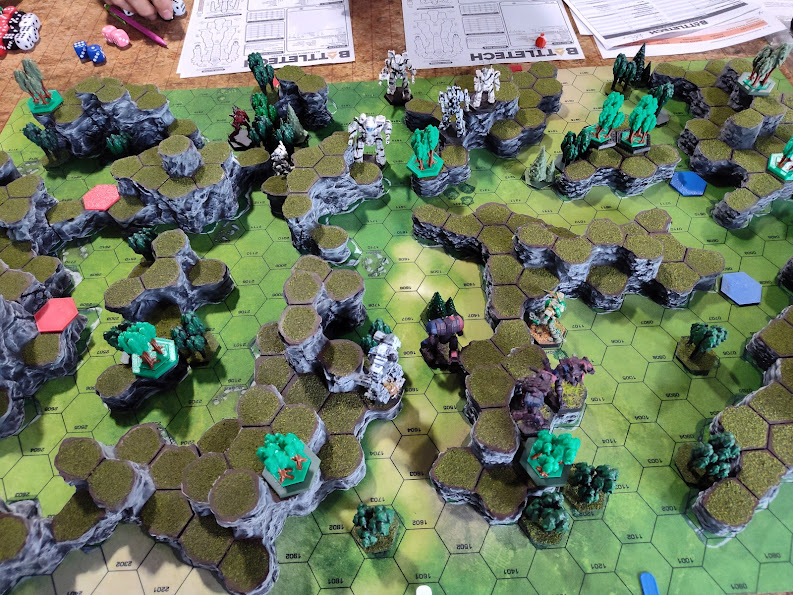 Pictured: A Kingfisher making itself a very conspicuous target and some Spiders making themselves very INconspicuous. This was another photo I didn’t think to take until we’d already pulled movement dice to start the next turn. Photo Credit: Lynn C.
In the next turn his Rifleman and Panther and my Orion held their firing positions, while my Kingfisher climbed down into some woods for cover, my Hercules finished moving into an isolated patch of heavy woods, his Thor and Warhammer advanced (the Thor jumping up onto a completely exposed ridge), and my Ostsol broke and ran to defend my goal as it became clear the Spiders wouldn’t expose themselves to fire until they got there. He continued to focus fire on my Kingfisher (mostly; the Hercules did take an extremely frightening Panther PPC to the face which left its head at two structure but didn’t score a crit), while I turned all my guns (except the Ostsol’s) against his Thor. I savaged the Thor, knocking one of its Heavy Larges out of commission and knocking it off its feet so it couldn’t jump away in the next turn. My Kingfisher took more armor damage in return, but it was a very good trade.
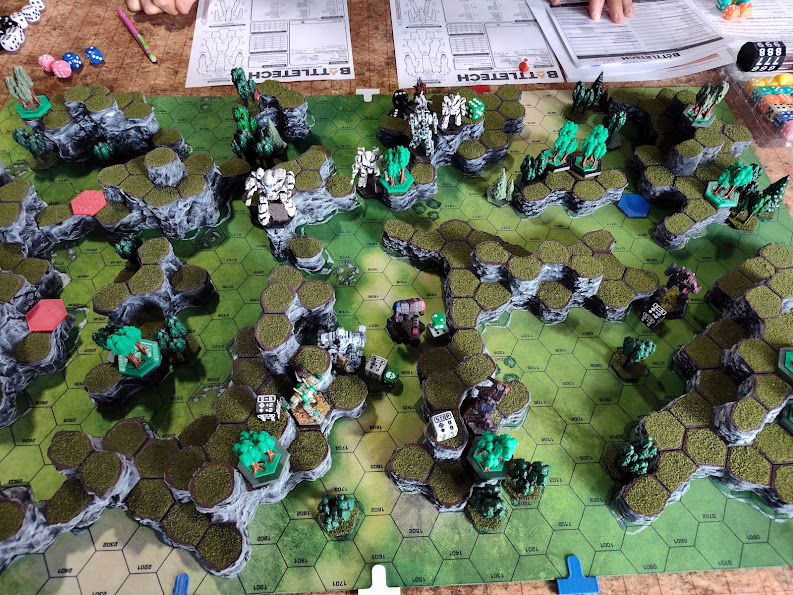 That Thor jumped into the wrong neighborhood. Picture taken before shooting, since it’s not on the ground yet. Photo Credit: Lynn C.
Turn three saw my Wraith and his Spiders
almost at each other’s goals, but not quite there. His goal was undefended, while mine contained the full pulse arsenal of an Ostsol 5M. His Thor stood back up at a walk and held its ground in the same hex, and our other mechs largely held their firing positions across the middle of the map, though his Rifleman stepped down off its hill into some light woods. Again, he sent everything into the Kingfisher, I sent everything into the Thor. The Kingfisher took over sixty damage and
extremely fell over, but his Thor died outright. My Ostsol, meanwhile, did some damage to the Spider with the sack but didn’t inflict anything critical.
I made a decision here which I regret in retrospect, but which seems like a natural negative consequence of not only playing with engine explosion rules, but offering a significant amount of points for triggering an engine explosion. His Thor died during the resolution of my Kingfisher’s firing due to damage from the head, but since its center torso was into structure and I had LB-10Xs left to fire at him, I insisted on resolving the rest of my shooting against the Thor in the unlikely event that it triggered an ammo explosion. As it happened, I didn’t even score a single engine crit, and the whole exercise was a total waste of time… and in a sort of karmic revenge, I got so caught up in chasing the 20-point ammo-explosion secondary objective that I completely forgot that it was damage to the head that actually killed the Thor… which I could’ve, and should’ve, scored for 15 secondary points. D’oh!
The fourth turn started out on an unnecessarily contentious note, possibly exacerbated by friction over my time-wasting shooting against the Thor. I won initiative, and my opponent made a big show of reminding me that the rules permit the player who wins initiative to choose whether to move first or second (which… doesn’t even seem to be true in the current version of the rules, but whatever), and when I said that I wanted him to move first, ran through my goal with his Spider and crowed that he’d gotten there first and I’d explicitly allowed him to do it. I had to call his attention to the fact that the scenario awarded equal points if we crossed in the same turn, AND later had to remind him again that the scenario also stated his sack-carrier had to actually survive that turn without being crippled or destroyed in order to score, and his mood soured dramatically.
I put my Ostsol into the back of his Spider 5V (which he’d left at a fairly poor TMM due to his misunderstanding of the specifics of goal-scoring) and focused the rest of my force on his Rifleman (my Orion finally running forward so that it could fire its MPLs), while he kept trying to kill my Kingfisher. He also attempted to DFA my Ostsol with his Spider 7M for those secondary points, knowing he needed a points swing to keep him in the game after the evaporation of the Thor.
The weapons phase started with both of us throwing our BSP at each other, but everything in both directions managed to whiff. After that, I shot the left side off of his sack-carrying Spider and it fell flat on its face at the Ostsol’s feet. The Kingfisher took enough damage to ALMOST lose its right torso, but that torso held on with one point of structure, and the only critical damage it suffered was the loss of both slots of its RT double heat sink. The Rifleman took a fair amount of armor damage and fell, but (as I recall) wasn’t crippled. My Wraith scored its goal unopposed.
Then the physical phase started, and things got messy. He rushed to resolve his DFA first, and believed he’d hit, until I pointed out that he’d forgotten to account for my Ostsol having TMM +1, and that was just enough to make it miss. Then I was confused because my Ostsol (standing at level 0) was adjacent to three level 1 hexes and the fallen Spider 7M and I wasn’t sure which hex it was supposed to be displaced into. Then my opponent disagreed with me over mechs failing a DFA automatically falling, and we had to get a TO and find rules reference for that. Then my opponent tried to stop me from kicking his Spider 5V with the Ostsol because of it having been displaced out of melee range, and I had to fall back on the Greek chorus of onlookers we’d gathered by this point to remind him that the physical phase, like the weapons phase, resolves attacks effectively simultaneously. Then my Ostsol kicked the Spider’s left arm and he started bubbling in armor damage there when I realized, wait, it shouldn’t be able to take damage there because the left torso had already been destroyed during the weapons phase (from behind, so the armor diagram still seemed to have armor from the front). I had to convince him to walk back the damage resolution and apply it in the correct place… and since the Spider had fallen straight forward and still had its back towards the Ostsol, the correct place was the rear center torso, and that was enough damage to destroy the Spider, both stopping my opponent from scoring the primary and also scoring me 25 secondary points, 10 from Joyful Wedgie (since I’d inflicted the fatal damage from the rear arc) and 15 from Jack Frosted, since I’d destroyed two of his units.
My opponent tried to rush into the next turn, and I had to remind him that we were in the last 15 minutes of the round and had been told not to start another turn. At that point he became sullen and disengaged to the point where it was a struggle to get him to actually fill out his score sheet so we could submit scoring for the round. I felt bad for him, particularly since I know how bad it can sting to make mistakes based on a misunderstanding of the scenario packet (I’d done the same in the first round of an online MegaMek league run on the Goonhammer server), but it was frustrating that a grown-ass man took the loss even less gracefully than the
literal child I played in the first round.
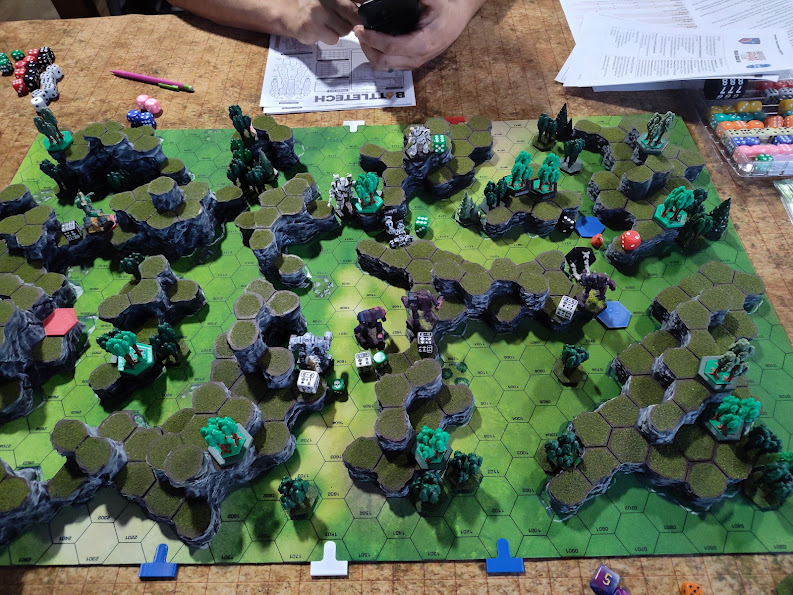 Photos taken moments after disaster. This was the end-game board state, with two of my opponent’s mechs missing and another two on the ground. Photo Credit: Lynn C.
In any event, the official result was recorded as a 105-5 victory for me. It would’ve been 120-5 with the Jingle Bell Rung achievement I forgot to score for myself, but that wouldn’t have been anywhere remotely near enough of a points swing to actually change the final standings.
The Results
When the dust settled, I’d had the lowest-scoring victories of the three undefeated players, putting me in third place! My out-of-state friend and prep partner Tentacle took second, and ChahDresh, the victor of WarZone ‘25, returned to the peak of the podium. I happen to have full lists for all of our forces and some direct quotes from the other winners, so I’ve done a little unpacking of each list in my “Thoughts and Analysis” section, later in this article.
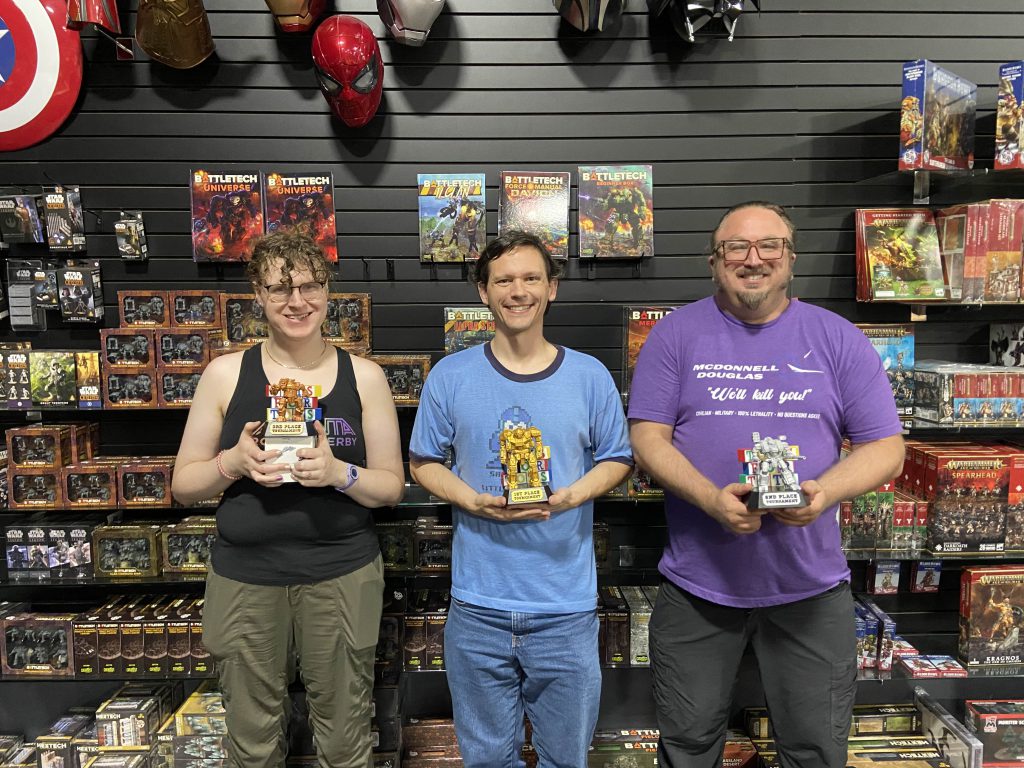 The victors! If I’d known I was going to win something, I would’ve made sure to wash my hair that morning, hah. Photo Credit: Scott "Clamps" Grill
Prize support this time around included a generous haul supplied by Cross Electric Designs, who do 3D-printed terrain and display bases for BattleTech. I was able to claim a very cleverly-designed bridge out of the prize pool, and I think that makes me the real winner. Bridges are cool. Everybody should go out and buy a bridge. (This article should not be taken as investment advice.)
My local paint meta is very much still in its display board era, though our second-place victor boldly battled through on the strength of his units alone.
Third went to Kevin C., who brought an elaborate spread including detailed lore for his mercenary force, including their participation in the Toys For Tots “Charity Military Exercise” itself, including custom pilot cards for all of his units. The pilot cards used AI art, unfortunately, but you may recall from my shout-outs in the Summer Fever article that I do actually like his Zeta-Gundam-Titans-inspired paint job on its own merits. He asked me if I’d include a pic focused on just his miniatures in this writeup, and I’ve done so below:
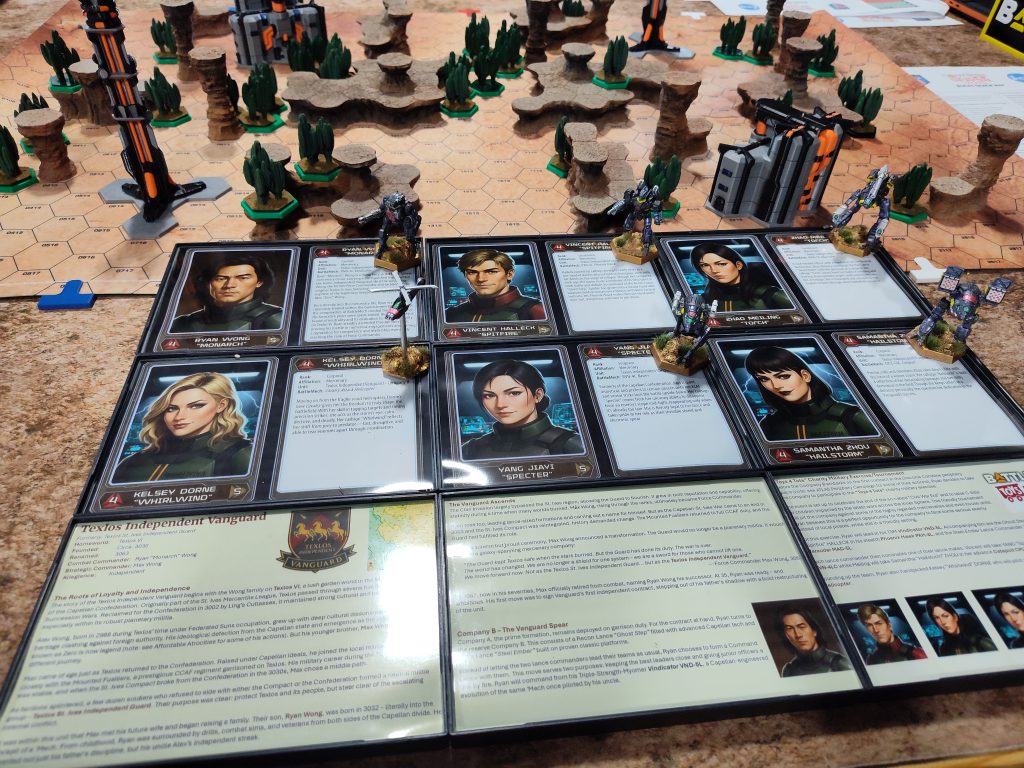 This was the full spread he brought to the tournament… Photo Credit: Lynn C.
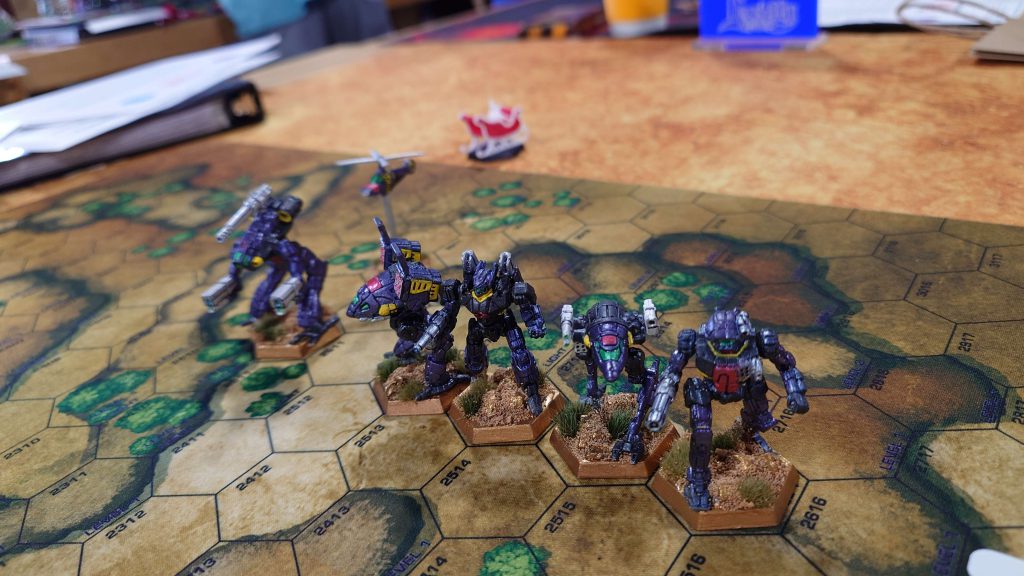 …but here they are without all the accoutrements. Photo Credit: Kevin C.
Second place went to Jacob H.’s McCarron’s Armored Cavalry, a classic BattleTech scheme executed well.
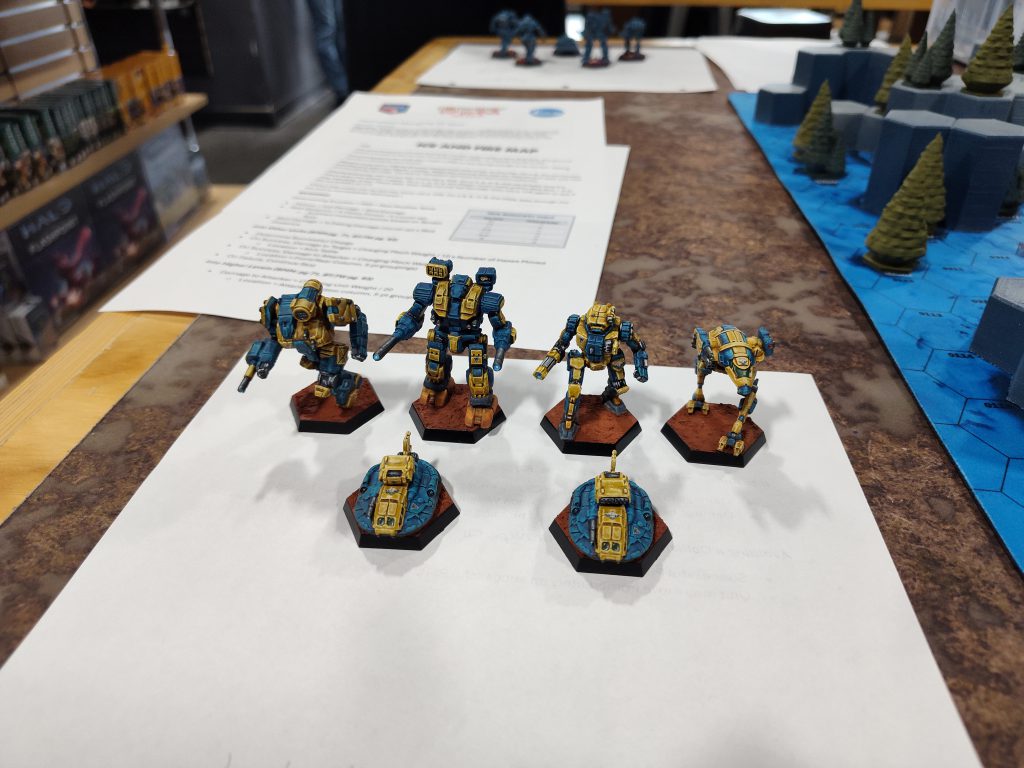 The Chancellor's favorite once-and-future mercenaries. Photo Credit: Lynn C.
First place was dominated by Joshua H.’s Ghost Bears, who were painted perfectly well, but were somewhat overwhelmed by their festive backdrop, a light-bedecked and present-strewn Christmastide forest.
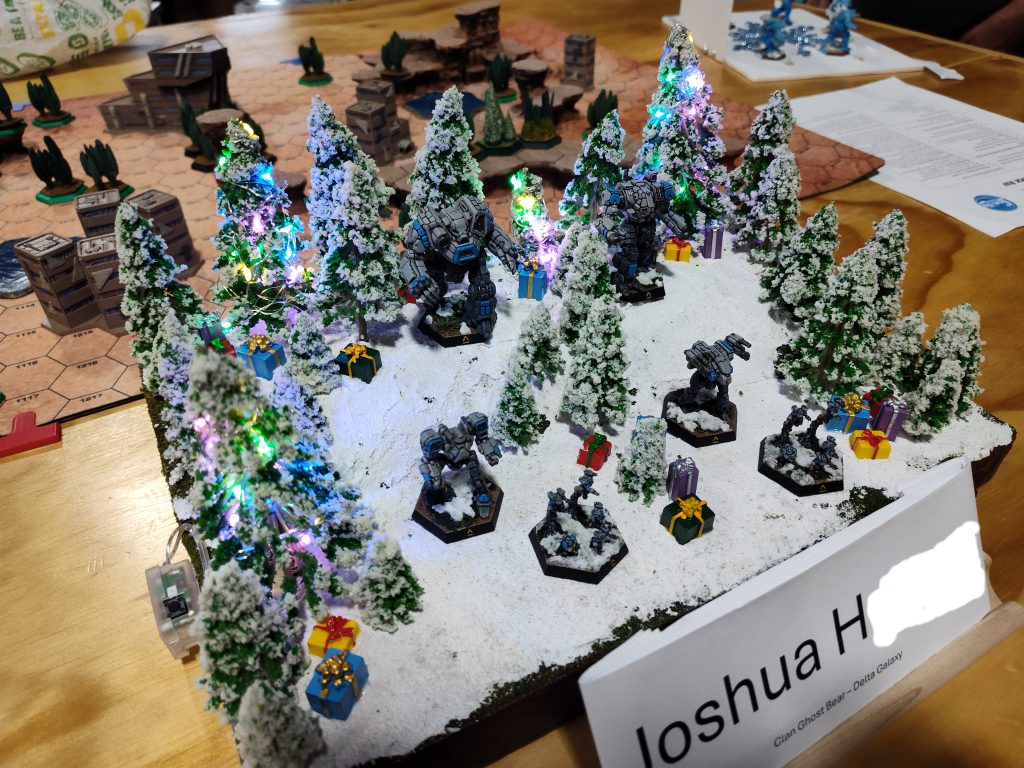 Unbeatably festive! Photo Credit: Lynn C.
I just want to include two personal shout-outs this time… first I’d like to highlight Robert S., whose clean, well-executed scheme included the best cockpit jeweling I saw in the Force Parade:
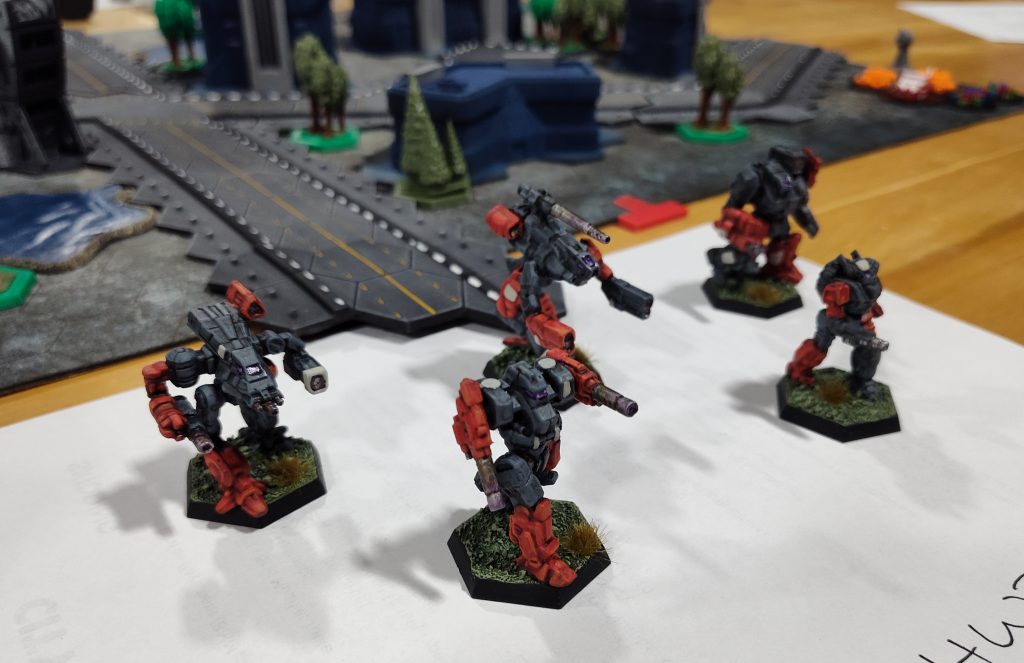 I also dig the heat-colored steel effect on the gun barrels. Photo Credit: Lynn C.
I also have to show you how thoroughly the tournament victor committed to his RWBY gimmick this time around:
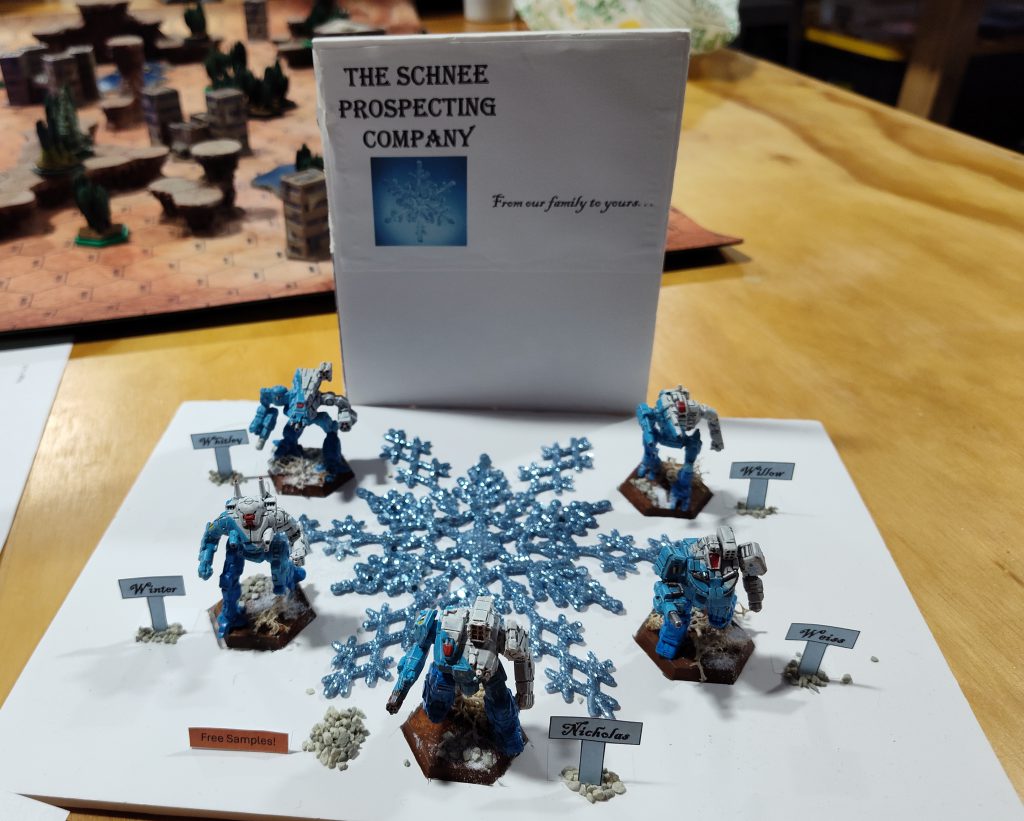 I expand a bit more on what this commitment to the bit entailed down in my list analysis. Photo Credit: Lynn C.
The commemorative certificates included the usual suspects, like the wooden spoon (“Didn’t Hear No Jingle Bell”), good sportsmanship (“Heart Grew Three Sizes”), etc., and acknowledged some mission-packet-specific achievements (like a certificate for the player who scored the most feats of strength for secondary scoring, which very much went to ChahDresh), but also acknowledged some more unusual circumstances. Though the packet allowed anyone to take one in their list, only one player actually brought a Unique mech (Hohiro Kurita’s Dire Wolf config), and he got a “Unique Snowflake” certificate out of it, for instance. Another player earned “Two By Two, Like Reindeer” for taking a pair of the same ‘Mech chassis and also a pair of the same vehicle chassis (two Crusaders and two Manticores in a Lyran list). No prize for using 8k BV exactly this time around, alas (likely because I wasn’t the only one who did it)
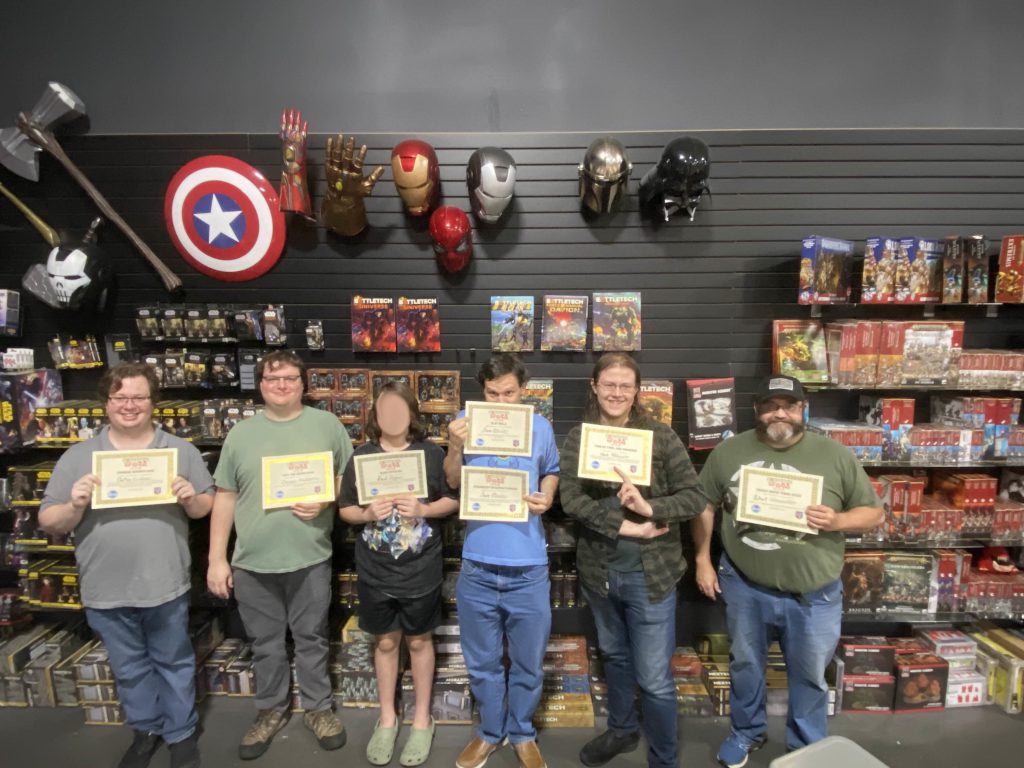 The full roster of certificate recipients! Photo Credit: Scott "Clamps" Grill, edited for anonymity by Lynn C.
Thoughts and Analysis
Speed of play continues to be the biggest impediment to BattleTech’s effectiveness as a tournament game, I think. It’s certainly
possible to play Classic at a quicker pace - one of our players, a veteran of the Infinity tournament scene, averaged more than nine turns completed per game across this very tournament, in two-and-a-half hour rounds - but there remain a lot of hurdles. I made my own speed of play a goal for this tournament… finally memorizing the front/rear hit chart, smoothing the process by which I calculate to-hit numbers, building a Box of Doom for my cluster weapons… and I still personally topped out at four rounds of play.
What went wrong? That’s a complex answer, because there’s a lot of factors that fed into it. One issue is that everyone has their own way of approaching time-consuming aspects of the game, especially the GATOR math, and sometimes that approach is sedimented by decades of habit. My third-round opponent, for example, acknowledged that it was a good idea that I was working out math on paper each round… and then continued to just sit there and stare at me while I was doing it, because he preferred to do his math off the cuff right before rolling his dice. That might’ve been fine if he was quick and accurate, but he frequently forgot to include
range modifiers, and me having to double-check him just added more delay. At the other extreme, that very time-efficient Infinity player I mentioned encourages just
rolling dice and only stopping to do math if the result isn’t obvious (e.g. a very low roll on a longer-range shot is obviously a miss, a very high roll on an easier shot is pretty obviously a hit, etc.), an approach which I find EXTRAORDINARILY stressful because it allows (me, at least) no time for careful odds-based fire allocation.
I’d also like to highlight again how casual the play culture around BattleTech broadly is.
Every single player I was paired against in this tournament walked away from the table in the middle of a timed round of play, two for restroom breaks and one to go buy a soda. Biological needs are biological needs, sure, and it can be difficult to fulfill them in the breaks between rounds when the giant game store you and several other groups of nerds are playing in only has two one-seat restrooms to serve the whole crowd, but any avoidable delay is frustrating when you’re on a clock. The widely received wisdom in BattleTech tournament communities seems to be simply to take everything less seriously - a mindset which also helps manage big emotions like the frustrations I saw at the end of my first and third games in this tournament - and I am, in fact, planning to take an intentionally silly list to the next tournament I have on my docket (Southern Assault 5’s Classic day), but that shouldn’t be
necessary. It’s entirely possible to go hard in the paint and also keep a positive attitude and have a good time, and I don’t think that should be a controversial opinion!
Of course, the culture around BattleTech’s tournament scene can’t help but be influenced by the fact that there’s no real established, accepted standards for pretty much anything about this game. That’s wonderfully freeing at times, and wonderfully frustrating at others. On the whole, I applaud Toys for Tots 2025 for continuing to experiment with missions, without getting quite as silly/arbitrary as some of the missions we saw in the previous year’s outing (like the one with Home-Alone-inspired booby traps). That said, when a “blind” mission packet is heavily geared in a particular direction, it can create some feel-bads off simply not building towards the traits the missions emphasize. There wasn’t really any mission here that significantly incentivized tough bastards who can stand on points, like a King of the Hill or take-and-hold scenario, while every objective incentivized speed (and high ground speed on a reasonably tough chassis, in particular, with the last mission), and the secondary achievements largely prioritized a mix of physical combat ability and sheer luck (and the three most commonly-achieved of them, for damaging half or more of your opponent’s units, destroying at least two opposing units, and killing from the rear arc, also happen to be the ones players have the most control over, funny that). Losing in list construction always feels bad in wargames, and it’s worse when you can lose in list construction without even having the opportunity to realize it.
That said, to some degree a list that’s good at playing BattleTech is going to be good at playing BattleTech, whatever gimmicks get piled on top of it. My own list for this tournament skewed a bit towards beef and had no particular interest in getting involved in physical shenanigans beyond kicks of opportunity (especially not charging/DFAing), but while my first round was chancy, I think I racked up decently solid victories in my other games. I was particularly impressed by the Hercules and Ostsol, while the Orion actually underwhelmed me in this outing.
My Hercules' ability to deliver two 10-point damage clusters at good range when needed provided a nice extra bite to my list on top of the Kingfisher’s dependable firepower, and the Orion’s LRM-20 felt anemic in comparison, even with Artemis. IS LRMs have such a small sweet spot in terms of range that it can be really frustrating getting them on target, and unlike the ON2-M, the ON1-MA makes matters worse because the LB/10 doesn’t enter Short range until the LRM is entering Minimum. I still love Orions, but this tournament was the Hercules' day.
My Ostsol, meanwhile, was nimble enough to control ranges pretty well, able to chip in a bit from distance, and really did work when it could get 2-3 hexes out from its target, all for a steal of a BV cost. The Wraith did what Wraiths do, and came into its own when I needed non-combat objectives done in the last two rounds; I spent too much of the first round trying to backstab a hard-as nails target (the Black Knight) with it, which really isn’t its strong suit. And the Kingfisher? I’ve always liked Kingfishers, and this one put in good work across all three games, but it really shone in the last round, where I managed to bait my opponent into making it his priority target: it managed to soak a total of
156 damage from my opponent’s list with internal damage in only one location and one double heat sink as its only casualty from critical hits. What a trooper.
Tentacle’s second-place Wolf-in-Exile list was a Nova Cat E, Warhammer IIC 3, Phantom H, Phantom E, and Adder E, all at 4/5 skills. That’s a horrendous amount of consistent damage output from some of the most BV-efficient weapons the Clans can offer (ATMs, pulse, massed tiny lasers), plus a couple TarComp’d Heavy Larges on the Warhammer just to put the fear of Kerensky into opposing MechWarriors (and indeed, Tentacle credited a headshot as the turning point in his close-fought first-round match).
The value of the Warhammer IIC 3 and Nova Cat E is probably obvious if you look at their sheets, and, indeed, Tentacle credited the WH IIC as his MVP, but I’d like to unpack the other choices just a bit. The Adder is vulnerably slow for its size even with near-max armor, but it survived all of Tentacle’s games by consistently showing up the turn AFTER the mid-board scrum began, when his opponent was already focused on other targets, and the damage output of the E variant is no joke, topping out at more than double the damage potential of my Ostsol’s front-facing alpha strike, with slightly better speed and without picking up any heat problems, for only 27 BV more (though it sacrifices armor and range to get there, and is at the mercy of the cluster table, albeit with Art IV). I definitely need to give that little guy a go sometime.
As for the Phantom, it is a
phenomenal OmniMech, Sarna Bad ‘Mechs editorial notwithstanding, with the H and E as its standout configurations. It’s a 40-tonner with decent armor for its weight which can move 9/14, just a fantastic speed for a backstabber, and when loaded with BV-efficient weapons it can really get to a place that feels godly. If you’ve ever played against a Locust IIC Standard, the Phantom H only costs 78 BV more for an Alpha Strike that’s only two damage lower, faster speed, and more armor, just mean as hell. Tentacle gifted me a Phantom mini at the event, so look forward to that terror joining my own roster in the future!
ChahDresh’s winning Mercenary list was the biggest beneficiary of the mission pack’s predilections, and I say that as no knock on his skill: he’s a phenomenal player, and his consistent tournament performance is all the more impressive when you know that he’s an out-of-towner whose local community almost exclusively plays Alpha Strike. He happened into a perfect list this time, though, in pursuit of a
theme. He’s the player who paints all his Inner Sphere ‘Mechs with RWBY-inspired colors based on their Alpha Strike Roles, and he decided to go all Schnees for Toys for Tots due to the Christmas theming, since the founder of their family in the show is a Santa Claus expy. The upshot of this is that he limited himself
entirely to ‘Mechs with the Skirmisher role. He ended up bringing a Thunderbolt 9SE, Starslayer 3C, Wolverine 7K (with one ton of Infernos for utility), Bushwhacker S2 (
technically a Sniper, but most Bushwhackers are Skirmishers, so I’ll give it a pass ;] ), and the star of the show, an Ostsol 8M upgraded to 4/2 skills. (It looks like everything else was 4/5 except for the Wolverine at 4/4; this put him at 7,888 BV, which also let him flex by winning the tournament with literally the lowest-BV list in contention.)
The Ostsol 8M is a punching machine, a TSM tempest with no silly melee weapons or limb-mounted guns to distract it from the power of its fists and feet. And, of course, as a 60-tonner, it’s exactly big enough to punch the head off any mech without advanced armor in a single hit when TSM is active. Recall the list of achievements for Secondary points in this tournament. As ChahDresh put it in his own tournament debrief:
“Every game, the Ostsol earned me ‘Kill a mech from the rear arc’, ‘Land two punches from the same mech in one phase’, ‘Destroy an enemy leg with a kick,’ and ‘Destroy an enemy mech by destroying the head.’ I maxed secondary every single round, trivially. Accidentally perfect.”
The Ostsol 8M is just a touch light on armor on those arms, per Ost family tradition, but arms aren’t an especially common target on the bell curve, and its feet are plenty dangerous as well. Combined with its speed (7/11 with TSM active), it’s truly difficult to do enough damage to stop it from getting its chance to rip and tear.
Beyond the turbo-mode Ostsol (assigned to Winter Schnee, incidentally, which tracks), the rest of his force had Enough.
Enough mobility,
enough armor,
enough threat, letting them play flexibly in response to unfolding battlefield conditions. Overall, his list simply performed well across the spectrum of mission objectives; I think there’s a
chance he might have come in second without the scoring boost from the secondaries, but he didn’t need them to do very good work.
Bonus Section: Dinner!
It’s been traditional for there to be a post-tournament group dinner at a nearby restaurant after the local one-day tourneys wrap up, but I’ve never actually attended one, whether due to timing, social awkwardness, emotional crashout, or, uh, heat exhaustion. With Tentacle visiting I wanted to hang with him a bit more, though, and as it turned out pretty much everyone who went out to dinner after this tourney was a friendly acquaintance of mine and it was a really nice time that helped end my good day on a firmly positive note.
We went to a pho place at the opposite end of the sprawling shopping center in which Level Up is located, and their food was great, with the only fly in the ointment being a truly unusual communication barrier with the staff. The menus identified every dish both by its Vietnamese name and with an alphanumeric code (e.g. “B9”), but the staff kind of struggled with both of those references, preferring generic descriptors. In the most egregious instance, as our food was being delivered there was a great deal of confusion over who had ordered the “chicken noodle soup,” which turned out to be chicken pho. I recognize that they probably spend their whole days dealing with a lot of stupid white folks, but it feels really strange for a restaurant to actively avoid using the name of a dish that’s also
in the name of the restaurant itself. Go figure.
Parting Words
I have, once again, already eclipsed the word count of my last article, but I can’t sign off without first saying:
Thank you for reading! One of the things that was really awesome to see throughout Toys for Tots ‘25 was the impact that Goonhammer has had on my local BattleTech community. I had multiple people approach me to comment on my articles and/or the site’s BattleTech coverage as a whole, and it’s really heartening to be even a small part of something that’s truly reaching people, encouraging them to get out and play, and helping them enjoy their hobby. I just want to say: You, person who read to the end of this rambling, I see you and I appreciate you. Thank you for taking this time out of your day to join me on my (semi-) competitive journey. Maybe someday soon we’ll get a chance to roll dice together, on MegaMek (join the Goonhammer Patreon Discord server to make your batchall!) or at a future tournament!
Next on my docket, tournament-wise, is Southern Assault 5, which I hadn’t planned to attend (it’s hot on the heels of my wedding and not exactly a honeymoon destination), but
which Liberty successfully bullied me int- I mean, which I decided to go for after an additional ten tournament slots recently opened up. Its Classic event is going to be pretty much impossible to play competitively - it’s a three round tournament with up to 60 participants, so we’re looking in the ballpark of 15 undefeated players at the end even if victors are only paired against other victors, which I feel is a field too broad to confidently proclaim any overall winner, really - so I’ve decided to go full Silly Season with a Dark Age Regulan Fiefs lance of all TSM-equipped, weapon-wielding melee mechs (sadly
not including the very on-theme Neanderthal because I kind of… forgot about it before submitting my list, whoops). I’ve also declared a grudge match against Liberty for the first round, so I’ll likely start my tournament off by receiving an ass-whooping from a Kodiak, but I’m very much looking forward to meeting more Goonfolk in person and getting to hatchet the shit out of a few mechs even if I get shot to death immediately after.
I can also tease that I’ll be contributing more to Goonhammer in the near future, beyond just tournament reports, so… I look forward to seeing you there!
Have any questions or feedback? Drop us a note in the comments below or email us at contact@goonhammer.com. Want articles like this linked in your inbox every Monday morning? Sign up for our newsletter. And don't forget that you can support us on Patreon for backer rewards like early video content, Administratum access, an ad-free experience on our website and more.Thank you for being a friend.
 This website uses cookies. Learn more.


 Goonhammer Hobby Round-Up: March 2026
 Goonhammer Reviews: Tribal Conquest
 Conquest: Weaver Courts Gemred Knights and Scaile Dancers Model Review