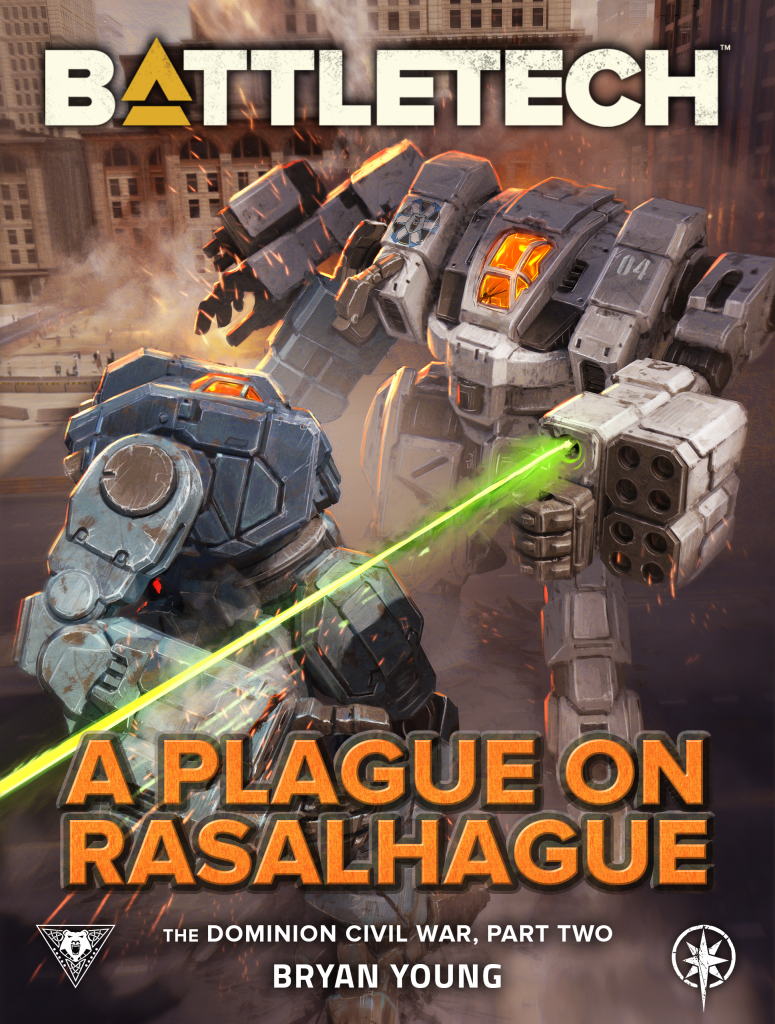
Hey there, MechWarriors! Today marks the release of the second installment in Bryan Young's quartet of novellas covering the Dominion Civil War,
A Plague on Rasalhague, and I'm pleased to be back with another review of the ongoing saga.
We'd like to thank Bryan for providing us with an advance copy of A Plague on Rasalhague
for our review.
 Credit: Catalyst Game Labs
If you're not familiar with the Dominion Civil War, I suggest taking a look at my previous review of the first part of this series,
Star-Crossed Warriors, and/or
my interview with Bryan about the series. If you've already done your homework, let's dive right into this review!
As a quick note, while this review will not contain any significant spoilers, I will be discussing the premise and themes of A Plague on Rasalhague in greater detail than the official synopsis. If you’re already planning to read the book and would prefer not to see that… go read the book! It’s good! But if you’re on the fence or you’d like to see me unpack my reactions, read on.
In structure,
A Plague on Rasalhague follows closely on the heels of its predecessor, taking place across multiple timeskips, with news broadcasts and chatterweb posts filling the interstitial spaces and providing context beyond the limited perspectives of its viewpoint characters. This book narrows its focus, however, moving through just four months: July through October 3151. This encompasses the aftermath of the planetary vote on Grumium, the reveal of the Dominion-wide vote's results, and the news of Alaric's refusal of the results making its way back to the Dominion. These three occasions for [joy/despair, delete as appropriate for your Joiner/Denier political affiliation] progressively ratchet the tension higher, constantly escalating the intensity and violence of the protests on Grumium until the conflict edges into a true civil war.
Vespertine gets more focus in this section of the story than she did in
Star-Crossed Warriors. In the first book she was representative of the "ugh, I can't wait until this stupid vote is over so we can stop talking about politics all the time" viewpoint, but in
A Plague we see her firmly commit to the Denier side of the line. Her newfound political awareness is strongly spurred on by her new friend Astrid, the leader of a Freeminder cell.
Strider's role in this phase of the story largely revolves around balancing his duty to the
touman and his love for Vesper with his own Joiner inclinations and his protectiveness towards his great-grandmother, Frigga, who plays a prominent role in Joiner political organizing in the planetary capital. He clings to the optimistic idealism he displayed in
Star-Crossed, but we see his principles ever-more-sorely tested as the conflict escalates.
We do get bits beyond Vesper and Strider's viewpoints at times in
A Plague, following both Astrid and Frigga, giving us a much closer look at civilian organizing than we got in the first book. Frigga follows a pretty familiar peaceful protest playbook (including a very fun punk concert from a band called the Dead Kodiaks), while Astrid is very willing and able to get her hands dirty. If you'll indulge me in doing exactly the opposite of Death-of-the-Author criticism, I found it enlightening that Young pushed back when I characterized Astrid as an emerging "villain" in this story while speaking with him about the book. While the tactics the powerless can use to strike against the powerful are often ugly, honor and morality aren't necessarily the same thing.
US media's relationship with protest and rebellion has always been... interesting. Our nation was born from revolution, and
certain protestors and protest movements have been popularly lionized after the fact, once the stances they fought for have become mainstream (Martin Luther King, Susan B. Anthony, Harvey Milk, and so on), but it's in the best interests of a hegemonic power to hold up only the most toothless forms of disobedience as appropriately "civil." We see this with the myth of a sharp dichotomy between the pure, peaceful MLK vs the misguided, violent Malcolm X, and we also see it in the way our fiction most commonly treats resistance. I think it's been good to see Star Wars fiction increasingly reckoning with the messier side of the Rebellion in the new canon, and I'm glad to have gotten the reminder that good and evil are never really clear-cut categories in BattleTech, even when it comes to popular action.
We do get to the part of the civil war where BattleMechs are fighting each other outside of the context of training in this book, but this story is still a far cry from the action-movie end of wargaming tie-in fiction. It wouldn't be appropriate for this particular story to revel in violence, but just know that if what you're looking for is a weightless shoot-em-up as a beach read, this cycle certainly ain't it. The violence here is a tragedy: the failure of dialogue amongst the belligerents.
I think Young does a good job here of keeping the reader in sympathy with both Strider and Vesper as their political divide begins to drive them apart. Their viewpoints and their actions are all painfully
understandable, on both sides, and that makes the whole situation hurt all the more.
A Plague on Rasalhague leaves me very curious where we're headed from here. This novella feels to me more like the middle part of a trilogy than it does the second quarter of a tetralogy, and I expect the next chapter will have curveballs to throw. I have enough trust in Young as a long-form storyteller to anticipate this Dominion Civil War cycle sticking its landing, but I can't guess quite what 3152 holds for Grumium, and I'm very interested to find out!
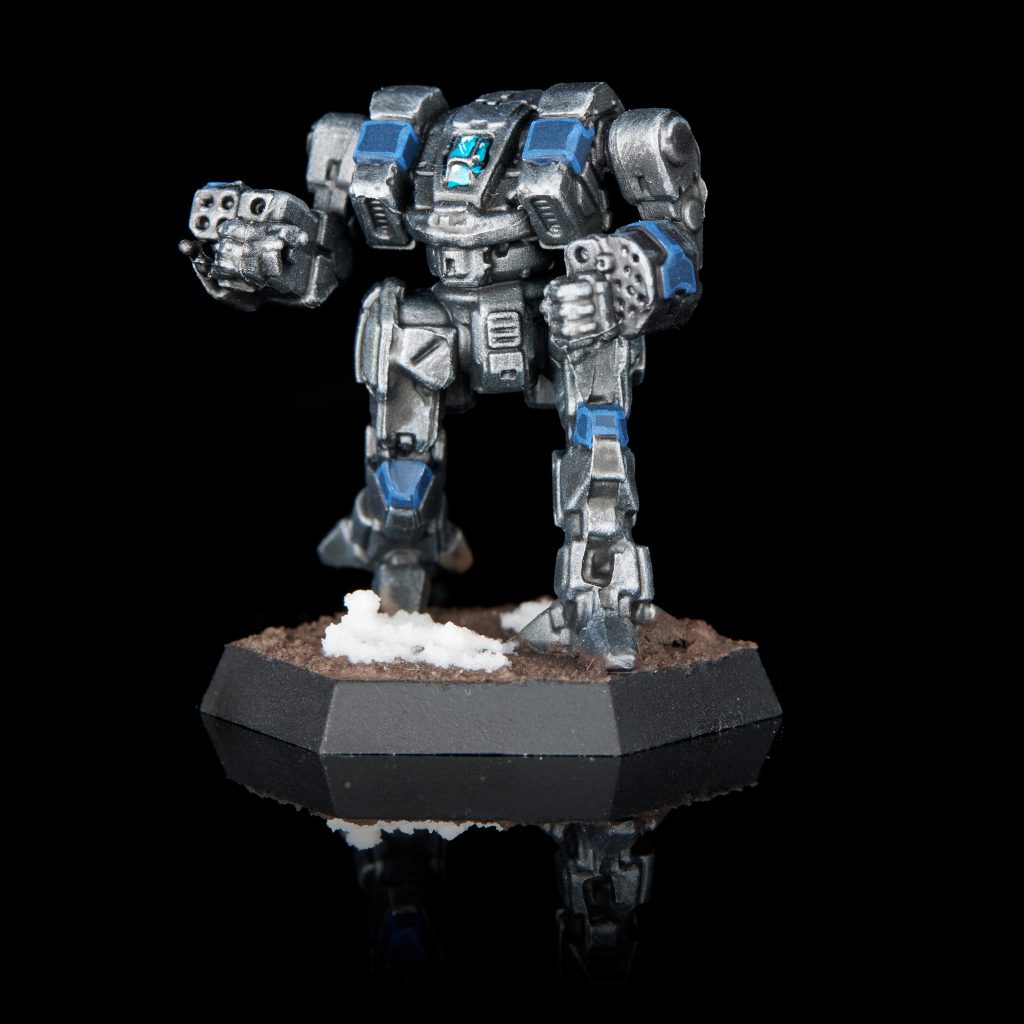 Clan Sea Fox Mist Lynx. Credit: Jack Hunter
Final Thoughts
The Dominion Civil War lives up to its Shakespearean ambitions in
A Plague on Rasalhague; with this novella we have clearly moved from "impending conflagration" to "actual ongoing tragedy." This second installment's voice maintains
Star-Crossed Warriors' verisimilitude. New arrival Astrid feels a touch less subtle, a touch less nuanced than the other characters we've spent time with, but well within the bounds of believability. One news article in the last batch of interstitial excerpts felt slightly clunky to me, with about half its length devoted to a pretty plain As You Know recap of how Grumium got from the start of this story to the point where this novella leaves it, but I can't even say that's out of character for news stories on a major unfolding event.
I'm still fully on board with Young's saga of the Dominion Civil War, and this story also has me eagerly anticipating the release of the Snowblind Aces box: I can't wait to get another slice of this deliciously complicated stretch of BattleTech's recent timeline.
Have any questions or feedback? Drop us a note in the comments below or email us at contact@goonhammer.com. Want articles like this linked in your inbox every Monday morning? Sign up for our newsletter. And don't forget that you can support us on Patreon for backer rewards like early video content, Administratum access, an ad-free experience on our website, and subscriber-only content covering competitive Warhammer 40K!Thank you for being a friend.
 This website uses cookies. Learn more.
 BattleTech Fiction Focus: A Plague on Rasalhague