Welcome back, Star Commander. Your return to this briefing room suggests you would like to learn more about the various battle armor designs available to the Clans, so let us cut to the chase.
Black Lanner A, Fire Falcon Prime, Corona Battle Armor, and Salamander Battle Armor. Credit: Valk.
Improving on the venerable Elemental suit is a difficult task, but was one that the Clans' scientist caste couldn't resist taking on. Decades of doctrinal shifts, technological development, and iterative design improvements, to say nothing of environmental demands, have given rise to a large variety of new Clan battle armor options. While none ever reached the same level of ubiquity of the Elemental, awareness of these new designs and the roles they fill can and will make a good Clan player into a great one.
For the sake of brevity, I'm going to sort new Clan battle armor designs into three major categories: general purpose designs, strike designs, and support designs. I'll also give a brief overview of a couple examples of each, which will help define their tactical niche and make it easier to understand those of similar designs in the Clan arsenal.
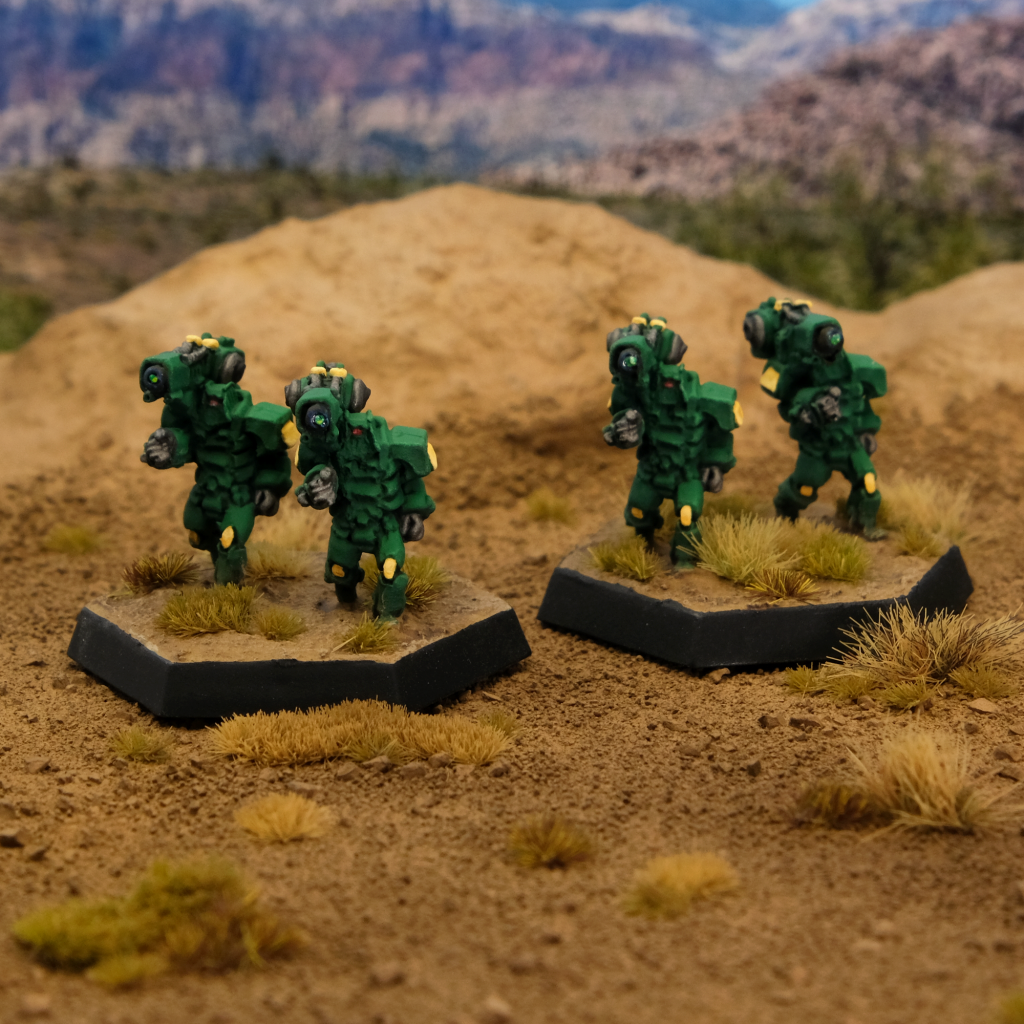
In 3056, Clan Hell's Horses introduced the Gnome, a production model of their experimental Rhino battlesuit, as a response to an emerging strain of heavily-armored Inner Sphere designs. The Gnome can be best described as a "heavy Elemental," having a reduced jump distance, but carrying increased armor -- 14 points, so you can laugh off anything less than an AC/20 round or Gauss slug at least once. The standard Gnome also features an Clan ER small laser, as well as an Advanced SRM 2 launcher that grants it a 4/8/12 range bracket and a minor bump on the cluster table (a +1 to the cluster roll that is mentioned only as a goddamned footnote in Total Warfare's Battle Armor Weapons table in the back of the book, because of course that's where it is). Later models offer even more potent, paradigm-shifting toys, such as an LRM variant that carries an LRM 4 and AP gauss rifle on each suit, turning the Point into a mobile Clan LRM 20 battery and 9-hex infantry exclusion zone.
These weapon choices are usually meant to help offset the Gnome's mobility problems by granting it a much broader engagement range than the Elementals it was introduced alongside. This is a welcome change, as the Gnome has one glaring flaw in combat: due to its size, it cannot perform leg or swarming attacks. While the design is still capable of riding on OmniMechs, this shift to improved weapons, improved armor, and lower mobility makes them optimized for shooting and scooting at short ranges, rather than waiting for an opportunity to go elbows deep in a Longbow's kneecaps.
Peri: The lack of leg attacks does hurt the Gnome, but the Gnome is one of my favorite generic suits in the game. The damage output is extremely good and they can be slung around by a Fire Moth or Phantom just the same as any other heavy/medium BA. You do need to mechanize these, 2 jump is way too slow, but once they get into position your opponent is going to be insanely annoyed trying to kill them. 25 damage from ERSLs and another 20 from SRMs is a really insane max hit, so your opponent is going to want them dead, but Gnomes basically always take 2 more turns of shooting than your opponent expects them to. They are quite possibly one of the best pieces in the entire game for holding an objective, assuming the objective you are playing allows BA to contest them. A point of Gnomes in cover is a right pain to remove and will probably kill any random light mech that gets sent after them, though with SRM light mechs that is likely to be a mutual kill from inferno missiles. Love them.
The Rabid
Clan Medium Battle Armor Point, Kara's Scorchers. Credit: Lynn B.
Other Elemental derivatives chose to go in the other direction. For those of you who played MechWarrior Dark Age, the Clan Medium battle armor is likely a familiar (if very '00s-coded) sight. In addition to looking like a tiny Gundam, the name is very dumb and makes writing this overview way more confusing than it needs to be, so I'll be using their nickname, the Rabid, for the rest of this article instead.
Where the Gnome was designed as a heavier Elemental, the Rabid was designed as a slightly more mobile one. Armor protection has been reduced to 9 points rather than the traditional 10 of the Elemental, making them vulnerable to one-shot kills by a much wider variety of weapons, but they boast a jump booster that allows them to jump 4 hexes instead of 3. Arm-mounted weapon variants are less diverse than those of the Elemental (unless vibro-claws are important to you for some reason), but a wrinkle in BV2 calculations allows for their use of one-shot SRM launchers to drop their cost by a fairly significant amount. A Point of standard Rabids runs 79 BV less than a comparable Flamer-equipped Elemental squad, and, as each one-shot SRM 2 can be fired individually, is capable of popping off all 20 tubes in a single round if you're so inclined. The Rache variant ups the ante even more, converting both launchers into 3-tube models while also bringing the armor to parity with the Elemental and retaining the extra jump movement, making for one hell of a sidegrade to the classics (at a discount, no less!).
Other Notable General-Purpose Designs
Undine (Upgrade)
A version of the Undine (see Other Notable Strike Designs, below), but for normal people. These go down to 8 armor, but pack 4 shots for their LRM 3s, making them a mobile Clan LRM 15 with half a ton of ammo for 458 BV. These seem a little underwhelming at first glance, but do not underestimate the psychological value of being able to prod someone from 21 hexes away. In doing so, you'll be forcing them to ask if it's worth trying to kill the little bastards they're almost certainly on the wrong end of a TN equation with rather than just waiting out the rain and risking a TAC from the heavens.
Thunderbird (Upgrade)
The Nova Cats cooked with this one, boys. The upgraded Thunderbird, like its base design, drops the typical missile pack seen on most generalist Clan battlesuits and is incapable of making anti-'Mech attacks, but packs some interesting tricks up its sleeve with a mix of great ranged armament and 10 points of Reflective armor, giving them solid protection against the pulse lasers most players will use to hunt them. All three of the upgrade T-birds have great guns, but the standout here is the battle armor-scale LB-X autocannon variant, which makes the point into a cheap LB-X 20 with weird range brackets. It's as scary as it sounds.
Peri: Thunderbird LB-X suits are hilarious, and the ER small/micro pulse ones can be genuinely threatening. I have used them at a tournament and they are very strong BA suits, and they are available to the Draconis Combine, who otherwise have a bit of a shortage of high quality medium BA suits in the ilClan era. The DCMS has strong assault suits but somewhat weak medium suits, so the Thunderbird is a great pick up in that context.
“Strike” Designs
Both strike and support battle armor designs will trend even further to either end of the mobility and armor/guns ends of the spectrum than the designs we've covered so far. While a fair number of strike designs will suffer from the ever-spiteful touch of Infantry Guy, it's less of a concern here, since a.) battle armor are, y'know, infantry, and b.) sometimes that malice towards squishies results in some interesting outcomes, including one of my favorite designs…
The Salamander
Do you like setting things on fire? I like setting things on fire. The Salamander likes setting things on fire a LOT.
Salamander Battle Armor. Credit: Valk.
Salamander battle armor are, first and foremost, an anti-infantry design. We have found the origin of Clan Infantry Guy: he’s a Fire Mandrill. Salamanders don't pack much in the way of armor: you get 7 pips per suit, plus the meatbag inside. This armor is, however, fire-resistant, which is great, because in case you've forgotten, we're gonna be starting a lot of fires. Armament on the Salamander consists of a single one-shot SRM, typically an Inferno load, and then two arm-mounted weapons that come in HMG, ER micro laser, and, of course, flamer flavor. As one might expect, this makes a point of Salamanders basically death on jump jets to conventional infantry; if the Infernos don't smoke them out completely, the arm weapons certainly will.
As scary as these things are to infantrymen, they're plenty dangerous to 'Mechs and vehicles too. In addition to whatever guns they're double-fisting like some kind of cracked-out John Woo protagonist, Salamanders are universally equipped with magnetic battle claws and are very much capable of making both leg and swarm attacks. If you're following the basic Elemental tactics I laid out in my previous article, Salamanders absolutely excel at the swarming part of the attack, as these claws give them a -1 to their TN when attempting the swarm, and then also give the opposing MechWarrior a +1 to his PSRs when he tries to throw them off.
Once attached, a swarming Salamander Point becomes very difficult to dislodge. This rapidly becomes a life or death struggle for the target, as swarming Salamanders can hit with both of their arm-mounted weapons, guaranteeing a PSR at full unit strength, regardless of loadout, and delivering a vicious 30 damage hit when equipped with HMGs. These guys give 3/5 assault pilots nightmares and are just an A+ terror unit all around.
The Afreet
Once again, Infantry Guy was allowed to work in the Battle Armor Design Bureau, and once again, it’s…kinda practical, given the circumstances. Afreets are designed as infantry hunters and scouts, with only 5 armor per suit and a pair of vibro-claws on each. All Afreets are capable of jumping up to 4 hexes at a time, and while their onboard weapons are usually limited, variants beyond the standard model all carry effective anti-infantry weapons that will shred conventional infantry platoons. The vibro-claws also allow them to make a “melee-style” attack against infantry in the same hex and deal additional damage during leg or swarm attacks.
While not as efficient as the Salamander in a combat generalist role, the Afreet is more mobile and marginally less expensive, and carries a 2-hex sensor suite/active probe that can be useful in scenario play. The Interdictor models improve their armor to a fire-resistant version, and swap the active probe for a single-hex ECM suite that, at least under the current ECM rules, makes them great for headhunting missions against C3 Master-equipped machines.
The Sylph
One of two designs in the game that use VTOL MP to get around, Sylphs are one of BattleTech’s most unique units. With only 5 points of armor, a single IS pulse laser will kill these guys dead (and a HAG will utterly gut them), but against an unprepared foe, they can still be a nasty surprise.
While it is capable of making leg and swarm attacks, the Sylph's most unique trick is its micro bomb rack. Each Sylph trooper carries a single small cluster bomb, allowing the Sylph to make an area-effect attack that is nearly impossible to miss with. The bomb does 2 damage per trooper in 5-point groupings to all units in the target hex and the surrounding six hexes, making it an effective ambusher against high TMM units – keep them landed behind cover, then make a pop-up bombing run when the opportunity presents itself. While this is a one-time gimmick and the target will need to get very close for it to work due to the Sylph’s limited MP, it's still one that can drastically change the strategic calculus of a combined arms game.
One other note: the Sylph has an upgrade model, the Sylph (Enhanced). This is, on paper, a much more typical battle armor design, dumping the weird VTOL motive system and bomb rack to mount a BA myomer booster and a single ER micro laser. It’s easy to write these off, but a quick read of TacOps spurred by a comment on my previous article reveals that the myomer booster, combined with standard manipulators, increases the damage done by leg attacks by 2 per trooper. While I have a feeler out on the official forums to verify that this isn’t an oversight, under the current rules as written, Sylph (Enhanced) Points are capable of doing a staggering 14 damage on a leg attack (plus TAC). They’re still incredibly fragile, but if you can get them under something, they’re one of two production suit designs capable of shredding legs in this manner (the other design being the Elemental II, which is better armored but slightly slower).
Peri: Another interesting note about Sylphs is that they can spot for indirect fire while hovering around, and you won’t get a spotter movement penalty when they do it. This makes them basically the best spotters in the game due to their ability to get good elevation, great lines of sight, and high TMMs while not inflicting significant penalties on the indirect firing unit. Very good use of the suit.
Other Notable Strike Designs
Undine
Do you like to play on maps with a ton of water for some reason? The Undine is one of the few battle armor that can swim, so these are immune to the "flea bath" anti-swarming tactic. Otherwise, they're basically a one-shot LRM 25 with some ER micro lasers. Very situational under the current ruleset; if/when water rules are updated, they'll become Mostly Situational instead as 'Mechs take to the water more often.
Buraq
The Honse battle armor is…weird. Extremely fast on foot (7 MP!), they're lightly armored and lightly armed in most cases, and can't be carried by OmniMechs nor make any sort of anti-'Mech attack. I generally don't like ground MP-only battle armor with short range weapons, as maps tend to demand too much in the way of elevation changes and water traversal to get away with it, but the Uma manages to be fast enough to make up for it and most variants are dirt cheap. A herd of Bronies won't strike fear into your opponents the way Salamanders will, but they're hard to ignore. A ten-pack of 2 damage hits running between their legs all the time WILL drive your opponent mad. Highly cost-effective harasser unit (which the Clans don't get many of!), and extremely funny to watch too.
…I'm out of horse jokes.
Peri: I have never used Buraqs, but as someone who has played against them they are way better than you would think, particularly for the price. The damage output is pretty great and the price low, so if you have them, using them costs you basically nothing and any damage they do is probably going to be worth more than they are.
“Support” Designs
Battle armor designed for the support role often share doctrinal roles with a Spheroid design, the Draconis Combine’s Kanazuchi, rather than the majority of their Clan contemporaries. The Kanazuchi was a notable design departure from previous Spheroid battlesuits, opting to simply create a heavily armored, inexpensive infantry unit instead of chasing the versatility benchmarks set by the Elemental. The result was a battlesuit capable of facetanking a Clan ER PPC shot, and then bringing a standard IS medium laser to bear in response. This made the Kanazuchi – and most battle armor like it – less of a headhunting unit and more of a mobile turret. The Clans, who are better at everything, naturally came to have their own selection of suit designs that can do everything the Kanazuchi can do and then some.
The Corona
The Corona is my favorite of the “support” role designs available to the Clans, often acting as the “yin” to my Star’s “yang” of Salamanders or Elementals. Coronas have a modest ground move speed, no jump, and only 8 points of armor, but what they lack in mobility and armor they more than make up for in weaponry, with standard models each carrying a ‘Mech-scale Clan medium pulse laser and all that entails.
Coronas excel at murdering backstabber light and medium ‘Mechs and providing an effective screen against enemy battle armor. My typical use of Coronas is to usually plant them in close proximity to a high-value sniper design, either in woods or behind a level 1 hill, and then use them as an area-denial tool against anything that tries to dislodge them. They’re obviously great at just holding down approaches to your flank or threatening things from the outskirts of a brawl, but watching a Fire Moth or Spider just get turned to dust trying to kick my Warhawk off a hill never gets old.
Peri: A pack of Coronas on a mid objective/in good terrain is one of the most annoying things in the game to get rid of. BA always take more to kill than you expect and the damage output on these little bastards is pretty extreme, particularly when you consider their to-hit bonus and lack of AMM. Mobility is poor, but that is what comrade Fire Moth is for. Very spendy but they can really make their points back.
Corona Battle Armor. Credit: Valk
The Golem
Remember the Gnome? Okay, what if Clan Ghost Bear decided to make him fatter and also fireproof? Now you have the Golem, an Assault-class battle armor that’s absolutely loaded down with guns and armor, designed to be brought up with an APC, dumped on an objective or choke point, and made into everyone’s problem.
As the name implies, the Golem is a brick shithouse of armor, wearing 18 points of fire-resistant armoron each suit. You are not one-tapping these fat boys with anything that isn’t an AC/20 or an Arrow IV dropped on their heads. The base model carries an Advanced SRM 5 with ammo for two rounds of fire, as well as a pair of Bearhunter autocannons, which act similarly to the HMGs found on other battlesuits. Other variants push even greater amounts of missile spam (Advanced SRM 6s on the Support model) or improved arm weapons (twin heavy recoilless rifles on the Rock Golem variant) to offset ammo dependency, so you can take your pick depending on what you value most. Due to their weight, none of the Golems can make leg or swarm attacks, so ranged weapon choice is critical here.
The only major downsides to the Golem are that they’re universally expensive for battle armor, often approaching Howler or Fire Falcon E costs, and none of them are mechanized, meaning you’ll need to unload them from something like a Tyr or Clantech Maxim to get them anywhere in a reasonable amount of time. Doing so will further inflate the BV cost of deploying a Point of Golems to the point where most “good” Clan light ‘Mechs and even budget-conscious medium ‘Mechs will be similarly expensive. For this reason, I tend to prefer the Gnome for the same role, but if you’re able to deploy them in prepared positions for a scenario, the Golem can be one hell of an objective goalie.
The Ironhold
The Ironhold is, for better or worse, a Jade Falcon take on the Assault battle armor concept. As with many late-era Jade Falcon designs, it has a soft spot for the AP Gauss rifle and jump jets, with the standard model carrying two AP Gauss rifles in the arms and being able to hop 2 hexes at a time – not great, considering it isn’t mechanized and thus cannot ride on Omnis, but it beats walking. While not as heavily armored as the Golem, 16 armor per suit ensures it’s still plenty durable for its role as “9-hex conventional infantry black hole.”
That said, if you don’t mind paying for a transport, the other Ironhold variants become anti-combined arms terrors once deployed. Both the Anti-Tank and Fire variants drop the jump jets, leaving them with a pathetic 1 MP for walking, but their armor has been upgraded for fire resistance on both models. For weapons, the Anti-Tank model straps a one-shot SRM 1 and twin battle armor LB-Xs to each suit, allowing a full Point to roll on the goddamned 20 column of the cluster table twice when they hit with both of the latter. The Fire model, by comparison, throws all sense of compassion or empathy for conventional infantry to the wind and instead uses the extra mass to strap an extra pair of AP Gauss rifles on top of the standard suit’s armament, for a total of 20 AP Gauss rifles in a Point.
Is that reasonable? No. Is it entertaining? Absolutely. This is Clantech, take your dezgra concept of practicality back to the Capellan Confederation where it belongs.
Other Notable Support Designs
Cuchulainn:
As a Clan Wolf design, I am legally obligated to hate the Cuchulainn, but I cannot deny that it is, in fact, good. Take the Corona, give it improved Stealth armor so it grabs defense bonuses at all ranges, upgrade the medium pulse laser to an ER model, and increase armor coverage by 50%. You now have a VERY hard to kill mechanized Clan pulse turret with better range in exchange for slightly worse hit numbers. Granted, you’re again in cheap light ‘Mech BV territory with these, but you will get your money’s worth if you use them in exactly the same way as you would the Corona.
Black Wolf
The Black Wolf is another battlesuit I’m legally obligated to hate, but I was torn between talking about this one or talking about the Warg, and the Black Wolf is more interesting (Wargs are basically just Golems for people who like boring factions). The Black Wolf comes in a variety of flavors (ER small pulse, LB-X, heavy flamer, plasma rifle, and heavy mortar), but they’re all slow boys with single-hex jump capabilities, and they’re all mechanized. What makes them interesting is their protection: all Black Wolf suits are clad in 11 points of Reactive armor. Reactive armor halves incoming damage from missiles, making it good to have against Streak SRM attacks that would normally whittle down a squad very quickly. More importantly, it also halves damage from artillery, which, as alluded to earlier, is an area-effect attack that hits all troopers in the hex rather than spreading damage around. Unfortunately, this doesn’t do much to protect them against pulse lasers and Inferno SRMs, both of which are going to see far more use on dedicated battle armor hunters, but it’s an interesting enough gimmick to warrant the design’s inclusion here in my eyes.
Conclusion
While far from a comprehensive review of all the battle armor designs to the Clans, most suits available to the children of Kerensky will fall into the doctrinal roles exemplified above, or at least adjacent to them. The best individual variants for any given job will likely depend on your personal preferences and playstyle, but most bring something interesting to the table that any ristar would be a fool to overlook.
And if nothing special strikes your fancy, well, that is why we still have the Elemental, quiaff?
Have any questions or feedback? Drop us a note in the comments below or email us at contact@goonhammer.com. Want articles like this linked in your inbox every Monday morning? Sign up for our newsletter. And don’t forget that you can support us on Patreon for backer rewards like early video content, Administratum access, an ad-free experience on our website and more.
 This website uses cookies. Learn more.

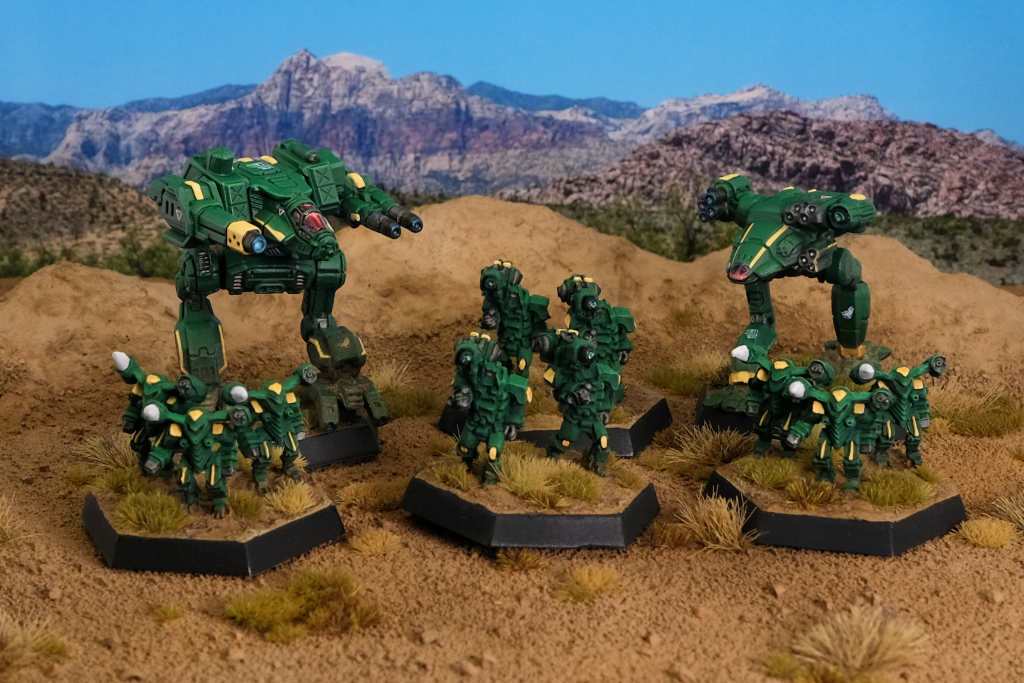 Black Lanner A, Fire Falcon Prime, Corona Battle Armor, and Salamander Battle Armor. Credit: Valk.
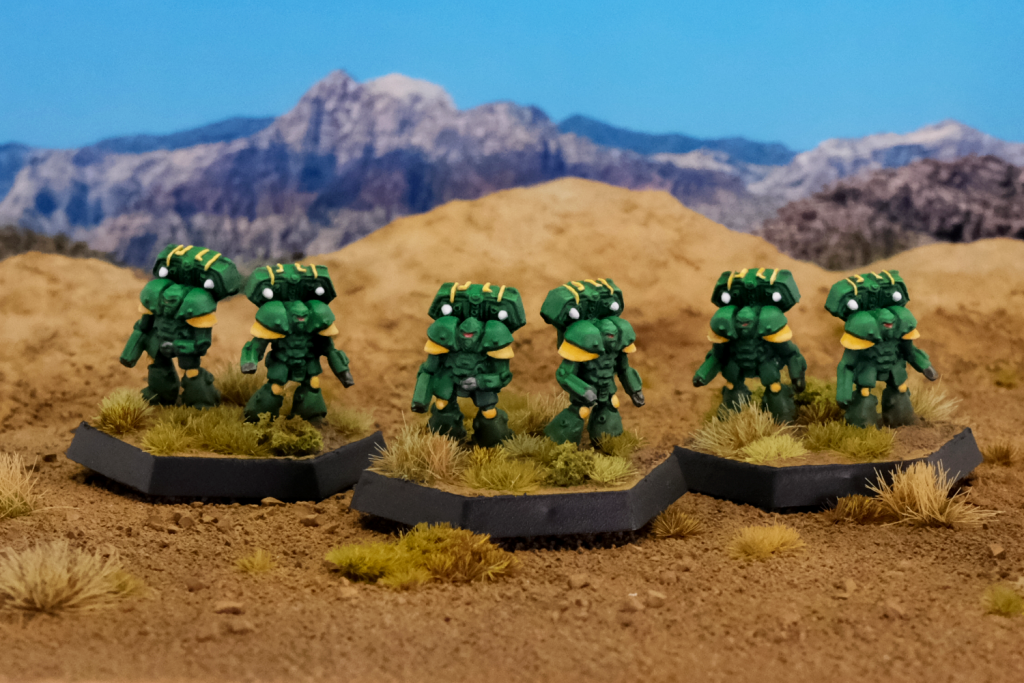 Gnome Battle Armor. Credit: Valk.
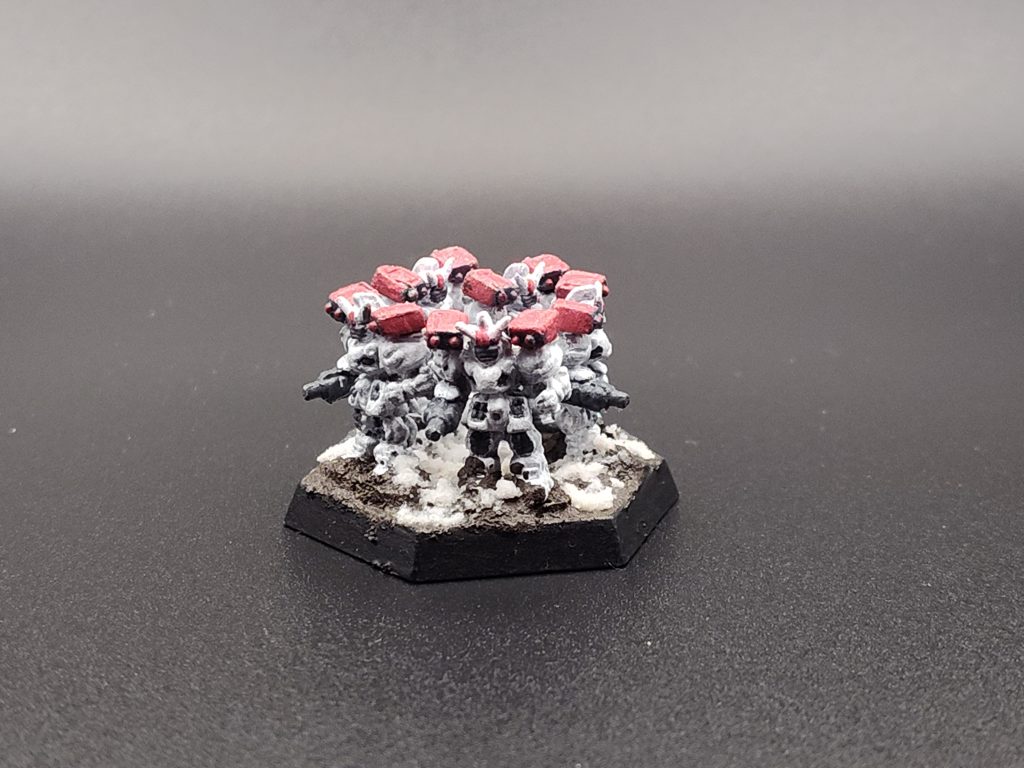 Clan Medium Battle Armor Point, Kara's Scorchers. Credit: Lynn B.
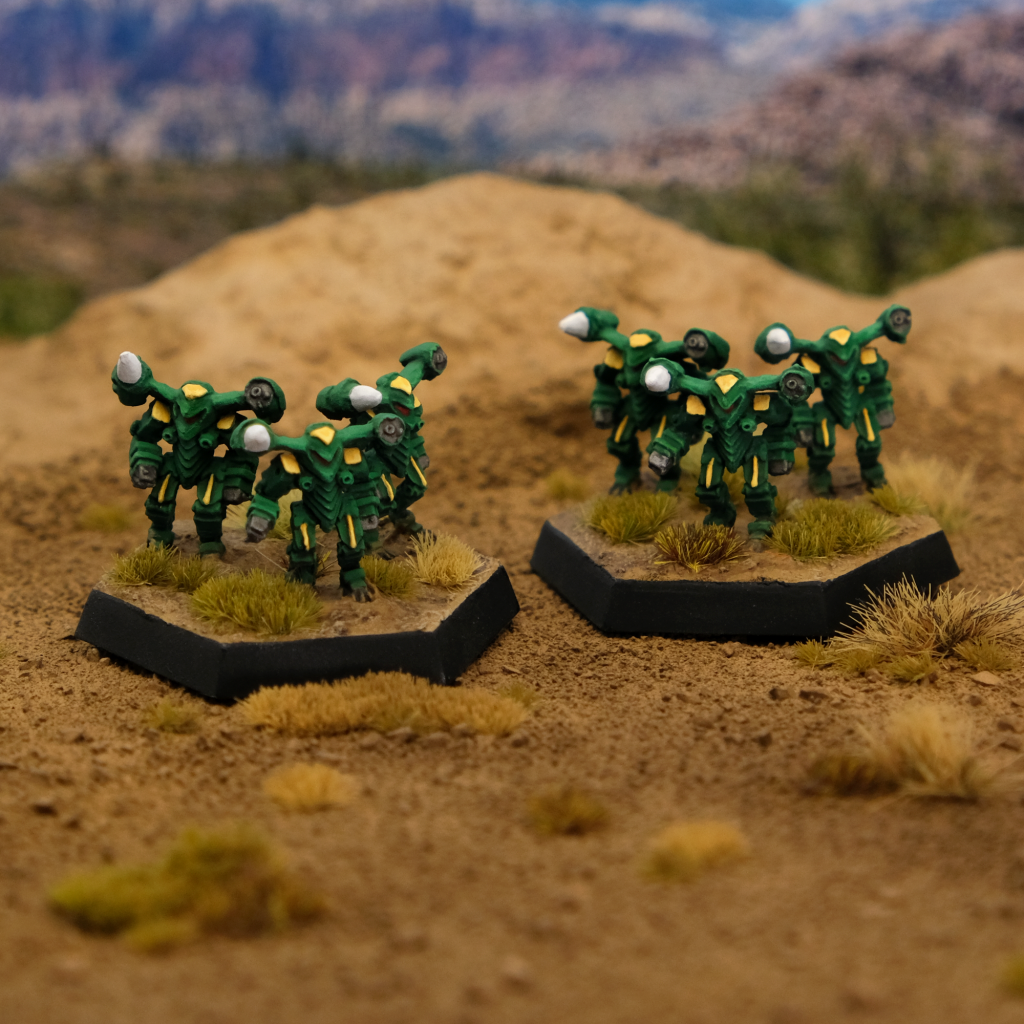 Salamander Battle Armor. Credit: Valk.
 Corona Battle Armor. Credit: Valk

 Infinity N5 First Principles: Understanding the Outcomes of Face to Face Rolls
 Tactical Feedback: Timing the Go-Turn
 SRM's Roundabout to Adepticon 2026: Curd Is the Word