 This website uses cookies. Learn more.
This website uses cookies. Learn more.
This website uses cookies. Learn more.
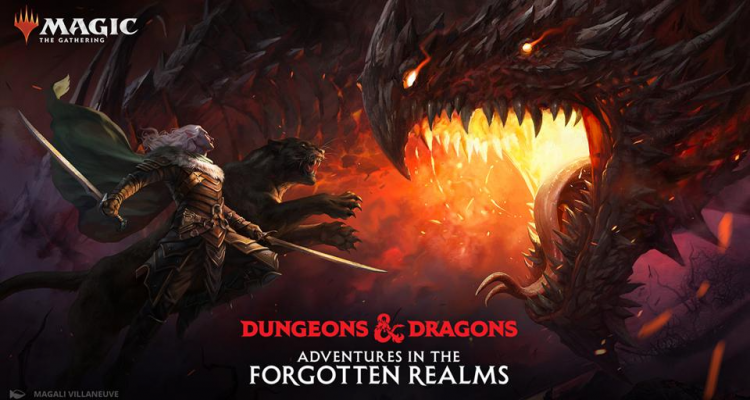
With the imminent release of the new D&D: Forgotten Realms set, we're meeting in a grimy tavern for some ale and to review the set's new cards. In this article - the first of four in our series - we'll examine the key mechanics of Forgotten Realms, how they work, and talk about what they mean for the game. Note that while typically our coverage is focused on Commander (and to some extent Conquest), we’re expanding our view just a little bit, and as part of that we're joined this week by new author and Pro Tour player David Inglis, who will be writing regular content for the site moving forward.
There are four key mechanics in Forgotten Realms; two new mechanics (Dungeons and Class), a slight reworking of an existing one with Flavor Words, and one making its debut on black-bordered cards - Rolling a d20.
 Credit: Wizards of the Coast
 Credit: Wizards of the Coast
 Credit: Wizards of the Coast
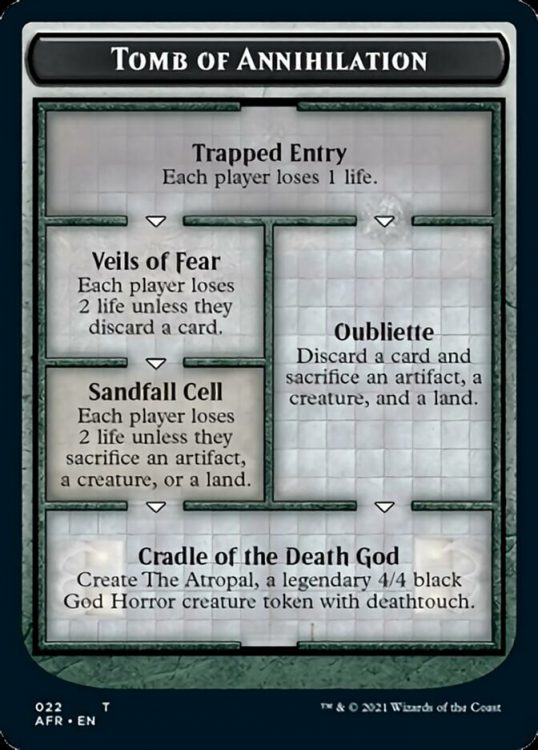
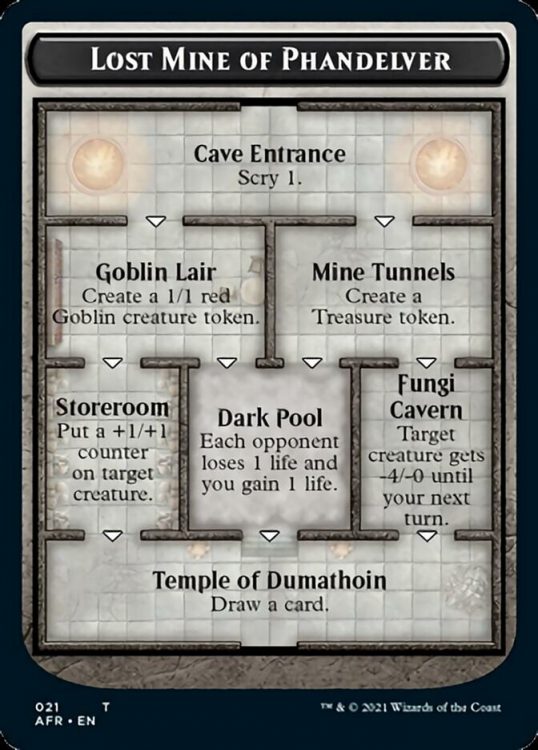
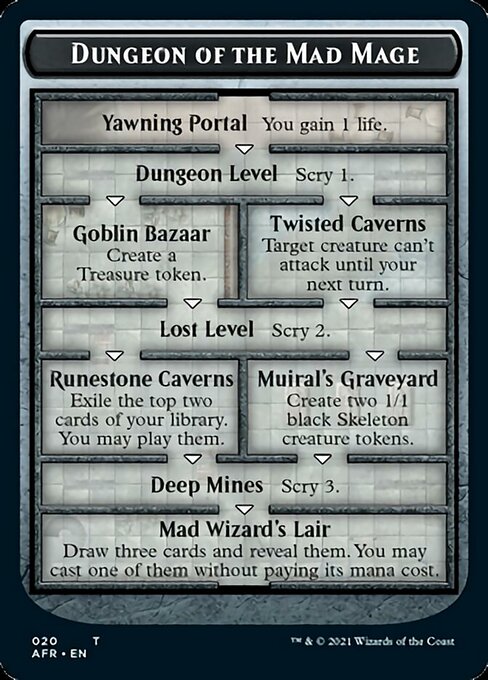
Dungeons are a new card type that don't actually go in your deck; rather they sit outside the game before ultimately going in your command zone after they are introduced to the game with a new keyword action: Venture into the dungeon. When a card instructs you to take this action, if you don't currently have a dungeon in your command zone you choose one of the three dungeon options and place it in that zone, then enter the dungeon and trigger the first room ability.
Each additional instance of venturing will move you to the next room and trigger its ability until you reach the final room, completing the dungeon and removing it from the game again. At this point you are free to start the same dungeon over again or choose a new one the next time you venture forth, and some cards will care that you have successfully completed a dungeon and give you some sort of bonus.
FromTheShire: I have mixed feelings about the dungeons. The ones they picked are absolute home run icons of D&D so no issues there, but the effects are maybe a little underwhelming for Commander, especially if the whole mechanic is as parasitic as it seems likely to be. I think that was necessary to attenuate the power level for other formats and there will be strong decks using them, but there just won't be enough venture cards to build an entire Commander deck around.
BPhillipYork: I would say that the dungeons add another complication to the game. They are pseudo-cards (haha injoke) that aren't really cards. They don't take up sideboard slots thus far, they are more like tokens, but we now have "the Monarch", "the Cities Blessing", Companions, Sideboards, Emblems, and now dungeons. For commander players, we also have the command zone, which also exists in all games, and is coincidentally where these dungeons go, once you've ventured into them. Before there they exist nowhere, apparently. This proliferation of mechanics that require cards and weird things to remember is not really good in my opinion, and it seems like the rate of new inclusions is accelerating. For a long time, one of the strengths of magic has been that it's a relatively straightforward game for new players, especially if you're careful to keep it to decks based on attacking with creatures. These dungeons feel rather clunky, and probably not that worthwhile unless someone comes up with a way to really break them in standard, they'll just be another mechanic that disappears as a historical curiosity. I also find it almost bizarre that this set doesn't include the party mechanic, and particularly that dungeons don't revolve around the party mechanic. I envisioned dungeons as something like Urza's Saga - a land saga that advanced as you "solved" it via the party mechanic.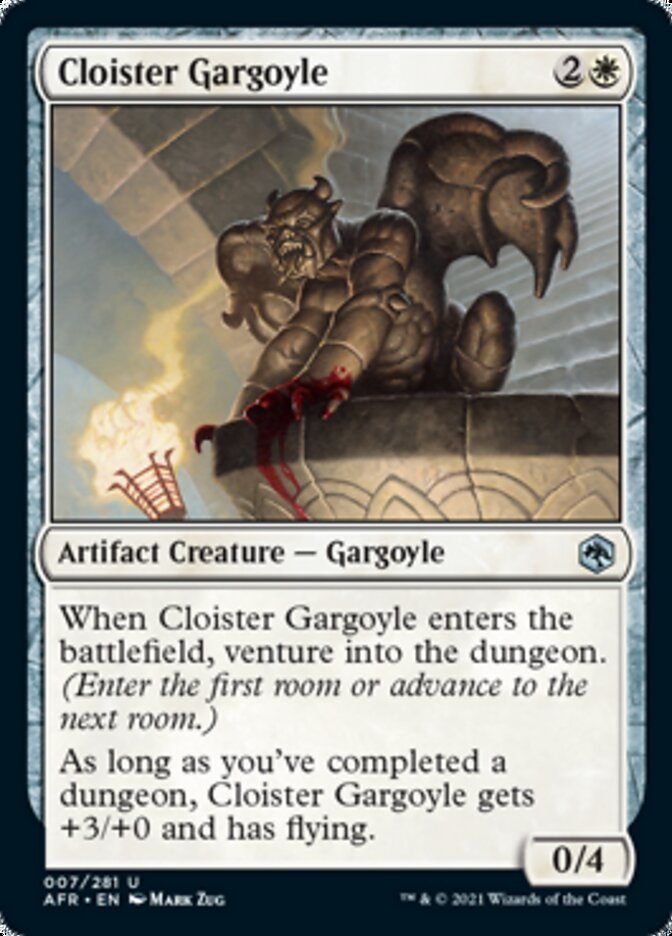 Credit: Wizards of the Coast
 Credit: Wizards of the Coast
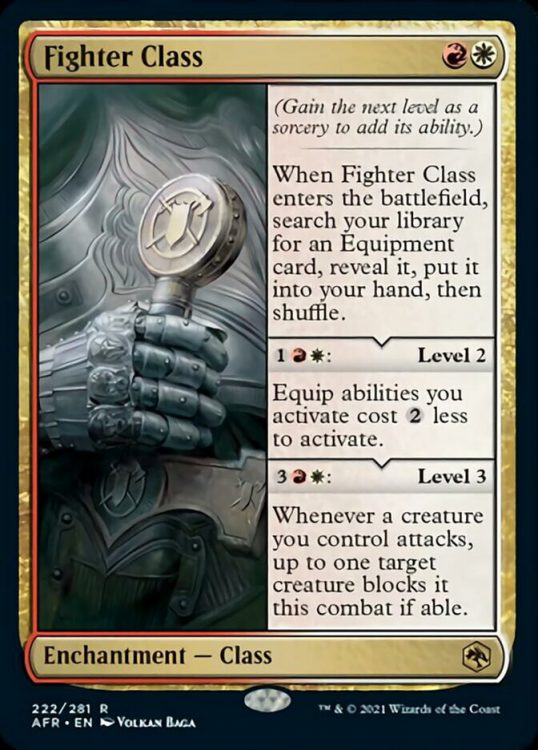
Each class is an Enchantment that enters at level 1 when you cast it and provides the listed effect, as well as a Sorcery speed activated ability to level up. When you pay the level up cost you move to the next level and gain its effect in addition to the ones you already have. You can also have multiple different types of classes or multiples of the same class, and the level of each of these is tracked independently.
FromTheShire: The Classes are pretty cool, and unlike their level-up predecessors from Zendikar, most of these start out solidly and only get better. It also helps a lot that these are enchantments and not creatures so your chance of dumping a ton of mana into them only to get blown out by removal is at least lowered.
TheChirurgeon: These I can get behind. They're like more modular sagas in some ways. It's a little weird that they don't apply to creatures but overall it works just fine for me and I like how they've done the cycles for these with different color combinations. I might have liked to see these have a tribal type associated with them but I completely understand why that didn't happen. Classes are pretty cool and I like that they only get better.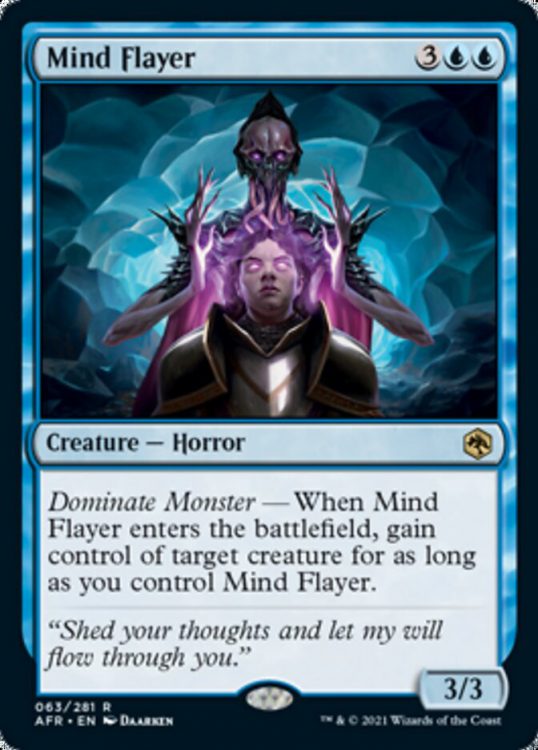 Credit: Wizards of the Coast
Flavor Words are mostly self-explanatory - they are flavorful ways of doing things like differentiating the effects on modal cards or explaining an ability. They are not rules text, rather they serve to tell the story of the spells you are casting.
FromTheShire: Appropriately enough for their name, the flavor on these spells is outstanding across the board. Covering a wide array of spells, abilities, and general D&D tropes, I love all of these regardless of how playable they are.
TheChirurgeon: I'm also a big fan of these. It's a fine way to add additional flavor without bogging the set down in a ton of keywords. Great stuff.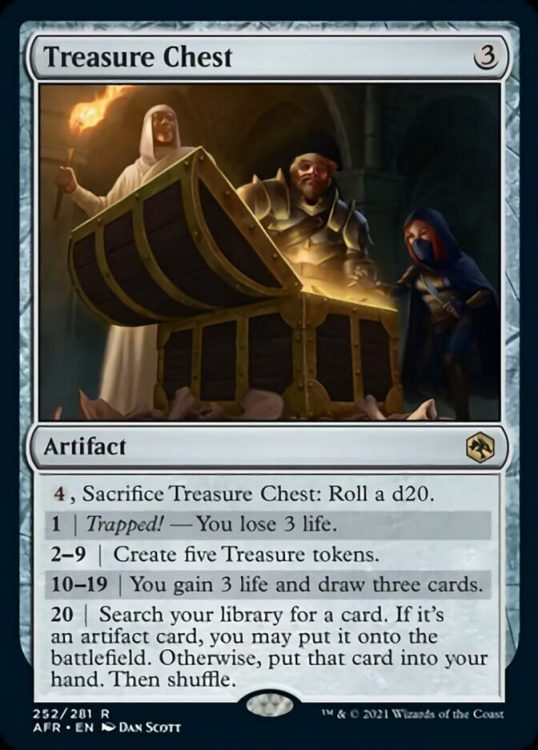 Credit: Wizards of the Coast
No longer a silver-bordered ability, Roll a d20 uses the iconic staple of D&D to bring an element of chance to constructed play. After determining the result of your roll you consult the table printed on the card and receive the appropriate effect.
FromTheShire: This is another effect I love. The actual effects aren't always powerful as I think we're starting to see the power decrease Wizards started steering towards a few years ago after every new set broke every format, and honestly I'm fine with that. There's definitely still some spicy stuff here, and as you're probably aware I'm a huge fan of elements of chance and chaos in general. Is it a little weird still to have d20's and dungeons in the game forever now as an ancient player who has a certain view of the lore an universe of the game? Absolutely. Is it going to stop me from drawing from The Deck of Many Things? Absolutely not.
TheChirurgeon: Gonna have to disagree on this one. I am very much not a big fan of random effects on cards and rolling a d20 just adds a ton more jankiness to games. It's also worth pointing out that Magic's spin-down life counters are not in fact good d20s for rolling. Still, this mechanic makes a lot more sense than the implementation of dungeons and the cards I've seen with the mechanic are fine. Odd that they couldn't reprint the Sword of Dungeons and Dragons in this set, though.That wraps up our look at the set's mechanics. Join us on Wednesday as we do a deeper dive into the set's cards, looking at the monocolored (WURBG) cards in the set, picking out our favorites, and talking about the future build-arounds. In the meantime, if you have any questions or feedback, drop us a note in the comments below or email us at contact@goonhammer.com.
Tags:

Thank you for being a friend.
 Infinity N5 First Principles: Understanding the Outcomes of Face to Face Rolls
 Tactical Feedback: Timing the Go-Turn
 SRM's Roundabout to Adepticon 2026: Curd Is the Word
Support us on Patreon to get access to our Discord and exclusive App features.
Thank you for being a friend.
Already a Patron? Login with Patreon.
Visit our incredibly official store on RedBubble.

Support us on Patreon to get access to our Discord and exclusive App features.
Thank you for being a friend.